

Beauford and Larry Potter
Beauford had multiple circles of friends and acquaintances in Paris.
One of them was a group of African-American artists who were a generation younger than him.
This group included Herb Gentry, Ed Clark, Harold Cousins, and Bob Blackburn.
It also included Larry Potter.

Photo by Robert King
Source: Explorations in the City of Light:
African Americans in Paris, 1945-1965
Fair Use Claim
When I published the article about reviewing auction house Websites to familiarize oneself with Beauford's work, I came across the image below on Case Antiques' Website.

(1963) Charcoal on paper
© Estate of Beauford Delaney
by permission of Derek L. Spratley, Esquire,
Court Appointed Administrator
I recalled having published an article about their sale of this work, but at the time of publication, I did not have an inkling as to who the subject might be.
It was only after seeing the Paris Noir exhibition at the Centre Pompidou in Paris that I thought of Larry Potter in the context of this "portrait on paper."
At the exhibition, in the room entitled "Le saut dans l'abstraction" ("The Leap into Abstraction"), Beauford's work is displayed along with that of Ed Clark, Herb Gentry, Harold Cousins, and Potter.

Larry Potter
Oil on linen canvas
Paris Noir exhibition, 2025
Centre Pompidou, Paris, FRANCE
Image © Entrée to Black Paris
The charcoal portrait of Potter that was sold by Case Antiques is clearly inspired by the photo shown above. Beauford sketched a mirror image of him, gave him a more somber expression, and dressed him differently.
But the posture is the same.
Potter first came to Paris in 1956. He returned to the States briefly before moving back to Paris in 1958. His work and Beauford's were shown in the 10 American Negro Artists exhibition at Den Frie in Copenhagen, Denmark in July 1964.
Potter died from an asthma attack in Paris in 1966, when he was only 40 years old.
Beauford was particularly saddened by his early demise, writing to his friends, Billy and Irene Rose, that he "supported it not too well."
Summertime at Sainte-Anne's Hospital
I'm not sure what drew me to Sainte-Anne's Hospital last Wednesday, but it was powerful.
I was feeling exhausted and debating taking a well-deserved nap when I looked outside and saw blue sky in the direction of the hospital.
Counterintuitively, something told me that I needed exercise more than I needed to sleep.
So, I set out with the intent to enjoy a tour of the grounds where Beauford strolled during his four-year stay at the hospital.
The hospital continues to renovate buildings and improve its landscape. Just past the reception area, an administrative building and the courtyard in front of it look fresh and new. A huge mural celebrates the 100th anniversary of the Fédération Hospitalière de France (FHF - French Hospital Federation), of which Sainte-Anne's is a member.

© Entrée to Black Paris
When I visit the hospital, I usually walk straight down Allée Paul Verlaine to Parc Charles Baudelaire. I immediately noticed that this tree-lined thoroughfare had been the subject of recent landscaping - short wooden fences protected new plantings of wood spurge at the base of the trees.

© Entrée to Black Paris

© Entrée to Black Paris
Something told me to turn off the road and go in a different direction that day. I found myself walking past the Musée d'Art et d'Histoire into the area that borders the rear of the psychiatric nursing facility of the Préfecture de Police.
I was rewarded with the discovery of a medieval garden and a small vineyard!
There is no path to the garden. You must walk across a long stretch of grass to enter the enclosed area.

© Entrée to Black Paris

© Entrée to Black Paris
The garden is quite small, but idyllic nonetheless. I was greeted by the gentle fragrance of lavender as I entered this space to take a few photos.
When I retraced my steps to the medieval garden sign and walked straight past it, I was startled to see the vineyard. It is planted around a sculpture of Victor Hugo by Georges Bareau.

© Entrée to Black Paris
The last time I photographed the sculpture was in 2018. Nothing remotely resembling a garden of any kind, let alone a vineyard, was there at that time.

Georges Bareau
Enameled stoneware
Given to the City of Paris in 1911
Installed at Sainte-Anne's Hospital in 1952
Photo © 2018 Entrée to Black Paris
Since then, the hospital has installed a white slab on which the sculpture now sits. They have placed a table and chairs there so hospital personnel and visitors can enjoy the view.

© Entrée to Black Paris
Near the sculpture, more mature vines are planted on a slope called Coteau "Les Contemplations." (Les Contemplations is the name of a collection of poems written by Hugo and published in 1856.)

© Entrée to Black Paris
A couple of olive trees punctuate this area as well.

© Entrée to Black Paris

© Entrée to Black Paris

© Entrée to Black Paris
To date, I have found no information on when the vineyard was planted or what the hospital does with the harvest!
I followed Allée Vincent Van Gogh away from the Coteau. Near its intersection with Allée Paul Verlaine, I discovered a plaque attesting to the bombardment of the hospital during World War I.

© Entrée to Black Paris
It reads "A German artillery shell fell on this wall on May 27, 1918 at 6:30 AM."
Once back on Allée Paul Verlaine, I walked past Parc Charles Baudelaire and found that the shallow trenches that once served as a man made rivulet had been filled with flower beds.

© Entrée to Black Paris

© Entrée to Black Paris

© Entrée to Black Paris
Continuing down Allée Paul Verlaine, I noted that the façade of the central administration building has been freshly scrubbed.

© Entrée to Black Paris
Going through this building's passageway toward the pharmacy, I turned my gaze toward my favorite sculpture on the grounds - Daphne.

© Entrée to Black Paris
The flowers surrounding the pedestal were graffiti geraniums and biennial beeblossoms.

© Entrée to Black Paris

© Entrée to Black Paris
Because I spent so much time in the area of the medieval garden and the vineyard, I had to move quickly through the rest of my visit to get back to my office for a meeting. Happily, I was still able to take several photos of the flora as I made my rounds before leaving the campus.

© Entrée to Black Paris

© Entrée to Black Paris

© Entrée to Black Paris

© Entrée to Black Paris

© Entrée to Black Paris

© Entrée to Black Paris
Perhaps my next blog post about Sainte-Anne's Hospital will be about a mid-winter visit. Then I will have written about all four seasons there.
To read about early spring and fall visits to the hospital, click on the links below:
UTLibraries Comes to Paris
The University of Tennessee Libraries is visiting Paris this summer to conduct research that will support a Beauford Delaney exhibition at its facility in Autumn 2025. The exhibition will feature the Beauford Delaney Papers*, which the libraries obtained in 2022 and made available to researchers in January 2024.
UTLibraries received a $250,000 grant from the Henry Luce Foundation to complete processing and promote the archive. The grant will not only fund the exhibition and celebration, but also support a two-year graduate research fellowship and community exhibitions planned in collaboration with the Knoxville Museum of Art (KMA), the Beck Cultural Exchange Center, and UT’s Ewing Gallery of Art.
Senior Associate Dean Holly Mercer contacted me in April 2024 to request my assistance through consulting and providing walking tours relevant to Beauford's life in Paris. Thanks to the Wells International Foundation's Entrée to Black Paris Cultural Awareness program, I was able to support this project by providing two private guided tours, a visit to Thiais Cemetery (Beauford's final resting place), and several hours of consulting over a period of three weeks.
In addition to Senior Associate Dean Mercer, I had the pleasure of interacting with Jennifer Beals, Director of the Betsey B. Creekmore Special Collections and University Archives; Kris Bronstad, Modern Political Archivist & Assistant Professor; and Katrina Stack, Graduate Research Assistant for the Beauford Delaney Papers.
During the first week, Director Beals and Ph.D. candidate Stack experienced the "Beauford Delaney's Montparnasse" walk, which takes place in Paris' 6th and 14th arrondissements.

© Wells International Foundation
During Week 2, the consultation session with Archivist Bronstad and Stack began at Le Select, one of Beauford's favorite Montparnasse cafés, and ended over lunch at the nearby Chez Lionel. In walking from one location to the other, we made a quick detour to stand in front of the hotel on rue Delambre where Beauford's first studio was located.

© Discover Paris!
Two days later, we visited Thiais Cemetery. Bronstad and Stack purchased a lovely bunch of yellow roses to place on the tombstone.

© Wells International Foundation

© Wells International Foundation
While at the grave, we discovered the remnants of a sketch and message left under the ceramic flower arrangement by UT Downtown Gallery Manager Mike Berry in October 2023. Though he had slipped the sketch into a Ziploc bag, the plastic failed to protect it.
Fortunately, we could still make out the words "With love, Knoxville, TN."
© Wells International Foundation
During Week 3, Associate Dean Mercer and Stack experienced the newly developed "Beauford on the Left Bank" walk, which emerged from the customization of the Entrée to Black Paris walk entitled "James Baldwin in Paris." Both tours take place on and around boulevard Saint-Germain in the 6th arrondissement.
Stack, a cultural geographer whose primary research areas are geographies of memory and Black geographies, remarked on the proximity of the locations visited on each of the walking tours. She also noted that the Left Bank walk ended down the street from where the Montparnasse walk began.

© Wells International Foundation
I am looking forward to visiting Knoxville next year to see the main exhibition at UT Libraries and the community exhibitions at KMA, Beck, and UT’s Ewing Gallery of Art!
*The Beauford Delaney Papers consists of family, personal, and professional correspondence, photographs, sketchbooks and notebooks, artwork, exhibition material, and biographical records created or collected by Beauford.
It also includes correspondence with influential artists and gallerists such as Palmer Hayden, Lawrence Calcagno, James LeGros, Dorothy Block, Darthea Speyer, and Joseph Delaney; the writers James Baldwin, Henry Miller, and James Jones; and other cultural figures.
For more information about the archive project, click HERE.
Beauford's Paris: Rue des Anglais
I don't know if Beauford ever visited the rue des Anglais in Paris.
What I do know is that his several of his paintings "lived" there for a period of time after he was committed to Sainte-Anne's Hospital.

© Entrée to Black Paris
David Leeming wrote about this in his biography called Amazing Grace: A Life of Beauford Delaney:
...Baldwin went to Paris hoping to find a way of arranging for Beauford's permanent care. His first act was to find—at his expense—a new apartment for the storage of Beauford's paintings and for the painter's use should he recover. The apartment was in the rue d'Anglais, near an apartment Baldwin hoped to rent or buy for himself.
I was inspired to write this post after a lengthy Facebook communication with author David Yeats. I posted this image of a painting by Khalif Tahir Thompson, and Yeats commented that he recognized Beauford's portrait of James Baldwin on the wall behind Thompson's brilliant portrayal of Baldwin.

Khalif Tahir Thompson
2020 mixed media
Image from FB - Fair use claim

(1971) Oil on canvas
Bequest of James Baldwin
Image courtesy of Clark Atlanta University Art Galleries
© Estate of Beauford Delaney
by permission of Derek L. Spratley, Esquire,
Court Appointed Administrator
Yeats told me that he mentions Beauford in his novel, The Opal Causeway, in a scene where two young boys are talking about art in a library and one of them says he thinks he recognizes a Beauford Delaney painting.
Yeats lived at 12, rue des Anglais in April 1975, which was about the time Beauford went to Sainte-Anne's. He knew Baldwin and Baldwin's dear friend, Bernard Hassell. He mentioned that Hassell lived on rue des Anglais and that Beauford's paintings were stored in a flat in the same building. He said the door of that flat had a huge seal on it.
While he couldn't remember the exact address of the building, Yeats described it as being "on the left coming from the direction of bd. Saint Germain." He thought the building might have been at Number 8.
I decided to go to the rue des Anglais to photograph the buildings as they look today.

© Entrée to Black Paris

© Entrée to Black Paris

© Entrée to Black Paris

© Entrée to Black Paris

© Entrée to Black Paris

© Entrée to Black Paris

© Entrée to Black Paris

© Entrée to Black Paris

© Entrée to Black Paris
I have asked the Beauford Delaney estate whether it knows the exact address of the storage flat, and they have initiated a search of the Beauford Delaney Papers at UTKnoxville to find this information.
I will update this post once the search is completed.
Beauford and American Express
"On nearly every weekday Beauford would walk to the American Express Office on the rue Scribe next to the Opéra to pick up his mail."
In Amazing Grace: A Life of Beauford Delaney, biographer David Leeming paints a vivid picture of how essential this location was to Beauford's existence in Paris.
Beauford was heavily reliant on international mail to receive not only updates from friends and family in the U.S., but also money. Leeming reports that Beauford's dear friend Larry Calcagno always sent money with his letters, and he cites other friends and acquaintances that sent funds as well. Among them was Congressman Adam Clayton Powell, who sent Beauford $50 (worth between $550 and $575 today) because he admired Beauford's work.
American Express opened its first foreign office at 6, rue Halévy in Paris in 1895. The company moved to the iconic address at Number 11 in 1905.
A New York Times article described 11, rue Scribe as "one of the most famous addresses in the world." It reported that in 1970, more than 5,000 tourists used American Express facilities daily and that the company processed 8,000 to 10,000 letters each day.
The office was closed in 2009.

© Discover Paris!
Summer Visit to Thiais Cemetery
The single yellow rose that I saw several days ago when I visited La Maison de Santé, the psychiatric clinic in Nogent-sur-Marne where Beauford underwent treatment after his 1961 suicide attempt, inspired me to visit Beauford's gravesite and place yellow roses on his tombstone.
So, I made my way to Thiais Cemetery to do just that.
I took the metro and the tram to the cemetery on Tuesday, August 22. It was hot, the sky was clear, and the cemetery was peaceful.
The flowers in the beds in front of the conservation office were a bit faded, but they still offered a spray of color near the cemetery's entrance.

© Entrée to Black Paris
I took an indirect route to the tombstone, wanting to approach the grave from a different direction so I could see a bit more of the cemetery.
I visited the tomb of several airline employees who died in a plane crash on a flight between Brazzaville, Congo and Paris in May 1961.

© Entrée to Black Paris
I then walked down the cemetery's Central Avenue to reach the upper border of Division 86, where Beauford is buried.
The neighboring division to the north, Division 87, was so filled with foliage that I decided to stop there first.
It looked like the perfect set for a graveyard scene in a horror movie. I have never seen tombs so overgrown before.

© Entrée to Black Paris

© Entrée to Black Paris

© Entrée to Black Paris

© Entrée to Black Paris

© Entrée to Black Paris
One of the paths between rows of stones was physically blocked by blackberry bushes!

© Entrée to Black Paris

© Entrée to Black Paris
Division 86 was overgrown as well, but not to the same extent.

© Entrée to Black Paris

© Entrée to Black Paris

© Entrée to Black Paris
I found Beauford's tombstone in pristine condition, lying in partial sun, almost like a beacon amidst the crumbling stones nearby.

© Entrée to Black Paris
I cleared away the weeds that I found next to the base of the tomb and laid five yellow roses there.

© Entrée to Black Paris
Over the years, the sun has bleached the coloring in the inscription on the stone beneath Beauford's photo, so it is now difficult to read.

© Entrée to Black Paris
I will investigate how this can be corrected.
Before leaving the cemetery, I went "next door" to Division 94 to see the Jardin du Souvenir to pay my respects to Beauford's friends, Larry Potter and Leroy Hayes. Their ashes were disbursed in this division years ago.

© Entrée to Black Paris
On my way back to the entrance, I saw signs posted at two divisions that announced the reclamation of tombs for which concessions had not been paid.

© Entrée to Black Paris
It was a tangible reminder of why I founded Les Amis de Beauford Delaney - to prevent Beauford's exhumation.

© Entrée to Black Paris
La Maison de Santé in Nogent
Beauford spent the Christmas holidays of 1961 and twenty (20) days in May 1962 at the private psychiatric institution called La Maison de Santé de Nogent-sur-Marne.
In Amazing Grace: A Life of Beauford Delaney, biographer David Leeming recounts that:
On December 20 Solange du Closel and her husband drove Beauford to the Nogent clinic where he was placed under the care of the well-known psychiatrist Dr. Ferdière, whose specialty was depression.
La Maison de Santé — the "Health House" — can still be found on the quiet rue de Plaisance in the eastern Paris suburb of Nogent-sur-Marne.

© Entrée to Black Paris
It is a much smaller facility than the Hôpital Sainte-Anne, where Beauford spent the last four years of his life. (I recently learned that Dr. Ferdière worked at Sainte-Anne's for several years during the 1930s, long before Beauford arrived in Paris.)
Last week I visited the clinic for the first time and took photos of the campus.
The entrance is nondescript overall, with the only distinguishing feature being the heavy green door that faces the street.

© Entrée to Black Paris

© Entrée to Black Paris
A gate that serves as an ambulance entrance also faces rue de Plaisance.

© Entrée to Black Paris
Upon entering the facility, you walk past reception into a vast green space that is bordered by buildings on the left. You could easily get the impression that you're in a park and that the treatment facilities are "incidental."

© Entrée to Black Paris
Unfortunately, I have no information about where Beauford's room(s) might have been located.

© Entrée to Black Paris
A gazebo provides a covered space where patients and visitors can smoke.

© Entrée to Black Paris

© Entrée to Black Paris
Benches in a dense grove at the rear of the property provide space to relax while looking out onto private homes on rue de Coulmiers.

© Entrée to Black Paris

© Entrée to Black Paris
A garden arbor was mostly bare of foliage, let alone flowers. I wished that I had visited in the spring so I could have seen it at its best.

© Entrée to Black Paris
One magnificent yellow rose remained. It reminded me of the rose that Silver Wainhouse placed on Beauford's tombstone when she visited Thiais Cemetery and was inspired to write the play Amazing Grace Is Yellow.

© Entrée to Black Paris
Early Spring at Sainte-Anne's Hospital
On a brilliant, sunny day earlier this week, my husband Tom and I took a stroll through the grounds at Sainte-Anne's Hospital - Beauford's final residence. We visit from time to time to enjoy the peaceful gardens and imagine Beauford enjoying them as well.
It has been unseasonably warm in Paris this year, and we hoped to find a multitude of colors and shapes in the flower beds and beneath the trees (some of which also flower) of the 7 hectares of green space that is managed by a team of 7 gardeners throughout the year.
We were a tad too early for this - there were loads of plants with green shoots in the beds along the main road that borders Parc Charles Baudelaire, but not as many flowers as we had hoped. We did find crocuses and snowdrops in abundance and the first daffodils of the season in this area.

Parc Charles Baudelaire - view from the street
© Entrée to Black Paris

Parc Charles Baudelaire - view from rear of park
© Entrée to Black Paris


Crocuses in Parc Charles Baudelaire
© Entrée to Black Paris

First daffodils
© Entrée to Black Paris

Snowdrops
© Entrée to Black Paris
A flowering tree in this park had lost almost all its flowers.

Bare flowering tree
© Entrée to Black Paris

Fallen flowers
© Entrée to Black Paris
Beauford would have been excited to see the vivid red of these English daisies.

English daisies
© Entrée to Black Paris
There was a fresh planting of pansies next to the lion statue in the park as well as around the sculpture of Daphne that is found in front of the pharmacy.

Pansies next to lion statue
© Entrée to Black Paris

Pansies next to lion statue - close-up
© Entrée to Black Paris

Flowers at the base of Daphne sculpture
© Entrée to Black Paris
A few poppies had also emerged at Daphne's base.

Poppies at the base of Daphne sculpture
© Entrée to Black Paris
Elsewhere on the grounds, we found a single cluster of white hyacinth along the covered walkway leading to the biology lab.

White hyacinth
© Entrée to Black Paris
We found that trees and bushes near the chapel had pushed out buds and early flowers.

Flowering shrub
© Entrée to Black Paris

Sumac
© Entrée to Black Paris
Ornamental cabbages and a single pink hyacinth are growing in a wall planter near the rue Alesia entrance.

Ornamental cabbage and pink hyacinth
© Entrée to Black Paris
And we found a tree full of white flowers in front of the Benjamin Ball pavilion, which may be where Beauford's room was located.

White flowering tree
© Entrée to Black Paris
A cold spell is due to sweep through Paris next week, so we'll wait a while before returning for another dose of spring.
Read previous articles about Sainte-Anne's Hospital by clicking on the links below:
Beauford's Paris: Sainte-Anne's Hospital - Part 1
Beauford's Paris: Sainte-Anne's Hospital - Part 2
Beauford's Paris: Saint Anne's Hospital - Part 3
Sainte Anne's Hospital: An Oasis of Calm
Beauford's Studio as Described by Larry Calcagno
Beauford met Larry Calcagno in Paris soon after Beauford's arrival, and the two men became dear friends. They frequently exchanged letters through which they conveyed not only the details of their daily lives, but also their love for each other.
Calcagno was a painter and as such, he was acutely sensitive to the environment in which Beauford created his art. In a handwritten document, he described Beauford's studio as follows:
"Beauford Delaney paints with joy each day, sitting beneath an enormous potted tree in his studio in Paris. A white island shining in a grey sea, it is filled with his inner light. Walls, floor, bed and chair, stacks of paintings and memorabilia — all covered with white — draperies, bedsheets, paper, a white shroud ...
"He puts everything away, literally out of sight — the past, the world, painful histories, frustration, and suffering. He paints with an enormous faith and serenity those he loves, who love him; in his world of white — [indecipherable] moves in a world of new beginnings."
Though Calcagno's document is undated, his description of the tree in the studio implies that he is describing the creative space at Beauford's rue Vercingétorix apartment.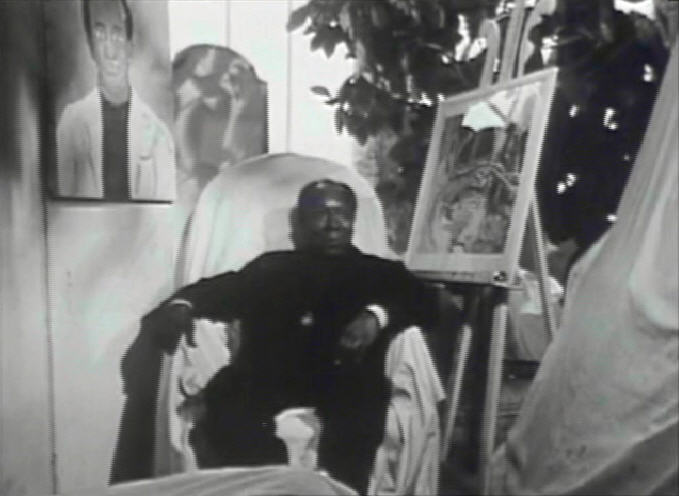
Screenshot from Henry Miller vu par ses amis
I found this document touching because of Calcagno's description of the emotional state he felt Beauford experienced in painting. Whether he thought Beauford summoned his faith to achieve serenity in order to paint the people he loved, or that Beauford's faith was strengthened and serenity achieved by the act of painting them, we cannot know.
Find additional posts about Beauford and Larry Calcagno at the links below:
Beauford and Larry Calcagno: The Letters
Larry Calcagno's Portrait of Beauford
Beauford at the American Hospital
The American Hospital of Paris is a private, non-profit hospital that is certified by the French Haute Autorité de Santé (French National Authority for Health). Established in 1906 in the western Paris suburb of Neuilly-sur-Seine, it is the only civilian hospital outside the U.S. that is accredited by the Joint Commission, an organization that sets the highest standards for health care around the world.

Image courtesy of the American Hospital of Paris
The hospital was in the midst of significant expansion when Beauford was admitted for several tests in 1961. These confirmed severe liver and kidney problems diagnosed at the hospital in Athens, Greece where Beauford was treated after his suicide attempts in Patras earlier that year.
Beauford returned to the American Hospital in February 1970, where the clinic treated him for flu and heart palpatations. This was shortly after his Christmas 1969 visit to Knoxville.
During the fall of 1970, the hospital treated Beauford's dear friend and mentee, James Baldwin, presumably for hepatitis that had been diagnosed in Istanbul when Baldwin was there to direct the play Fortune and Men's Eyes.
Other friends and acquaintances of Beauford who were treated at the American Hospital include Tria French, a friend and literary agent of Baldwin, who died of a cerebral hemorrhage there.
Writer Richard Wright was treated at the hospital several times during his 14-year stay in Paris. His wife Ellen had an appendectomy there and his youngest daughter was born there. Led by Wright, the Franco-American Fellowship protested the establishment's discriminatory hiring policy regarding black people in 1951.
The American Hospital informed Les Amis that all medical records for patients treated there prior to 1989 have been destroyed in accordance with their policy to archive records for a period of 30 years. Therefore, the details of Beauford's diagnostic and treatment regimens at this institution are now permanently lost.
Beauford's Studio - Scenes from "Meeting the Man"
I was thrilled to learn that the recently restored short documentary called "Meeting the Man: James Baldwin in Paris" contains footage shot inside Beauford's rue Vercingétorix studio.
As the camera pans around the small room, you see Baldwin, Beauford, Baldwin's brother David, and several young people sitting or lounging on what appears to be a bed.
The chair that Baldwin sits in is draped in white cloth, which is characteristic of Beauford's habit of covering surfaces in his living space with white to increase the light available for painting.
The walls are covered with Beauford's paintings.
An additional work, which leans against a wall to Baldwin's left, presents two figurative beings, one of which has a luminous eye that reminds me of the eye in the image of the painting shown below.

(1965) Oil on canvas
Private Collection
© Estate of Beauford Delaney
by permission of Derek L. Spratley, Esquire,
Court Appointed Administrator
View two <2-minute clips from the 27-minute documentary at the links below.
Sounds of Sainte-Anne's Hospital

© Discover Paris!
I've published several posts about Sainte-Anne's Hospital on this blog. They include numerous photos of the buildings and grounds that comprised Beauford's "home" during the last four years of his life.
Beauford's Paris: Saint Anne's Hospital - Part 1
Beauford's Paris: Saint Anne's Hospital - Part 2
Beauford's Paris: Saint Anne's Hospital - Part 3
Sainte Anne's Hospital: An Oasis of Calm
Beauford in "Psychology and Art" - Part 2
Today, I'm pleased to share a link to a blog post that presents the sounds of Sainte-Anne's Hospital as well as a wonderful history of the institution. The article also presents lovely photos of the hospital.
Soundlandscapes' Blog - Centre Hospitalier Sainte-Anne
Soundlandscapes is the brilliant product of the passion of Des Coulam. For more information about him and his recordings of the sounds of Paris, click HERE.

at Sainte-Anne's Hospital, 1976
Photo by Max Petrus
Knoxvillians Explore Beauford Delaney's Montparnasse

Rosa Mar, and Steve Cotham
© Entrée to Black Paris
Steve Cotham manages the Calvin M. McClung Historical Collection at the East Tennessee History Center in Knoxville. The McClung Historical Collection sponsored the historical marker that honors Beauford and his brother, Joseph, in Knoxville.
I was thrilled to be able to show Steve and his friends, Tom Whisman and Rosa Mar, the two plaques that Les Amis de Beauford Delaney had installed to honor Beauford in Montparnasse.

Photo courtesy of Steve Cotham

Photo courtesy of Steve Cotham
I was also thrilled to take the group to Columbia Global Centers | Paris at Reid Hall, the space where the Resonance of Form and Vibration of Color exhibition was held in 2016 and show them several photos of the "Knoxville 11" enjoying the vernissage for that show. Columbia Global Centers | Paris is where the reading for Amazing Grace Is Yellow, Silver Wainhouse's play about Beauford, will take place on October 16, 2019.
Another highlight of the tour was the Montparnasse Cemetery, where James Baldwin would have liked to see Beauford buried. I shared before and after photos of Beauford's grave in Thiais Cemetery and explained the circumstances of his burial.

© Discover Paris!

© Discover Paris!
A host of Knoxville events honoring Beauford have been scheduled for the next several months. Watch this blog for further information about the ever growing movement to honor him in his hometown!
To find out more about the "Beauford Delaney's Montparnasse" walking tour, send e-mail to .
Beauford at the Luxembourg Garden
So I was tickled to read in correspondence between two of Beauford's dearest friends, Charley Boggs and Larry Calcagno, that Beauford enjoyed the garden as well!
Boggs wrote to Calcagno that he and Beauford visited the garden in early April 1965 and enjoyed the spring weather, sitting in the sun and watching the children play with their sailboats at the octagonal pond near the palace. He left Beauford there, sitting in a rented chair, while he went back to his atelier.
For those of you who are not familiar with the garden, here are some photos of the area mentioned in Boggs' letter.

© Discover Paris!

© Discover Paris!

© Discover Paris!

© Discover Paris!

© Discover Paris!
Happily, sitting in chairs at the garden is now free of charge!

Amazing Grace is Yellow
in Paris on October 16, 2019.

"Adopt an actor" to contribute 450€ or $500 for rehearsals and the actual reading by clicking HERE!
Parisian Café Culture and Beauford Delaney
Maija Brennan is the Wells International Foundation's 2019 summer intern. A rising senior at Smith College, she majors in French and art history with a concentration in museum studies. Her eight-week internship focuses on researching the life and art of painter Beauford Delaney and creating an online exhibition of a selection of his works.
Induction into the café scene in Paris has been a rite of passage for artists and intellectuals from around the world for over two centuries. A hub for heated discourse, the exchange of new ideas, and a place to build up your network of connections, cafés have been prominent pillars in French society since before the French Revolution.

Image in public domain
Coffee arrived in Western countries in the 17th century as a result of political and imperial expeditions. Consuming coffee was, at first, reserved for the dominant social classes. During the age of the Enlightenment and the French Revolution, innovative ideas surrounding the political and social spheres in France were exchanged amongst revolutionaries over coffee and alcohol in salons littéraires. By 1909, Paris alone housed 30,000 cafés.
Such “micro-societies” remained at the forefront of fostering new schools of thought in the arts and politics throughout the twentieth century. Expats from other countries began to understand the importance of cafés in finding a community, from German avant-garde artists before World War I to the “Lost Generation” of the 1920s.

The Murphys, Pauline Pfeiffer, and the Hemingways
Image in public domain
Beauford Delaney, an African-American Abstract Expressionist painter who traded his artistic life in New York for Paris in 1953, found solace and solidarity in the Parisian cafés he frequented until his death in 1979. It was during his first night in Paris, hungry and restless, that Beauford walked into the Dôme Café on the corner of rue Delambre and boulevard du Montparnasse, returning often after that point. This and other Parisian cafés in Montparnasse and Saint-Germain-des-Près became crucial to Beauford’s well-being and happiness throughout the 26 years he lived in the city.
As an African-American gay man who struggled intensely with his mental and emotional health, the various social circles that existed within the cafés dispersed throughout Paris offered a refuge for fraternity, stimulating conversation, and oftentimes a discounted or free meal when he couldn’t afford one himself as a impoverished painter. The community provided by Parisian café culture for artists and writers of all persuasions, and for African-American artists and writers in particular, was central to Beauford Delaney’s life and the birthplace for many valued relationships he cultivated during his time in France.

Mickael Favier
Creative Commons License
The strong historical precedent for African-American presence in Paris cafés began in the aftermath of the First World War, when expats flocked to Montmartre for conversations with like-minded individuals. Tyler Stovall described this black experience in Paris Noir: African Americans in the City of Light, stating that by 1919, musical opportunities for black jazz musicians were drying up in the US due to the wartime industrial boom coming to an end. Jazz was becoming wildly popular in France and in Paris, and for many African Americans who relocated, it was a quick way to gain fame and fortune. Montmartre in the 1920s was seen as Harlem transplanted, the jazz clubs being where black and white people alike went for a good time.
Places such as Le Grand Duc and Chez Florence, clubs owned by African Americans, became notorious not only amongst those in Montmartre, but other circles as well; Scott Fitzgerald and other members of the Lost Generation flocked to the area from Montparnasse, knowing it was where the best parties were occurring. Fitzgerald loved Ada Louise Smith (“Bricktop”), an African-American singer, so much that he included her in one of his fictional pieces and bragged about “discovering” her before his other friends.

1934 Carl Van Vechten
Image in public domain
The Flea Pit, a café in Montmartre, became a staple for African-American musicians. They would meet there at any point in the day to share a drink and each other’s company.

from Becoming American in Paris
Brooke L. Blower
While this era was not the first for African Americans in Paris or for café culture, it was a time where black creatives could thrive in spaces that were typically dominated by their white peers.
The black community that developed in Paris during the 20s was virtually destroyed as a result of the Depression and the Second World War, and many African Americans recrossed the Atlantic during the 1930s. The community slowly rebuilt itself in the 40s and 50s, this time across the Seine in Montparnasse and Saint-Germain-des-Prés. Herbert Gentry, an African-American painter who sailed to France with Beauford on the SS Liberté, said it best when he said that “it was the Americans who really made Montparnasse.”

c. 1949
Image courtesy of Mary Anne Rose
The artistic community on the Left Bank thrived after World War II. African-American artists and writers began holding court at many of the cafés the white expats and intellectuals frequented during the same period: the Closerie de Lilas, the Coupole, and Café de Flore. Café Tournon and Café Monaco, however, were spots known for its African-American following. Richard Wright and James Baldwin were among those who could be seen every day engrossed in conversation nursing a cup of coffee (or something stronger), and not getting as much writing or work done as they had anticipated. Paris Noir cites the journal of Vertamae Smart-Grosvenor, a black South Carolina native who moved to Paris in 1958. She writes that two hours after landing, a “brother from Senegal” invited her to have coffee at Café Dupont in the 15th arrondissement. She was in awe at finding a “gang” so quickly after arriving.
Beauford Delaney was one of those Americans that made Montparnasse the lively, culturally rich environment that it was known for. The Dôme Café, the place he stumbled upon hours after arriving in Paris, became one of his usual haunts. He loved the Dôme for its affordable prices at the time, yet was often invited to the Coupole (the most expensive of the Montparnasse cafés at the time) as well by his European artist friends. Along with the Dôme and the Coupole, he could be spotted at Café de Flore and Café Tournon, popular spots for friends in his circle. He would spend hours at a table with them, doling out pieces of advice and sharing stories of his upbringing in Tennessee.

Beauford wrote on his adoration for Parisian café culture shortly after moving:
“Some of the cafés never closed. I had never seen such life and could not suppress an eagerness to join into this rhythm. . . . Nights and days we would come together at mealtimes and swap our various experiences or relate how this activity in life and art were fused, what this group or that group thought of this or that school of painting, writing, music.”
Through the relationships formed in Paris cafés, Beauford was being intellectually stimulated like never before, generating new ideas and beliefs surrounding art and the kind of work he wanted to produce. Even in his later years, when his delusions and paranoia were getting the better of him, he would walk into his favorite cafés confused and with little to no money. Patrons and diners alike loved Beauford though; he was a local café celebrity known for his sweet demeanor and constant words of wisdom. Someone would always be there to help him pay for a meal and to guide him home.

Delfo
Creative Commons License
Beauford sailed to France never intending to stay longer than a few months. He fell into the rhythm of Montparnasse, teeming with creative and intellectual energy, and lived out the remaining 26 years of his life there. The café culture for artists in Paris is notorious throughout the globe, and Beauford Delaney is a longstanding symbol of the community and camaraderie synonymous with it.
Beauford at Notre Dame Cathedral
Beauford and Emery: The Delaney Brothers at Notre Dame Cathedral
Beauford's Paris: Notre Dame Cathedral and Fauré's Requiem
I'm also sharing several photos of the cathedral that Discover Paris! (now Entrée to Black Paris) has taken over the years.

© Discover Paris!

© Discover Paris!

© Discover Paris!

© Discover Paris!

© Discover Paris!
"Point Zero" for France is located in the square in front of Notre Dame. The number of miles to any place in the country is measured from this spot.

© Discover Paris!
The cathedral of "Our Lady" will be rebuilt!
Joseph Delaney in Paris

Sketchbook drawing of Paris, 1976
Ink on paper
Courtesy Ewing Gallery of Art and Architecture, University of Tennessee, Knoxville
Reproduced with permission of the Estate of Joseph Delaney,
Mark K. Williams, Administrator C.T.A.
Photo courtesy of Dawn Kunkel*
By this time, Beauford was living at Sainte-Anne's Hospital. Beauford's biographer, David Leeming
 has the following to say about Joseph's visit:
Joseph Delaney came to Paris in the summer of 1976 as the family's representative, presumably to take charge of his brother, perhaps even to take him home. Apparently, however, finding that Beauford was without memory but at least comfortable, he decided to leave matters in the hands of Baldwin and the court-appointed trusteeship.
Joseph had visited Beauford in Paris once before, in 1969. He spent three weeks in the City of Light and the brothers enjoyed strolling the streets together. According to Leeming:
They explored the bookstores and galleries, talked of the past and of their work, and went to jazz clubs and the opera.
Joseph returned to Paris in 1979 to attend his brother's funeral.
KMA has included the following sketch of the Louvre that he did during that visit.

Sketchbook drawing of Paris, 1979
Ballpoint pen on paper
Courtesy Ewing Gallery of Art and Architecture, University of Tennessee, Knoxville
Reproduced with permission of the Estate of Joseph Delaney,
Mark K. Williams, Administrator C.T.A.
Photo courtesy of the Knoxville Museum of Art
Stephen C. Wicks, Barbara W. and Bernard E. Bernstein Curator at KMA, states that he included this drawing in Joseph Delaney: On the Move "in order to underscore Joe’s concern for Beauford and his key role in helping to get Beauford’s belongings back to the U.S. after his death."

by Beauford Delaney
in Amazing Grace: A Life of Beauford Delaney
by David A. Leeming
*Dawn Kunkel is an art teacher at Nature's Way Montessori School in Knoxville, Tennessee. She will accompany the Knoxville students who are coming to Paris as part of the Classes Duo Paris / Knoxville program.
September 1953 - Beauford Arrives in Paris
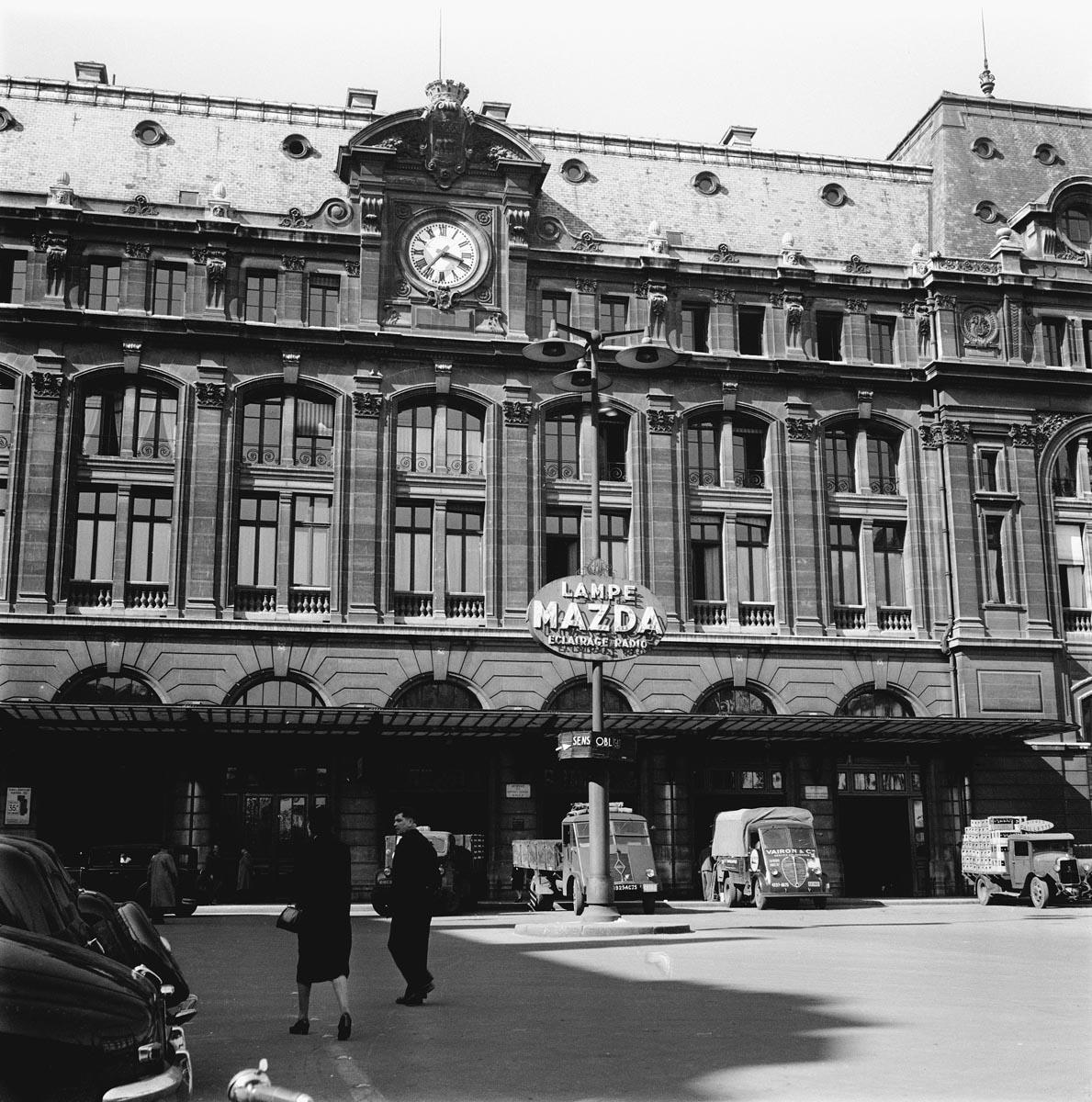
SNCF Open Archives
He had traveled to France on the SS Liberté, in the company of fellow artist, Herbert Gentry. But he somehow lost sight of Gentry upon docking and took the train to Paris alone.
As was typical of Beauford when he traveled, he was disoriented and frightened by the time the train pulled into Saint Lazare station.
According to Beauford's biographer, David Leeming
, just as Beauford began to feel panicky, he was approached by two friends from New York - Robert Blackburn and Oliver Harrington.Blackburn, a printmaker, was in Paris because he had received the John Hay Whitney Fellowship to work at the renowned Atelier Desjobert (a lithograph print shop) in 1953–1954.
Harrington, a cartoonist and journalist, had been in Paris since 1951. He left the United States to avoid being investigated by the House Un-American Activities Committee as a suspected Communist. He was the creator of the famous comic character, Bootsie.

Right: from top to bottom - Ollie Harrington (1954), Herb Gentry (1950), and Bob Blackburn (1951)*
Gentry, who was returning to Paris after having spent two years in New York, found the three men on the platform. He, Blackburn, and Harrington all accompanied Beauford to a hotel on boulevard Raspail in Montparnasse.
The following day, Beauford moved from that hotel (name unknown) to the Hôtel Odessa, which is where Les Amis de Beauford Delaney had a commemorative plaque installed in his honor in 2015.
*Fair use claimed for images at right of collage.
August 1964 - Beauford's Family Visits Paris
From Amazing Grace: A Life of Beauford Delaney
:On the first Sunday Emery and Beauford went alone to mass at Notre Dame ... during the day there was time to sightsee ... as well as time for Beauford to do sketches for portraits of all three loved ones along with a self-portrait, his greatest of many, that would be finished in 1965.
The biography gives no further details about what the family may have seen during its sightseeing forays.
For those who do not know Paris, here are some present day images of major landmarks and monuments that Emery, Gertrude, and Imogene likely saw during their stay:
The Eiffel Tower, viewed from boulevard Pasteur (very near the location of Beauford's rue Vercingétorix studio)

© Discover Paris!
Palais Garnier, Paris' opera house during Beauford's Paris years

© Discover Paris!
The Louvre, viewed from the Musée d'Orsay

© Discover Paris!
Sacré Coeur Basilica, Montmartre

© Discover Paris!
Place de la Concorde

© Discover Paris!
And here is an image of the self-portrait that Beauford began during their visit:

(1965) Oil on canvas
© Estate of Beauford Delaney
by permission of Derek L. Spratley, Esquire,
Court Appointed Administrator
It is currently held by the Whitney Museum of American Art. The portrait was featured during the exhibition Human Interest: Portraits from the Whitney's Collection that was shown from
April 27, 2016 through February 12, 2017.
Beauford's 1959 Thanksgiving

© Discover Paris!
Both Beauford and his dear friend, James Baldwin, were in a fragile emotional state during the weeks and months leading up to Thanksgiving that year. Both men benefited from an elaborate Thanksgiving dinner party that Baldwin organized in Beauford's honor.
David A. Leeming, author of Amazing Grace: A Life of Beauford Delaney, says that the party was "memorable, and Beauford demonstrated his happiness by for the first time in years singing some of the old songs with Baldwin."
Fern Marja Eckman, author of The Furious Passage of James Baldwin, provides readers with greater detail. She notes that Baldwin lived "about a block away" from Beauford, in a flat located above a country restaurant. Baldwin had the owners of the restaurant, whom he called Pierrot and Pierrette, prepare the meal under his supervision. Eckman quotes one of the invitees for the evening, a Belgian writer and director named Robert Cordier, to paint a picture of the festivities:
Jimmy took over the whole restaurant for Thanksgiving ... The table was carefully arranged with autumn decorations. It was really a banquet for twenty people. Jimmy's a gourmet, a connoisseur of wine and cognac. That was a great night!
Happy Thanksgiving weekend from Les Amis de Beauford Delaney!
