

Radiant Horizons: The Global Legacy of Beauford Delaney
For many years, Les Amis has had the pleasure and privilege of working with Derek L. Spratley, Esquire, Court-appointed Administrator of the Beauford Delaney Estate, to ensure the accuracy of the representation of Beauford’s art on this blog.
To acknowledge and celebrate 30 years of collaboration with individuals, organizations, and institutions that have expanded Beauford’s legacy across the globe, Spratley organized Radiant Horizons, a conversation between award-winning biographers David Leeming and Nicholas Boggs that examined Beauford’s life, work, and impact on James Baldwin and the world.
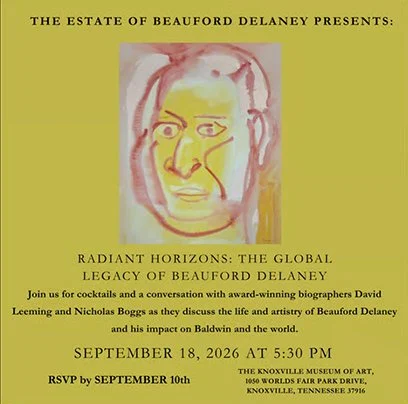
I was honored to represent Les Amis and the Wells International Foundation in person at this event, which took place at the Knoxville Museum of Art in Beauford’s hometown of Knoxville, TN.
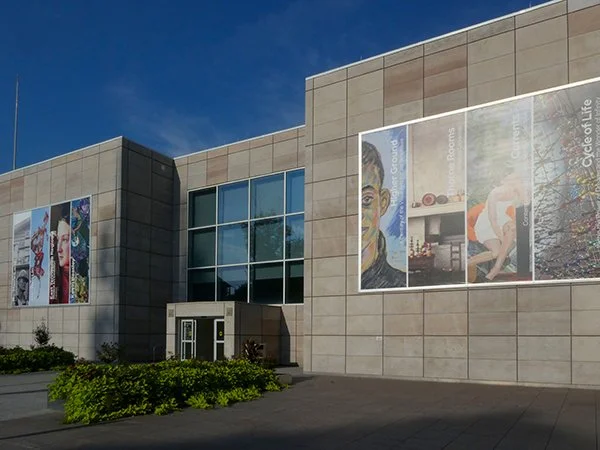
Knoxville Museum of Art - façade
© Wells International Foundation
The program for this festive evening began with opening words by Maya Spratley and a dance performance by Faith Spratley (both young women are Derek Spratley’s daughters).
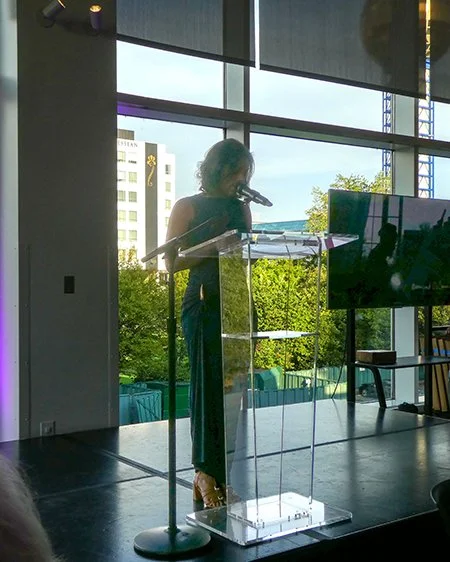
Maya Spratley
© Wells International Foundation
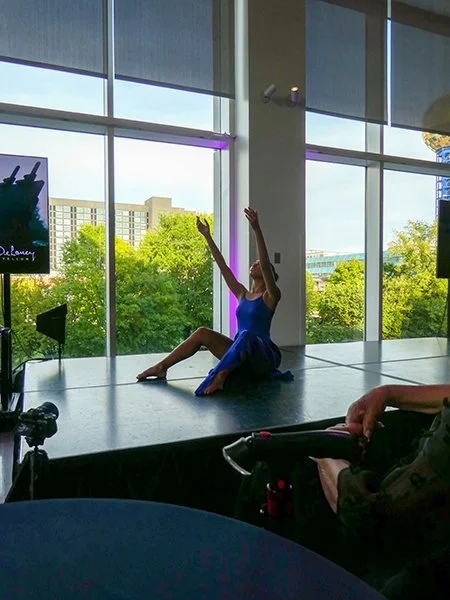
Faith Spratley
© Wells International Foundation
Next, halley k. harrisburg of the Michael Rosenfeld Gallery delivered the “State of the State” address to present numerous elements of Beauford’s expanding legacy, …
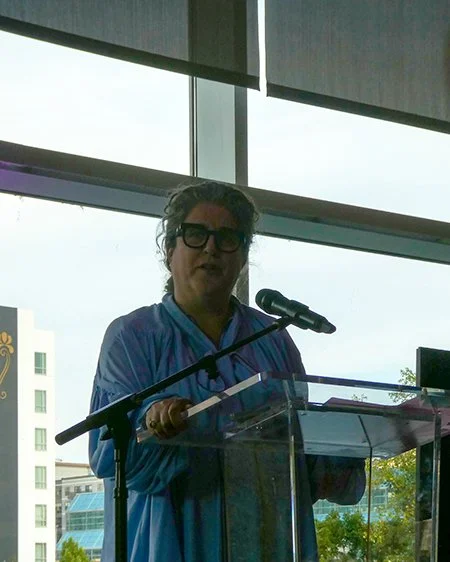
halley k. harrisburg
© Wells International Foundation
… and Mary Campbell, UTK Associate Professor of Art History and author of the soon-to-be-released Beauford Delaney biography entitled Lovelight: The Art and Life of Beauford Delaney, commenting on the similarities between Radiant Horizons and the 1969 reception hosted by the American Cultural Center that honored Beauford in Paris.
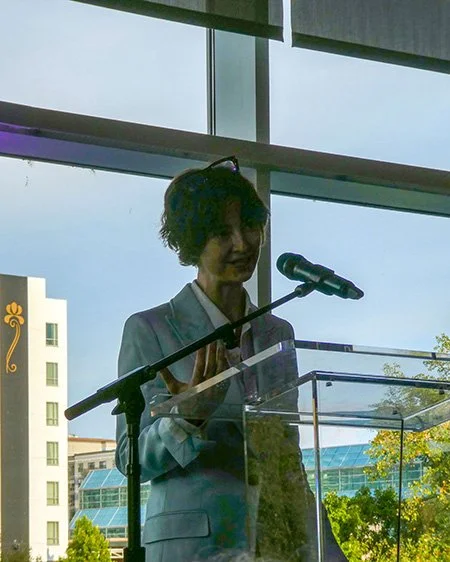
Mary Campbell
© Wells International Foundation
Nicholas Boggs, author of James Baldwin: A Love Story, then interviewed David Leeming, author of Amazing Grace: A Life of Beauford Delaney, about Leeming’s relationship with Beauford and how he began to accumulate the information he would eventually include in the biography.
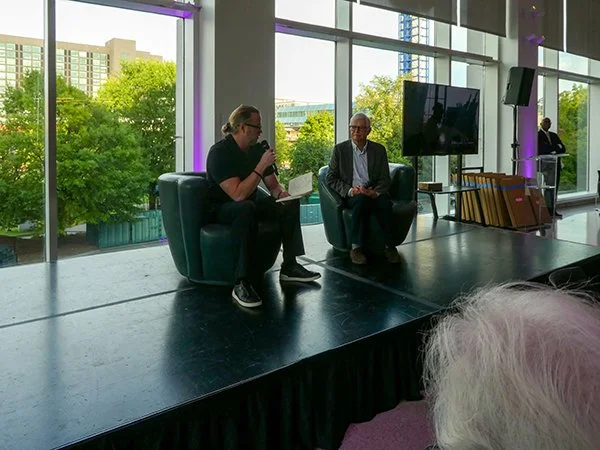
Nicholas Boggs and David Leeming
© Wells International Foundation
Host Derek Spratley then took the stage to thank the audience for attending, talk about his motivation for organizing the event, and announce a series of awards that were a surprise to everyone.
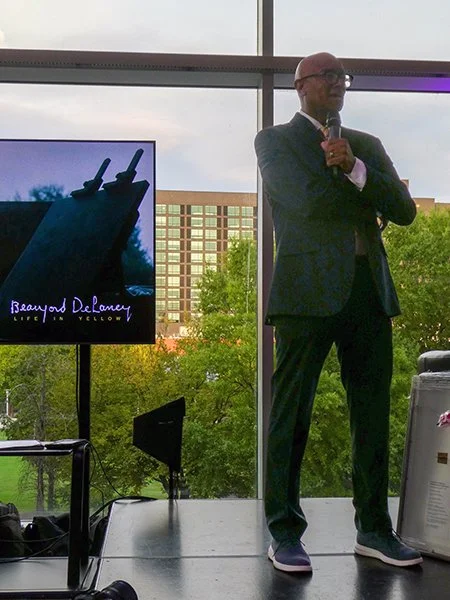
Derek Spratley, Esquire
© Wells International Foundation
Boggs, Leeming, and over a dozen additional people received the Golden Palette award, which Spratley personally designed in the name of the estate.
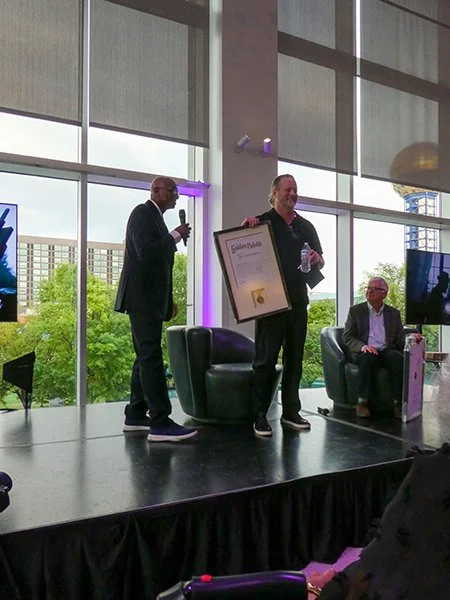
Nicholas Boggs with his award
© Wells International Foundation
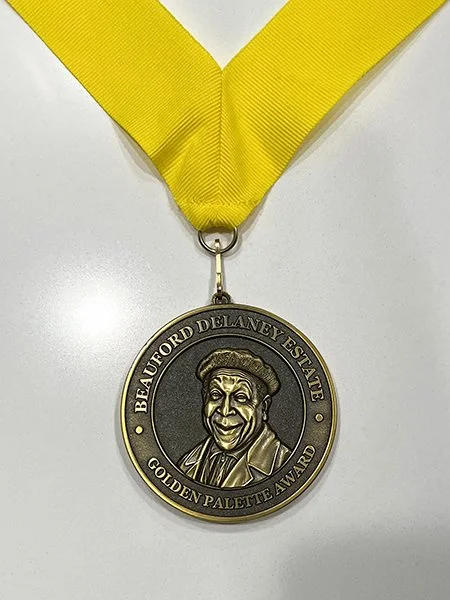
The Golden Palette Award
© Wells International Foundation
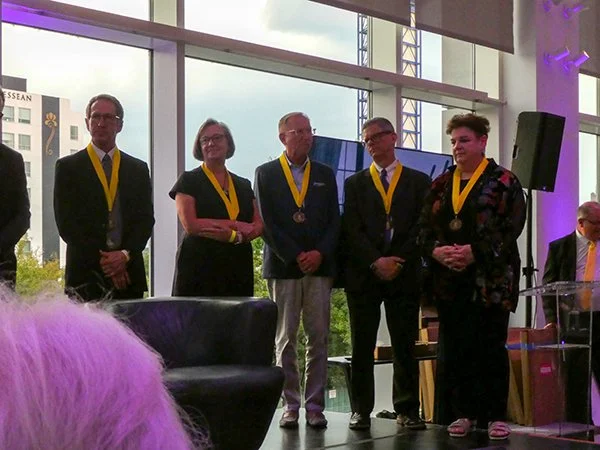
Several Golden Palette award winners on stage
© Wells International Foundation

Monique Y. Wells, Sylvia Peters, and Rev. Reneé Kesler
© Wells International Foundation
The evening culminated with Spratley’s presentation of the gift of the papers David Leeming used to write Amazing Grace: A Life of Beauford Delaney to UTLibraries’ Beauford Delaney Papers, the Beck Cultural Exchange Center, and the Knoxville Museum of Art, a call for financial support for the Delaney Museum at Beck, and the screening of a trailer for a new Beauford Delaney documentary entitled Beauford Delaney: Life in Yellow.
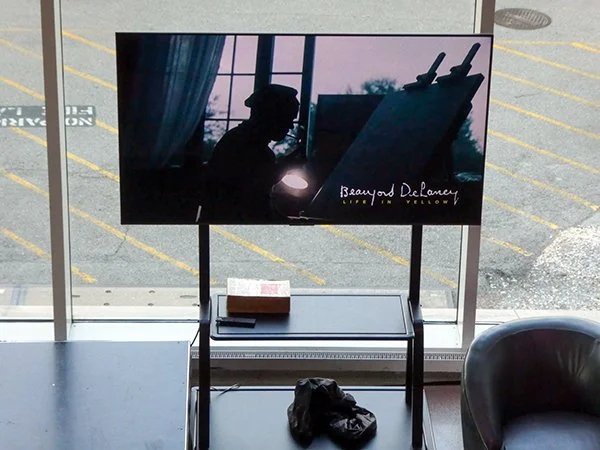
Title screen for Beauford Delaney: Life in Yellow
© Wells International Foundation
Life in Yellow is a work in progress.
Wadada Leo Smith and Beauford – The Red Bar
I have always said that Beauford Delaney’s spirit creates magic, evokes magic—is magic.
The story behind legendary trumpetist Wadada Leo Smith’s performance at The Drawing Center during its 2025 solo exhibition entitled In the Medium of Life: The Drawings of Beauford Delaney is a perfect example of this.
Smith and N’da Kulture, an avant-garde musical ensemble formed by Smith in the 1990s, gathered at The Drawing Center on July 25, 2025, to regale a packed house with music Smith composed after encountering Beauford’s Untitled (Red Bar) (1962).
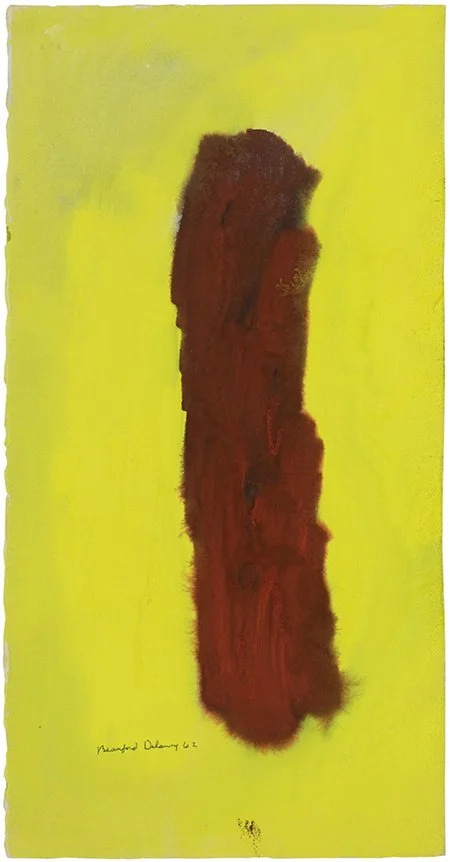
Untitled (Red Bar)
(1962) Gouache on paper
© Estate of Beauford Delaney
by permission of Derek L. Spratley, Esquire,
Court Appointed Administrator
Courtesy of Michael Rosenfeld Gallery, LLC, New York, NY
After the performance, Smith said the following about this work:
“Aimee (Good) had invited me down to see the exhibit. And I looked at everything. Then, when I got to the Red Bar, I understood something that was really clear and direct and unclouded.
“What does the Red Bar represent? It's not a bar, by the way, but it's a structure or a stroke in which any bar can be constructed and only understood by the receiver who understood...”

Wadada Leo Smith
Bimhuis Amsterdam 12 October 2014
Dirk Neven, photographer
CC-BY-2.0
Smith encountered Good when she went to see his exhibition, Kosmic Music, at the American Academy of Arts and Letters. The works shown there represented over 50 years of what Smith calls art scores—artistic representations of a performable musical language called Ankhrasmation.

Kosmic Music, The Dream, 2008
© Wadada Leo Smith
Gel, inks, and acrylic on paper
12x18”
Good heard Smith perform at the Academy and asked him to contact her. When he did, she extended the invitation for him to perform at In the Medium of Life. At the time, she was unaware that he had met Beauford in Paris 56 years before.
Smith granted Les Amis an exclusive interview during which he recounted the story of that meeting.
As part of the iconic Association for the Advancement of Creative Musicians in Chicago, he relocated to Paris with the other members of the group during the summer of 1969. Violinist Leroy Jenkins, who Smith described as a close colleague, was told that a famous painter was going to be present at a luncheon to be held at a Montparnasse restaurant. He invited Smith to come along.
Smith didn’t know anyone at the event, and his only vocal interaction with Beauford was a timid “Hello”:
“… just from observing him, I kind of got a good, beautiful vibe. We didn’t talk, and it was a brief moment in my life.
“But you know, some people believe that eye contact is the essence of meeting. I’m one of those people.”
Smith felt that the invitation to perform at The Drawing Center brought him and Beauford together again in a way that transcended time and space, and he visited In the Medium of Life several times in preparation for the performance. Though he was “only” asked to perform, he felt compelled to compose a piece for the occasion.
When he saw Untitled (Red Bar), Smith was inspired by what he described as a “huge, beautiful patch inside that big Beauford yellow.” He took out his notebook and began writing music for the performance on the spot, knowing that he would “construct several red bars” in the composition. He described them as being sonic vertical stacks that would continuously evolve and constantly shift in this patch of color. He said he added a horizontal line throughout the piece that consisted of different voices represented by the instruments played by the ensemble.
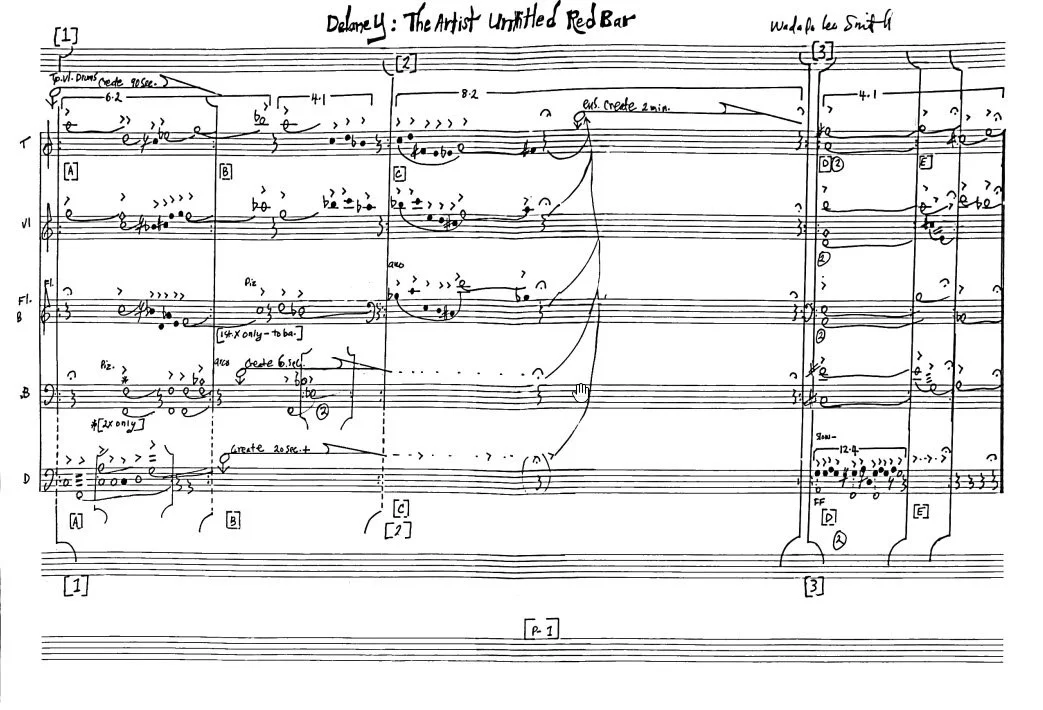
Sheet music for “Delaney: The Artist Untitled Red Bar”
Image courtesy of Wadada Leo Smith
Once he got home, he started thinking about the work and looking at it in the catalog and online. His inspiration “started to churn,” and he began reflecting on how the image could be “infused” or “submerged as a musical quality.” *
Smith said he wanted to capture “a psychological profile of [Beauford’s] creativity” with “The Artist Untitled Red Bar.” He wanted the music to be “Pure. Fresh.” So, he deliberately chose musicians with whom he had never played before and allowed only 30-35 minutes of rehearsal of the piece on the day of the performance.
The ensemble musicians—Tom Chiu on violin, Joe Fonda on double bass and concert flute, Luke Stewart on double bass, and Eli Keszler on drums—had not encountered Beauford’s work prior to the concert. The Drawing Center gave each of them an exhibition catalog after the performance.
Listen to the entire concert HERE.
*This process inspired the work that The Beauford Delaney Project is pursuing through its Resonance program.
When Art Speaks to Art
Ekphrastic Poetry and Music at UT Downtown Gallery
For Beauford, art was never a solitary endeavor. The rhythm of jazz, the cadence of blues, and the elegance of classical music all fed the brilliance of his canvases.
And his dear friend James Baldwin waxed poetic when describing Beauford’s work.
It is in this exact spirit of creative dialogue that the UT Downtown Gallery in Knoxville, TN is hosting a special upcoming event: an afternoon of poetry and music directly inspired by the visual art in its current exhibition of Beauford’s work, entitled Degrees of Separation.
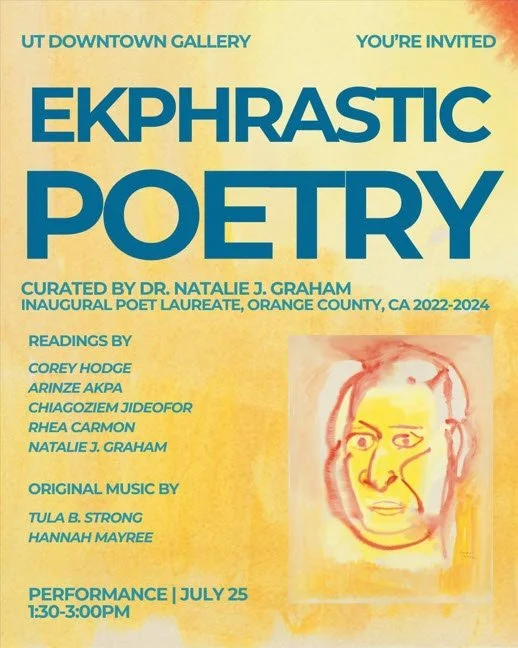
If you’ve never encountered the term, ekphrastic poetry is a beautiful, centuries-old form of writing where a poet uses vivid descriptions to respond to, interpret, or expand upon a work of visual art. Think of it as a bridge between the brushstroke and the written word, allowing us to see a painting through another artist’s eyes and soul.
The poetry performance that centers Beauford’s work will be the second annual event held at the Gallery. The performance debuted last year when Knoxville Poet Laurate Rhea Carmon (aka RheaSunshine) and University of Tennessee (UT) Knoxville Professor Natalie Graham collaborated on a successful inaugural event.
Both poets will recite works at this year’s performance, which will be held on Saturday, July 25 from 1:30 PM to 3:00 PM.
They will be joined by UT Knoxville’s Corey Hodge, Arinze Akpa, and Chiagoziem Jideofor.
Music will be provided by Cal State Fullerton lecturer Tula B. Strong and Black Banjo Reclamation Project founder and executive director Hannah Mayree.
Knoxvillians and visitors have Dr. Graham to thank for the above lineup.
The gallery is located at 106 S. Gay Street, next door to the Arts and Cultural Alliance in the Emporium Building.
All exhibitions and events organized at the gallery are free and open to the public.
A New Chapter Begins
Launching The Beauford Delaney Project and Its First Creative Initiative
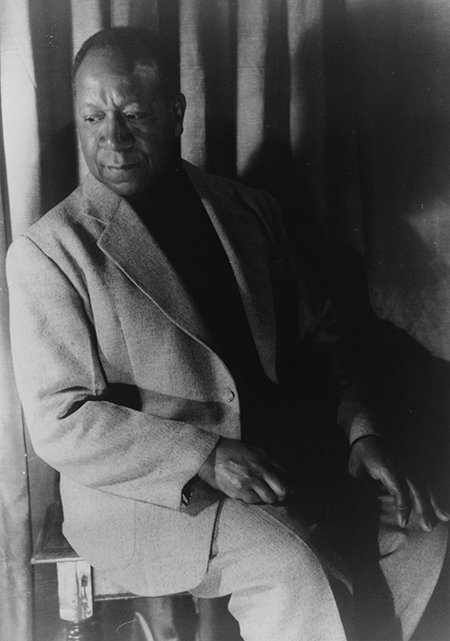
Portrait of Beauford Delaney
© Carl van Vechten 1953
Public domain
Today, Les Amis is pleased to report an important milestone in our efforts to honor, explore, and share the legacy of Beauford Delaney.
We are delighted to announce the launch of The Beauford Delaney Project, a new digital humanities initiative led by the Wells International Foundation (WIF), as well as the launch of the project's first official undertaking—a creative and scholarly soundscape project led by WIF's Summer 2026 intern, George Henry.
For many years, Les Amis has served as a space for sharing research, stories, discoveries, and conversations about Beauford as one of the 20th century's most remarkable artists.
The Beauford Delaney Project represents the next stage of that work—it is creating new opportunities for scholarship, education, artistic engagement, and public access centered on Beauford's life and legacy.
Rather than treating his story as something confined to museums or academic publications, the project seeks to bring Beauford's life into conversation with contemporary audiences—especially students, emerging scholars, artists, and community members. Through research, creative practice, educational programming, and international engagement, WIF is fostering new ways of understanding both his artistic achievements and the broader cultural worlds he inhabited.
The launch of the platform is only the beginning.
The First Project: Listening to Beauford's New York
We are especially pleased to introduce the first project developed under this new initiative.
This summer, George Henry, a recent Amherst College graduate whose work bridges Black Studies, technology, archival practice, and sound, will undertake an innovative exploration of Beauford's New York through audio.
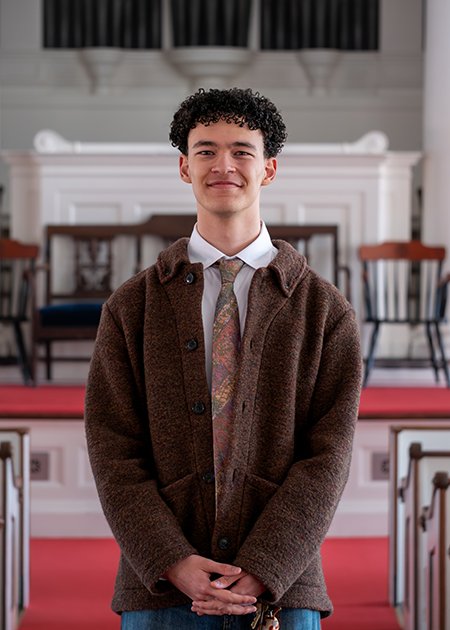
George Henry
Image courtesy of George Henry
Drawing upon archival research and field recordings collected at locations associated with Beauford's life—including Harlem, Greenwich Village, and other neighborhoods where he lived and worked—Henry will create a series of immersive soundscapes designed to evoke the environments that surrounded Beauford during pivotal periods of his career.
The project asks a compelling question: What might we learn about Beauford's world by listening as closely as we look?
By combining scholarship, artistic interpretation, and contemporary audio practice, these soundscapes will offer audiences a new way to engage with Beauford's story—one that complements traditional historical research while inviting deeper sensory and emotional connection.
In many ways, the project reflects the broader vision of overall project: bringing together disciplines, perspectives, and communities to create new pathways into Beauford's life and work.
Looking Ahead
As The Beauford Delaney Project grows, we look forward to sharing new research, creative projects, educational opportunities, and collaborations inspired by Beauford's far-reaching influence.
We are grateful to everyone who has supported Les Amis over the years and invite you to explore the new platform, follow the progress of George Henry's work this summer, and join us as we continue building a space where scholarship, creativity, and community come together.
Find The Beauford Delaney Project HERE.
Beauford Immortalized in Sculpture in Knoxville
A full-body likeness of Beauford now graces the landscape of his hometown of Knoxville, TN.
On April 16, 2026, four new bronze sculptures honoring historic Black figures from Knoxville were unveiled at Covenant Health Park, the city's new multi-purpose sports stadium.
Beauford's was one of them.
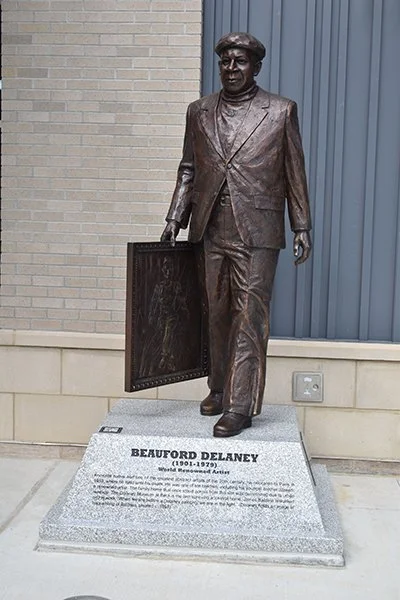
Beauford Delaney statue
Image courtesy of the Beck Cultural Exchange Center
Beck Cultural Exchange Center President and City of Knoxville Historian of African American History Rev. Reneé Kesler played an integral role in the creation and placement of the works. She graciously granted Les Amis an exclusive interview to discuss the project.
Rev. Kesler explained that she commissioned these statues and seven additional ones that honor Knoxville's Negro Baseball team, the Giants, as a means of acknowledging and honoring the history of the area.
The new stadium is located a couple of miles from the park where the Giants played from 1920-1932. Situated within the Magnolia Avenue Warehouse District, just east of Knoxville's Old City, it was built on land that was formerly home to a vibrant Black community and essentially razed in the name of urban renewal.
Working with sculptor Brian Hanlon and various stakeholders over the past 5-6 years, Rev. Kesler determined who would be represented in the statues, how they would be represented, and where the finished works would be placed. She elected to have Beauford represented with a likeness of one of his more iconic portraits of his mentee, James Baldwin.
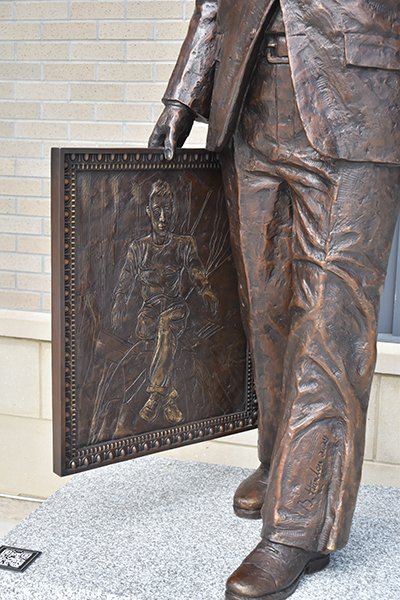
Beauford Delaney statue - detail of Baldwin portrait
Image courtesy of the Beck Cultural Exchange Center

James Baldwin
(c. 1945-1950) Oil on canvas
© Estate of Beauford Delaney
by permission of Derek L. Spratley, Esquire,
Court Appointed Administrator
Courtesy of Michael Rosenfeld Gallery, LLC, New York, NY
Though all were commissioned at the same time, the first seven sculptures were unveiled when the stadium opened last April. Last week's unveiling was timed to coincide with the opening of the Delaney Building, an exclusive, mostly residential complex.
The sculptures that commemorate Black baseball history at Covenant Health Park represent Jerry Benjamin, William M. Brooks, Claude “Steel Arm” Dickey, Forrest “One Wing” Maddox, William Nathaniel “Nat” Rogers, “Big Jim” Tugerson, and Payne Avenue Little League.
The four figures honored by the works unveiled last week are painter Ruth Cobb Brice, singer and “Queen of the Blues” Ida P. Cox, writer and poet Nikki Giovanni, and Beauford.
At the base of each statues is a QR code that allows you to learn more about the individuals represented in the works.
Rev. Kesler said that the Beck Cultural Exchange Center worked in close collaboration with Randy Boyd, the Boyd Family Foundation, Boyd Sports, and the Knoxville Smokies baseball team to move the sculpture project forward. She explained that ever since the renovation of the area began, Beck came in as a partner with the responsibility to hold onto and reclaim names and spaces to preserve its history.
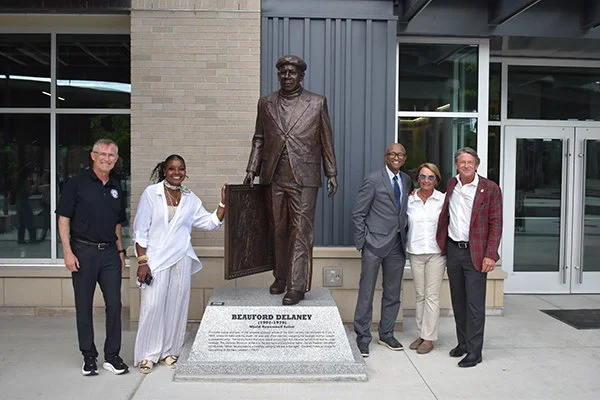
(L to R) sculptor Brian Hanlon,
Rev. Reneé Kesler, Derek Spratley, court-appointed administrator
of the Beauford Delaney estate, and Jenny and Randy Boyd
with Beauford Delaney statue
Image courtesy of the Beck Cultural Exchange Center
Covenant Health Park serves as the home park for the Smokies as well as the city's Division III soccer team, One Knoxville SC. It opened on April 15, 2025.
The new Delaney building overlooks the stadium.
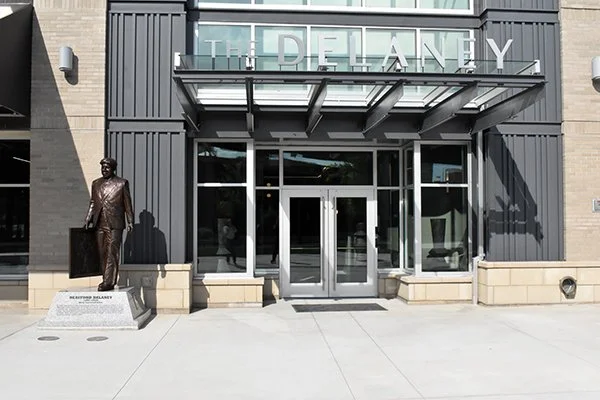
Beauford Delaney statue and entrance to the Delaney Building
Image courtesy of the Beck Cultural Exchange Center
Click on the links below to read previous Les Amis articles about the Delaney Building:
Beauford in Six Minutes or Less
Last week, I came across a well crafted, 4:19-minute video about Beauford in a recently launched series about art history. Catherine, the creator of the series, chose to feature Beauford in her first episode.
Artist Series Ep.1 - Beauford Delaney
Viewing this video inspired me to look for others that grasped the essence of Beauford's life and/or work in a relatively short period of time.
Below are links to videos that do so in six minutes or less.
Some talk about Beauford biographically and some feature specific works of art.
Beauford Delaney: The Artist's Artist
A Modern Icon: Beauford Delaney's Marian Anderson
Beauford Delaney, Can Fire in the Park, 1946
Gathering Light
The video short called BLACK HISTORY MONTH 2026! Daily Drawing Day Eight Beauford Delaney depicts an artist sketching a portrait of an older Beauford, which I believe was inspired by Errol Sawyer's 1973 photo portrait.

Beauford Delaney
Rue Guilleminot
France 1973
© Errol Sawyer
Click HERE to view it.
A Sleeping Beauty
David Byrne - award-winning musician, writer, visual artist, and filmmaker - performed his David Byrne - Who Is The Sky? concert yesterday at the Big Ears Festival in Beauford's home town of Knoxville, TN.

David Byrne - Everybody Laughs
Photo credit: Shervin Lainez
Byrne is featuring Beauford in his upcoming book, Sleeping Beauties, which is all about brilliant ideas that got overlooked or forgotten but can be / are being revived.
He found Beauford’s renaissance over the last 10 years to be a "sleeping beauty," and he reached out to Les Amis to set up a fact checking call for the chapter he is writing about Beauford's rediscovery.
Byrne experienced Beauford's work for the first time when he visited the Be Your Wonderful Self: The Portraits of Beauford Delaney exhibition at the Michael Rosenfeld Gallery in NYC.
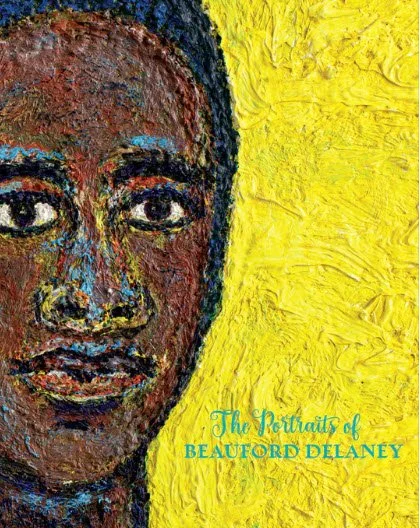
The Portraits of Beauford Delaney
Catalog cover
Artwork © Estate of Beauford Delaney,
by permission of Derek L. Spratley, Esquire,
Court Appointed Administrator,
Courtesy of the Michael Rosenfeld Gallery, LLC, New York, NY
He told me that he and his wife went to the show because it had "gotten a nice review in the Times." The magnificence of Beauford's paintings notwithstanding, they were greatly impressed with his writing, which they discovered in a display of his correspondence that had been included in the show. (One of the vitrines was filled with handwritten letters to Larry Calcagno, Al Hirshfeld, Palmer and Miriam Hayden, and other friends and acquaintances.)
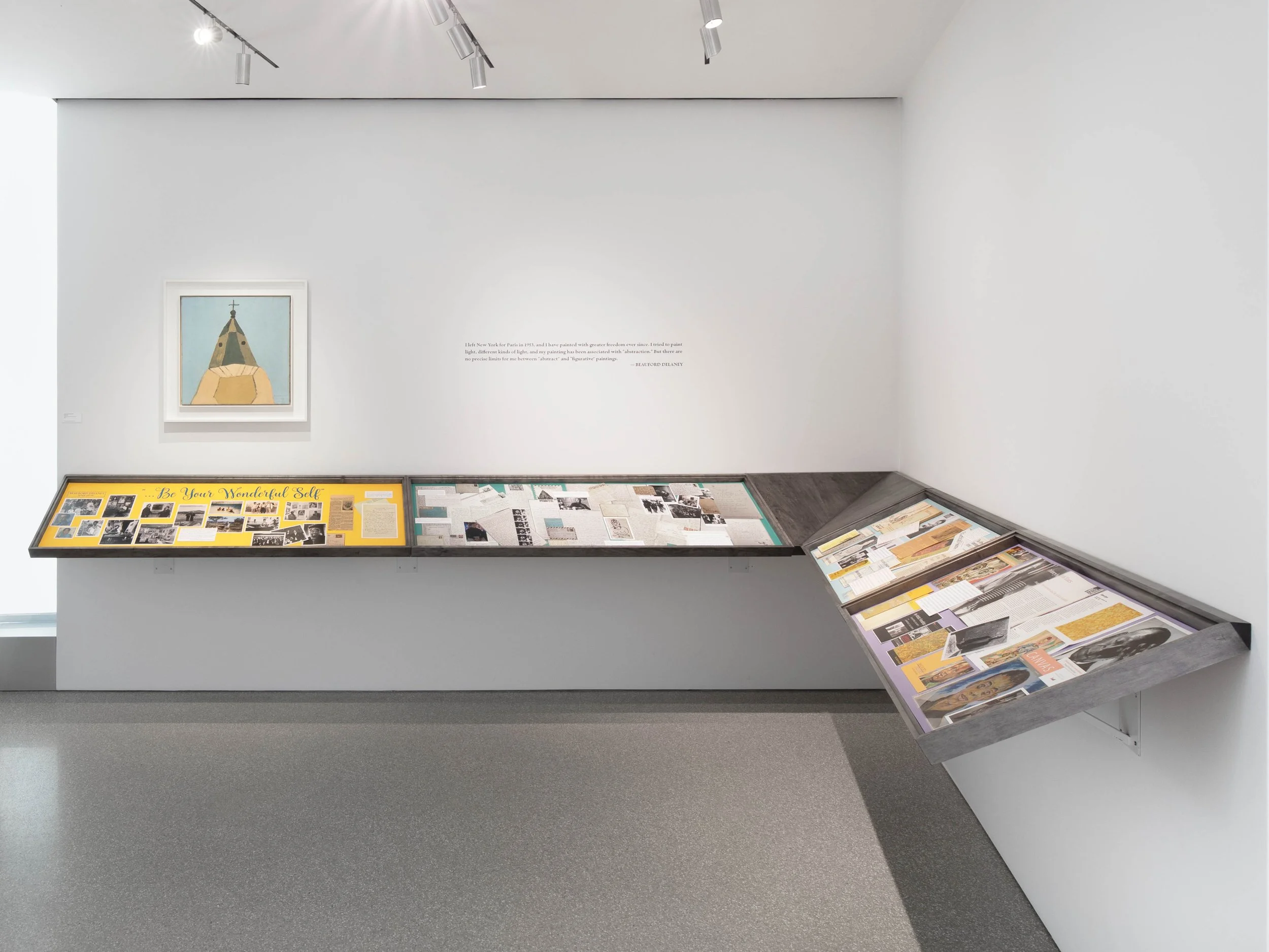
Installation view 28 of Be Your Wonderful Self: The Portraits of Beauford Delaney
(September 8–December 23, 2021) at Michael Rosenfeld Gallery, New York, NY
Artworks © Estate of Beauford Delaney,
by permission of Derek L. Spratley, Esquire,
Court Appointed Administrator,
Courtesy of Michael Rosenfeld Gallery LLC, New York, NY
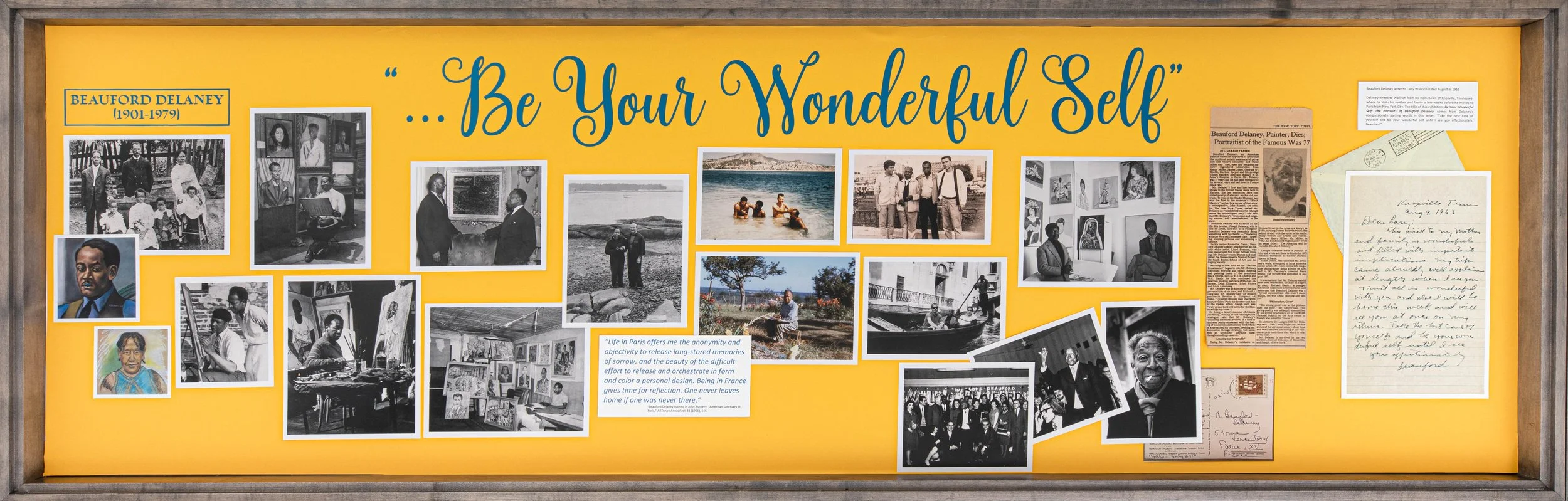
Installation view 24 of Be Your Wonderful Self: The Portraits of Beauford Delaney
(September 8–December 23, 2021) at Michael Rosenfeld Gallery, New York, NY
Artworks © Estate of Beauford Delaney,
by permission of Derek L. Spratley, Esquire,
Court Appointed Administrator,
Courtesy of Michael Rosenfeld Gallery LLC, New York, NY
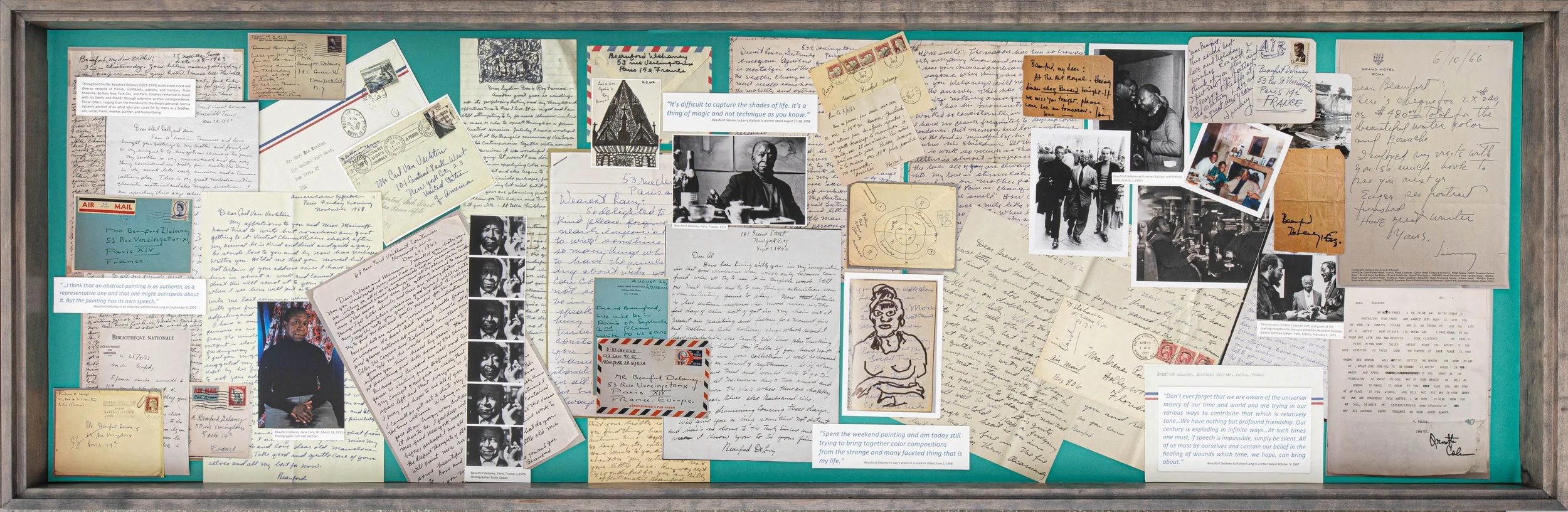
Installation view 25 of Be Your Wonderful Self: The Portraits of Beauford Delaney
(September 8–December 23, 2021) at Michael Rosenfeld Gallery, New York, NY
Artworks © Estate of Beauford Delaney,
by permission of Derek L. Spratley, Esquire,
Court Appointed Administrator,
Courtesy of Michael Rosenfeld Gallery LLC, New York, NY
They subsequently saw Be Your Wonderful Self at the Ogden Museum of Southern Art in New Orleans. Byrne told me, "By then we realized - oh, he's back."
During a second call, I spoke to Byrne at length about Beauford and Sleeping Beauties. He reiterated how impressed he and his wife were by Beauford's writing, saying that many visual artists are challenged when it comes to expressing themselves in writing. He said that after visiting the exhibition at Ogden, he began seeing more references about Beauford.
I mentioned that one of the essays in the catalog for the Resonance of Form and Vibration of Color exhibition that the Wells International Foundation organized in Paris in 2016 is all about Beauford's writing and noted that this exhibition is credited by some as being the beginning of Beauford's renaissance.*
Our conversation turned to the reason Byrne is including Beauford in Sleeping Beauties. He said that after seeing Beauford's work at Ogden, he asked himself "How in the world did this go missing?" and "How did it get rediscovered?" His search for the response to that question brought him to Les Amis and to me.
Byrne talked about how the people of Knoxville had known so little about Beauford before Resonance of Form, and I told him about the "Knoxville 11," the eleven people from Knoxville who came to Paris to see the show. I also told him that the September 2016 article the NYTimes published about Beauford was a direct result of the Paris exhibition.
Sleeping Beauties is a work in progress, and Byrne said that he may reach out for additional information as he finishes up his writing.
As soon as the book is published, Les Amis will read the chapter about Beauford and post a review!
**Resonance of Form was part of a much larger, multi-layered tapestry of scholarship and advocacy that has specifically helped anchor his brilliance in his hometown of Knoxville, Tennessee. One of the most significant contributions to 2016 catalog for the show was Levi Prombaum’s essay, "Reading Beauford Delaney’s Words and Letters: Three Thoughts." By meticulously exploring Delaney’s literacy and intellectual life, Prombaum shifted the focus away from a reductive "struggling artist" persona, reframing him instead as a master of both the brush and the pen whose prose was as "vibrating" as his abstractions.
The renewed appreciation for Delaney’s genius is the result of a massive, collective effort involving decades of work from numerous scholars and academics. The intellectual groundwork was laid by foundational figures like David Leeming, whose definitive biography remains a touchstone, and Richard J. Powell, whose rigorous art historical analysis elevated Delaney’s profile within the canon of Modernism. Deep critical analysis from scholars such as Mary Campbell, Adrienne L. Childs, and Monika Gehlawat has provided the essential lenses through which we now view Delaney’s transition from portraiture into his transcendent yellow abstractions.
The cultural and literary context of Delaney’s life has been further enriched by the insightful perspectives of Hilton Als, Rachel Cohen, and Amy Elias, who have bridged the gap between his visual output and his profound connections to the 20th-century literary world. This scholarly movement has been bolstered by the institutional stewardship of the Smithsonian American Art Museum and the Knoxville Museum of Art, where Stephen Wicks has been a pivotal force in celebrating Delaney’s legacy on a local level. Together, these voices have ensured that Delaney is recognized not just as a figure of the past, but as a central player in International Modernism.
Much of the specific historical detail and research that allows for such a deep understanding of Delaney’s career today is owed to the tireless, decades-long service of Michael Rosenfeld and halley k harrisburg of the Michael Rosenfeld Gallery. Their unwavering commitment to Delaney’s oeuvre and their willingness to share their extensive archives have been essential to the recovery effort. Through their work and the combined efforts of the academic community, the "vibration of color" that Delaney captured on canvas continues to resonate from the galleries of Paris to the streets of Knoxville.
Jazz Pianist Donald Brown Creates Music Inspired by Beauford
The Big Ears Festival is the flagship event of the Tennessee nonprofit of the same name. The festival explores the influences that inspire and connect musicians and artists, crossing the boundaries of musical genres as well as artistic disciplines.
This year, one of the artists on the roster for this three-day mega-event performed music inspired by Beauford!
Jazz pianist Donald Brown is a prolific and masterful composer of jazz music. Perhaps best known for his performances with Art Blakey and the Jazz Messengers in the early 80s, one of his compositions earned Wynton Marsalis a Grammy nomination for the 29th edition of the awards.
Brown began teaching at Berklee College of Music in 1983. Though health problems curtailed his ability to perform, he remained active as a composer and left the position in 1985 to resume performing.
He joined the faculty of the University of Tennessee Knoxville (UTK) in 1988, where he continued to compose and perform throughout his tenure. He retired from his post in 2020.
Brown brought three new compositions to the 2025 Big Ears Festival as a result of having participated in Boundless: Artists in the Archives, a seven-year-old UTK initiative that invites musicians and other artists to visit the UT Libraries' Betsey B. Creekmore Special Collections and University Archives and create original works inspired by the unique primary sources preserved there.

He not only researched the Beauford Delaney Papers at the library, but also interacted with students who consulted the papers as part of an independent study course at the university.


Donald Brown interacting with UTK students
and consulting the Beauford Delaney Papers
Images courtesy of UT Libraries
Martha Rudolph, Editor for Marketing & Communication at UT Libraries shared that Brown had wanted to attend Berklee College of Music but could not afford to do so. She said that Brown taught piano, improvisation, and jazz history at the University of Tennessee College of Music for 32 years.
Rudolph described Brown as "a gifted educator who could explain the very complex language of jazz in a manner that is easy to understand."
Brown is a native Tennessean (born in Memphis in 1954) who currently resides in Knoxville. As a prelude to Big Ears, he and a small group of acclaimed jazz musicians performed his Beauford-inspired compositions at the Knoxville Museum of Art (KMA) on Wednesday, March 26.
According to the Knoxville News Sentinal, they are entitled "$5 Blues for Beauford Delaney," "Theme for Beauford's Mom," and "A Letter from James Baldwin."
UT Libraries Modern Papers Archivist Kris Bronstad attended the event and thoroughly enjoyed it:
I attended, it was wonderful. The music was incredible, the musicians were incredible, and everyone was in a good mood. Donald Brown had 3 pieces ....
He talked about Delia Delaney and imagining what she was like (for the first composition), then about Beauford and Baldwin being Black and gay (second composition). The final composition was a boogie-woogie inspired piece ....
I can’t help but imagine that Beauford would have loved it.
For additional details about Brown's career, his participation in Boundless, and the three works he performed at KMA, read the Knox News article entitled Knoxville jazz icon returns to writing, and Beauford Delaney is the focus: See the debut!
To see additional photos of Brown interacting with UTK students at the library, read the Knox News article entitled Jazz pianist to debut new piece based on Beauford Delaney archives.
New Edition of Amazing Grace: A Life of Beauford Delaney
The new edition of David Leeming's biography about Beauford—Amazing Grace: A Life of Beauford Delaney—was released by Karma Books on January 7, 2025 (three weeks later than the December 17, 2024 date that was originally projected).
I pre-ordered my copy well before the end of 2024 and was excited to receive it just a few days ago. I wanted to compare my tattered, thoroughly annotated first edition (Oxford University Press, 1998) with this new version in anticipation of my upcoming visit to Knoxville to peruse the Beauford Delaney Papers that the University of Tennessee Libraries made available to researchers as of January 2024.

I was somewhat taken aback when I read the following in Leeming's foreword:
Given the many meticulously researched exhibition catalogues produced in the last twenty years as well as what is sure to be a comprehensive account of his life from Dr. [Mary] Campbell, Amazing grace is reprinted here without any changes in the original text.
But I was gratified to read that the papers Leeming consulted to write the book are now held at UTLibraries.
This long awaited reprint is graced by a laudatory and intensely personal introduction by Hilton Als, who explains his familiarity with Leeming's writings and describes Leeming's treatment of Beauford's life story as "transcend[ing] the limitations of biography to create a historical narrative of huge scope based on Delaney's vulnerable mind and body."
Als mentions three Beauford Delaney works in his introduction—Portrait of a Young Man (ca. 1937-1940), Dark Rapture (1941), and Abstraction No. 9 (ca. 1963)—and provides his take on the emotions Beauford might have experienced in creating them.
An image of Dark Rapture can be found on page 123 of Amazing Grace.

(1941) Oil on masonite
© Estate of Beauford Delaney
by permission of Derek L. Spratley, Esquire,
Court Appointed Administrator
Unfortunately, images of the other two works are not presented in the book.

(ca. 1937-1940) Color pastel crayons
© Estate of Beauford Delaney
by permission of Derek L. Spratley, Esquire,
Court Appointed Administrator

(circa 1963) Oil on canvas
© Estate of Beauford Delaney
by permission of Derek L. Spratley, Esquire,
Court Appointed Administrator
Image courtesy of the Johnson Collection, Spartanburg, South Carolina
On the last page of his introduction, Als claims Beauford as the brother he's always felt him to be.
Aside from a higher page count in the new book, there are several differences between the first and second editions of Amazing Grace that will be of interest for readers who wish to approach Beauford's life and art from a scholarly perspective:
1) While there are chapter headers at the top margin of the pages in the first edition, there are none in the second edition.
2) Detail in black and white photos is better discerned in the first edition.
3) Color representations of Beauford's art (now on individual pages) are brighter and more vivid in the second edition.
4) There are six fewer references cited in the bibliography of the second edition.
5) Importantly, the second edition has no index. Anyone who does not have the first edition of the book will be hard pressed to find specific information in the reprinted version.
New Edition of Amazing Grace to Be Released
The original edition of the Beauford Delaney "bible" - Amazing Grace: A Life of Beauford Delaney - has been out of print for some time.
Published by Oxford University Press in 1998, it is the sole comprehensive exploration of Beauford's life in book form.
Author David A. Leeming spoke about Beauford and James Baldwin at the Stonington Free Library in Stonington, CT in May 2024 as a prelude to the release of a new, second edition of the book.
Finally, the release date has been announced.
Karma Books of NYC will make the second edition of Amazing Grace available on December 17, 2024!

2024 book cover
A major addition to this new edition is an introduction by curator, writer, theater critic, and Pulitzer Prize winner Hilton Als. Als has referenced Beauford's relationship with James Baldwin in numerous writings about Baldwin, so it will be interesting to see what he has penned for the biography.
The cover for the Karma Publishing edition uses a black background and the same self-portrait of Beauford as did the Oxford University Press edition.

Amazing Grace: A Life of Beauford Delaney
1998 book cover
It is 292 pages long, compared to 221 pages for the Oxford University Press edition.
This is due, at least in part, to the increased emphasis that photographs and images of Beauford's work are given in the book. Several images are now displayed solo on individual numbered pages instead of in a color plate insert bound into the center of the book.

To pre-order the new edition of Amazing Grace: A Life of Beauford Delaney from Amazon.com, click HERE.
Mike Berry and Beauford - Part 3
Mike C. Berry is Gallery Manager at the University of Tennessee (UT) Downtown Gallery and Artist/Owner of Mike C. Berry Studio in Knoxville, TN. He has developed a unique and fascinating "relationship" with Beauford through his framing of Beauford's art for UT. He graciously provided Les Amis with an interview in which he "tells all," including how Beauford's work influences his artistic practice.
Because Berry was so generous with his responses, this interview is presented in three parts.* Find Part 3 below.
Les Amis: Talk about your visit to Beauford’s grave at Thiais Cemetery during your recent visit to Paris.
MCB: On Oct 12, 2023, I took the Paris Metro south out of the city center arriving at the Cimetiere Parisian de Thiais on a overcast drizzly morning. I knew I was looking for “Avenue M, Division No. 86,” and I began to walk in the quiet expanse of this rather large cemetery. I walked for some time finally arriving at Square 86. I walked in between the hedges thinking "Ok, this should be easy to spot because it’s a new piece of marble within a section of old broken headstones overgrown with weeds."

Image courtesy of Mike Berry
I walked around the square which is literally a approx. 50-60 foot square of plots with hedges on each side and not seeing anything I began to wonder if I were in the wrong section. At this point I haven’t seen a soul and it's quiet, all I hear are the rustling of trees and occasionally airplanes above because of its close proximity to Orly airport. Just then, a cemetery attendant approached me from behind. He actually startled me to be honest. I’m standing among graves and I hear “Bonjour!” I probably jumped a little. He smiled and asked me if I spoke French, which I do not, and he told me that he did not speak English.
So, with various hand gestures I communicated my search to him. He somehow was convinced that I was not in the right section and he motioned for me to follow him. I thought this odd as I had just walked past the sign marking Section No.86. We took several steps around a large piles of broken tombstones and I saw it. I exclaimed, "Oui oui, Monsieur, this is it" as I pointed. He smiled and excused himself as I thanked him.
I stood in the drizzling rain and a flood of emotions and thoughts filled my mind. Mainly how short life can be. Mostly just thoughts of respect and honor for an artist that did what he loved and tried to express himself and figure it all out through a mountain of obstacles and hardships ... very much like will all do. I thought about the passage of time and its swiftness. I thought about art, life, his life, light, color....

Image courtesy of Mike Berry
I thought about sense of place and belonging and Beauford’s love of Paris. I thought about eternity and Heaven. The last line on Beauford’s tombstone reads: "I am Home." I interpreted this as his eternal rest in heaven or his love for Paris. I think both would be appropriate interpretations. But thinking about home, especially Knoxville, which has been my home for over half of my life and Beauford’s birthplace and family home, I decided to make a sketch to leave on the tombstone as an expression of love and gratitude from Knoxville.

Image courtesy of Mike Berry
Once the sketch was completed, I slipped it into a Ziploc bag and placed it under the ceramic flowers. I also made a few rubbings of the tombstone inscription to take home for remembrance. I gathered my backpack and stood in silence, said a short prayer of thanks and exited through the hedges and began my quiet walk back to the Metro station.
This memory will stay with me forever ... me alone in a Paris cemetery paying respects to a great artist.
Very special, such a honor.
Les Amis: Any final thoughts?
MCB: I am really blessed to have an active role with the Delaney Estate in helping to raise the profile and honoring a great artist by promoting and preserving his works. Each day I am grateful to use my talents to help and benefit Beauford’s great legacy. A special thanks to Derek Spratley whose kindness and generosity has overflowed onto me.
Thank you, Derek.

*Read Part 1 of the interview HERE.
*Read Part 2 of the interview HERE.
Mike Berry and Beauford - Part 2
Mike C. Berry is Gallery Manager at the University of Tennessee (UT) Downtown Gallery and Artist/Owner of Mike C. Berry Studio in Knoxville, TN. He has developed a unique and fascinating "relationship" with Beauford through his framing of Beauford's art for UT. He graciously provided Les Amis with an interview in which he "tells all," including how Beauford's work influences his artistic practice.
Because Berry was so generous with his responses, this interview will be presented in three parts).* Find Part 2 below.
Note that all photos and content have been approved for posting by Derek Spratley, Esq., Court appointed administrator of the Beauford Delaney Estate.
Les Amis: As a painter, you bring a unique perspective to the act of framing. How has this influenced the way you frame Beauford’s work?
MCB: I try to think how to best highlight the work with a clean and simple presentation and not attempt to “jazz” it up with stylized mouldings that are unnecessary. I always think “less is more” with Beauford’s work and what will allow the work to be the main star on the stage.

Les Amis: Among all the Beauford Delaney works that you’ve framed, which is your favorite?
MCB: I have two, for different reasons.
First is the Henry Miller ballpoint pen sketch piece. This piece is very intriguing to me because it’s basically a rough draft for a 1944 oil portrait. The sketch of Miller is on the back of a catalogue page with a print narrative about Miller on the opposite side. There is a photo of Mr. Miller standing beside the 1944 portrait posted on this blog (Jan 7, 2017).
As I understand it, the 1944 portrait is no longer available to the public or it has been completely lost, which leaves this blue ball point pen rough sketch of Miller the only remaining work from this series. I framed it in a way that either side (portrait side or printed side) can be viewed within the frame.

My other favorite piece is a blue abstract from Madrid 1955. I just love this piece because of the color, and the composition reminds me of my time spent in Madrid a few years ago. I felt very connected to this piece as I shared a strong sense of place to it, and I love the color blue.

Les Amis: As a cityscape artist, please comment on the similarities and differences in the way Beauford and Joseph interpret and portray cityscapes.
MCB: Their similarities are their use of pure color and simplication of form. Of course, Beauford pushes this much farther than Joseph does.
The biggest difference is I see Joseph as the reporter or illustrator of the cityscapes while I tend to view Beauford as the interpreter or the emotional translator of his subjects. Beauford’s work strikes me has highly infused with emotions (through use of color and line) to connect the viewer with their own narrative and emotional response the imagery he presents.
Les Amis: Joseph Delaney’s work inspired you early on. Has Beauford’s work begun to inspire you in some way?
MCB: Working closely with Joseph work definitely inspired me to look the cityscape as a subject matter. My piece, Gay Street Rainy Night, was greatly influenced by Joseph’s work.

Mike C. Berry
Today, I am still inspired by Joseph’s work and continue to look to the city for interesting compositions.
Currently I do find myself in the presence of a lot of Beauford’s work and it has pushed me to simplify form and push my palette towards bright saturated colors.
Recently I experimented with a composition using single color notes inspired by Beauford where I attempted to simplify a downtown scene in Knoxville.

Mike C. Berry
Les Amis: Do you also do framing for or have some other professional relationship with the Joseph Delaney estate?
MCB: The Ewing Gallery of Art & Architecture at the University of Tennessee was bequeathed a third of Joseph’s estate as stated in his will upon his death in 1991. Because of this gift, the Ewing Gallery has a large collection of Joseph’s works which I have had the privilege of framing, cataloguing and exhibiting.
The 2004 exhibition Joseph Delaney, Life in the City was the first professional gallery exhibition I worked on when I started at the UT Downtown Gallery. It was the gallery’s inaugural exhibit. In 2018 I worked on the exhibit Face to Face – Joseph Delaney, which focused on Joseph’s many portraits, mainly those created during his years of working in Washington Square in NYC.
*Read Part 1 of the interview HERE.
Mike Berry and Beauford - Part 1
Mike C. Berry is Gallery Manager at the University of Tennessee (UT) Downtown Gallery and Artist/Owner of Mike C. Berry Studio in Knoxville, TN. I had the pleasure of meeting him in Paris last fall.
Berry has developed a unique and fascinating "relationship" with Beauford through his framing of Beauford's art for UT. He graciously provided Les Amis with an interview in which he "tells all," including how Beauford's work influences his artistic practice.
Because Berry was so generous with his responses, this interview will be presented in three parts. Find Part 1 below.
Note that all photos and content have been approved for posting by Derek Spratley, Esq., Court appointed administrator of the Beauford Delaney Estate.
Les Amis: Please remind me of circumstances under which you framed a Beauford Delaney painting for the estate for the first time.
MCB: I was assisting with the installation of an exhibition of Delaney works on the University of Tennessee campus in preparations for the Delaney symposium held on campus that year. While assisting on that exhibit I was asked by Derek L. Spratley to frame some pieces for the exhibit entitled Beauford Delaney, The Paris Years at the new Student Union Gallery in 2019.

Then, with a partnership with the School of Art at UT, we collaborate together on another exhibit entitled Beauford Delaney – Transcending Race and Time (December 4 – January 30, 2021) at the UT Downtown Gallery and then again for Beauford and Joseph Delaney – Lives in Art (February 5 – 27, 2021), also at the UT Downtown Gallery.


Les Amis: Describe how your relationship with the estate has grown since that time.
MCB: After working on three exhibitions together and framing over a hundred of Beauford’s pieces since our meeting in 2019, Derek and I have built a professional partnership and now a personal friendship that has its foundation in mutual respect and trust.
What I respect about Derek is that he approaches every matter concerning Beauford’s work with two things in mind: 1) Will it raise Beauford’s artist profile positively? and 2) Will it benefit and honor the Delaney heirs?
I am excited to continue working alongside Derek and honoring Beauford’s artistic legacy by framing and conserving his work for generations to come. I am truly lucky.
I recently learned that Derek and I have a fondness and love of donuts, however my love for them tends to show a bit more than his does. Wink! Wink!

Les Amis: Is the work you do for the estate done under the auspices of UT Downtown Gallery, independently, or both?
MCB: The work I do for the Estate is performed independently through my studio and totally separate from my work at the UT Downtown Gallery.
However, when we designed and installed the two Delaney exhibits in 2020-21, the University was involved and of course there were some overlap because the responsibility of framing and exhibit design were within my purview at the UT Downtown Gallery.
Les Amis: Talk about the Beauford Delaney exhibitions that you framed for the estate in the context of the previous question.
MCB: We decided to mount an exhibition of Beauford's work directly from the estate to showcase some never-before-seen works and make them available to collectors locally and regionally.
This was very successful, with 100% of the works selling to collectors, most of whom were first time Beauford Delaney collectors.
The second show, which was the very next month, featured the two brothers exhibiting together. I have to give a big shout out to my colleague Sarah McFalls, our collection manager at the Ewing Gallery of Art & Architecture (UT School of Art), because she championed the idea of the brothers exhibiting together by asking "When in the course of time will both collections be this readily available for exhibition ever again in Knoxville?"
Remember, we had just had a successful showing of Beauford’s the month prior with 100% sales.
Sarah proposed to exhibit the brothers together since the Ewing Gallery has one of the largest collections of Joseph Delaney works. There had never been an two-person exhibition of their work in Knoxville.
Beauford and Joseph had been invited by the McClung Museum (now the McClung Museum of Natural History & Culture located on the UT campus) to exhibit together in 1970. This resulted in an exhibition including only Joseph’s works because of the difficulty of organizing and shipping Beauford’s works from France.
So, now the time was right to exhibit the brothers together. The gallery was available and the artwork was here - it just needed to be organized and brought together in one room.
I suppose we broke one of our unwritten rules at the gallery of never showing the same artist in back-to-back exhibitions, but this was one of those rare incidents that the stars aligned to create a beautiful moment.
This would not have happened without the hard work of our team: Sam Yates (retired director), Sarah McFalls, collections manager, and Eric Cagley, gallery preparator, as well as the generosity and grace of Derek Spratley, the Court appointed administrator of the Beauford Delaney Estate.
Video Explorations of Beauford's Life and Art
I recently learned that Beauford's biographer, David A. Leeming, will soon be featured in a livestreamed interview during which he will talk about the relationship between Beauford and James Baldwin.
The news inspired me to look for videos that explore this relationship and other aspects of Beauford's life, and I found more than I expected.
Below are a few short (less than 5-minute) recordings that present various perspectives on his life and art.
"Remembering Knoxville-born Artist Beauford Delaney" gives a brief overview of Beauford's life, focusing on his Knoxville origin.
"MIA Highlight: Beauford Delaney, Untitled, 1954" presents Beauford's famous "raincoat painting," focusing on the abstract nature of this work.
"#FallenThroughTheCracks: Black Artists in History - Beauford Delaney" beautifully and succinctly summarizes Beauford's development as an artist.
"Portrait of James Baldwin by Beauford Delaney" presents the 1945 oil portrait of Baldwin held by the Philadelphia Museum of Art.
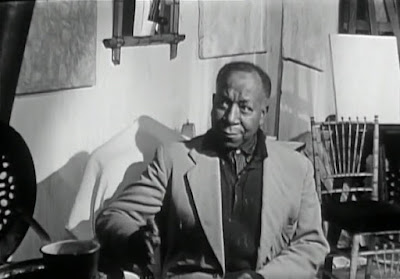
Finally, the Knoxville Museum of Art obtained permission from INA France to present this ~1-minute video of rare footage of Beauford being interviewed in his Clamart studio on the KMA Facebook page.
Click on the image below to view it.
A Catapult for Beauford's Legacy
Celebrations organized by the Delaney Legacy Committee in Knoxville, TN took place at the Beck Cultural Exchange Center and the Knoxville Museum of Art (KMA) on October 19, 2023.
The Knoxville News Sentinel published an extensive article and a robust photo gallery of the events online:
Not just paintings on a wall: Knoxville honors Beauford Delaney’s family and art legacy
Beauford Delaney's work honored at Beck Cultural Center, World's Fair Park
In the section entitled "Preserving the Delaney Legacy in Knoxville," the Knoxville News Sentinel mentions that
- KMA has acquired new Beauford and Joseph Delaney pieces.
- A large gallery space will be devoted to the Delaney brothers within the museum's permanent Higher Ground exhibit beginning Nov. 3, 2023.
- Delaney pieces have been loaned to the Art Institute of Chicago and the Grey Art Gallery at New York University.
KMA Executive Director David Butler granted Les Amis an exclusive interview that expands upon this information and provides clarification about the origins and activities of the Delaney Legacy Committee.
Les Amis: You said you anticipated about 250 people would come. How many people actually attended?
DB: We had just over 250. It was packed.
Les Amis: Is the gallery space devoted to Higher Ground the same space where Through the Unusual Door was hung?
DB: Actually, it’s the same space, reconfigured and renovated. The room in Through the Unusual Door so memorably hung with Clamart abstracts was a direct inspiration for the expansion of Higher Ground. I have sent some pictures of the installation in process just today!


Photos courtesy of KMA
Les Amis: Thanks to recent acquisitions, KMA now holds the largest public collection of Beauford’s work in the world. Is the museum actively planning to acquire additional works – specifically oils – or will you “rest on your laurels” for the time being?
DB: We very much hope to continue to add to our Beauford Delaney holdings as resources allow.
Les Amis: Please share information about loans requests for recent and upcoming national and international shows that KMA has fielded in the past 12-24 months, including those for the Art Institute of Chicago and the Grey Art Gallery at NYU.
DB: The KMA board has just approved the loan of Beauford’s Self-Portrait in a Paris Bath House, 1971 (oil on canvas, 21 5/8 x 18 1/8 inches, 2018 Beauford Delaney Acquisition), to the Art Institute of Chicago for the exhibition Project a Black Planet, which opens in Chicago in late 2024 and will then travel to the Museu d’Art Contemporani de Barcelona and KANAL-Centre Pompidou in Brussels.
The board has also approved the loan of Beauford’s Blue-Light Abstraction, circa 1962 (oil on canvas, 25 3/4 x 21 1/2 inches, 2018 Beauford Delaney Acquisition) to the Grey Art Gallery, New York University for the exhibition Americans in Paris, which opens in New York in early 2024 and will then travel to NYU Abu Dabhi.
Les Amis: Are any Delaney descendants on KMA’s board or acquisition committees?
DB: Derek Spratley, court-appointed attorney for the Beauford Delaney Estate, serves on the KMA board.
Les Amis: The Knoxville News Sentinel describes the Delaney Legacy Committee as being composed of KMA, UT Libraries, Beck, and the Delaney estate. Please talk about the connection between the Delaney Legacy Committee and The Delaney Project: Gathering Light (if any).

DB: The Delaney Legacy Committee grew directly out of the “Gathering Light” initiative that was spearheaded by Sylvia Peters. We actually got a lot done and had some great momentum going when COVID shut everything down. The Delaney Legacy Committee is the successor to that effort, involves many of the same people, and has more administrative support through the UT Libraries.
Les Amis: Is there any active collaboration specifically between UT Libraries and KMA at present?
DB: The KMA worked closely with the UT Libraries and helped with fundraising for the purchase of the Beauford Delaney papers. It was important that that precious resource stay in Knoxville; UT Libraries has the staff and resources to facilitate public and scholarly access to the papers. Steve Smith, UT Libraries dean, serves on the KMA board, as do Renee Kesler (Beck) and Derek Spratley (Beauford Delaney Estate). Having these key people in leadership positions at the KMA has been tremendously helpful.
Les Amis: Doesn’t the committee also include the UT School of Art Galleries and the UT Humanities Center?
DB: Yes. The School of Art Galleries has significant holdings of works by Joseph Delaney (he was a visiting instructor at UT in his last years); the UT Humanities Center organized an international symposium on Beauford Delaney and James Baldwin during Through the Unusual Door in 2020. I believe the proceedings will be published next summer, I am told. (I should note that the Joseph Delaney Estate is also represented on the Delaney Legacy Committee.)
Les Amis: Is the East Tennessee Historical Society no longer part of the Delaney project?
DB: The East Tennessee Historical Society was instrumental in getting the State of Tennessee to install a historical marker at the site of Beauford and Joseph’s childhood home in downtown Knoxville. All the constituent organizations of the Delaney Legacy Committee have significant holdings of works by or offer programming specifically about Beauford and Joseph, so ETHS isn’t formally a member but is certainly a valued resource and strong ally.
Fraternal Light: On Painting While Black - Part 2
Dr. Arlene Keizer is Professor and Former Chairperson of the Department of Humanities and Media Studies at Pratt Institute in NYC. She is a scholar in the fields of literary and cultural studies who writes about the literature, lived experience, theory, and visual art of the African Diaspora.
Dr. Keizer graciously granted Les Amis this interview as a prelude to the release of Fraternal Light: On Painting While Black, her book of poems inspired by Beauford's life and work. In Part 2 of this blog post, she discusses several of Beauford's works that inspired her poetry.

Cover art by Nell Painter
Les Amis: In the panel discussion called “Red Summer Remembered: Cultural Trauma and Commemorative Art Practices” that you organized in 2019, you discussed three Beauford Delaney paintings in relation to the 1919 Knoxville Race Riot that took place during Red Summer. In your Speaking of Marvels interview, you identify two Beauford Delaney paintings that inspired the poem “Terror in the Heart of Freedom.” Please share a list of the paintings that inspired the poems in Fraternal Light and other areas of your work focused on Beauford.
AK: Here is the list:
Untitled (Knoxville Landscape), 1922, watercolor on paper
%201922_private%20collection.jpg)
(1922) Gouache on paper
© Estate of Beauford Delaney
by permission of Derek L. Spratley, Esquire,
Court Appointed Administrator
Knoxville Landscape, 1969, mixed media on paper
Harlem Blue, exhibited February 1949 (This is likely the same painting sold by Swann Auction Galleries as Untitled (Village Street Scene) in 2018.)
Dark Rapture (James Baldwin), 1941, oil on Masonite
Abstraction #12, 1963, oil on canvas
Moving Sunlight, 1965, oil on canvas

(1965) Oil on canvas
Knoxville Museum of Art, 2018 acquisition
© Estate of Beauford Delaney
by permission of Derek L. Spratley, Esquire,
Court Appointed Administrator
Marian Anderson, 1965, oil on canvas
Portrait of a Young Musician, n.d., acrylic on canvas (The Studio Museum in Harlem owns this painting.)
Untitled, circa 1958, oil on canvas (This painting was acquired in 2022 by the Cleveland Museum of Art.)
Jean Genet, 1972, oil on canvas
Portrait of Walter Anderson, n.d., oil on canvas

Beauford Delaney
Portrait of Walter Anderson
Date unknown
Oil, 130 x 97 cm.
Photographer unknown.
Page 50 from Richard A. Long, Mary Schmidt Campbell,
James Baldwin, and Joseph Delaney,
Beauford Delaney: A Retrospective
(New York: Studio Museum in Harlem, 1978).
Published in conjunction with an exhibition of the same title,
organized by and presented at the Studio Museum in Harlem,
April 9—July 2, 1978
© Estate of Beauford Delaney
by permission of Derek L. Spratley, Esquire,
Court Appointed Administrator
Head of a Poet, 1944, pastel on paper
Grèce, 1967, oil on canvas
Self-Portrait in a Paris Bath House, 1971, oil on canvas
Additionally, I've been inspired by many Delaney self-portraits and portraits of James Baldwin, many paintings with variations on the title “Portrait of a Man,” and portraits of Ahmed Bioud.

31 7/8" x 25 1/2" / 81.0 x 64.8 cm
Image courtesy of Michael Rosenfeld Gallery
© Estate of Beauford Delaney
by permission of Derek L. Spratley, Esquire,
Court Appointed Administrator
Les Amis: Have you seen these works in person, or were you working solely from photographic images of them?
AK: I’ve been lucky to see many of Delaney’s works in person because of recent shows, especially those at the Michael Rosenfeld Gallery and the David Zwirner Gallery. Some paintings I’ve seen only in printed or online reproductions. Seeing Untitled (c. 1958), Dark Rapture, and Rehearsal in a David Zwirner Gallery show curated by Hilton Als was crucial to the development of Fraternal Light.
Les Amis: Are images of Beauford’s works included in Fraternal Light?
AK: Instead of including Delaney’s works in Fraternal Light, I opted to feature works inspired by him. I remain fascinated by the number of writers, visual artists, and musicians who drew inspiration from Delaney and his work, adding myself to their company. Nell Painter, the renowned historian-turned-artist, allowed me to use one of her Delaney-inspired drawings on the cover of Fraternal Light, and I’m profoundly grateful.
Les Amis: In the Speaking of Marvels interview, you state that after writing “Mandala,” the final poem of Fraternal Light, you felt that I had traveled as far you could “in the company of Delaney’s extraordinary body of work.” Does this mean that you will no longer pursue scholarly research on him?
AK: I would be delighted to continue contributing to projects related to Delaney, but my original research on his life and work has (mostly) come to an end. It’s possible that I’ll write an essay about the process of researching his life/art and developing a poetry manuscript out of archival work, since I’ve been giving talks about this. When the embargo on the letters between Delaney and Baldwin is lifted, I will return to the Schomburg Center for Research in Black Culture in Harlem to read every one of them!
Les Amis: Is anyone “following in your footsteps” regarding researching Beauford? Do you have or know of any graduate students who would like to extend or build upon your work?
AK: At present, I’m not working with any graduate students who focus on African American art or poetry.
Les Amis: Do the poems in Fraternal Light lend themselves to spoken word performance?
AK: Yes! I’ve read some of the poems while giving talks on my research at Smith College and at the Schomburg, where I was a Scholar-in-Residence during the 2021-22 academic year. I plan to read from Fraternal Light wherever I might be invited to do so.

Image courtesy of Dr. Keizer
Fraternal Light is scheduled for release on August 29, 2023. It is currently available for pre-order HERE.
Read Part 1 of this post HERE.
Fraternal Light: On Painting While Black - Part 1
Dr. Arlene Keizer is Professor and Former Chairperson of the Department of Humanities and Media Studies at Pratt Institute in NYC. She is a scholar in the fields of literary and cultural studies who writes about the literature, lived experience, theory, and visual art of the African Diaspora.
Dr. Keizer graciously granted Les Amis this interview as a prelude to the release of Fraternal Light: On Painting While Black, her book of poems inspired by Beauford's life and work. In Part 1 of this blog post, she discusses how she came to know Beauford's work and why it inspires her.
Cover art by Nell Painter
Les Amis: Congratulations on winning the 2022 Stan and Tom Wick Poetry Prize! What inspired you to apply for this award?
AK: Thanks for your congratulations, and thanks for this question. It’s very difficult to publish a first book of poetry, so most US-based poets who haven’t yet published a full collection enter contests established by independent and university presses and foundations dedicated to keeping poetry alive. I submitted the manuscript of Fraternal Light to at least 50 contests or open-reading periods before it won the Wick First Book Prize.
Les Amis: When and under what circumstances did you first learn about Beauford Delaney?
AK: I’m a literary scholar by training, so I first learned about Delaney when I began studying the life and work of James Baldwin back in the late 1980s. At that time, I thought of Delaney as a footnote in Baldwin’s narrative, so it was an enjoyable surprise when he took center stage in my imagination.
Les Amis: What is it about his life and/or work that inspires you?
AK: I am awed by Delaney’s artistic skill, generosity of spirit, and extraordinary resilience in the face of intense adversity. I feel that his life and work can teach me (and others) how to endure the kinds of difficulties that he not only survived but often transcended. He somehow pushed himself to create original, continually path-breaking art in spite of grinding poverty, anti-Black and homophobic discrimination and violence, and serious psychiatric problems. And his work is radiant with the joy of existence.
Les Amis: In the interview you gave to Speaking of Marvels, you talk about “years of examining his [Beauford’s] art and reading his letters and excerpts from his journals.” How many years have you been studying Beauford?
AK: I began doing serious research on Delaney’s life and work in 2018.
Les Amis: In reference to the above statement, describe the documents you discovered at the Beinecke Library at Yale and the Schomburg Center in NYC.
AK: To summarize a wealth of material: Most of the Delaney documents at the Schomburg and the Beinecke are letters Delaney wrote to friends and professional acquaintances. Both archives also contain some letters that Delaney received from friends and colleagues. I was surprised and delighted to find that the Schomburg also owns some Delaney drawings and paintings.

(1944) Pastel on paper
Schomburg Center for Research in Black Culture
Image courtesy of Arlene Keizer
© Estate of Beauford Delaney
by permission of Derek L. Spratley, Esquire,
Court Appointed Administrator
The Beinecke purchased two drawings of Delaney by the illustrator Don Freeman, a close friend, and one of these drawings appears in Fraternal Light. The Delaney-related materials I found most moving are David Leeming’s interviews with Delaney’s friends and relatives, including Baldwin and Bernard Hassell, which are housed at the Beinecke.
Les Amis: How did these documents inform your poems?
AK: As I wrote Fraternal Light, I was interested in learning as much as possible about Delaney’s character, his interior life, and his approach to art, and his letters to friends were illuminating. It’s clear from what’s in the archives that Delaney derived emotional sustenance from writing letters and reading (and re-reading) the letters he received from friends and family.

Image courtesy of Dr. Keizer
Fraternal Light is scheduled for release on August 29, 2023. It is currently available for pre-order HERE.
Come back next week to learn about specific Beauford Delaney works that inspired Dr. Keizer's poetry.
Maestro Beauford Delaney - A Tribute by Joel Crooms
Joel M. Crooms commented on a recent Entrée to Black Paris Facebook post about the works auctioned during Christie's "Istanbul Calling" sale as follows:
Beauford was my inspiration as a young artist studying in NYC and New Jersey during the seventies and today! The brilliance of his colors is so powerful. At that time, minimalist and color field artists were big in the NYC area, but Mr Delaney’s colors far outshine those works ... in the process greatly affecting me, exciting me! The yellows!

Beauford Delaney portraits auctioned by Christie's London
This led to an email exchange, which culminated in the interview below.
Les Amis: How and when did you first learn about Beauford's work?
JC: I first learned of Beauford's work at the Studio Museum in Harlem. It was a retrospective of his work in nineteen seventy-eight (1978).

Beauford Delaney: A Retrospective catalog cover
Les Amis: What makes his colors "far outshine" the works by the minimalist and color field artists of the 70s?
JC: Minimalism was the rave during my time as a young artist in Manhattan of the seventies. The professed cold intellectualist nonspiritual objective approach yielded work I could appreciate on that basis. So, I dove right in. But I felt a need to find a model akin to me and my creative life. I would haunt the streets of Harlem, devouring all black culture there - visual art, theater, dance, politics, history, bookstores, and religious institutions.
I walked through the Studio Museum’s doors, and I saw art by Black Artists! The Delaney retrospective was down but there were still pieces hanging. I walked upstairs and on this floor I saw Beauford’s work. Portraits first, street scenes next, and then, the abstractions. Those Yellows, there were greens and some reds.
For me though, it was and still is those yellows. Bright, brighter than bright! Emotive spiritual heat. So much light. Executed with skill, technique and passion. Not just some mechanical exercise, Beauford lit the way!
Les Amis: How prevalent was knowledge of Beauford's work among your fellow students during the time you were studying art?
JC: Beauford was a non-entity to the students at the institutions I attended.
Les Amis: How prevalent was knowledge of his work among your professors and mentors during the time you were studying art?
JC: If professors knew of Mr. Delaney they did not share that knowledge or were too culturally chauvinistic to acknowledge the work. I did have an art associate who introduced me to Alice Neel, a woman portrait artist who referred me to Beauford s work and encouraged me to continue my artwork.
Les Amis: How prevalent is knowledge of his work amongst your artist peers today?
JC: Many of my current peers know of Beauford Delaney's work thanks to efforts of the Studio Museum, the Smithsonian, and organizations like Les Amis Beauford Delaney.
Les Amis: (How) does Beauford's artistic style influence yours?
JC: It’s the light, along with Rembrandt’s chiaroscuro. The glazing techniques of illustrators like Maxfield Parish. Beauford's striking results heavily influence my analog, digital, and projection work.
Les Amis: Do you have a preference for his figurative versus his abstract works or for works he created during a specific period of his career (New York versus Paris)?
JC: Initially I preferred Beauford’s abstractions. However, as I look, I see the abstract aspects in his figurative and landscape work (Street Scenes).
Les Amis: You mentioned Beauford's yellows in your original comments. Please tell us why you find them so exciting.
JC: Beauford's yellows burn, illuminate, vibrate the space they occupy. In my current digital work experiments I attempt to master that.
Les Amis: Your biography states that all your work is political. Do you "see politics" in Beauford's work? If so, in what way(s)?
JC: Beauford’s very existence at the time he practiced his art and ventured to explore the practice of art, let alone abstraction, as the world around him denied his very humanity - let alone his and others' creative capabilities - is a powerful political statement.
Even though Beauford's expat situation did not end well, he took a popular path to find a better life free of constraints.
Les Amis: Your biography states that your work speaks to cosmopolitan / universal issues. Do you believe Beauford's work does this as well? If so, in what way(s)?
JC: Of course, Beauford created works of art that speak to the human condition ... the figure, the landscape and the psyche.
Les Amis: What do you know about Beauford's life story? Do you find any similarities between his story and yours?
JC: At first, I knew little if anything at all about Beauford’s life. As I learned about it, my first thoughts were that it was tragic. But as I've lived and seen the lives of many of my peers come to similar conclusions - I realize that there are triumphant aspects to his and their journey. I appreciate the lessons learned from them that helped me find positive alternatives.
Les Amis: Any final thoughts you'd like to share?
JC: If it weren’t for Beauford Delaney, the world would be a poorer place. He brought his own light. I for one am indebted and thankful for the lessons and possibilities he gave ... and most of all, the JOY.
Thank you, Maestro Beauford Delaney!

Joel M. Crooms
Image courtesy of Joel M. Crooms
Beauford in The Art of the Affair
A couple of weeks ago, I reported that Forsyth Harmon created a beautiful watercolor portrait of Beauford for a book called The Art of the Affair: An Illustrated History of Love, Sex, and Artistic Influence by Catherine Lacey.

(2017) Watercolor on paper
Forsyth Harmon
I reached out to Harmon to learn more about the book and her portrait of Beauford, and she graciously granted Les Amis the interview below.
Les Amis: Amazon lists you as an author on The Art of the Affair alongside Catherine Lacey. How much of the writing did you contribute to this book in addition to your wonderful illustrations?
FH: The Art of the Affair grew from a piece Catherine Lacey contributed to The Believer magazine. The concept was Catherine's, however she and I worked together to co-curate the relationship chains between turn of the century writers, artists, musicians, and more. Catherine did the writing, and I did the illustrations. The process was very collaborative, and a lot of fun. I learned so much.
Les Amis: What story does the book tell about Beauford Delaney?
FH: Beauford is featured in Chapter Five of The Art of the Affair--a section entitled "The Way Your Blood Beats." He appears as an important artist of his time, and one of only the two persons Georgia O'Keefe ever drew. The book also calls attention to the ways in which he inspired James Baldwin, who called him "the first living proof, for me, that a black man could be an artist," and "a cross between Brer Rabbit and St. Francis of Assisi." Beauford helped James find a way to pay for his father's funeral when he was still a teenager. They later traveled together in Europe.

Image courtesy of Forsyth Harmon
Les Amis: Did you decide to include him in the book or did Catherine Lacey?
FH: I can't recall which of us pulled in Beauford! I do remember curating this chapter in Catherine's Fort Greene apartment over dinner. It was a wonderful night!
Les Amis: What inspired you and / or Lacey to include him in the book?
FH: As a portrait artist myself, I have always been a fan of Beauford's work. It wasn't until later in life that I realized an organization founded by my family, The Harmon Foundation, had frequently exhibited his early pastel portraits during the1930s and 1940s. The Foundation supported a variety of causes, but is best known for having served as a patron of African-American art during the Harlem Renaissance, helping African-American artists gain the recognition they deserved.
Les Amis: What inspired your watercolor of Beauford? Was it a photo portrait, one of his self-portraits ... ?
FH: I generally use multiple sources to inspire my portraits. In this case, I used a combination of photographs and Beauford's self-portraits, but was probably most inspired by a photograph taken by Rue Guilleminot in France in 1973. I did my best to capture his expression in this photograph ... knowing, bemused, and perhaps a bit exhausted.

Rue Guilleminot
France 1973
© Errol Sawyer
Les Amis: You are donating the proceeds from the sale of your Beauford Delaney portrait to support the library at the A. J. William-Myers African Roots Center. What is your relationship with the center?
FH: I am local to the A. J. William-Myers African Roots Center, which is headquartered in Kingston, New York. I've been inspired by the work the organization does around literacy and the advancement of historical knowledge, cultural enrichment, civic engagement and social justice. Over the past two years, The Harmon Foundation has included the center in its annual funding disbursement at my direction.
Les Amis: Has anyone purchased the portrait of Beauford, allowing you to donate to the Center?
FH: I am making the donation.
Les Amis: How well do you know Beauford's work?
FH: I'm not an expert! Although now I'm inspired to learn more.
Les Amis: What, if anything, about it inspires you?
FH: I find so much movement and depth of emotion in his portraits especially. The subject paint application embodies a lot of energy, and the background washes feel almost auric, creating a kind of halo. I feel they offer true access into the subject's internal state.
Les Amis: Are there any final thoughts you'd like to share?
FH: Just gratitude for the opportunity to support the A. J. William-Myers African Roots Center by celebrating Beauford Delaney. Thank you!
One Good Beauford Story Inspired Another
On July 2, 2022, I published a post about a splendid article that Scalawag Magazine published about Beauford.
Today, I'm sharing the backstory regarding this article.
Elaine Lee is one of America’s leading experts on travel. A San Francisco/Bay Area-based journalist, she has visited 65 countries and completed two solo trips around the world. She is the editor of “Go Girl” The Black Woman's Book of Travel and Adventure," and her website, ugogurl.com, is a leading portal for information on black travel, black travel writing and travel media information. She and I have known each other for many years.
I subscribe to the UGoGirl newsletter, and on Wednesday, August 31, I was thrilled to receive the message below (reprinted with permission). It is entitled "My Story about Delaney Didn't Make It to Press, but at Least I Inspired Another":
Greetings!
I hope this email finds you well.
When I visited Paris in 2019, I attended a play called Amazing Grace is Yellow – the Life of Beauford Delaney, Painter, written by Silver Wainhouse. Afterward, I spoke to Monique about the play as well as the documentary that she and Zach (Miller) were working on. I offered to write an article to help publicize their project and the growing resurgence of interest in Delaney's work.
I designed a pitch and sent it everywhere I could think of. I got nowhere - until I contacted Scalawag magazine, whose editor asked to see the story. Though she did not like it, she liked the idea and assigned the project to another writer, Tyra Seals, who did a fabulous job.

Even though my story about Delaney didn't make it to press, at least I inspired a magazine editor and another writer to carry out the project. There's no such thing as a small victory!I am grateful to Elaine Lee for her grace and humility in sharing this story with her audience and for allowing me to share it with you!
Below is the link to the story:
Out of the Shadows: The Queer Life of Artist Beauford Delaney

© Entrée to Black Paris