

Historical Marker Honors Beauford and Joseph Delaney in Knoxville
Ever since the "Knoxville Eleven" came to Paris for the Resonance of Form and Vibration of Color exhibition in 2016 and saw the plaques that honor Beauford at two locations in Montparnasse, they have been on a mission to inspire the City of Knoxville to honor its native son in a similar fashion.
They have succeeded!

"Knoxville Eleven" on the Beauford Delaney
Commemorative Walking Tour in Paris
(2016) © Discover Paris!
In 2017, the Calvin M. McClung Historical Collection at the East Tennessee Historical Center submitted a proposal to the State of Tennessee requesting the marker. The request was approved during the fall and work began on the marker's construction. Once completed, it was installed on Summit Hill Drive close to the location of the Delaney homestead during the month of August 2018.

On Thursday, September 13, 2018, the 114th anniversary of Joseph Delaney's birth, the double-sided marker was unveiled.
The text for Beauford's side of the marker reads as follows:
BEAUFORD DELANEY
1901 – 1979
Beauford Delaney is considered one of the
greatest abstract painters of the 20th century.
Battling poverty, racial prejudice and mental
illness, he achieved acclaim for his expressive
portraits, cityscapes and abstractions.
An African American artist, Beauford was one
of 10 children born to the Rev. John Samuel
and Delia Elizabeth Johnson Delaney at
815 East Vine Avenue near this site. He spent
most of his life in New York City and Paris, France,
forming lifelong friendships with writers James Baldwin,
Henry Miller, and other luminaries. Beauford Delaney
is buried in Cimetière Parisien de Thiais.

Beauford Delaney marker
Image courtesy of the Knoxville Museum of Art
The text for Joseph's side reads as follows:
JOSEPH DELANEY
1904 – 1991
Born near this site, Joseph Delaney, an African American
artist like his older brother Beauford, studied under
local artist Lloyd Branson. In 1930, Joseph began his
studies in New York at the Art Students League. He spent
the next 56 years painting portraits and scenes of urban
life in lower Manhattan. In 1986, he returned to Knoxville
and served as artist-in-residence at University of Tennessee
until his death in 1991. His works are in the collection of
the Smithsonian American Art Museum and other major museums.
Joseph Delaney is buried in Knoxville's Greenwood Cemetery.

Joseph Delaney marker
Image courtesy of the Knoxville Museum of Art
Speakers at the dedication ceremony included Knoxville Mayor Madeline Rogero, Knoxville Museum of Art trustee Sylvia Peters of the Gathering Light Delaney Project, and Reverend Renee Kesler of the Beck Cultural Center.

Unveiling ceremony for Beauford and Joseph Delaney marker
Image courtesy of the Knoxville Museum of Art
The Knoxville Law Enforcement Credit Union at 501 E Summit Hill Dr. offered light refreshments in the lobby after the dedication.
They have succeeded!

Commemorative Walking Tour in Paris
(2016) © Discover Paris!
In 2017, the Calvin M. McClung Historical Collection at the East Tennessee Historical Center submitted a proposal to the State of Tennessee requesting the marker. The request was approved during the fall and work began on the marker's construction. Once completed, it was installed on Summit Hill Drive close to the location of the Delaney homestead during the month of August 2018.

On Thursday, September 13, 2018, the 114th anniversary of Joseph Delaney's birth, the double-sided marker was unveiled.
The text for Beauford's side of the marker reads as follows:
1901 – 1979
Beauford Delaney is considered one of the
greatest abstract painters of the 20th century.
Battling poverty, racial prejudice and mental
illness, he achieved acclaim for his expressive
portraits, cityscapes and abstractions.
An African American artist, Beauford was one
of 10 children born to the Rev. John Samuel
and Delia Elizabeth Johnson Delaney at
815 East Vine Avenue near this site. He spent
most of his life in New York City and Paris, France,
forming lifelong friendships with writers James Baldwin,
Henry Miller, and other luminaries. Beauford Delaney
is buried in Cimetière Parisien de Thiais.

Image courtesy of the Knoxville Museum of Art
The text for Joseph's side reads as follows:
JOSEPH DELANEY
1904 – 1991
Born near this site, Joseph Delaney, an African American
artist like his older brother Beauford, studied under
local artist Lloyd Branson. In 1930, Joseph began his
studies in New York at the Art Students League. He spent
the next 56 years painting portraits and scenes of urban
life in lower Manhattan. In 1986, he returned to Knoxville
and served as artist-in-residence at University of Tennessee
until his death in 1991. His works are in the collection of
the Smithsonian American Art Museum and other major museums.
Joseph Delaney is buried in Knoxville's Greenwood Cemetery.

Image courtesy of the Knoxville Museum of Art
Speakers at the dedication ceremony included Knoxville Mayor Madeline Rogero, Knoxville Museum of Art trustee Sylvia Peters of the Gathering Light Delaney Project, and Reverend Renee Kesler of the Beck Cultural Center.

Image courtesy of the Knoxville Museum of Art
The Knoxville Law Enforcement Credit Union at 501 E Summit Hill Dr. offered light refreshments in the lobby after the dedication.
The Beautiful Haunt of Beauford Delaney
by Silver Wainhouse
Silver Wainhouse is a woman of many talents and accomplishments. She is the archivist of the Wainhouse Collection at Syracuse University; the director at Womanistics; and an actress, writer, speaker, astrologist, and coach. Wainhouse fell in love with Beauford's story and is now writing a play about his life. As part of her preparation for this project, she and I visited Beauford's gravesite at Thiais Cemetery. She has graciously submitted the article below for publication on the Les Amis blog.
Beauford Delaney’s body, about to be exhumed from an unmarked grave to be moved to a collective grave, became indignant. So, it did what all great spirits do, it attached itself to someone to keep it alive. And that person was Dr. Monique Y. Wells. Monique, who was moved to satisfy a growing curiosity about African-American gravesites in Paris, was rumbled by Beauford’s baritone voice.

Beauford's unmarked grave - 2009
© Discover Paris!
Beauford, after all, was a notable painter whose list of friends and acquaintances included the likes of James Baldwin, Jackson Pollock, W. C. Handy, Ethel Waters, Edna St. Vincent Millay, Richard Wright and Duke Ellington. He painted Marian Anderson as she sang. Of course Monique Y. Wells would be infected by his spirit.
During a lunch I caught the Beauford virus as Monique told me about Beauford’s life and of her project to reintroduce Beauford Delaney to the world. “You must read Amazing Grace: A Life of Beauford Delaney by David Leeming,” she told me. “It is my Beauford bible.”
David Leeming does a remarkable job of immersing you in Beauford’s world. I will not see the colors of yellow and red as I did before. They have become Beauford’s colors when I see them, separate and merging. After reading Leeming’s book, I wanted to see his paintings. I wanted to visit his grave.
Monique and I coordinated a time for me to arrive, keeping in mind weather and the fact that I would have to take the northern bound to Paris train from Nîmes.
I felt as if I were on a holy pilgrimage and felt mounting tears. We stopped to buy yellow flowers to honor him. He so loved yellow. There was a sadness because we knew that he attempted to keep demons at bay his entire life, a contest he lost.

Silver Wainhouse at Beauford's Gravesite
© Discover Paris!
Thiais is a sprawling cemetery of 225 acres located 6.5 miles south of Paris. The sections range in appearance from desolate to noble. Beauford is in Section 86; now with a marked grave and hopefully with flowers from others who have discovered his beauty.

Thiais Cemetery - Division 86
© Discover Paris!
Jake Cigainero was piqued and a story about Beauford Delaney graced the New York Times. Just like in the ole days. It’s because Beauford Delaney has a way of getting into you. He really does.
Silver Wainhouse is a woman of many talents and accomplishments. She is the archivist of the Wainhouse Collection at Syracuse University; the director at Womanistics; and an actress, writer, speaker, astrologist, and coach. Wainhouse fell in love with Beauford's story and is now writing a play about his life. As part of her preparation for this project, she and I visited Beauford's gravesite at Thiais Cemetery. She has graciously submitted the article below for publication on the Les Amis blog.
Beauford Delaney’s body, about to be exhumed from an unmarked grave to be moved to a collective grave, became indignant. So, it did what all great spirits do, it attached itself to someone to keep it alive. And that person was Dr. Monique Y. Wells. Monique, who was moved to satisfy a growing curiosity about African-American gravesites in Paris, was rumbled by Beauford’s baritone voice.

© Discover Paris!
Beauford, after all, was a notable painter whose list of friends and acquaintances included the likes of James Baldwin, Jackson Pollock, W. C. Handy, Ethel Waters, Edna St. Vincent Millay, Richard Wright and Duke Ellington. He painted Marian Anderson as she sang. Of course Monique Y. Wells would be infected by his spirit.
During a lunch I caught the Beauford virus as Monique told me about Beauford’s life and of her project to reintroduce Beauford Delaney to the world. “You must read Amazing Grace: A Life of Beauford Delaney by David Leeming,” she told me. “It is my Beauford bible.”
David Leeming does a remarkable job of immersing you in Beauford’s world. I will not see the colors of yellow and red as I did before. They have become Beauford’s colors when I see them, separate and merging. After reading Leeming’s book, I wanted to see his paintings. I wanted to visit his grave.
Monique and I coordinated a time for me to arrive, keeping in mind weather and the fact that I would have to take the northern bound to Paris train from Nîmes.
I felt as if I were on a holy pilgrimage and felt mounting tears. We stopped to buy yellow flowers to honor him. He so loved yellow. There was a sadness because we knew that he attempted to keep demons at bay his entire life, a contest he lost.

© Discover Paris!
Thiais is a sprawling cemetery of 225 acres located 6.5 miles south of Paris. The sections range in appearance from desolate to noble. Beauford is in Section 86; now with a marked grave and hopefully with flowers from others who have discovered his beauty.

© Discover Paris!
Jake Cigainero was piqued and a story about Beauford Delaney graced the New York Times. Just like in the ole days. It’s because Beauford Delaney has a way of getting into you. He really does.
Amaranth Ehrenhalt Remembers Beauford
I do not know if i "want to paint" or do not "want to paint". It is just something that I do - like breathing and moving, walking and talking. I can not imagine my life without it.
-- Amaranth Ehrenhalt
This quote can be found on the Web site of Amaranth Ehrenhalt - painter, sculptor, photographer, and tapistry maker. Ehrenhalt is a seasoned, yet contemporary artist whose works were recently on display in the Works in Progress exhibition at Lawrence Art Gallery. Her description of herself could just as easily be ascribed to Beauford.
"Amara" graciously responded to my request for an interview. She told me that she met Beauford some time around the late 50's - early 60's at a cafe, especially known by artists and writers, possibly Le Select. She was living and working in Paris at the time and did not know anything about him prior to that meeting. She and Beauford participated in exhibitions from time to time and had a friend in common - painter and writer Arlene Hiquily.

© Discover Paris!
Amara's most vivid memory of Beauford is of seeing him at the Select, when he came over to the table where she was sitting with others and helped himself to any of the drinks that were unfinished. She said "this was tolerated with amusement because he was such a fine and serious artist."
Jean-Loup Msika's Friendship with Beauford - Part 2
Painter/sculptor/architect Jean-Loup Msika met Beauford for the first time at La Coupole. It was during the late 1960s, when Msika was working as an assistant for Hungarian-born sculptor/painter Anton Prinner (née Anna Prinner).
After a day's work, Msika and Prinner would make their way from Prinner's studio on rue Pernety to the famous Montparnasse café to have a drink. Prinner had a regular table at the entrance and ate a hamburger every evening while "holding court" with several artists. Beauford would sometimes attend these gatherings.

Msika remembers La Coupole as being a place where you were expected to dine and that it was fairly costly. For that reason, he would often go to the Select for a drink. He said he frequently saw Beauford at the Select.
Having often heard people say that Beauford's paintings were marvelous, Msika and another painter friend, Loulou Taÿeb, were thrilled when Beauford invited them to visit his studio on rue Vercingétorix. They happily accepted his invitation.
Msika remembers that Beauford's studio was located up several flights of stairs (he believes there were four of them) and that everything inside was covered with white cloth. He said Beauford painted in the main room of the studio and described the studio as being full of light:
He and Taÿeb were amazed by Beauford's work, particularly the portrait of Marian Anderson and other portraits of his friends.
Subsequently, Msika and Beauford would cross paths on the streets of Montparnasse in the evenings. He said Beauford was often on his way to meet friends and he felt that Beauford was lonely at his studio.

Beauford at his rue Vercingétorix studio
Screenshot from Henry Miller vu par ses amis
At this time, Msika, his wife, Albine (who is also a sculptor and painter), and their daughter lived on rue de la Bidassoa in the 20th arrondissement. Beauford visited them there and they would read poetry together and cook pasta "al' dente." Msika didn't believe that Beauford ate very well at home - he remembers seeing Beauford consuming only bananas, apples, chocolate, bread, and milk at his studio. He said Beauford was always grateful when he was invited out to dinner.
During one visit to the rue Vercingétorix studio, Msika remembers seeing a stack of 78 rpm records made by Henry Miller. Miller had offered them to Beauford - Msika described them as being "marvelous recordings of Miller's voice, reading his own writings, poems, stories, etc..."
Beauford told Msika that he had never heard the recordings before, so Msika purchased a phonograph for Beauford. He and Beauford listened to a few of the recordings together and Beauford was pleased. On his next visit to the studio, Msika observed that the phonograph had "disappeared under white linen."
In 1971, Beauford invited Msika to purchase a 25 F (25 figure) canvas so he could paint Msika's portrait. Msika purchased the canvas at an art supply store near or on rue Vercingétorix. He sat for the portrait twice at Beauford's studio and then let Beauford work on it for a while.
When it was completed, Msika found it to be a fine work and asked whether he could purchase it. Beauford agreed. Msika owns the portrait to this day.

Jean-Loup Msika and his portrait
Portrait: © Estate of Beauford Delaney
by permission of Derek L. Spratley, Esquire,
Court Appointed Administrator
Image: © Discover Paris!

Portrait of Jean-Loup Msika (detail)
(1971) Oil on canvas
© Estate of Beauford Delaney
by permission of Derek L. Spratley, Esquire,
Court Appointed Administrator
Image courtesy of Jean-Loup Msika
Msika explained that Beauford was a brilliant colorist and said that only a master could succeed in using a combination of acid greens, blues, and purples in a single work. He compared Beauford's genius to that of Matisse and Bonnard, and mentioned that Beauford loved the work of Bonnard.
Loulou Taÿeb was just as impressed with Beauford's work as Msika. He painted a portrait of Beauford for which he used a textured yellow background that Msika described as "Beauford's yellow." Msika says Taÿeb has depicted Beauford in front of one of Beauford's own paintings.
This portrait was part of an exhibition called Les Lumineux - the people who radiate light. It is one of two works that Msika purchased.

Loulou Taÿeb
Portrait of Beauford Delaney
(Undated) Oil on canvas
Portrait: © Loulou Taÿeb
Image: © Discover Paris!
Beauford gave Msika confidence as an artist, making him understand that there was more to art than technique. He told Msika that "art is difficult" but that if it comes from the heart, you can succeed. (See Jean-Loup Msika at work at a 1985 art installation here.)
I asked Msika about his best memories of Beauford. He replied that Beauford had a great sense of humor and would turn everything into a good laugh. He said Beauford had a "metaphysical laugh."
To sum it all up, he said that his favorite memories of Beauford are:

Jean-Loup Msika (second from left) and Loulou Taÿeb
(third from left) at
Resonance of Form and Vibration of Color exhibition
© Discover Paris!
After a day's work, Msika and Prinner would make their way from Prinner's studio on rue Pernety to the famous Montparnasse café to have a drink. Prinner had a regular table at the entrance and ate a hamburger every evening while "holding court" with several artists. Beauford would sometimes attend these gatherings.

Msika remembers La Coupole as being a place where you were expected to dine and that it was fairly costly. For that reason, he would often go to the Select for a drink. He said he frequently saw Beauford at the Select.
Having often heard people say that Beauford's paintings were marvelous, Msika and another painter friend, Loulou Taÿeb, were thrilled when Beauford invited them to visit his studio on rue Vercingétorix. They happily accepted his invitation.
Msika remembers that Beauford's studio was located up several flights of stairs (he believes there were four of them) and that everything inside was covered with white cloth. He said Beauford painted in the main room of the studio and described the studio as being full of light:
Beauford was about LIGHT. It was a spiritual thing about light being a symbol of purity and elevation - spiritual elevation.
He and Taÿeb were amazed by Beauford's work, particularly the portrait of Marian Anderson and other portraits of his friends.
Subsequently, Msika and Beauford would cross paths on the streets of Montparnasse in the evenings. He said Beauford was often on his way to meet friends and he felt that Beauford was lonely at his studio.

Screenshot from Henry Miller vu par ses amis
At this time, Msika, his wife, Albine (who is also a sculptor and painter), and their daughter lived on rue de la Bidassoa in the 20th arrondissement. Beauford visited them there and they would read poetry together and cook pasta "al' dente." Msika didn't believe that Beauford ate very well at home - he remembers seeing Beauford consuming only bananas, apples, chocolate, bread, and milk at his studio. He said Beauford was always grateful when he was invited out to dinner.
During one visit to the rue Vercingétorix studio, Msika remembers seeing a stack of 78 rpm records made by Henry Miller. Miller had offered them to Beauford - Msika described them as being "marvelous recordings of Miller's voice, reading his own writings, poems, stories, etc..."
Beauford told Msika that he had never heard the recordings before, so Msika purchased a phonograph for Beauford. He and Beauford listened to a few of the recordings together and Beauford was pleased. On his next visit to the studio, Msika observed that the phonograph had "disappeared under white linen."
In 1971, Beauford invited Msika to purchase a 25 F (25 figure) canvas so he could paint Msika's portrait. Msika purchased the canvas at an art supply store near or on rue Vercingétorix. He sat for the portrait twice at Beauford's studio and then let Beauford work on it for a while.
When it was completed, Msika found it to be a fine work and asked whether he could purchase it. Beauford agreed. Msika owns the portrait to this day.

Portrait: © Estate of Beauford Delaney
by permission of Derek L. Spratley, Esquire,
Court Appointed Administrator
Image: © Discover Paris!
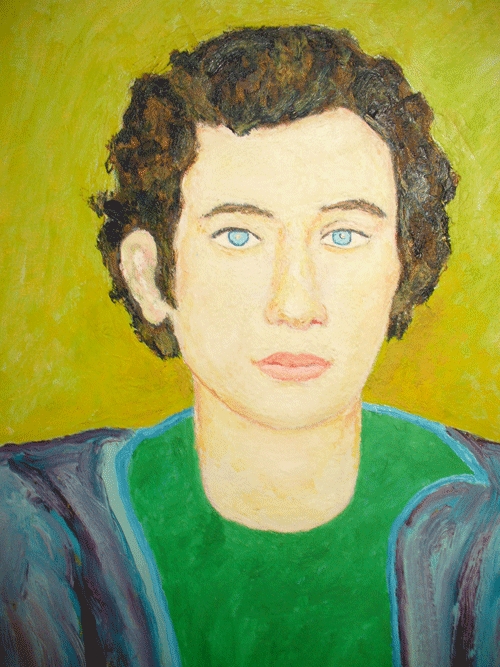
(1971) Oil on canvas
© Estate of Beauford Delaney
by permission of Derek L. Spratley, Esquire,
Court Appointed Administrator
Msika explained that Beauford was a brilliant colorist and said that only a master could succeed in using a combination of acid greens, blues, and purples in a single work. He compared Beauford's genius to that of Matisse and Bonnard, and mentioned that Beauford loved the work of Bonnard.
Loulou Taÿeb was just as impressed with Beauford's work as Msika. He painted a portrait of Beauford for which he used a textured yellow background that Msika described as "Beauford's yellow." Msika says Taÿeb has depicted Beauford in front of one of Beauford's own paintings.
This portrait was part of an exhibition called Les Lumineux - the people who radiate light. It is one of two works that Msika purchased.

Portrait of Beauford Delaney
Portrait: © Loulou Taÿeb
Image: © Discover Paris!
Beauford gave Msika confidence as an artist, making him understand that there was more to art than technique. He told Msika that "art is difficult" but that if it comes from the heart, you can succeed. (See Jean-Loup Msika at work at a 1985 art installation here.)
I asked Msika about his best memories of Beauford. He replied that Beauford had a great sense of humor and would turn everything into a good laugh. He said Beauford had a "metaphysical laugh."
To sum it all up, he said that his favorite memories of Beauford are:
- his studio
- his smile
- his marvelous paintings.

(third from left) at
Resonance of Form and Vibration of Color exhibition
© Discover Paris!
Adeline Goldminc-Tronzo Remembers Beauford
Adeline Goldminc-Tronzo is a French artist who moved to New York City in the mid 1970s. She studied at the Art Students League with American Artists: Marshall Glasier, Joseph Hirsch, Robert Beverly Hale, and Norman Lewis. She holds a BFA in Art and Philosophy.
Adeline wrote to me after having discovered the Les Amis blog. She wanted to share a photo of Beauford that was taken before his death at Sainte-Anne's Hospital in Paris. She also shared the story of how she came to know Beauford and Beauford's brother, Joseph, and graciously granted her permission for me to publish them here.

Beauford at Sainte-Anne's Hospital - 1978
Image courtesy of Adeline Goldminc-Tronzo
The year was 1968. As a kid - and I mean a kid (I was 15 years old) - I would escape my family and go to Montparnasse to hang out with artists.
One of these artists was Anton Prinner (a Hungarian artist) and sometimes Beauford would come to the Coupole and hang out at Prinner's table. And I had the privilege to be there a few times. Beauford did not speak French and I was a kid and hardly spoke English.
He was a quiet man - a soulful, dreamy presence.
And the striking memory I have is of Beauford's most beautiful hands. They really were beautiful!
Years later, as a very young adult, I moved to NY. While there, I befriended Jo (Joseph) Delaney. A beautiful soul as well.
Jo mentioned a brother once or twice but never by name and where he lived ...
Then one day, he mentioned Beauford and it was amazing! How I could meet these two brothers in two different countries, eight years apart?
Serendipity.
Jo was very worried about Beauford. He told me he was at Sainte-Anne Hospital in Paris and that the French government had taken all his work and Jo could not go there because JO was broke and didn't understand the legalese, the language etc ....
And apparently James Baldwin had moved to the south and could no longer be of much help for Beauford at that point.
It was a heartbreaking story.
I was to visit my parents in Paris and there Beauford was - having an exhibit at the Studio Museum in Harlem. Jo asked me to go to the hospital and to try and help Beauford.
So I went to Paris and visited with Beauford at Sainte Anne's, giving him the catalog for the exhibition at the Studio Museum. But Beauford was in another place. I mean he was there but he could no longer communicate. He kept looking at his hands...those beautiful hands!
I returned to visit him a couple more times...brought him socks and pajamas and talked, talked about his brother, about his exhibit, about painting...
I do not know if Beauford understood. He never talked. He was in another world.
I returned to NY and saw Jo until I moved to California. When I returned from California a couple of years later, Jo was no longer in his Union Square place.
And I never saw Jo again.
Adeline wrote to me after having discovered the Les Amis blog. She wanted to share a photo of Beauford that was taken before his death at Sainte-Anne's Hospital in Paris. She also shared the story of how she came to know Beauford and Beauford's brother, Joseph, and graciously granted her permission for me to publish them here.

Image courtesy of Adeline Goldminc-Tronzo
The year was 1968. As a kid - and I mean a kid (I was 15 years old) - I would escape my family and go to Montparnasse to hang out with artists.
One of these artists was Anton Prinner (a Hungarian artist) and sometimes Beauford would come to the Coupole and hang out at Prinner's table. And I had the privilege to be there a few times. Beauford did not speak French and I was a kid and hardly spoke English.
He was a quiet man - a soulful, dreamy presence.
And the striking memory I have is of Beauford's most beautiful hands. They really were beautiful!
Years later, as a very young adult, I moved to NY. While there, I befriended Jo (Joseph) Delaney. A beautiful soul as well.
Jo mentioned a brother once or twice but never by name and where he lived ...
Then one day, he mentioned Beauford and it was amazing! How I could meet these two brothers in two different countries, eight years apart?
Serendipity.
Jo was very worried about Beauford. He told me he was at Sainte-Anne Hospital in Paris and that the French government had taken all his work and Jo could not go there because JO was broke and didn't understand the legalese, the language etc ....
And apparently James Baldwin had moved to the south and could no longer be of much help for Beauford at that point.
It was a heartbreaking story.
I was to visit my parents in Paris and there Beauford was - having an exhibit at the Studio Museum in Harlem. Jo asked me to go to the hospital and to try and help Beauford.
So I went to Paris and visited with Beauford at Sainte Anne's, giving him the catalog for the exhibition at the Studio Museum. But Beauford was in another place. I mean he was there but he could no longer communicate. He kept looking at his hands...those beautiful hands!
I returned to visit him a couple more times...brought him socks and pajamas and talked, talked about his brother, about his exhibit, about painting...
I do not know if Beauford understood. He never talked. He was in another world.
I returned to NY and saw Jo until I moved to California. When I returned from California a couple of years later, Jo was no longer in his Union Square place.
And I never saw Jo again.
De Hirsh Margules' Portrait of Beauford

De Hirsh Margules
(ca. early 1950s) Oil on canvas
Image courtesy of Adrian Lesher
Reprinted with the permission of Adam Tansky
De Hirsh Margules (1899–1965) was a Romanian-born American "abstract realist" painter who crossed paths with many major American artistic and intellectual figures of the first half of the 20th century. Elaine de Kooning said that he was "[w]idely recognized as one of the most gifted and erudite watercolorists in the country"... He was also a well-known participant in the bohemian culture of New York City's Greenwich Village, where he was widely known as the "Baron" of Greenwich Village. --Wikipedia
Adrian Lesher is the owner of the painting depicted above. He has done a good bit of research on Margules and is the primary contributor to the Wikipedia page on Margules. He contacted me to ask whether I could verify that Beauford was the man in the portrait and provide him with information about any contact that Margules may have had with him. I was quickly able to confirm that the portrait is of Beauford.
I was not able to find any direct evidence of a relationship between Margules and Beauford, but I have subsequently learned that they traveled in the same circles in New York and had many friends in common. Willem de Kooning, Elaine de Kooning, John Marin, Alfred Stieglitz, Georgia O'Keeffe, and Henry Miller were among them.
Margules left New York in 1927 to spend two years in Paris. He returned in 1929, the same year that Beauford arrived.
Nell Painter on Beauford
Nell Painter (the artist formerly known as the historian Nell Irvin Painter) lives and works in Newark, New Jersey. She uses found images and digital manipulation to reconfigure the past and to revision herself through self-portraits. She first focused on Beauford’s work when she was writing her book entitled Creating Black Americans: African American History and Its Meanings, 1619 to the Present (Oxford University Press, 2006). All of the images in this book are of black fine art, and she comments on Beauford’s Can Fire in the Park (1946) and his portrait of Marian Anderson in it.
Nell is particularly enamored of the self-portrait that Beauford created when he was at Yaddo in 1950.

Self-portrait, Yaddo
(1950) Pastel, watercolor, and charcoal on paper
© Estate of Beauford Delaney
by permission of Derek L. Spratley, Esquire,
Court Appointed Administrator
She discovered this self-portrait a few years before she became an artist in residence at Yaddo (October 2012). While there, she corrected an oversight that left Beauford off the list of visual artist "guests" kept by the program. She said that Yaddo was proud of Delaney and that they mounted a show of his work. But he still had been left off the list of guests.
She has created numerous collages based on this work, several of which she has allowed me to reproduce here.

Yaddo Diptych, Framed
Nell Painter
(2014) Digital collage on paper

Yaddo L Lines
Nell Painter
(2014) Digital collage on paper
Right now, her favorite is Beauford Delaney at Yaddo on Pink, 2014. It is the last of the series based on the Yaddo self-portrait.

Beauford Delaney at Yaddo Pink 2014
Nell Painter
(2014) Digital and manual collage on paper
I asked Nell how the greater body of Beauford's work has influenced her art. She replied:
She also shared the following reflection on Beauford's life and work:
Nell is particularly enamored of the self-portrait that Beauford created when he was at Yaddo in 1950.

(1950) Pastel, watercolor, and charcoal on paper
© Estate of Beauford Delaney
by permission of Derek L. Spratley, Esquire,
Court Appointed Administrator
She discovered this self-portrait a few years before she became an artist in residence at Yaddo (October 2012). While there, she corrected an oversight that left Beauford off the list of visual artist "guests" kept by the program. She said that Yaddo was proud of Delaney and that they mounted a show of his work. But he still had been left off the list of guests.
She has created numerous collages based on this work, several of which she has allowed me to reproduce here.

Nell Painter
(2014) Digital collage on paper

Nell Painter
(2014) Digital collage on paper
Right now, her favorite is Beauford Delaney at Yaddo on Pink, 2014. It is the last of the series based on the Yaddo self-portrait.

Nell Painter
(2014) Digital and manual collage on paper
I asked Nell how the greater body of Beauford's work has influenced her art. She replied:
One clear influence is my use of cadmium yellow as a base coat for paintings of people to give the painting overall warmth, a kind of humanity. His portraits of James Baldwin taught me that a portrait needn't try to mimic the look of the sitter in order to convey power and affection. The yellow helps with this.
She also shared the following reflection on Beauford's life and work:
I have a long involvement with France, starting with junior year abroad in 1962-63 in Bordeaux and 1996-1997 in Paris. My husband and I are both fluent in French, so I couldn't ignore the strong French thread running through the lives, experiences, and work of many of the twentieth-century black painters whose work I liked, e.g., Palmer Hayden, Hale Woodruff, Romare Bearden, Robert Colescott... I think my painters could not have painted without their French dimension encouraging them to be themselves in their work. Beauford Delaney stands out among them with his need for freedom and support. I doubt he could have made his magnificent oeuvre had he remained in the U. S.
Beauford the Mentor
I'm happy to welcome E. L. Kornegay, Jr., Ph.D., M.Div. and founder of the Baldwin~Delaney Institute for Academic Enrichment and Faith Flourishing back to the pages of the Les Amis blog! Today, E. L. shares his thoughts about Beauford as mentor.
As violence becomes more of what connects us one to another across the world, what about Beauford might help us to quell the rage fueling the aggression and brutality? Everyday acts, stories, and sounds paint graphic pictures of violence that are completely antithetical to Beauford’s artistic eye.
Happily, this artistic eye – the cultivation and articulation captured in Beauford’s style – is something transferable. Through it, Beauford is able to mentor us to find a way to channel the rage that produces the violence.

Detail of Self-Portrait
(1944) Oil on canvas
Art Institute of Chicago
Photo courtesy of Tim Paulson
© Estate of Beauford Delaney
by permission of Derek L. Spratley, Esquire,
Court Appointed Administrator
As mentor, Beauford showed a young James Baldwin how to create literary art out of his rage. Yes, Baldwin expressed anger through his writing. However, his vivid style and his message always lent themselves to creating a new world: a world in which love would reign supreme. Beauford gave Baldwin a way not to succumb to the fear of a world that wanted him dead or to drive him to insanity, a way to find instead a more peaceable and transformative path.

Photo portraits of James Baldwin (1955) and Beauford (1953)
Carl Van Vechten
Collage by Discover Paris!
The serenity in Beauford’s paintings has the capacity to mentor us into a peaceable existence. Just look at his work and see where it takes you. The peaceable feeling derived from the colors and figures mentor us into a new way of thinking about ourselves and the world around us.

Still Life with Pears
(1946) Oil on canvas
© Estate of Beauford Delaney
by permission of Derek L. Spratley, Esquire,
Court Appointed Administrator

Abstract in Orange and Red
(1963) Gouache on wove paper
© Estate of Beauford Delaney
by permission of Derek L. Spratley, Esquire,
Court Appointed Administrator

Untitled
(1961) Watercolor on paper
© Christie's Images
© Estate of Beauford Delaney
by permission of Derek L. Spratley, Esquire,
Court Appointed Administrator
We need to lift up those who are the real mentors: the ones who are able to look into the darkness and see the light. Let us not merely admire the art or ponder over the man, but embrace the meaning of how the two come together to mentor us.
As violence becomes more of what connects us one to another across the world, what about Beauford might help us to quell the rage fueling the aggression and brutality? Everyday acts, stories, and sounds paint graphic pictures of violence that are completely antithetical to Beauford’s artistic eye.
Happily, this artistic eye – the cultivation and articulation captured in Beauford’s style – is something transferable. Through it, Beauford is able to mentor us to find a way to channel the rage that produces the violence.

(1944) Oil on canvas
Art Institute of Chicago
Photo courtesy of Tim Paulson
© Estate of Beauford Delaney
by permission of Derek L. Spratley, Esquire,
Court Appointed Administrator
As mentor, Beauford showed a young James Baldwin how to create literary art out of his rage. Yes, Baldwin expressed anger through his writing. However, his vivid style and his message always lent themselves to creating a new world: a world in which love would reign supreme. Beauford gave Baldwin a way not to succumb to the fear of a world that wanted him dead or to drive him to insanity, a way to find instead a more peaceable and transformative path.

Carl Van Vechten
Collage by Discover Paris!
The serenity in Beauford’s paintings has the capacity to mentor us into a peaceable existence. Just look at his work and see where it takes you. The peaceable feeling derived from the colors and figures mentor us into a new way of thinking about ourselves and the world around us.

(1946) Oil on canvas
© Estate of Beauford Delaney
by permission of Derek L. Spratley, Esquire,
Court Appointed Administrator

(1963) Gouache on wove paper
© Estate of Beauford Delaney
by permission of Derek L. Spratley, Esquire,
Court Appointed Administrator

(1961) Watercolor on paper
© Christie's Images
© Estate of Beauford Delaney
by permission of Derek L. Spratley, Esquire,
Court Appointed Administrator
We need to lift up those who are the real mentors: the ones who are able to look into the darkness and see the light. Let us not merely admire the art or ponder over the man, but embrace the meaning of how the two come together to mentor us.
Beauford Delaney Crossword Puzzle
Imagine my surprise when I Googled Beauford's name the other day and saw that there is a crossword puzzle dedicated to him!

Beauford Delaney Crossword Activity
Logo by Alicia L. McDaniel,
Creator of the Beauford Delaney Crossword Activity
Alicia L. McDaniel is the author of "Great Art Lessons for the Creative Soul" at www.artforthecreativesoul.com. A native of Detroit, Michigan, she has a B.S. in Art Education from Wayne State University and an M.A. in Humanities from Central Michigan University. A professional artist, she enjoys expressing her creativity by painting in bright colors and bold patterns.
Alicia has over 15 years of professional teaching experience. She has created "an affordable group of art history lessons, activities and games" that she makes available on her Web site. One of these lessons is the Beauford Delaney Crossword Activity.
Alecia considers this crossword puzzle to be a wonderful way to introduce secondary students (6th, 7th, 8th, 9th, 10th, and 11th graders, Homeschool students) and staff to Beauford's talent:
The puzzle comes with a lesson plan, answer key, and activity sheet. Students are instructed to read a biographical paragraph about Beauford and then complete the puzzle.
For more information, click here.

Logo by Alicia L. McDaniel,
Creator of the Beauford Delaney Crossword Activity
Alicia L. McDaniel is the author of "Great Art Lessons for the Creative Soul" at www.artforthecreativesoul.com. A native of Detroit, Michigan, she has a B.S. in Art Education from Wayne State University and an M.A. in Humanities from Central Michigan University. A professional artist, she enjoys expressing her creativity by painting in bright colors and bold patterns.
Alicia has over 15 years of professional teaching experience. She has created "an affordable group of art history lessons, activities and games" that she makes available on her Web site. One of these lessons is the Beauford Delaney Crossword Activity.
Alecia considers this crossword puzzle to be a wonderful way to introduce secondary students (6th, 7th, 8th, 9th, 10th, and 11th graders, Homeschool students) and staff to Beauford's talent:
After learning about Mr. Delaney many years ago, I began to teach students in grades 9-12 about his incredible talent as an artist and interesting journey as an African-American man in the 20th century. His work is inspiring and timeless.
The puzzle comes with a lesson plan, answer key, and activity sheet. Students are instructed to read a biographical paragraph about Beauford and then complete the puzzle.
For more information, click here.
Beauford and the Brouards - Part 2
In Part 1 of this article, I spoke of a delightful luncheon hosted by Geneviève and Jean-Claude Brouard in honor of Beauford. Today I am sharing more stories about Beauford and the Brouards.
Geneviève would frequently visit Beauford at his Montparnasse studio on rue Vercingétorix. She purchased works from him, paying him handsomely so that he could live as long as possible on the money she paid for them. In addition to inviting him to dine with her family and with friends, she helped him financially in this way.

Untitled
(1962) Oil on canvas
39.4 x 31.9 inches; 100 x 81 cm
Signed on back: Beauford Delaney 1962
53 Rue Vercingétorix Paris
© Estate of Beauford Delaney
by permission of Derek L. Spratley, Esquire,
Court Appointed Administrator
Image by Discover Paris!
She remembers that she and Jean-Claude would often run into Beauford in the Saint-Germain-des-Prés area (where they viewed the film La Grande Bouffe together). They once found him seated on a bench reading a French newspaper. Geneviève said that Beauford spoke French well (contrary to what is indicated in Beauford’s biography, Amazing Grace: A Life of Beauford Delaney , which says that he never overcame his “inadequacies in French”). She said that she and Jean-Claude could not have spent so much time with him otherwise because their spoken English was not strong.
Geneviève recounts that Beauford visited the Brouards at home quite often, both when they lived in Paris’ 12th arrondissement and after they moved to Fontainebleau. She remembers that he loved children and described how he much he enjoyed the company of hers in the back seat of the car when she and Jean-Claude would drive him to his apartment in Clamart. She says that her kids have very fond memories of Beauford as well.
After spending an enjoyable evening with the Brouards, Beauford offered to paint Geneviève’s portrait. He intended it to be a gift, but he did not have the money to purchase the canvas. So Geneviève went with him to the art supply store and paid for the canvas that he selected.
Geneviève would then go to Beauford’s studio on rue Vercingétorix every Saturday morning to sit for her portrait. Each time, she sat in the same armchair – the chair that Beauford had all of his subjects sit in when he captured their likenesses on canvas.
The result was the painting shown below.

Portrait of Geneviève Brouard
(1964) Oil on canvas
15 x 12.6 inches; 40 x 32 cm
Signed on back: Beauford Delaney 1964
© Estate of Beauford Delaney
by permission of Derek L. Spratley, Esquire,
Court Appointed Administrator
Image by Discover Paris!
It is one of Geneviève’s most treasured remembrances of Beauford.
Les Amis dedicates this article to Jean-Claude Brouard, who passed away on May 27, 2014. May you rest in peace, Jean-Claude.
Geneviève would frequently visit Beauford at his Montparnasse studio on rue Vercingétorix. She purchased works from him, paying him handsomely so that he could live as long as possible on the money she paid for them. In addition to inviting him to dine with her family and with friends, she helped him financially in this way.

(1962) Oil on canvas
39.4 x 31.9 inches; 100 x 81 cm
Signed on back: Beauford Delaney 1962
53 Rue Vercingétorix Paris
© Estate of Beauford Delaney
by permission of Derek L. Spratley, Esquire,
Court Appointed Administrator
Image by Discover Paris!
She remembers that she and Jean-Claude would often run into Beauford in the Saint-Germain-des-Prés area (where they viewed the film La Grande Bouffe together). They once found him seated on a bench reading a French newspaper. Geneviève said that Beauford spoke French well (contrary to what is indicated in Beauford’s biography, Amazing Grace: A Life of Beauford Delaney
, which says that he never overcame his “inadequacies in French”). She said that she and Jean-Claude could not have spent so much time with him otherwise because their spoken English was not strong.Geneviève recounts that Beauford visited the Brouards at home quite often, both when they lived in Paris’ 12th arrondissement and after they moved to Fontainebleau. She remembers that he loved children and described how he much he enjoyed the company of hers in the back seat of the car when she and Jean-Claude would drive him to his apartment in Clamart. She says that her kids have very fond memories of Beauford as well.
After spending an enjoyable evening with the Brouards, Beauford offered to paint Geneviève’s portrait. He intended it to be a gift, but he did not have the money to purchase the canvas. So Geneviève went with him to the art supply store and paid for the canvas that he selected.
Geneviève would then go to Beauford’s studio on rue Vercingétorix every Saturday morning to sit for her portrait. Each time, she sat in the same armchair – the chair that Beauford had all of his subjects sit in when he captured their likenesses on canvas.
The result was the painting shown below.

(1964) Oil on canvas
15 x 12.6 inches; 40 x 32 cm
Signed on back: Beauford Delaney 1964
© Estate of Beauford Delaney
by permission of Derek L. Spratley, Esquire,
Court Appointed Administrator
Image by Discover Paris!
It is one of Geneviève’s most treasured remembrances of Beauford.
Les Amis dedicates this article to Jean-Claude Brouard, who passed away on May 27, 2014. May you rest in peace, Jean-Claude.
Beauford and the Brouards - Part 1
I have published several articles about Robert Tricoire and his collection of Beauford’s work. Thanks to him, I had the pleasure of meeting Geneviève and Jean-Claude Brouard, who were also friends of Beauford. The Brouards graciously invited Robert, James LeGros (a principal member of Beauford’s tutelle), and me to an amazing lunch in honor of Beauford at their home in Fontainebleau.

Around the table at the Brouards
From left to right – Robert Tricoire, Geneviève Brouard, James K. LeGros, Monique Y. Wells, Jean-Claude Brouard
Photo by Christian Parramon
I was particularly interested in meeting Geneviève because she is the founder of the French non-profit association Les Amis de James Keville LeGros. She is working to create a catalogue raisonnée of Jim’s art. I hope that Les Amis de Beauford Delaney will be able to do the same for Beauford in the near future.
Geneviève and Jean-Claude met Beauford through Jim LeGros. They, Jim and his wife Bunny, and Beauford went on to forge an enduring friendship. Robert Tricoire also met Beauford because of Jim. Though Beauford was considerably older than them when they met, his humor and his gentle spirit drew them to him. I was honored to listen to them talk about their experiences with Beauford and to laugh with them as they walked down memory lane.
We met at the Brouards’ splendid home on a beautiful sunny afternoon. As we enjoyed our appetizers, they laid out numerous documents and photos of Beauford. They allowed me to photograph the ones for which they did not have copies.
Several of these photos were snapped around the table at which we were about to dine. At the time they were taken, Beauford had stopped shaving himself and having his hair colored (Bunny LeGros used to do this for him).

Bunny LeGros, Jean-Claude Brouard, and Beauford
Image courtesy of Geneviève Brouard

Beauford, Jim LeGros, and Geneviève Brouard
© Discover Paris!
Geneviève recounted the story of one of her most cherished memories of Beauford – that of Beauford inspiring her father to get up and dance the Charleston in his house slippers! She regrets to this day that no photos were taken of the occasion.
Jim LeGros’ painting, 96 Cases, hangs in the Brouard dining room. A mini-portrait of Beauford figures among the many images that comprise this work (5th row, 9th image from the left), as do a mini-portrait of Geneviève (second row, 8th image from the left) and one of Jean-Claude (third row, 11th image from the left). Jim LeGros placed his own image and signed the painting in the bottom row at the far right.

96 Cases
(1975) Acrylic on canvas
25.2 x 48.8 inches ; 64 x 124 cm
Signed at lower right: JKL X -75
© James Keville LeGros
Image by Discover Paris!
Geneviève noted that a photo appearing in David Leeming’s biography of Beauford, Amazing Grace: A Life of Beauford Delaney, is incorrectly described as having been taken at Beauford’s studio. In fact, the photo was taken in her dining room – 96 Cases is clearly visible on the wall behind Beauford.

Photo of Beauford at the Brouards’ dining room table
Image courtesy of Geneviève Brouard
We moved to the dining room to continue the meal and the conversation. Geneviève recalled that Beauford had joined the group and gone to see the movie La Grande Bouffe at a cinema near Eglise Saint-Germain-des-Près. The star-studded film (a drama) was considered quite risqué at the time – the plot concerned four men who decided to retire to a private villa and eat themselves to death. Beauford – who Geneviève noted was frequently hungry – watched scene after scene of these men stuffing themselves at tables overflowing with food and began to laugh. His laughter was so infectious that the entire audience began to laugh!
Geneviève shared another story that she remembered concerning Beauford and food. Beauford was frequently invited to eat by friends, not only because they enjoyed his company, but also because they knew that he did not eat regularly because of his poverty. At one such gathering, someone commented to Beauford that he should invite everyone next time. He quickly accepted and went on to organize a simple meal at his studio on rue Vercingétorix. Paella was the main course. Everyone sat on the floor around Beauford’s bed and each person served himself / herself from a communal dish that passed from hand to hand. When Beauford feared that there was not enough food to satisfy everyone, he opened a can of peas and everyone was served directly from the can!
In Part 2 of this article, I’ll share more stories about Beauford and the Brouards.
Les Amis dedicates this article to Jean-Claude Brouard, who passed away on May 27, 2014. May you rest in peace, Jean-Claude.

From left to right – Robert Tricoire, Geneviève Brouard, James K. LeGros, Monique Y. Wells, Jean-Claude Brouard
Photo by Christian Parramon
I was particularly interested in meeting Geneviève because she is the founder of the French non-profit association Les Amis de James Keville LeGros. She is working to create a catalogue raisonnée of Jim’s art. I hope that Les Amis de Beauford Delaney will be able to do the same for Beauford in the near future.
Geneviève and Jean-Claude met Beauford through Jim LeGros. They, Jim and his wife Bunny, and Beauford went on to forge an enduring friendship. Robert Tricoire also met Beauford because of Jim. Though Beauford was considerably older than them when they met, his humor and his gentle spirit drew them to him. I was honored to listen to them talk about their experiences with Beauford and to laugh with them as they walked down memory lane.
We met at the Brouards’ splendid home on a beautiful sunny afternoon. As we enjoyed our appetizers, they laid out numerous documents and photos of Beauford. They allowed me to photograph the ones for which they did not have copies.
Several of these photos were snapped around the table at which we were about to dine. At the time they were taken, Beauford had stopped shaving himself and having his hair colored (Bunny LeGros used to do this for him).

Image courtesy of Geneviève Brouard

© Discover Paris!
Geneviève recounted the story of one of her most cherished memories of Beauford – that of Beauford inspiring her father to get up and dance the Charleston in his house slippers! She regrets to this day that no photos were taken of the occasion.
Jim LeGros’ painting, 96 Cases, hangs in the Brouard dining room. A mini-portrait of Beauford figures among the many images that comprise this work (5th row, 9th image from the left), as do a mini-portrait of Geneviève (second row, 8th image from the left) and one of Jean-Claude (third row, 11th image from the left). Jim LeGros placed his own image and signed the painting in the bottom row at the far right.

(1975) Acrylic on canvas
25.2 x 48.8 inches ; 64 x 124 cm
Signed at lower right: JKL X -75
© James Keville LeGros
Image by Discover Paris!
Geneviève noted that a photo appearing in David Leeming’s biography of Beauford, Amazing Grace: A Life of Beauford Delaney
, is incorrectly described as having been taken at Beauford’s studio. In fact, the photo was taken in her dining room – 96 Cases is clearly visible on the wall behind Beauford.
Image courtesy of Geneviève Brouard
We moved to the dining room to continue the meal and the conversation. Geneviève recalled that Beauford had joined the group and gone to see the movie La Grande Bouffe at a cinema near Eglise Saint-Germain-des-Près. The star-studded film (a drama) was considered quite risqué at the time – the plot concerned four men who decided to retire to a private villa and eat themselves to death. Beauford – who Geneviève noted was frequently hungry – watched scene after scene of these men stuffing themselves at tables overflowing with food and began to laugh. His laughter was so infectious that the entire audience began to laugh!
Geneviève shared another story that she remembered concerning Beauford and food. Beauford was frequently invited to eat by friends, not only because they enjoyed his company, but also because they knew that he did not eat regularly because of his poverty. At one such gathering, someone commented to Beauford that he should invite everyone next time. He quickly accepted and went on to organize a simple meal at his studio on rue Vercingétorix. Paella was the main course. Everyone sat on the floor around Beauford’s bed and each person served himself / herself from a communal dish that passed from hand to hand. When Beauford feared that there was not enough food to satisfy everyone, he opened a can of peas and everyone was served directly from the can!
In Part 2 of this article, I’ll share more stories about Beauford and the Brouards.
Les Amis dedicates this article to Jean-Claude Brouard, who passed away on May 27, 2014. May you rest in peace, Jean-Claude.
James LeGros Remembers Beauford - Part 1
Several days ago, I had the great pleasure of spending the afternoon with one of Beauford's dearest friends, James K. (Jim) LeGros. Jim is a painter who came to Paris in the 1950s and studied at the Académie Julian under the G. I. Bill. Over coffee, cornbread, and fig preserves, he, his granddaughter Maud, and I talked about life in Paris after the Second World War, what it means to be an artist, and of course, Beauford.

Portrait Beauford Delaney
(1972) Pastel on Paper
© James K. LeGros
Jim was introduced to Beauford by their mutual friend, Larry Calcagno. Beauford lived in a room on the top floor of the Hôtel des Ecoles in Montparnasse at the time. Jim remembers Beauford as wearing a long robe with decorated sleeves and having his hair slicked back, which gave him an exotic appearance. Though there was a great difference in their ages, Jim and his wife Bunny (now deceased) would become two of Beauford's greatest friends.
Jim and Bunny moved into a large home in the Paris suburb of Vélizy in 1959. It is bordered on two sides by woods and a huge pond called the "Etang d'Ecrivisses." Because of these idyllic surroundings, Beauford began to refer to Jim and Bunny as "the dear friends in the country."

The LeGros house
© Discover Paris!
In Beauford's time, Vélizy was much less developed than it is now. The road between the pond and the rear of the house had not yet been paved and the pond had not been "gentrified."

Woods and pond behind the LeGros house
© Discover Paris!
Beauford visited so frequently that the LeGros designated a room on the first floor just for him. Jim painted the portrait shown above as Beauford sat on the living room couch - the same couch that I sat upon when I conducted my interview with Jim!
Jim acknowledged Beauford's beatific image as portrayed in David Leeming's biography Amazing Grace: A Life of Beauford Delaney. He affirmed that Beauford was quite gentle and never spoke ill of others. He said that the French described him as "doux," which translates into "soft" or "sweet" in English.
But he would not go so far as to call Beauford a "saint." He was well aware of Beauford's frailties, particularly regarding his consumption of alcohol. He talked a bit about Beauford's night life, saying that Beauford would often "just be getting started" with his socializing at 1 AM or 2 AM and that he frequented several private clubs that one could not enter without "knowing the right people." He said that Beauford had incredible stamina, not only with regard to walking (Beauford's walking feats were legendary and Jim could not keep up with him), but also with regard to drinking. Beauford's alcohol consumption seriously undermined his health and caused him to be hospitalized on more than one occasion.
Jim said that Beauford had a profound effect on people. He spoke of his first solo art exhibit that took place in 1963 at La Case d'Arts, a gallery located at 3 / 3 bis, rue des Beaux Arts in the 6th arrondissment (now Galerie Loft La Case d'Arts). Beauford attended the opening. Jim laughingly said that even though it was his show, Beauford was the center of attention there!

Beauford and James LeGros (center) Image courtesy of James K. LeGros
Jim described Beauford's hands, saying that Beauford had long, "spatula-like" fingers. He said that Beauford would often touch people gently with his forefinger and middle finger to emphasize a point. He said that when Beauford touched you, "You were touched!"
Though Jim and Beauford were active artists, they rarely spoke to each other about their work. When Beauford did remark about Jim's art, it was to comment that Jim could increase the amount of light in his workspace if he would cover the surfaces with sheets and newspaper.
Jim said that Beauford's conversation was primarily philosophical - he preferred to discuss his observations on life and on human behavior. Jim recalled a conversation that he had with Beauford when he accompanied Beauford to a dentist's office in rue Saint-Denis. The two men observed a woman who was feeding pigeons nearby. Beauford remarked "If only we knew what these pigeons know..." referring to the fact that the birds knew how to be fed without having to struggle or come up with their own resources. Jim observed that Beauford's existence somewhat mirrored that of the pigeons - he was frequently "taken care of" by others, whether that meant being invited for a meal or receiving a gift of cash, clothing, or art supplies.
Jim was one of seven persons selected by the City of Paris to participate in a tutelle - an official guardianship formed to look after Beauford's affairs when he was committed to Sainte-Anne's Hospital. In fact, Jim was named as Beauford's subrogé-tuteur, or surrogate guardian. His role was to defend Beauford's interests in the event that the guardians of his person (Bernard Hassell) and his belongings (James Baldwin) ever acted in a way that was counter to Beauford's best interests.
In Part 2 of this article, look for additional information about the tutelle.

(1972) Pastel on Paper
© James K. LeGros
Jim was introduced to Beauford by their mutual friend, Larry Calcagno. Beauford lived in a room on the top floor of the Hôtel des Ecoles in Montparnasse at the time. Jim remembers Beauford as wearing a long robe with decorated sleeves and having his hair slicked back, which gave him an exotic appearance. Though there was a great difference in their ages, Jim and his wife Bunny (now deceased) would become two of Beauford's greatest friends.
Jim and Bunny moved into a large home in the Paris suburb of Vélizy in 1959. It is bordered on two sides by woods and a huge pond called the "Etang d'Ecrivisses." Because of these idyllic surroundings, Beauford began to refer to Jim and Bunny as "the dear friends in the country."

© Discover Paris!
In Beauford's time, Vélizy was much less developed than it is now. The road between the pond and the rear of the house had not yet been paved and the pond had not been "gentrified."

© Discover Paris!
Beauford visited so frequently that the LeGros designated a room on the first floor just for him. Jim painted the portrait shown above as Beauford sat on the living room couch - the same couch that I sat upon when I conducted my interview with Jim!
Jim acknowledged Beauford's beatific image as portrayed in David Leeming's biography Amazing Grace: A Life of Beauford Delaney
. He affirmed that Beauford was quite gentle and never spoke ill of others. He said that the French described him as "doux," which translates into "soft" or "sweet" in English. But he would not go so far as to call Beauford a "saint." He was well aware of Beauford's frailties, particularly regarding his consumption of alcohol. He talked a bit about Beauford's night life, saying that Beauford would often "just be getting started" with his socializing at 1 AM or 2 AM and that he frequented several private clubs that one could not enter without "knowing the right people." He said that Beauford had incredible stamina, not only with regard to walking (Beauford's walking feats were legendary and Jim could not keep up with him), but also with regard to drinking. Beauford's alcohol consumption seriously undermined his health and caused him to be hospitalized on more than one occasion.
Jim said that Beauford had a profound effect on people. He spoke of his first solo art exhibit that took place in 1963 at La Case d'Arts, a gallery located at 3 / 3 bis, rue des Beaux Arts in the 6th arrondissment (now Galerie Loft La Case d'Arts). Beauford attended the opening. Jim laughingly said that even though it was his show, Beauford was the center of attention there!

Jim described Beauford's hands, saying that Beauford had long, "spatula-like" fingers. He said that Beauford would often touch people gently with his forefinger and middle finger to emphasize a point. He said that when Beauford touched you, "You were touched!"
Though Jim and Beauford were active artists, they rarely spoke to each other about their work. When Beauford did remark about Jim's art, it was to comment that Jim could increase the amount of light in his workspace if he would cover the surfaces with sheets and newspaper.
Jim said that Beauford's conversation was primarily philosophical - he preferred to discuss his observations on life and on human behavior. Jim recalled a conversation that he had with Beauford when he accompanied Beauford to a dentist's office in rue Saint-Denis. The two men observed a woman who was feeding pigeons nearby. Beauford remarked "If only we knew what these pigeons know..." referring to the fact that the birds knew how to be fed without having to struggle or come up with their own resources. Jim observed that Beauford's existence somewhat mirrored that of the pigeons - he was frequently "taken care of" by others, whether that meant being invited for a meal or receiving a gift of cash, clothing, or art supplies.
Jim was one of seven persons selected by the City of Paris to participate in a tutelle - an official guardianship formed to look after Beauford's affairs when he was committed to Sainte-Anne's Hospital. In fact, Jim was named as Beauford's subrogé-tuteur, or surrogate guardian. His role was to defend Beauford's interests in the event that the guardians of his person (Bernard Hassell) and his belongings (James Baldwin) ever acted in a way that was counter to Beauford's best interests.
In Part 2 of this article, look for additional information about the tutelle.
Homage to Beauford: Douglas Petrovic
From time to time, I "Google" Beauford. When I do so, I inevitably stumble across something intriguing that I never knew about him. Such was the case a few days ago, when I found the logo below on a Web site called Artistes sans Frontières (Artists without Borders):

© Artistes sans Frontières/Douglas Petrovic, 2004
The site also posts a tribute to Beauford that is particularly touching. It was written by Douglas Petrovic, an artist who met Beauford at the Café Sélect in Paris. To further investigate, I sent a message to the Web site and received a response from Helga Strobl, one of the artists whose work is presented there. I learned that Douglas Petrovic was her husband and that he died two years ago.
Helga told me that Douglas shared with her stories of his early years in Paris when he met Beauford:
Douglas founded Artistes sans Frontières in 2001 and the homage to Beauford page was one of the first that they created.
Here is my translation of Douglas' homage:

Untitled
(1970) Gouache
© Artistes sans Frontières/Douglas Petrovic, 2004
© Estate of Beauford Delaney
by permission of Derek L. Spratley, Esquire,
Court Appointed Administrator

Untitled
(1970) Gouache
© Artistes sans Frontières/Douglas Petrovic, 2004
© Estate of Beauford Delaney
by permission of Derek L. Spratley, Esquire,
Court Appointed Administrator
The site also posts a tribute to Beauford that is particularly touching. It was written by Douglas Petrovic, an artist who met Beauford at the Café Sélect in Paris. To further investigate, I sent a message to the Web site and received a response from Helga Strobl, one of the artists whose work is presented there. I learned that Douglas Petrovic was her husband and that he died two years ago.
Helga told me that Douglas shared with her stories of his early years in Paris when he met Beauford:
He had come to Paris in 68 at [the age of] 17...all alone, wanting to be an artist, studying art and surviving as he could. He met Beauford in the circles of artists and philosophers in the Montparnasse area and they became friends, Beauford a bit of a mentor, helping him sometimes. Whenever he spoke of him, it was fond memories he told me and he cherished the paintings of Beauford [that] he had - I still do.
Douglas founded Artistes sans Frontières in 2001 and the homage to Beauford page was one of the first that they created.
Here is my translation of Douglas' homage:
It was in November or December 1968 that I met Beauford Delaney at the café Sélect in Montparnasse in Paris while I took a little nap the morning after an all-nighter. He was sitting next to me and he woke me up because I was snoring too loudly.
As I had just arrived in France, I spoke only rudimentary French and we immediately began a conversation in English. After a few glasses of red wine, I learned from him that he arrived in France during the 1950s for a tour of Europe that he never did - rather, he stayed in Paris. I also learned that he was a painter and had done portraits of many celebrities like Louis Armstrong, Henry Miller, James Baldwin... Because I was only 17 years old, I knew these celebrities by name or by reading and that impressed me enormously.
Because I didn't have a lot of money, he invited me to have lunch with him at the restaurant Milles Colonnes, where they had low-cost meals. (It still exists but it has become a chic restaurant.) It was a place frequented by all the painters, writers, philosophers and Beauford knew almost all of them. This was how I entered into the artistic and intellectual world of 1968 Montparnasse.
As I lived in a tiny room, we saw each other almost every week for many years to have a few glasses of wine, which he loved to do in my company. He brought me to his studio at rue Vercingétorix, near the Gare Montparnasse. I remember well when I went there the first time that even though it was not very big, it was fairly high like an artist's studio and it was full of plants, almost like a jungle. The light entered by the glass roof and was filtered by the plants. When I asked him why the plants were so large, he told me that he had received some of them when they were tiny and he had only watered them from time to time - they grew by themselves.
Today I can say that this was a reflection of his huge heart and his tolerant and generous soul.
He showed me all his paintings. His color abstracts were the most fascinating to me. The portraits were done in a very naive style and were too "kind" for my taste. He could never imagine that someone could act in bad faith. He was oblivious to all the negative characteristics of people and of humanity in general. He was the opposite of Francis Bacon with regard to this aspect of figurative painting.
During the summer of '71, I lived in an apartment on the 7th floor on boulevard du Montparnasse with a balcony that extended the entire length of the apartment. After an evening of jazz at the American Center, boulevard Raspail, I invited Beauford and several musicians to have a drink at my place. At around 6:30 AM, the musicians and Beauford decided to wake Paris up with a jazz concert. The balcony was long but not wide and they lined up, a trumpetist, a cornet player, Beauford in the middle, a guitarist, and a drummer who played the iron railing of the balcony with [pieces of] wood. That was the first time that I heard Beauford sing with a voice so sweet and admirable that you could only imagine it coming from children singing in Baptist choirs in New Orleans. All the windows of the neighboring buildings opened and everybody applauded despite having been awakened too early. The concert lasted a half-hour or more.
We became true friends despite the difference in our ages - he could have been my grandfather. Despite my travels around the world we always found each other again until he was hospitalized in 1975. Today I regret not having visited him during those last years that he spent at Sainte Anne's Hospital in Paris.
For my first marriage, he offered me the two paintings that I present here and that I have kept for 34 years.

(1970) Gouache
© Artistes sans Frontières/Douglas Petrovic, 2004
© Estate of Beauford Delaney
by permission of Derek L. Spratley, Esquire,
Court Appointed Administrator

(1970) Gouache
© Artistes sans Frontières/Douglas Petrovic, 2004
© Estate of Beauford Delaney
by permission of Derek L. Spratley, Esquire,
Court Appointed Administrator
It is because of him that I began painting and went to the Ecole des Beaux Arts. He was my first, and therefore my most important, art critic.
Douglas de Petrovic
re-Searching Beauford Delaney: A Final Reflection
This post is contributed by E. L. Kornegay, Jr., Ph. D., author of the many "re-Searching Beauford" articles and other posts that you'll find on the Les Amis blog. Though it is the final article in the "re-Searching Beauford" series, I will continue to ask Dr. Kornegay to share his musings about Beauford's legacy as it pertains to inspiration and service in the workings of the Baldwin-Delaney Institute.
************
You could not have told me nearly three years ago that I would be where I am now, in great part, because of Beauford Delaney.
My study of James Baldwin and my desire to understand the man who taught him how to write so colorfully led to me “meet” Beauford.

James Baldwin and Beauford
at the American Cultural Center, Paris
Photo: U.S. Information Service
Through that introduction I have met wonderful people – friends of Beauford, seen beautiful works of art – Beauford’s paintings, and encountered wonderful memories – Beauford’s spirit. And like James Baldwin, I have been inspired to write by the man whom he called his mentor. I have earned my Ph.D., written my first book (to be released in December of this year), and established the Baldwin-Delaney Institute for Academic Enrichment and Faith Flourishing at Chicago Theological Seminary. Needless to say, I have walked through the unusual door!*
When my soul looks back over this time, I find myself in the grasp of Beauford’s model of manhood; a manhood that dares to live within the grace given by God to pursue the fulfillment of your gift. It takes great energy to maintain the worldly identities that are thrust upon us and the pursuit of one’s vocation beyond the stifling dependency on these identities often comes at great cost. Yet, that cost is minimal when put up against the madness of pursuing mediocrity, the middle ground, the easy life, the safe thing to do.
The door that Beauford opened is one that few walk through completely and the path he pioneered is one that few navigate successfully. I see Beauford and imagine his exhaustion: an exhaustion that comes with carrying the great burden of manhood encumbered by blackness and being misunderstood sexually. Yet, his craft did not fail him nor does it fail us. In spite of it all, the rage never limited the beauty of his art or the import of his sacrifice, even if it cost him his sanity.
+Oct+3+2013.jpg)
Untitled (Composition in Blue)
1963 Watercolor on Wove Paper
© Estate of Beauford Delaney
by permission of Derek L. Spratley, Esquire,
Court Appointed Administrator
I think that more than anything, the purpose of the paintings Beauford left for us is to inspire us to live our greatest vision of ourselves. So here I am at the end of one thing and the beginning of another. It is Beauford that guided me here, giving me the strength to go through the unusual door and unto the path of greatness. It is not a path for the faint of heart and Beauford reminds us of what can happen, but not that it has to happen. So, I move forward wanting to make the world a better place, desiring to be a good steward of the path of vocational freedom, and to love well while I live.

Beauford Delaney
Rue Guilleminot
France 1973
© Errol Sawyer
Every time I look at Beauford’s face, every time I look at one of his paintings, I am reminded of this. Thank you Beauford, for showing me the way and for being my friend.
*According to James Baldwin, the “unusual door” is a lyric from a song that “Beauford would often sing.” Baldwin speaks of this in his essay “The Price of the Ticket” in Collected Essays ed. Toni Morrison.(New York: Library of America, 1998), p. 830.
You could not have told me nearly three years ago that I would be where I am now, in great part, because of Beauford Delaney.
My study of James Baldwin and my desire to understand the man who taught him how to write so colorfully led to me “meet” Beauford.

at the American Cultural Center, Paris
Photo: U.S. Information Service
Through that introduction I have met wonderful people – friends of Beauford, seen beautiful works of art – Beauford’s paintings, and encountered wonderful memories – Beauford’s spirit. And like James Baldwin, I have been inspired to write by the man whom he called his mentor. I have earned my Ph.D., written my first book (to be released in December of this year), and established the Baldwin-Delaney Institute for Academic Enrichment and Faith Flourishing at Chicago Theological Seminary. Needless to say, I have walked through the unusual door!*
When my soul looks back over this time, I find myself in the grasp of Beauford’s model of manhood; a manhood that dares to live within the grace given by God to pursue the fulfillment of your gift. It takes great energy to maintain the worldly identities that are thrust upon us and the pursuit of one’s vocation beyond the stifling dependency on these identities often comes at great cost. Yet, that cost is minimal when put up against the madness of pursuing mediocrity, the middle ground, the easy life, the safe thing to do.
The door that Beauford opened is one that few walk through completely and the path he pioneered is one that few navigate successfully. I see Beauford and imagine his exhaustion: an exhaustion that comes with carrying the great burden of manhood encumbered by blackness and being misunderstood sexually. Yet, his craft did not fail him nor does it fail us. In spite of it all, the rage never limited the beauty of his art or the import of his sacrifice, even if it cost him his sanity.
+Oct+3+2013.jpg)
1963 Watercolor on Wove Paper
© Estate of Beauford Delaney
by permission of Derek L. Spratley, Esquire,
Court Appointed Administrator
I think that more than anything, the purpose of the paintings Beauford left for us is to inspire us to live our greatest vision of ourselves. So here I am at the end of one thing and the beginning of another. It is Beauford that guided me here, giving me the strength to go through the unusual door and unto the path of greatness. It is not a path for the faint of heart and Beauford reminds us of what can happen, but not that it has to happen. So, I move forward wanting to make the world a better place, desiring to be a good steward of the path of vocational freedom, and to love well while I live.

Rue Guilleminot
France 1973
© Errol Sawyer
Every time I look at Beauford’s face, every time I look at one of his paintings, I am reminded of this. Thank you Beauford, for showing me the way and for being my friend.
*According to James Baldwin, the “unusual door” is a lyric from a song that “Beauford would often sing.” Baldwin speaks of this in his essay “The Price of the Ticket” in Collected Essays ed. Toni Morrison.(New York: Library of America, 1998), p. 830.
re-Searching Beauford: A Penultimate Reflection for a Generation Now
This post is contributed by E. L. Kornegay, Jr., Ph. D., author of the many "re-Searching Beauford" articles as well as other posts on this blog. I consider him to be the first Beauford Delaney scholar!
************

E. L. Kornegay, Jr., Ph. D.
Photo courtesy of Dr. Kornegay
I have been reflecting on Beauford for quite a while now. My first reflection was published on this site in 2011. Since then I have written a handful of short essays about my journey as I’ve searched for an understanding of Beauford. I have met a handful of people along the way, seen a handful of Beauford’s paintings, read a handful of other reflections on the work, person, and life of Beauford Delaney. A handful here, a handful there, a gathering of souls putting handfuls together offering portions of a picture of the man, the painter, the soul of Beauford Delaney – all desiring to be made whole.
I wonder, in this moment, if desire is enough to express the spaces in between the handfuls? Yes, desire is the source of both the problem and the solution to understanding Beauford as a whole. There is a desire to understand who Beauford was and the call to understand Beauford as he is. Who Beauford was is a memory held by friends, family, and admirers reminded of a history framed by maddening genius, spiritual giftedness, and human frailty. This is who Beauford was. It is something – this history – that is indisputable for it is real to those who knew Beauford. But what does this mean for those who want to know Beauford now?
Beauford Delaney
Rue Guilleminot
France 1973
© Errol Sawyer*
I am not playing a game of semantics here. We know who Beauford was, but are we really willing to know who he is for us now? How do we “shake loose” the loving memory of Beauford so that we can find a new story – the story of his humanity, his blackness, his masculinity and what remains of him as an artist? How do the handfuls come together to reveal new depth, clarity and truth to who Beauford is to us now?
I have a “critical orientation” to the challenges these two perspectives pose. I believe that what gets said about Beauford Delaney today must be said about who he is to us now. I believe that his story can liberate those who have no one to peer into their souls and guide them into a truth they never dared to imagine for themselves. This is an embodiment of who Beauford is and should be to a new generation of youth that is “young, gifted, and black.”
There is a tangible meaning to Beauford’s life and art that intersects with the community and culture of his birth. That which extends beyond who he was and how his life is remembered must somehow circle back to the everyday folk he painted from memory. His art was his “amazing grace,” but his choice to become an artist against all odds is an amazing feat we can all learn from!

Beauford's Paint Box
© Discover Paris!
In a world where little black boys and girls get lost in a world where their gifts are often snuffed out early on, Beauford offers us a lasting memory and an ever present tangible hope for a way forward beyond the violence, injustice, and madness that unique ability encounters because of race, gender, sexuality and religion. Just like a young James Baldwin, this generation can benefit from a “rite of passage” consisting of Beauford’s past and present, and not a moment too soon. For youth facing the dangers of dreams deferred and the real possibility of losing their lives, the handfuls of Beauford need to come together and work toward an outcome befitting his legacy.
I am going to write more about Beauford, maybe even a book. I will have to see what comes next, but I know our youth need Beauford and we need Beauford – every last handful of him – now.
*To read about Errol Sawyer's portrait of Beauford, click here.

Photo courtesy of Dr. Kornegay
I have been reflecting on Beauford for quite a while now. My first reflection was published on this site in 2011. Since then I have written a handful of short essays about my journey as I’ve searched for an understanding of Beauford. I have met a handful of people along the way, seen a handful of Beauford’s paintings, read a handful of other reflections on the work, person, and life of Beauford Delaney. A handful here, a handful there, a gathering of souls putting handfuls together offering portions of a picture of the man, the painter, the soul of Beauford Delaney – all desiring to be made whole.
I wonder, in this moment, if desire is enough to express the spaces in between the handfuls? Yes, desire is the source of both the problem and the solution to understanding Beauford as a whole. There is a desire to understand who Beauford was and the call to understand Beauford as he is. Who Beauford was is a memory held by friends, family, and admirers reminded of a history framed by maddening genius, spiritual giftedness, and human frailty. This is who Beauford was. It is something – this history – that is indisputable for it is real to those who knew Beauford. But what does this mean for those who want to know Beauford now?
Rue Guilleminot
France 1973
© Errol Sawyer*
I am not playing a game of semantics here. We know who Beauford was, but are we really willing to know who he is for us now? How do we “shake loose” the loving memory of Beauford so that we can find a new story – the story of his humanity, his blackness, his masculinity and what remains of him as an artist? How do the handfuls come together to reveal new depth, clarity and truth to who Beauford is to us now?
I have a “critical orientation” to the challenges these two perspectives pose. I believe that what gets said about Beauford Delaney today must be said about who he is to us now. I believe that his story can liberate those who have no one to peer into their souls and guide them into a truth they never dared to imagine for themselves. This is an embodiment of who Beauford is and should be to a new generation of youth that is “young, gifted, and black.”
There is a tangible meaning to Beauford’s life and art that intersects with the community and culture of his birth. That which extends beyond who he was and how his life is remembered must somehow circle back to the everyday folk he painted from memory. His art was his “amazing grace,” but his choice to become an artist against all odds is an amazing feat we can all learn from!

© Discover Paris!
In a world where little black boys and girls get lost in a world where their gifts are often snuffed out early on, Beauford offers us a lasting memory and an ever present tangible hope for a way forward beyond the violence, injustice, and madness that unique ability encounters because of race, gender, sexuality and religion. Just like a young James Baldwin, this generation can benefit from a “rite of passage” consisting of Beauford’s past and present, and not a moment too soon. For youth facing the dangers of dreams deferred and the real possibility of losing their lives, the handfuls of Beauford need to come together and work toward an outcome befitting his legacy.
I am going to write more about Beauford, maybe even a book. I will have to see what comes next, but I know our youth need Beauford and we need Beauford – every last handful of him – now.
*To read about Errol Sawyer's portrait of Beauford, click here.
Beauford: His Art and His Light
Today, as I reflect on the tremendous reception that Beauford's work has received at the recent Beauford Delaney: Internal Light exposition in New York, I think of the inextricable way that his life and art were intertwined. Indeed, I believe that most people who knew him could not separate him from his art and the light that he not only saw in his surroundings, but also emanated himself and brought to his art. Here are a few brief quotes that bear witness to this.
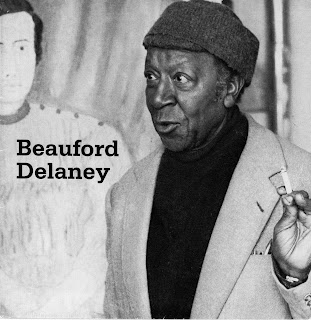
Invitation card to 1973 exposition at Galerie Darthea Speyer
Image courtesy of Galerie Darthea Speyer
Beauford, you are the complete artist, not just in the medium of paint but in the medium of life.
- James Jones
I learned about light from Beauford Delaney, the light contained in every thing, in every surface, in every face.
- James Baldwin
Beauford was an artist from before birth; he was an artist in the womb, and even before that.
- Henry Miller
First and last Beauford is an artist - one of the most sensitive and talented of all artists of all times.
- Joseph Delaney
...this is indeed, the hallmark of Beauford's art, a joyful pursuit of the exact.
- Richard A. Long
For many years, the sparkle of his gaze shone around him and attracted a crowd of friends, fascinated by this strong, if silent, presence. It was not his discourse that captivated, but a light that emanated from him and permeated everyone. (Translated from French)
– Darthea Speyer
To see a short video of the Beauford Delaney: Internal Light exposition opening, click here.

Image courtesy of Galerie Darthea Speyer
Beauford, you are the complete artist, not just in the medium of paint but in the medium of life.
- James Jones
I learned about light from Beauford Delaney, the light contained in every thing, in every surface, in every face.
- James Baldwin
Beauford was an artist from before birth; he was an artist in the womb, and even before that.
- Henry Miller
First and last Beauford is an artist - one of the most sensitive and talented of all artists of all times.
- Joseph Delaney
...this is indeed, the hallmark of Beauford's art, a joyful pursuit of the exact.
- Richard A. Long
For many years, the sparkle of his gaze shone around him and attracted a crowd of friends, fascinated by this strong, if silent, presence. It was not his discourse that captivated, but a light that emanated from him and permeated everyone. (Translated from French)
– Darthea Speyer
To see a short video of the Beauford Delaney: Internal Light exposition opening, click here.
Sedat Pakay's Tribute to Beauford
Sedat Pakay is a Turkish photographer and filmmaker who was a great friend of James Baldwin. He met Beauford in Istanbul during the summer of 1966 when Beauford first visited Baldwin's home in the Rumeli Hisarı quarter1 of the city.

Image from Wikipedia Commons
Pakay graciously granted me the following interview about his encounters with Beauford:
Les Amis: What was your first impression of Beauford and how did this change over time (if it did at all)?
Sedat Pakay: Upon arrival to Istanbul he looked very haggard and exhausted after the long arduous journey from Paris2. Within few days, in the company of James Baldwin who adored him, and with help from Black Sea breezes that gently swept by the stone porch where he would sit and sketch daily, he relaxed and looked very radiant and gratified. His chair would almost be placed next to the Bosphorus. Often, I would catch him in contemplative mood watching waves and the sail boats in between his sketching -- on small notepads with colored markers.
Later during the summer, he looked very content -- free from the pressures of living in a big city; this quiet living reflected its joy on his angelic face. He was in a loving environment, working without interruption. He was truly happy, and Jimmy took excellent care of him.
Les Amis: David Leeming writes that Beauford "became an object of veneration among our Turkish friends, who would come to him each afternoon as to a wise guru." Were you one of these friends?
Sedat Pakay: In the Turkish culture elderly people are respected and addressed in words of veneration. I always sought advice of older men and women in my family to resolve personal issues, with expectations that they would have the answers. BD was not any different. I would sit by him and listen to him. If one knows how to listen, words of a wise, experienced person are invaluable.
Les Amis: Did you consider Beauford to be wise?
Sedat Pakay: I did consider him wise. At that point (age 21) I knew very little about his life experience. As I read and heard of his painful past, my respect for the man grew. He was wise, benevolent, and generous. A small sketch he gifted me is a prize possession.
Les Amis: What inspired you to call him "Uncle Beauford"?
Sedat Pakay: I called him "Uncle Beauford" in conforming with Turkish cultural traditions. All old cultures revere their elderly and serve them to make them feel comfortable in their later years. In this tradition, addressing one's senior with words of respect, i.e. "uncle," "aunt," etc. is very proper.

Photograph by Sedat Pakay @1966
reproduced with the permission of the photographer
Les Amis: Regarding the photos that you took of Beauford with Baldwin and singer Bertice Reading in Baldwin's apartment, what was the occasion for this gathering?
Sedat Pakay: It was an afternoon visit by Bertice and her children -- a daughter in her teens, and a baby boy she and her husband adopted in Istanbul. It was a social visit, you know, talk of memories, old gossip, jokes, lots of laughs.
Les Amis: Did Beauford inspire you as a photographic subject?
Sedat Pakay: Faces inspire me as subjects for my photographs. You might say that "I collect faces". It was difficult to capture BD photographically because he would sit by the Bosphorus in a contemplative mood and would not even move a finger. Only when visitors arrived, and the house would come alive did one see him socializing, playing with friends' children, carrying on a quiet conversation.
Les Amis: Did you ever film him?
Sedat Pakay: I never filmed him. I started making films in 1967-68 when I was doing my Masters at Yale Art School.
Les Amis: What is your fondest memory of Beauford?
Sedat Pakay: My fondest memory of Beauford is his stoic disposition, at peace with himself while he was involved in producing his art. As I reflect on it now I realize how much I admired an artist so dedicated to his work which is very lyrical visually, while he was fighting with his demons day in and day out.
1The Rumeli Hisarı quarter takes its name from a majestic fortress built by Mehmet the Conqueror at the narrowest part of the Bosphorus River on the European side of the city. In his biography Amazing Grace: A Life of Beauford Delaney
, David Leeming states that Beauford often "did watercolors of the hills of Asia across the straits" during his stay with Baldwin.
2David Leeming vividly recounts the details of the journey in Amazing Grace.
Beauford, What is the Price of a Ticket?
Artist Ealy Mays has paid a wonderful tribute to Beauford with his painting entitled Beauford, What is the Price of a Ticket?

Beauford, What is the Price of a Ticket?
Ealy Mays
(2012) Acrylic on canvas
Image courtesy of the artist

Jazz Quartet
Beauford Delaney
(1946) Oil on canvas
Image courtesy of Burt and Patricia Reinfrank
Mays provides the following information about the painting:
For additional information about Mays' original painting, as well as prints and memorabilia of the work, visit his Web site at EalyMaysArtWorks.com.

Ealy Mays
(2012) Acrylic on canvas
Image courtesy of the artist

Beauford Delaney
(1946) Oil on canvas
Image courtesy of Burt and Patricia Reinfrank
Mays provides the following information about the painting:
Beauford’s original painting was “Jazz Quartet”. Jimmy Baldwin attributed “Price of a Ticket” to his friend Beauford. Ealy Mays pays tribute by combining title with image.
Setting of Beauford’s original painting was more of a church with a woman a playing a Piano. Here, it is changed from a church to a Jazz lounge in Paris, juxtaposing the individuals and instrument played.
For additional information about Mays' original painting, as well as prints and memorabilia of the work, visit his Web site at EalyMaysArtWorks.com.
A Birthday Card for Beauford
Artist and singer Joseph Langley was one of the many people who attended the reception celebrating the laying of Beauford's tombstone in October 2010. Joe created a wonderful video to capture the highlights of that event.
I asked Joe if he would be willing to create an artistic work in celebration of Beauford's birthday (December 30, 1901) and he immediately rose to the challenge. Here is the painting that he created:

Portrait of Beauford Delaney
Joseph Langley
(2012) Acrylic and pencil on canvas
Click on the image to see the video that Joe created to present this work of art.
HAPPY BIRTHDAY BEAUFORD!
To learn more about Joe and his art and music, visit www.josephlangleymusic.com.
I asked Joe if he would be willing to create an artistic work in celebration of Beauford's birthday (December 30, 1901) and he immediately rose to the challenge. Here is the painting that he created:
Joseph Langley
(2012) Acrylic and pencil on canvas
Click on the image to see the video that Joe created to present this work of art.
To learn more about Joe and his art and music, visit www.josephlangleymusic.com.
Art and Desire
re-Searching Beauford Delaney: Part Four
EL Kornegay Jr., Ph.D.

In Amazing Grace: A Life of Beauford Delaney
, David Leeming opens the unusual door to what might be considered the sexual life of Beauford Delaney. According to
James Baldwin, this lyric about the “unusual door” comes from a song “Beauford
would often sing.”[1]
This unusual door signals at least two aspects of who Beauford Delaney is: a
“…living exemplar of a black man as functioning, self-supporting artist” and according
to Leeming, a homosexual. Beauford was a Negro artist and a homosexual.[2] Yet,
both are constrained by the former, with Beauford’s art having limitations in
the world of whiteness and his sexuality having limitations in the world of
blackness.
Both comprise a double-edged sword of desire with the sharp blade of race and sexuality cutting both ways. The issue of race is a traceable event; sexuality is a bit more elusive, for the latter requires the willingness of lovers to speak and encounters to be exposed. Race plays itself out in the open; sex, most often behind closed doors. How can we account for these acts, which most often remain sealed behind a wall of silence? How do we add the dimension of physical intimacy to our beloved Beauford in ways that celebrate his manhood and his desire to love and be loved?
Leeming asks if Beauford’s paintings say anything about his racial or sexual history. I say his painting say something about both. This is a co-constituted viewpoint, one in which race and sexuality are combined in a colorful commentary of blended pastels, vividly textured swirls, and dimensioned landscapes where images of desire have been captured.
The joy and pain of a double-edged life that has been raced and sexed is wrapped up in a climatic crescendo of brushstrokes distilled on canvas where truth lies somewhere between the painted images we see and the reasons for their being that we cannot. It is in this space where the answer to the question concerning Beauford’s sexual selfhood might be found.
Leeming writes that some friends of Beauford’s claim that he “did not concern himself with racial or sexual issues” and “that his whole life was his painting.” Yet we find hints of a sexual pulse in Dark Rapture (1941); hidden desire roams under the moonlit streets and city lights of Greenwich Village (1945), in the interplay of couples in the light of day in Washington Square (1952), and in the brightly colored celebration of the erect phallus set between testicular orbs in Sun and Moon (1970). Beauford subtlety expresses his racial and sexual self in certain of his paintings; he reveals what he wants us to see privately, not publicly.

Dark Rapture
(1941) Oil on canvas
Private collection
Private collection
Leeming mentions that Delaney was a very private man and was careful never to blur the lines between eroticism and friendship, between race and sex. However, Beauford does integrate these themes into his work and is quite flamboyant in his celebration of human eroticism in both his love for the blues and its reflection in his art. There is a voyeuristic quality to his paintings; many of his subjects seem not to see him and therefore do not necessarily see his desire for them. He seems to be an unknown admirer framing the silhouette of someone he finds beautiful up close (in Jean Genet [1972], Genet seems to emerge from a thicket after a private encounter) or admires from afar (in Rosa Parks [1970], the specter of a perpendicular bulge adorns a random dark figure in the background of the painting). The angles in his works belie coyness, a shyness only revealed when you catch the glance of an admirer in the corner of your eye.

Jean Genet
(1972) Oil on canvas
Private collection
I appreciate Leeming’s response to the questions surrounding Delaney’s racial and sexual identity. Along with black religion, they are important aspects shaping Beauford’s life and work. However, I find that Beauford’s desire – to resist racial and sexual limitations – is directly tied to and bound up in his art. There is no need to speculate about either: we only have to look at what he painted and left behind to get a glimpse of who, what, and how he loved. It is an unusual door to open, but once you have entered, the understanding of the many dimensions of Beauford’s desire begins to emerge.
[1] I have not been able to trace the anecdotal reference by Baldwin of this lyric often
sung by Beauford. However, I do understand this is possibly an example of a
folk “spiritual” indicative of the black church tradition both men shared and
one which Baldwin very often references. James Baldwin, “The Price of the
Ticket”, ed. Toni Morrison. Collected
Essays.(New York: Library of America, 1998), 830.