

Beauford at the Art Institute of Chicago
Last week, I had the pleasure of presenting “Beauford Delaney: From Paris to Beyond” at the G. R. N’Namdi Gallery. The talk was extremely well received, and I was proud to announce to the audience that Les Amis de Beauford Delaney has reached its fundraising goal.
I was also pleased to announce that, earlier in the day, I had had the opportunity to visit the Art Institute of Chicago to see the Beauford Delaney works that this museum owns. The trip was most educational and enjoyable! The museum holds three paintings, two of which are not on public display.
I have already presented the 1944 self-portrait that hangs in Gallery 262 at the Art Institute of Chicago in previous blog postings (You've Got the Eye; Cid Corman's Poetic Tribute to Beauford). But a friend recently visited the gallery and took some extraordinary photos of the painting, and I would like to share them with you here. Note the very heavy streaks of paint that Beauford used to create this image of himself.
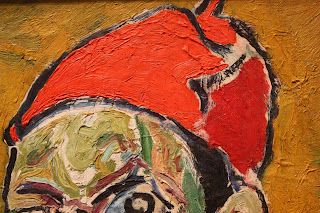


As vivid and compelling as these photos are, the painting itself is even more striking!
A second work (see image below) is in storage. I made an appointment with the American Art department to see it. Associate Curator Sarah Kelly took me into the basement of the museum and located the room in which the painting is stored. We looked at it for several minutes together. There is no signature or date on the front of the painting, but the date “1965” was indicated in pencil on the rear of the painting. Other information about the date and acquisition was presented on two labels affixed to the rear of the work. The work itself is a conglomerate of curves, swipes, and splotches of paint in varying shades of green, yellow, and melon. I thought that I saw two cowboys amidst the colorful swirls!

Sarah accompanied me to the Prints and Drawings Department, where I saw the third Delaney that is owned by the museum. Though it is a painting, the museum has classified it as a drawing because it is painted with a transparent medium (watercolor) and is on paper. The Prints and Drawings department is equipped to store and display such works, which require special preservation. Works held by this department are displayed for three months, and then placed back into storage to preserve them.

Curator Mark Pascale talked with me at length about this painting, which is untitled. He said that the colors of the painting were greatly faded, and showed me how to recognize the fading of the “cream wove”paper that Beauford used for this work as well. Mark described watercolor as a “fugitive medium,” and said that it has “inherent vice.” I found this description (which indicates the fragile nature of watercolor) amusing, and Mark said that the first time he heard it, it amused him as well.
As well as watercolor, Beauford also used gouache for this painting. Gouache is a mixture of opaque white paint with watercolor. This mixture can be made transparent by adding water.
Beauford painted this work for his friends Miriam and Palmer Hayden. His inscription—Pour Mariam & Palmer with love Beauford—and the date—“ ’61”—are barely visible. The painting was acquired from the Haydens by artist and art historian Semella Lewis, who in turn presented it to an art dealer, who sold it to the museum.
I highly recommend a visit to the Art Institute of Chicago to see Beauford’s works. You may phone the Prints and Drawings Department for an appointment to see the watercolor and gouache painting. The American Art Department may also grant a request to see the oil painting that is in storage, but only if you visit alone.
I was also pleased to announce that, earlier in the day, I had had the opportunity to visit the Art Institute of Chicago to see the Beauford Delaney works that this museum owns. The trip was most educational and enjoyable! The museum holds three paintings, two of which are not on public display.
I have already presented the 1944 self-portrait that hangs in Gallery 262 at the Art Institute of Chicago in previous blog postings (You've Got the Eye; Cid Corman's Poetic Tribute to Beauford). But a friend recently visited the gallery and took some extraordinary photos of the painting, and I would like to share them with you here. Note the very heavy streaks of paint that Beauford used to create this image of himself.
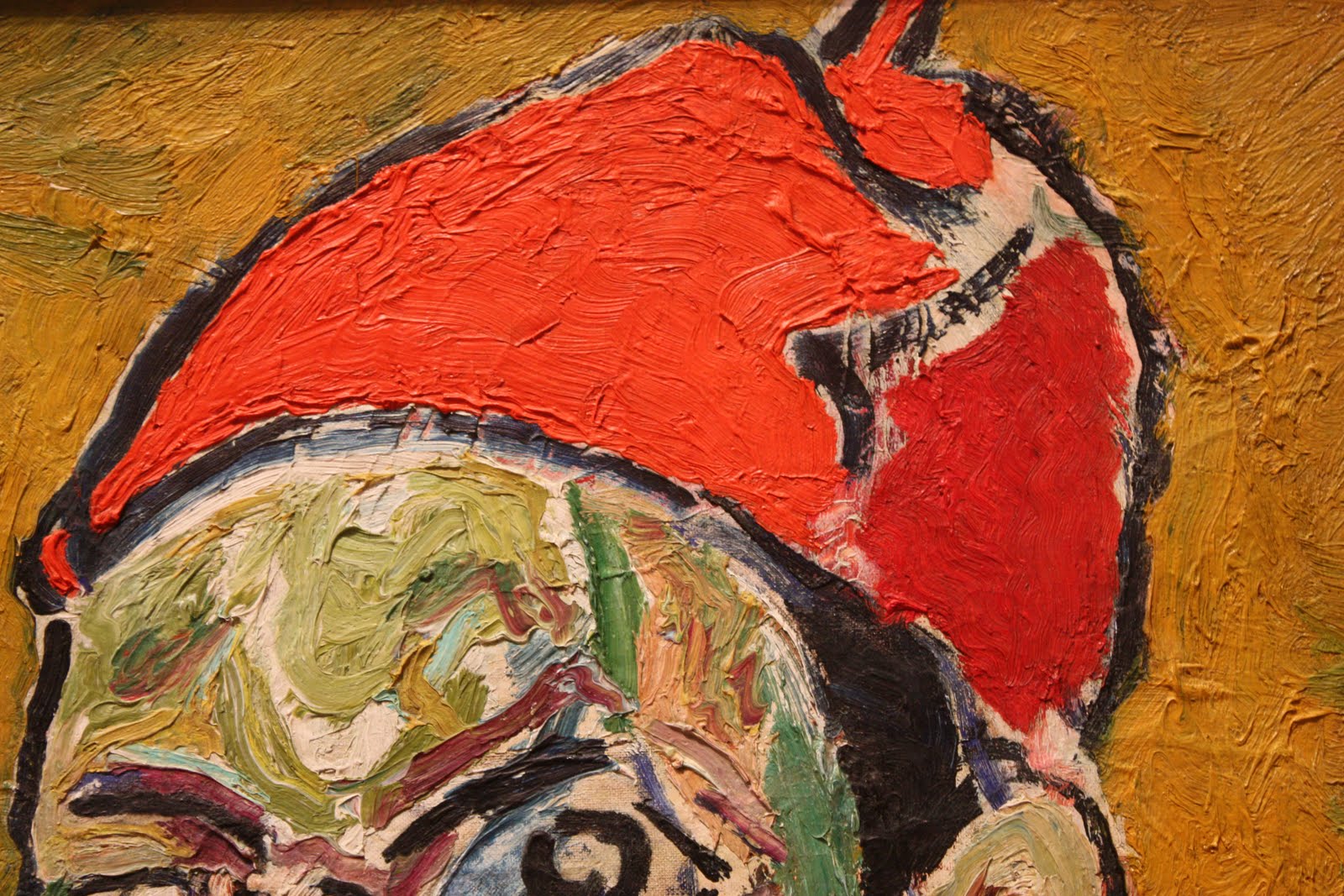


Photos of Beauford's 1944 Self-portrait
Photos courtesy of Tim Paulson
As vivid and compelling as these photos are, the painting itself is even more striking!
A second work (see image below) is in storage. I made an appointment with the American Art department to see it. Associate Curator Sarah Kelly took me into the basement of the museum and located the room in which the painting is stored. We looked at it for several minutes together. There is no signature or date on the front of the painting, but the date “1965” was indicated in pencil on the rear of the painting. Other information about the date and acquisition was presented on two labels affixed to the rear of the work. The work itself is a conglomerate of curves, swipes, and splotches of paint in varying shades of green, yellow, and melon. I thought that I saw two cowboys amidst the colorful swirls!

Untitled by Beauford Delaney
(1965) Oil on canvas
Image courtesy of the Art Institute of Chicago
Sarah accompanied me to the Prints and Drawings Department, where I saw the third Delaney that is owned by the museum. Though it is a painting, the museum has classified it as a drawing because it is painted with a transparent medium (watercolor) and is on paper. The Prints and Drawings department is equipped to store and display such works, which require special preservation. Works held by this department are displayed for three months, and then placed back into storage to preserve them.

Photo of “Untitled” (1961) by Beauford Delaney
© Discover Paris!
Curator Mark Pascale talked with me at length about this painting, which is untitled. He said that the colors of the painting were greatly faded, and showed me how to recognize the fading of the “cream wove”paper that Beauford used for this work as well. Mark described watercolor as a “fugitive medium,” and said that it has “inherent vice.” I found this description (which indicates the fragile nature of watercolor) amusing, and Mark said that the first time he heard it, it amused him as well.
As well as watercolor, Beauford also used gouache for this painting. Gouache is a mixture of opaque white paint with watercolor. This mixture can be made transparent by adding water.
Beauford painted this work for his friends Miriam and Palmer Hayden. His inscription—Pour Mariam & Palmer with love Beauford—and the date—“ ’61”—are barely visible. The painting was acquired from the Haydens by artist and art historian Semella Lewis, who in turn presented it to an art dealer, who sold it to the museum.
I highly recommend a visit to the Art Institute of Chicago to see Beauford’s works. You may phone the Prints and Drawings Department for an appointment to see the watercolor and gouache painting. The American Art Department may also grant a request to see the oil painting that is in storage, but only if you visit alone.
"You've Got the Eye"
In a recent posting of an anecdote about Beauford, Burt Reinfrank indicated that Beauford would frequently say to Burt, "You've got the eye."
While this may have been true in the context that Beauford was speaking—Burt could easily distinguish original Delaneys from copies or fraudulent pieces)—in fact, it is Beauford who “had the eye.” Whether or not he knew it consciously, we may never know. But one can certainly see it in his paintings, and particularly in his self-portraits.
In Beauford’s formative years as an artist, capturing likeness was his primary goal in portraiture. But during his New York years, he began to take painterly liberties with his portraits of Harlem residents, and in his Paris years, his portraits of others reflected his increasing concern with color and the “inner light” of his subjects in opposition to likeness. Author David Leeming cites an example of this attitude in Amazing Grace , the only biography of Beauford in print thus far. In an exchange between Beauford and Elwood Peterson regarding Peterson’s portrait, Beauford states:
Sue Canterbury, curator of the Minneapolis Institute of Arts exposition entitled Beauford Delaney: From New York to Paris , states in her essay on Beauford’s life and work that “One eye sees without; the other within.” She elaborated on this comment for today’s blog posting, saying that she wished to draw attention to the difference between two types of vision that one might attribute to Beauford—one being the reading of external phenomena, and the other, reading/seeing on a deeper plane of meaning that one might call that spiritual or cosmic. Burt Reinfrank, a great friend of Beauford and a contributor to this blog, believes that Beauford was connected to humanity in a way that transcends our worldly consciousness, and stated that Beauford often spoke of “the cosmos.”
In looking at a series of Beauford’s self-portraits, the astute observer will note that there is often asymmetry in Beauford’s eyes. This irregularity differs from portrait to portrait, and is not a reflection of any physical disfigurement in Beauford’s face. Perhaps this is Beauford's way, consciously or subconsciously, of depicting the two types of vision described above.


While this may have been true in the context that Beauford was speaking—Burt could easily distinguish original Delaneys from copies or fraudulent pieces)—in fact, it is Beauford who “had the eye.” Whether or not he knew it consciously, we may never know. But one can certainly see it in his paintings, and particularly in his self-portraits.
In Beauford’s formative years as an artist, capturing likeness was his primary goal in portraiture. But during his New York years, he began to take painterly liberties with his portraits of Harlem residents, and in his Paris years, his portraits of others reflected his increasing concern with color and the “inner light” of his subjects in opposition to likeness. Author David Leeming cites an example of this attitude in Amazing Grace
, the only biography of Beauford in print thus far. In an exchange between Beauford and Elwood Peterson regarding Peterson’s portrait, Beauford states:If you wanted an exact likeness you could have gone to a photographer…when you sing you become eighteen again, and that’s what I wanted to capture.Peterson offered to buy the painting, but Beauford refused payment, giving the painting to his subject instead.
Sue Canterbury, curator of the Minneapolis Institute of Arts exposition entitled Beauford Delaney: From New York to Paris
, states in her essay on Beauford’s life and work that “One eye sees without; the other within.” She elaborated on this comment for today’s blog posting, saying that she wished to draw attention to the difference between two types of vision that one might attribute to Beauford—one being the reading of external phenomena, and the other, reading/seeing on a deeper plane of meaning that one might call that spiritual or cosmic. Burt Reinfrank, a great friend of Beauford and a contributor to this blog, believes that Beauford was connected to humanity in a way that transcends our worldly consciousness, and stated that Beauford often spoke of “the cosmos.”In looking at a series of Beauford’s self-portraits, the astute observer will note that there is often asymmetry in Beauford’s eyes. This irregularity differs from portrait to portrait, and is not a reflection of any physical disfigurement in Beauford’s face. Perhaps this is Beauford's way, consciously or subconsciously, of depicting the two types of vision described above.
In his 1944 self-portrait, Beauford has represented his right eye as being entirely white. His left eye is larger than the right, rhomboid in shape, and one gets the impression that it has no lid. The pupil is light-colored and the surrounding iris black. In his 1950 self-portrait, it is the right eye that is smaller, with a black iris and no apparent pupil, while the left eye is a grayish tan with a clear tan iris and a dark pupil.
In his 1964 self-portrait, Beauford had retained the proportions that he used in his 1950 self-portrait. His face is gaunt, making the white of the almond-shaped left eye seem sunken in and the white of that eye more gleaming.

Self-portrait
Oil on canvas (1964)
Collection of the Reinfrank Family
In his 1972 portrait, he returns to marked asymmetry, this time accentuated by the fullness of his face. The left eye is larger and higher than the right, the iris is thin and the pupil large and light-colored—even mottled.

Self-portrait
Gouache on paper (1972)
Collection of David Leeming
Catherine St. John, a professor at Berkeley College in New Jersey and author of the essay “A Narrative of Belonging: The Art of Beauford Delaney and Glen Ligon,” describes the white eye in the 1944 self-portrait as “vacant,” and refers to the “monocular stare” that philosopher Jacques Derrida evoked in his Memoirs of the Blind: The Self-Portrait and Other Ruins – “a single eye open and fixed firmly on its own image, seeing nothing, nothing but an eye which prevents it from seeing anything at all.” St. John poses the rhetorical question “Are Delaney’s self-portraits attempts to find his own identity in his own image?”
In my opinion, Beauford’s numerous self-portraits are some of his most extraordinary oeuvre. (The ones presented here are but a few of them.) I encourage you to search for images of these works on line or to view them in person at museums and judge for yourself.
Beauford's Makonde Figure at the Armory Show Modern in NYC
The Michael Rosenfeld Gallery is exhibiting Beauford's Makonde Figure, a signed and dated painting of an African sculpture, among numerous other works at the Armory Show Modern in Manhattan. Dates and times are as follows:
Thursday, March 4 - Noon to 8 PM
Friday, March 5 - Noon to 8 PM
Saturday, March 6 - Noon to 8 PM
Sunday, March 7 - Noon to 7 PM
The Armory Show Modern is being held at Twelvth Avenue and Fifty-fifth Street, NYC. The Michael Rosenfeld Gallery will be at Booth #237 - Pier 92. For more information, phone the gallery at 212-247-0082, or send e-mail to website (at) michaelrosenfeldart (dot) com.
Thursday, March 4 - Noon to 8 PM
Friday, March 5 - Noon to 8 PM
Saturday, March 6 - Noon to 8 PM
Sunday, March 7 - Noon to 7 PM
The Armory Show Modern is being held at Twelvth Avenue and Fifty-fifth Street, NYC. The Michael Rosenfeld Gallery will be at Booth #237 - Pier 92. For more information, phone the gallery at 212-247-0082, or send e-mail to website (at) michaelrosenfeldart (dot) com.
Beauford and the Michael Rosenfeld Gallery
The Michael Rosenfeld Gallery, located at 24 West 57 Street, opened its doors in Manhattan in 1989. It acquired its first Beauford Delaney painting – an untitled portrait – soon afterward, and has been a champion of Beauford’s work ever since. To date, the gallery has mounted twenty-five expositions that have included paintings by Beauford, including two solo expositions of selected abstract works.
Michael Rosenfeld’s wife and partner, halley k harrisburg, is the director of the Michael Rosenfeld Gallery. She kindly consented to grant me an interview to provide insight into why the gallery is such a fervent supporter of Beauford’s œuvre.
The story begins with the adolescent Michael Rosenfeld, a precocious youth with an unquenchable thirst for knowledge of art history and artists. He would spend hours roaming the city to look at and buy art objects, and developed relationships with vendors and galleries around town – including many on Madison Avenue. He poured over old ads and archives of artistic works in libraries and museums, noted the names of artists whose work interested him, and sought these artists out. When they consented to meet with him, they were invariably surprised to find that a teenager presented himself for the rendezvous. Michael would put himself through college by buying and selling art.
Many of the paintings that Michael Rosenfeld acquired during his youth were created by African-American artists. He often did not know this at the time that he obtained the works – it was only later that he became aware of the “African-American artist” and the struggles that faced such artists in the American art world, and began to recognize the names of particular artists in this light.

Michael and halley visited the Paul Facchetti Gallery in Paris during the mid-1990s. Facchetti was a major supporter of Beauford during his Paris years and held several of his works, and Michael and halley purchased several of Beauford’s paintings from Facchetti during that trip. These became the nexus of the Michael Rosenfeld Gallery Delaney collection. Michael and halley also established relationships with Darthea Speyer and others in Paris who supported Beauford and his art. Since that time, they have actively sought to acquire authentic Delaney paintings (halley indicated that there are numerous counterfeit works on the market today), with the intent to sell them to museums as well as to private collectors. They are also eager to make Beauford’s work available to museums for exhibitions.
_MRosenfeldGallery.jpg)
In 1995, the gallery held its first solo exposition of Beauford’s paintings. It was entitled Beauford Delaney: 1960s Paris Abstractions, and it ran from September 14 - November 11. At the time, the scant press that Beauford’s work had received concerned his figurative paintings, such as those shown at the Studio Museum in Harlem in 1978. In this context, to mount a solo exposition exclusively composed of abstract works could be considered audacious. halley indicated that this exposition was very poorly attended, and stated her conviction that this was because the public could not comprehend the significance of abstract art produced by an “African-American artist.”
MRosenfeld+Gallery.jpg)
halley stated that the gallery feels privileged to have handled so many of Beauford’s paintings. When asked what makes his work desirable for the gallery, her passion for it burst forth as she spoke of Beauford’s electric palette, and the raw emotion, sheer integrity, and consistency of intent of his œuvre. She stated that Beauford’s approach to portraits, landscapes, his representations of Washington Square, and his abstractions are quintessentially his own; and that each work of art that he produced was an external representation of all the opportunities, hardships, and relationships that he had experienced in life up to the moment that he set his brush to canvas. She and Michael believe that Beauford is one of the most important of all 20th-century American painters.

The Michael Rosenfeld Gallery is a supporter of the mission of Les Amis de Beauford Delaney to place a permanent marker at Beauford’s grave at Thiais Cemetery. Please join them in supporting our effort! Send your donation check, made payable to Les Amis de Beauford Delaney, to us at one of the following addresses:
US Dollar donations:
Monique Y. Wells
Les Amis de Beauford Delaney
11503 Sandhurst
Houston, TX 77048
USA
Euro donations:
Monique Y. Wells
Les Amis de Beauford Delaney
52, rue Lhomond
75005 Paris
FRANCE
Michael Rosenfeld’s wife and partner, halley k harrisburg, is the director of the Michael Rosenfeld Gallery. She kindly consented to grant me an interview to provide insight into why the gallery is such a fervent supporter of Beauford’s œuvre.
The story begins with the adolescent Michael Rosenfeld, a precocious youth with an unquenchable thirst for knowledge of art history and artists. He would spend hours roaming the city to look at and buy art objects, and developed relationships with vendors and galleries around town – including many on Madison Avenue. He poured over old ads and archives of artistic works in libraries and museums, noted the names of artists whose work interested him, and sought these artists out. When they consented to meet with him, they were invariably surprised to find that a teenager presented himself for the rendezvous. Michael would put himself through college by buying and selling art.
Many of the paintings that Michael Rosenfeld acquired during his youth were created by African-American artists. He often did not know this at the time that he obtained the works – it was only later that he became aware of the “African-American artist” and the struggles that faced such artists in the American art world, and began to recognize the names of particular artists in this light.

Beauford Delaney (1901-1979)
Ahmed Bioud, 1964
oil on canvas
39 1/4" x 32", signed
© Estate of Beauford Delaney; Courtesy of Michael Rosenfeld Gallery, LLC, New York , NY
Michael and halley visited the Paul Facchetti Gallery in Paris during the mid-1990s. Facchetti was a major supporter of Beauford during his Paris years and held several of his works, and Michael and halley purchased several of Beauford’s paintings from Facchetti during that trip. These became the nexus of the Michael Rosenfeld Gallery Delaney collection. Michael and halley also established relationships with Darthea Speyer and others in Paris who supported Beauford and his art. Since that time, they have actively sought to acquire authentic Delaney paintings (halley indicated that there are numerous counterfeit works on the market today), with the intent to sell them to museums as well as to private collectors. They are also eager to make Beauford’s work available to museums for exhibitions.
_MRosenfeldGallery.jpg)
Beauford Delaney (1901-1979)
Exchange Place, 1943
oil on panel
33 1/4" x 45 1/2", signed
© Estate of Beauford Delaney; Courtesy of Michael Rosenfeld Gallery, LLC, New York , NY
In 1995, the gallery held its first solo exposition of Beauford’s paintings. It was entitled Beauford Delaney: 1960s Paris Abstractions, and it ran from September 14 - November 11. At the time, the scant press that Beauford’s work had received concerned his figurative paintings, such as those shown at the Studio Museum in Harlem in 1978. In this context, to mount a solo exposition exclusively composed of abstract works could be considered audacious. halley indicated that this exposition was very poorly attended, and stated her conviction that this was because the public could not comprehend the significance of abstract art produced by an “African-American artist.”
MRosenfeld+Gallery.jpg)
Beauford Delaney (1901-1979)
Untitled, 1960
oil on canvas
51" x 38", signed
© Estate of Beauford Delaney; Courtesy of Michael Rosenfeld Gallery, LLC, New York , NY
halley stated that the gallery feels privileged to have handled so many of Beauford’s paintings. When asked what makes his work desirable for the gallery, her passion for it burst forth as she spoke of Beauford’s electric palette, and the raw emotion, sheer integrity, and consistency of intent of his œuvre. She stated that Beauford’s approach to portraits, landscapes, his representations of Washington Square, and his abstractions are quintessentially his own; and that each work of art that he produced was an external representation of all the opportunities, hardships, and relationships that he had experienced in life up to the moment that he set his brush to canvas. She and Michael believe that Beauford is one of the most important of all 20th-century American painters.

Beauford Delaney in his Vercingetonix Studio, c.1967
© Estate of Beauford Delaney; Courtesy of Michael Rosenfeld Gallery, LLC, New York , NY
The Michael Rosenfeld Gallery is a supporter of the mission of Les Amis de Beauford Delaney to place a permanent marker at Beauford’s grave at Thiais Cemetery. Please join them in supporting our effort! Send your donation check, made payable to Les Amis de Beauford Delaney, to us at one of the following addresses:
US Dollar donations:
Monique Y. Wells
Les Amis de Beauford Delaney
11503 Sandhurst
Houston, TX 77048
USA
Euro donations:
Monique Y. Wells
Les Amis de Beauford Delaney
52, rue Lhomond
75005 Paris
FRANCE
Beauford and the Briet Brothers
Philippe Briet (1959-1997) was a French gallery owner and publisher who was passionate about the work of Beauford Delaney. His brother Sylvain shares that passion to this day. Sylvain Briet graciously consented to speak with me about the work that he and Philippe undertook during the late 1980s through the mid 1990s to lift Beauford’s works from obscurity and promote them. (He also contributed the photos in this posting; they are not to be reproduced elsewhere or otherwise utilized without his express permission.)
Philippe Briet’s passion for art was born when he was a high school student in Caen, Normandy in 1977. He organized several exhibitions of modern and contemporary art at his school, including the works of great painters such as Chagall and Sonia Delaunay. He befriended Sonia Delaunay in Paris in 1978, and she generously created a poster for one of his shows. At his tender age, he would meet artistic greats such as Salvador Dalí, Marc Chagall, and Andy Warhol. By the time he was 22 years old, Philippe was responsible for the contemporary art program for the City of Caen, and organized a traveling exhibit of contemporary French art in Africa for the French Ministry of Foreign Affairs. He would later befriend painter Jean-Michel Basquiat in New York, and earnestly support this artist when his work was not yet popular.


Briet moved to New York in 1985, and opened the Philippe Briet Gallery in SoHo, Manhattan in 1987. One Sunday in April 1988, Philippe took Sylvain and some friends to the Studio Museum in Harlem, and was surprised to find it closed. The gallery’s bookstore was open, however, and inside, Philippe’s attention was drawn to a tall pile of books with an orange cover bearing a black and white photo of a man whose face he had not seen before. This was a stack of catalogs for the Studio Museum in Harlem’s retrospective of Beauford’s works, organized by Richard A. Long in 1978. Beauford’s photo was on the cover. The catalogs were on sale for $1.00.

Sylvain indicated that Philippe was entranced by the depth of Beauford’s expression on the cover, and the images of the works that he saw in that catalog. Feeling the importance of that moment, he bought a copy for each of his friends. He later contacted Mary Schmidt Campbell, New York City Commissioner of Cultural Affairs and former Executive Director of the Studio Museum, to learn more about this amazing painter, and discovered that Beauford was deceased. Campbell would introduce Philippe to several persons who knew Beauford personally, including Solange du Closel, Richard Long, and Al Hirschfeld. Captivated and impassioned by Beauford’s work, Philippe moved heaven and earth to organize and present the first Beauford Delaney exposition since 1978. Entitled Beauford Delaney [1901-1979]: From Tennessee to Paris, this show was presented in November 1988. It included roughly ten works from New York and Paris, including a portrait of Solange du Closel and a magnificant painting of Washington Square in New York.

According to Sylvain, Philippe felt that people were much more cognizant and appreciative of Beauford’s personality than they were of his art. Philippe embarked on a treasure hunt of sorts, finding some of Beauford’s paintings in the homes of persons who had purchased them long ago and, not realizing their artistic value, stored them in basements or closets. He recovered several that were in less-than-optimal condition, paid fair market value for them, and had these paintings restored. His mission was to acquire Beauford’s works to showcase, not to sell, and to convince museums and the art press of the importance of these works.
Sylvain joined his brother in New York, and together the two men pursued the work of operating a new SoHo gallery, which opened on Broadway in October 1989 with Don’t You Know by Now, a show curated by jazz musician Ornette Coleman. Philippe and Sylvain would mount two retrospectives of Beauford’s work: A Retrospective: Fifty Years of Light (1991) and Beauford Delaney: The New York Years (1994). Forty-seven paintings were hung at the latter exhibit, which was a remarkable feat given that only œuvre created between 1929 and 1953 were shown. Most of these works were being shown for the first time in over fifty years.


In 1995, Philippe Briet collaborated with American poet Cid Corman and American curator and publisher Richard Milazzo to create a book of poetry dedicated to Beauford. Called Tributary (Edgewise Press, 1999), it contains fifty poems and five color reproductions of Beauford’s paintings. In 1995, Philippe also wrote a draft essay about Beauford that he did not have the opportunity to finalize. It would eventually be published in the catalog for the 2007 art exhibit entitled Philippe Briet: Art. Art. Art., which was organized by Sylvain for the Région Basse-Normandie in honor of the 10th anniversary of his brother’s death and presented at the Abbaye-aux-Dames in Caen, France.

Sylvain Briet has followed the status of Beauford’s gravesite since 2002. He continues to hope that Beauford’s remains will someday be transferred to Montparnasse Cemetery, the burial ground closest to where Beauford spent most of his life in Paris, and where James Baldwin wanted to see his friend buried. He is following the progress of Les Amis de Beauford Delaney regarding the placement of a permanent marker at the tomb at Thiais Cemetery.
Philippe Briet’s passion for art was born when he was a high school student in Caen, Normandy in 1977. He organized several exhibitions of modern and contemporary art at his school, including the works of great painters such as Chagall and Sonia Delaunay. He befriended Sonia Delaunay in Paris in 1978, and she generously created a poster for one of his shows. At his tender age, he would meet artistic greats such as Salvador Dalí, Marc Chagall, and Andy Warhol. By the time he was 22 years old, Philippe was responsible for the contemporary art program for the City of Caen, and organized a traveling exhibit of contemporary French art in Africa for the French Ministry of Foreign Affairs. He would later befriend painter Jean-Michel Basquiat in New York, and earnestly support this artist when his work was not yet popular.

Philippe Briet (right) and his art teacher at the Sonia Delaunay exposition (1978)
© Sylvain Briet

Philippe Briet (left) and Sonia Delaunay (1979)
© Sylvain Briet
Briet moved to New York in 1985, and opened the Philippe Briet Gallery in SoHo, Manhattan in 1987. One Sunday in April 1988, Philippe took Sylvain and some friends to the Studio Museum in Harlem, and was surprised to find it closed. The gallery’s bookstore was open, however, and inside, Philippe’s attention was drawn to a tall pile of books with an orange cover bearing a black and white photo of a man whose face he had not seen before. This was a stack of catalogs for the Studio Museum in Harlem’s retrospective of Beauford’s works, organized by Richard A. Long in 1978. Beauford’s photo was on the cover. The catalogs were on sale for $1.00.

Cover of the Studio Museum in Harlem catalog (1978)
Courtesy of Sylvain Briet
Sylvain indicated that Philippe was entranced by the depth of Beauford’s expression on the cover, and the images of the works that he saw in that catalog. Feeling the importance of that moment, he bought a copy for each of his friends. He later contacted Mary Schmidt Campbell, New York City Commissioner of Cultural Affairs and former Executive Director of the Studio Museum, to learn more about this amazing painter, and discovered that Beauford was deceased. Campbell would introduce Philippe to several persons who knew Beauford personally, including Solange du Closel, Richard Long, and Al Hirschfeld. Captivated and impassioned by Beauford’s work, Philippe moved heaven and earth to organize and present the first Beauford Delaney exposition since 1978. Entitled Beauford Delaney [1901-1979]: From Tennessee to Paris, this show was presented in November 1988. It included roughly ten works from New York and Paris, including a portrait of Solange du Closel and a magnificant painting of Washington Square in New York.

Interior of the invitation card for the 1988 exposition
Courtesy of Sylvain Briet
According to Sylvain, Philippe felt that people were much more cognizant and appreciative of Beauford’s personality than they were of his art. Philippe embarked on a treasure hunt of sorts, finding some of Beauford’s paintings in the homes of persons who had purchased them long ago and, not realizing their artistic value, stored them in basements or closets. He recovered several that were in less-than-optimal condition, paid fair market value for them, and had these paintings restored. His mission was to acquire Beauford’s works to showcase, not to sell, and to convince museums and the art press of the importance of these works.
Sylvain joined his brother in New York, and together the two men pursued the work of operating a new SoHo gallery, which opened on Broadway in October 1989 with Don’t You Know by Now, a show curated by jazz musician Ornette Coleman. Philippe and Sylvain would mount two retrospectives of Beauford’s work: A Retrospective: Fifty Years of Light (1991) and Beauford Delaney: The New York Years (1994). Forty-seven paintings were hung at the latter exhibit, which was a remarkable feat given that only œuvre created between 1929 and 1953 were shown. Most of these works were being shown for the first time in over fifty years.

A Retrospective: Fifty Years of Light (1991)
© Sylvain Briet

Philippe Briet (right) and Richard Long at the 1991 exposition
© Sylvain Briet
None of the works shown at either of these exhibits were for sale. The shows drew the attention of major newspapers and magazines (The New York Times, The New Yorker, Village Voice, Art in America, New York Magazine, Amsterdam News, Arts Magazine...), as art critics noted the quality of the works and posed the question "Why did Beauford Delaney disappear from American art history?" Shortly after this exposition ended, the Briet brothers closed the gallery and began to publish books about artists and their work.

Beauford Delaney: The New York Years (1994)
© Sylvain Briet

Haywood "Bill" Rivers at the 1994 exposition
© Sylvain Briet

Philippe (left) shows Brice Porter a self-portrait of Beauford at the 1994 exposition
© Sylvain Briet
In 1995, Philippe Briet collaborated with American poet Cid Corman and American curator and publisher Richard Milazzo to create a book of poetry dedicated to Beauford. Called Tributary (Edgewise Press, 1999), it contains fifty poems and five color reproductions of Beauford’s paintings. In 1995, Philippe also wrote a draft essay about Beauford that he did not have the opportunity to finalize. It would eventually be published in the catalog for the 2007 art exhibit entitled Philippe Briet: Art. Art. Art., which was organized by Sylvain for the Région Basse-Normandie in honor of the 10th anniversary of his brother’s death and presented at the Abbaye-aux-Dames in Caen, France.

Cover of the Philippe Briet: Art. Art. Art. catalog
Courtesy of Sylvain Briet
Sylvain Briet has followed the status of Beauford’s gravesite since 2002. He continues to hope that Beauford’s remains will someday be transferred to Montparnasse Cemetery, the burial ground closest to where Beauford spent most of his life in Paris, and where James Baldwin wanted to see his friend buried. He is following the progress of Les Amis de Beauford Delaney regarding the placement of a permanent marker at the tomb at Thiais Cemetery.
Beauford at Galerie Darthea Speyer
Darthea Speyer is an extraordinary woman whose passion and vision changed the landscape of Paris’ art scene. She worked as exhibit officer for the United States Information Services at the American Embassy and helped to found the American Cultural Center in the rue de Dragon. Subsequently, during the midst of the May 1968 riots, she established an art gallery in the heart of Saint-Germain des Prés. Her brother, A. James Speyer, designed the space, and brother and sister worked together to plan the expositions.


Galerie Darthea Speyer
© Discover Paris!
Beauford and Darthea Speyer met in the fall of 1956, when Speyer purchased a watercolor that Beauford painted during his summer in Ibiza that year. She would later organize a group exhibition that included Beauford’s works at the American Cultural Center in 1966, and host two solo exhibitions of his work at her gallery. She was a staunch supporter of Beauford during good times and bad, and often commissioned him to paint portraits of herself and her family to provide him with work. She was a member of the trustee panel that handled Beauford’s affairs during his last years, which were spent at Saint Anne’s Hospital.

Darthea
Beauford Delaney
Oil on canvas (1965)
Courtesy of Galerie Darthea Speyer
The 1973 solo exposition at the Speyer Gallery was quite successful and received positive reviews. Beauford’s portraits commanded the most attention. Among them were works depicting Jean Genet, Ahmed Bioud, and James Baldwin. Speyer also selected several abstract and semi-abstract paintings to exhibit, including many that featured African themes. The exposition ran from February 6 through March 2.

Invitation card for 1973 exhibit at Galerie Darthea Speyer
Courtesy of Galerie Darthea Speyer
Not much is written about the 1992 solo exposition at the Speyer Gallery. However, in the invitation card for the exhibit, Speyer tenderly eulogizes Beauford. She speaks of his coming almost each day to her office at the American Cultural Center, and then to the gallery. She states how he happily and quickly captured the images of her family and friends on canvas. She laments the shadow that descended upon his spirit and eventually led to his commitment at Saint Anne’s.

Invitation card for 1992 exhibit at Galerie Darthea Speyer
Courtesy of Galerie Darthea Speyer
Galerie Darthea Speyer permanently closed its doors at the end of 2009. It will donate its remaining works by Beauford to the Smithsonian Institute in Washington, D.C.

Beauford and Darthea
Invitation card for 1973 exhibit at Galerie Darthea Speyer
Courtesy of Galerie Darthea Speyer