

Beauford's Portraits of James Baldwin - Part 2
Last week, Dr. Catherine St. John commented on two of Beauford's portraits of James Baldwin. both of which are in private collections. Today, I present images of two Baldwin portraits that belong to major museums and one from a private collection that traveled the U.S. in a major exposition of Beauford's works, along with excerpts from descriptions that the museums present(ed) with these works. I invite you to compare and contrast these portraits, including the ones discussed last week, and submit a comment about which one(s) you appreciate most.
*************
The portrait owned by the Philadelphia Museum of Art is part of the museum's permanent collection, but it is not currently on view. The label for the painting reads:

Portrait of James Baldwin
(1945) Oil on canvas
Philadelphia Museum of Art
The National Portrait Gallery of the Smithsonian Institute owns the portrait shown below. Part of its description of the painting reads as follows:

James Baldwin
(1963) Pastel on Paper
National Portrait Gallery, Smithsonian Institute
The Sage Black was a key oeuvre shown at the exposition mounted by the Minneapolis Institute of Arts in 2004-2005. The museum's description of this remarkable painting mentions Beauford's technique as well as comments on his choice of colors:
The Sage Black
(1967) Oil on canvas
Private collection
Image from Artsmia Web site
The portrait owned by the Philadelphia Museum of Art is part of the museum's permanent collection, but it is not currently on view. The label for the painting reads:
This iconic painting is a very early depiction of the famous writer and civil rights activist James Baldwin, who was twenty-one when Delaney created this portrait. Closely cropped and vibrantly painted, it jumps out from the canvas, presenting an up-close encounter with the sitter. As in Delaney's self-portraits, he painted one eye slightly different from the other, a pictorial device also found in Pablo Picasso's paintings. Of the many portraits Delaney made of Baldwin, this one is among his most direct and expressive.

(1945) Oil on canvas
Philadelphia Museum of Art
The National Portrait Gallery of the Smithsonian Institute owns the portrait shown below. Part of its description of the painting reads as follows:
Although Delaney loved Baldwin, his portrait is not about nostalgic affection. Heated and confrontational, its harsh colors roughly applied, the pastel hints at the inner anxieties that would ultimately land Delaney in a psychiatric hospital. His pastel glows with the vibrant, Van Gogh–inspired yellow the artist often used after he moved to Paris in the 1950s. One of perhaps a dozen portraits that Delaney made of Baldwin over thirty years, it is both a likeness based on memory and a study of light.

(1963) Pastel on Paper
National Portrait Gallery, Smithsonian Institute
The Sage Black was a key oeuvre shown at the exposition mounted by the Minneapolis Institute of Arts in 2004-2005. The museum's description of this remarkable painting mentions Beauford's technique as well as comments on his choice of colors:
Delaney superimposed a calligraphic outline on an abstract composition of reds, greens, yellows, and blues. Filled with all the colors of a flame, this incendiary, combustible background peers through Baldwin's form, conveying the passion and fire that was such an integral part of the author who penned, just a few years before, the foreboding essay titled The Fire Next Time.

(1967) Oil on canvas
Private collection
Image from Artsmia Web site
Of the portraits displayed last week and the ones shown above, I personally favor the 1963 portrait (shown above) because it makes Baldwin look youthful and accessible. Which do you prefer? Leave your comments in the space below!
Beauford's Portraits of James Baldwin - Part 1
I recently received a letter from Dr. Catherine St. John, Doctor of Arts, Professor of Humanities and Social Sciences at Berkeley College in New Jersey, and long time supporter of Les Amis de Beauford Delaney. In it, she states:
Dr. St. John also mentions how Beauford's subjects are often painted in strikingly different colors.

Dr. Catherine St. John at
Beauford's Gravesite Ceremony - October 2010
© Discover Paris!
In reading this letter, I was reminded of how many portraits Beauford painted of James Baldwin, how colorful they are, and how different they are from each other. Dr. St. John graciously consented to comment on two of them - Dark Rapture (1941) and a 1965 portrait of Baldwin - and to share further thoughts on Beauford's work.
About these portraits, Dr. St. John states:
*Beauford's 1965 portrait of Baldwin was shown at the Studio Museum in Harlem in 1978 during the first retrospective of his work. It is Number 18 in the catalog of the show, and is simply listed as Portrait of James Baldwin. The provenance is shown as "Private Collection of Beauford Delaney: Paris."
Beauford Delaney’s life-spanning friendship with James Baldwin is well known. A rewarding topic of focus for me is the dozen or so portraits he did of Baldwin, his muse. They give us unique glimpses into specific moments in Delaney’s art making practice but, even more, the incontestable truth of how we construct identity, how we make it visible and how we experience a sense of belonging.
Dr. St. John also mentions how Beauford's subjects are often painted in strikingly different colors.

Beauford's Gravesite Ceremony - October 2010
© Discover Paris!
In reading this letter, I was reminded of how many portraits Beauford painted of James Baldwin, how colorful they are, and how different they are from each other. Dr. St. John graciously consented to comment on two of them - Dark Rapture (1941) and a 1965 portrait of Baldwin - and to share further thoughts on Beauford's work.
About these portraits, Dr. St. John states:
Both portraits, Dark Rapture (James Baldwin), 1941, oil on canvas or board, 34 x 28 inches, and James Baldwin, 1965, oil on canvas, 30 x 21 inches, are modest in dimensions. Both paintings are signed and dated. Their intimate scales draw us more closely to the virtuosity of Delaney’s painterly touch. They are created with straightforward media and give viewers an immediate sense of the paintings as physical objects.
Dark Rapture
(1941) Oil on canvas
Private collection
Portrait of James Baldwin*
(1965) Oil on canvas
Private collection
Dark Rapture is an especially dynamic and luminous painting that shows Beauford Delaney’s preferred palette, a range of colors and white chosen for symbolic, emotional and aesthetic reasons. It is the first portrait that Beauford Delaney did of James Baldwin and it marks a new and original approach to the male nude, a subject generally less frequently addressed by artists.
It is a composition that combines gesture and chromatic intensity with the silhouette of Baldwin, one side in shadow lit from the right, against a background of light emanating from color. It is a deeply affecting work, one of a number of portraits that Delaney created of his muse. Pieced together, they record the personal journeys of two great artists and form a collective field of memory.
While the 1965 portrait of James Baldwin, completed decades later, is not nearly as explosive as Dark Rapture, it is charged with human presence. The isolated, self-contained image of Baldwin is the special intersection of the world of light and the subjective consciousness that Beauford Delaney brought to his portraits. It is a supremely expressive portrait in which the eyes, the most intimate and powerful feature of the face, act like magnets, bringing us close to the mind, soul and emotions of a great writer who finds his place in history through his literature as well as the unique visual language of his mentor, Beauford Delaney.
Beauford Delaney worked with the materiality of paint with color and texture applied in an abstract gestural style, filling the entire pictorial space. His tactile surfaces of brilliant colors are prime carriers of light and space and it is in his use of yellow - ochre, cadmium, lemon - that we discover the substance of light in relation to spirit. It is the concreteness of his color rather than its illusionistic potential that is the essence of Delaney’s art.


*Beauford's 1965 portrait of Baldwin was shown at the Studio Museum in Harlem in 1978 during the first retrospective of his work. It is Number 18 in the catalog of the show, and is simply listed as Portrait of James Baldwin. The provenance is shown as "Private Collection of Beauford Delaney: Paris."
Beauford Painting Auctioned at Doyle New York
Many thanks to DLeopold, who recently shared the following comment on the blog posting about Beauford and Al Hirschfeld:
I visited the Doyle New York Web site and found a single Delaney painting that had been assigned Lot Number 151 and an estimated sale price of $4000 to $6000. It is a pastel on grey/green paper entitled Street Scene, dated 1953 (the year that Beauford sailed for Paris).

Street Scene
Beauford Delaney
(1953) Pastel on paper
The auction was held on June 22, 2011 at 10 AM. Beauford's pastel sold for $37,500!
Hirschfeld and Freeman were instrumental in introducing Delaney to a wide range of friends and collectors, which provided him the means to focus on his art. Several works on paper by Delaney from Hirschfeld's collection will go to the auction block on June 22nd. Check it out at http://www.doylenewyork.com/content/more.asp?id=157.
I visited the Doyle New York Web site and found a single Delaney painting that had been assigned Lot Number 151 and an estimated sale price of $4000 to $6000. It is a pastel on grey/green paper entitled Street Scene, dated 1953 (the year that Beauford sailed for Paris).

Beauford Delaney
(1953) Pastel on paper
The auction was held on June 22, 2011 at 10 AM. Beauford's pastel sold for $37,500!
Beauford and Friends on Greene Street
After reading last week's guest posting by Richard Gibson on sitting for his Delaney portrait, his friend Tony Hagert sent the information below regarding Beauford's studio on Greene Street in New York. It is a wonderful glimpse at what life was like for him, his roommate, Richard Hadlock, and landlord Beauford!

Greene Street
Beauford Delaney
(1940) Oil on canvas
Photo by André Moran from the Artsmia Web site
Actually, Dick Hadlock and I were on the second floor and Beauford on the third. We paid him $35 per month and later found out he was paying $25 for both floors - all from a generous friend, I think, because it was pretty cheap even for those days (1951+).
The first floor at 181 Greene Street was a twine warehouse and not a fashionable address altho' only two blocks from Washington Square, Fifth Avenue, and New York University. There was no hot water so we used to go to Grand Central Station every so often to bathe for 75 cents (plus tip). If we were invited to someone's home, we would ask if it was OK for us to bring our soap and towel, and they could watch if they wanted - or help, even.
Before we moved in, we had to empty out the second floor which was completely filled with bags of ashes from the pot bellied stove on the third floor - several years' worth. I cannot recall how we disposed of them but it must have been by stealth at night because we could not afford to have them hauled away.
Then we repainted the second floor over the four or five haphazard end-of-the-can colors that had been there before the ashes, brought in our old records, and were as happy as clams.

Beauford Delaney
(1940) Oil on canvas
Photo by André Moran from the Artsmia Web site
Actually, Dick Hadlock and I were on the second floor and Beauford on the third. We paid him $35 per month and later found out he was paying $25 for both floors - all from a generous friend, I think, because it was pretty cheap even for those days (1951+).
The first floor at 181 Greene Street was a twine warehouse and not a fashionable address altho' only two blocks from Washington Square, Fifth Avenue, and New York University. There was no hot water so we used to go to Grand Central Station every so often to bathe for 75 cents (plus tip). If we were invited to someone's home, we would ask if it was OK for us to bring our soap and towel, and they could watch if they wanted - or help, even.
Before we moved in, we had to empty out the second floor which was completely filled with bags of ashes from the pot bellied stove on the third floor - several years' worth. I cannot recall how we disposed of them but it must have been by stealth at night because we could not afford to have them hauled away.
Then we repainted the second floor over the four or five haphazard end-of-the-can colors that had been there before the ashes, brought in our old records, and were as happy as clams.
Richard Gibson Sits for a Portrait by Beauford
Richard Gibson met Beauford at the age of sixteen in Philadelphia and considered Beauford a friend and mentor for the rest of his life. Among the things that Beauford helped Gibson accomplish was to get accepted at the Yaddo artists’ community in Sarasota Springs, NY when he was a struggling young writer trying to produce his first book. In this posting, he talks about how Beauford came to paint his portrait, which was eventually hung at a major exposition at the Philadelphia Museum of Art.
****************
I visited Beauford in Paris when I was stationed outside Karlsruhe in the US Army in the last days of the allied occupation. I was fortunate enough to obtain my discharge from the Army without having to go back to the States and instead went straight to Paris, taking an overnight train to see Beauford and William Gardner Smith, another good friend. I found a room in what was then called the Hotel des Ecoles on the rue Delambre, where Beauford was staying in a bedroom that was very light and bright on the top floor. The maids had given him old white sheets to improve the light. He slept and worked in this fairly spacious room, which I remember as overlooking rue Delambre. It was hard to see the street because of the guttering on that floor of the building.
The light in the room was reminiscent of that in Beauford’s Greene Street apartment in Greenwich Village, but the space was far more comfortable. I often visited him at Greene Street and two school friends of mine from Philadelphia actually stayed on the floor above for some months. Beauford’s studio there was damp and poorly heated by a pot-bellied stove, but quite light due to the old white sheets that he scattered over furniture and hung over the dark walls.
It was at the rue Delambre apartment where Beauford said he wanted to do my portrait one day in 1955. I did not have to go to classes at the Sorbonne (where I was trying to learn and perfect my French on the GI Bill) that day.
Beauford’s custom was to listen to music of all kinds – from jazz to Marian Anderson, the great black singer of the day – while working, and so it was that day. I was astounded at how swiftly his brushes moved across the small standard canvas that one found in local Montparnasse art shops. My portrait was completed in two hours. It was little more than a sketch perhaps, but I still treasure it as the best likeness of me as a young man.

Portrait of Richard Gibson
Beauford Delaney
Oil on canvas (1955)
To read Richard’s tribute to Beauford on the Les Amis blog, click here.

Richard Gibson standing next to his portrait at the 2005 exposition
Beauford Delaney: From New York to Paris
Philadelphia Museum of Art
Photo courtesy of Richard Gibson
To read more about the 2005 exposition at the Philadelphia Museum of Art, click on the following links:
http://www.fallonandrosof.com/2005/11/delaney-in-paris-and-philadelphia.html
http://theartblog.org/2005/11/weekly-update-delaneys-embrace/
I visited Beauford in Paris when I was stationed outside Karlsruhe in the US Army in the last days of the allied occupation. I was fortunate enough to obtain my discharge from the Army without having to go back to the States and instead went straight to Paris, taking an overnight train to see Beauford and William Gardner Smith, another good friend. I found a room in what was then called the Hotel des Ecoles on the rue Delambre, where Beauford was staying in a bedroom that was very light and bright on the top floor. The maids had given him old white sheets to improve the light. He slept and worked in this fairly spacious room, which I remember as overlooking rue Delambre. It was hard to see the street because of the guttering on that floor of the building.
The light in the room was reminiscent of that in Beauford’s Greene Street apartment in Greenwich Village, but the space was far more comfortable. I often visited him at Greene Street and two school friends of mine from Philadelphia actually stayed on the floor above for some months. Beauford’s studio there was damp and poorly heated by a pot-bellied stove, but quite light due to the old white sheets that he scattered over furniture and hung over the dark walls.
It was at the rue Delambre apartment where Beauford said he wanted to do my portrait one day in 1955. I did not have to go to classes at the Sorbonne (where I was trying to learn and perfect my French on the GI Bill) that day.
Beauford’s custom was to listen to music of all kinds – from jazz to Marian Anderson, the great black singer of the day – while working, and so it was that day. I was astounded at how swiftly his brushes moved across the small standard canvas that one found in local Montparnasse art shops. My portrait was completed in two hours. It was little more than a sketch perhaps, but I still treasure it as the best likeness of me as a young man.

Beauford Delaney
Oil on canvas (1955)
To read Richard’s tribute to Beauford on the Les Amis blog, click here.

Beauford Delaney: From New York to Paris
Philadelphia Museum of Art
Photo courtesy of Richard Gibson
To read more about the 2005 exposition at the Philadelphia Museum of Art, click on the following links:
http://www.fallonandrosof.com/2005/11/delaney-in-paris-and-philadelphia.html
http://theartblog.org/2005/11/weekly-update-delaneys-embrace/
Beauford's Portraits
In "A Narrative of Belonging: The Art of Beauford Delaney and Glenn Ligon," Dr. Catherine St. John writes:
When I reread this excerpt from Dr. St. John's paper, I was inspired to look at images of dozens of portraits that Beauford painted during his lifetime. I bring you several below; these have not been displayed previously on the Les Amis blog.

Untitled (Portrait of a Young Woman)
(1934) Color pastels
Private collection

Michael Fraenkel
(1946) Drawing
From Death, A Literary Quarterly Vol 1, No. 1 (Summer 1946)

Marian Anderson
(1965) Oil on Canvas
©2001 Malcolm Varon

Portrait of Bernard Hassell
(ca 1971) Oil on Canvas
Estate of Beauford Delaney

Ella Fitzgerald
(1968) Oil on canvas
The Walter O. Evans Collection of African American Art
Beauford painted pastel portraits of Duke Ellington and W.E.B. DuBois, but I have never found images of them. If any of you have seen these portraits, or images of them, please let me know by leaving a comment below!
It is the expressive single-figure realist portrait that first brought Beauford Delaney critical notice and a measure of success. He loved people. He continued the art of portraiture without interruption throughout his career. His portraits tell a story that is human and real, saying as much about him as those he painted.
When I reread this excerpt from Dr. St. John's paper, I was inspired to look at images of dozens of portraits that Beauford painted during his lifetime. I bring you several below; these have not been displayed previously on the Les Amis blog.

(1934) Color pastels
Private collection

(1946) Drawing
From Death, A Literary Quarterly Vol 1, No. 1 (Summer 1946)

(1965) Oil on Canvas
©2001 Malcolm Varon

(ca 1971) Oil on Canvas
Estate of Beauford Delaney

(1968) Oil on canvas
The Walter O. Evans Collection of African American Art
Beauford painted pastel portraits of Duke Ellington and W.E.B. DuBois, but I have never found images of them. If any of you have seen these portraits, or images of them, please let me know by leaving a comment below!
Beauford at the Art Miami Basel Festival
Laurence Choko, proprietor of the Galerie Intemporel in Paris, displayed the Beauford Delaney painting entitled Portrait de Vasilli Pikoula during her Ten is One exposition at the Art Miami Basel Festival in December 2010.

Exposition Ten is One , Art Basel Miami Festival 2010
Photo courtesy of Galerie Intemporel
Choko has the following to say about Beauford’s work, and about this portrait (shown at the right in the photo above) in particular:
I love the expressionist aspect of Beauford Delaney’s figurative works. The subjects of his portraits often express great emotion, and their vulnerability brings them alive for me.
What I admire in the Portrait de Vasilli Pikoula, which I included in the Ten is One exposition from the Art Basel Miami Festival last December, is the generosity with which he represented his painter friend (Pikoula was a Greek painter). In this portrait, Delaney gives her an aristocratic air – it reminds me of the dignified, old women of the Antilles who carried themselves well regardless of their social position.
Beauford and Larry Calcagno

Catalog cover for art exposition
Palmer Museum of Art (2001)
Larry Calcagno was one of Beauford’s closest friends. They met in Paris through their mutual friend Charley Boggs. Beauford and Calcagno were both artists, both gay men, and both deeply philosophical. Beauford’s biographer, David A. Leeming
 , describes their relationship as “intellectually intense, but for the most part physically platonic.”
Calcagno had a studio on rue Vercingétorix, the street where Beauford’s patron Mme du Closel would later purchase a studio for Beauford. Beauford spent a great deal of time there before Calcagno returned to the United States. Calcagno gave Beauford several canvases, paper for watercolor paintings, and paints prior to his departure.
See a letter written by Beauford to Calcagno, dated December 1953, below.


Images: Archives of American Art, Smithsonian Instititution
The two men would correspond regularly for many years, with Beauford frequently confiding his emotional difficulties to Calcagno in his writings.
Calcagno returned to Europe in 1955, and invited Beauford to accompany him on the first of several trips that they would take together. He and Beauford traveled to Madrid for Calcagno’s art exposition at the Gallery Clan. Calcagno was able to convince the gallery to mount a show for Beauford in June 1955. It was Beauford’s first solo exposition in Europe, and it was a commercial success. In 1956, Calcagno and Beauford visited Ibiza, Spain, where they met up with James Baldwin and other friends. Calcagno, Darthea Speyer, and Charley Boggs took Beauford on a trip to Venice in 1966, where they attended the Bienniale exposition.

Photo from Amazing Grace: A Life of Beauford Delaney (1998)
Calcagno would frequently send Beauford money with his letters – money that Beauford often desperately needed. When Beauford required hospitalization after his 1961 suicide attempt, Calcagno contributed money to pay for Beauford’s care and came to Paris to visit Beauford during this difficult time. In the spring of 1975, he interrupted his European travels to come to Paris to search for Beauford, who had disappeared. Calcagno wrote of this episode, saying:
He disappeared a couple of times. This time he can’t seem to be located. We called and looked in all the places where one might want to disappear to—I know a lot of them. He must still be alive, his body would have shown up. He has just simply dissolved himself to escape the final cruelty of the world. I weep for him and I bless him!Beauford was eventually found. He was committed to Sainte-Anne’s Hospital soon thereafter.
The relationship between Beauford and Larry Calcagno can be summarized in a single phrase that Beauford wrote in a letter to Calcagno in 1968, in which he described a “deathless kinship that is constant [and] is always alive and close between us.”
Beauford at the Michael Rosenfeld Gallery

Photo possibly taken by Gjon Mili
The Michael Rosenfeld Gallery has mounted an exposition called Abstract Expressionism: Reloading the Canon, which is comprised of a selection of paintings and sculpture. Two of Beauford's works – Composition, 1958 and Composition Bleu, 1960 – are part of the show. Both works are oil on canvas, and both are signed and dated. Beauford painted them during his "Paris years," when he lived in the suburb of Clamart.
To see these works, and the other works in the show, click here. Among the other works are sculptures by Harold Cousins and a painting by Hale Woodruff, both of whom were African Americans who lived in Paris.
Abstract Expressionism: Reloading the Canon
January 22 through March 19, 2011
Michael Rosenfeld Gallery
24, West 57th Street
New York, NY 10019
Tel: 212-247-0082
Beauford Describes Beauford: Beauford's Tribute to Henry Miller
Here is yet another contribution to the Les Amis blog by Beauford's dear friend Burt Reinfrank. Though I have thanked Burt privately for these guest postings, I want to do so publicly today. Burt has been one of my staunchest supports regarding the blog, and everything else concerning Beauford and the gravesite project. Thank you, Burt!
Though the title of the painting shown below is Self Portrait, Burt indicated that he believes it is a composite of Beauford and Henry Miller. What do you think?
**************Burt writes:
After a day out together with Beauford we passed by Beauford’s studio. Beauford said to my first wife Sara, “You type well. I’ve written a homage to Henry Miller but my handwriting is so bad I would really like to send it typed if you could do that for me.” Sara took the handwritten copy and several days later I returned the typed version to Beauford. When I read what Beauford had written to describe how he saw Henry Miller, I thought, “He is describing himself.” I have never met Miller and for Beauford it may be Miller. But for me it is Beauford.

Beauford wrote:
H E N R Y M I L L E R
Henry Miller is a transcentdental [sic] spirit whose vision illumens [sic] the cosmic heritage of mankind. His constant growth of enlightenment includes the unity and obligations of the human family, to honor one and all with patience and understanding of the universal oneness of our varied heritage. His understanding of this unique necessity and truth flows through all of his writing, his painting, and includes varieties of joy, and some patience with the painful human condition in its search for clarity, offering himself to problems, vision and minute observation, arousing intention by awareness and urgency, through methods of philosophical techniques, and finding time to persuade all of us to look back as well as forward into our historical past, and by so doing, augment the present with our findings of the differences and sameness of each epoch, including art, science and philosophy, giving light to the eternal heritage of all mankind, with joy and selflessness, devotion and infinite patience.
What sometimes seems impossible, his faith augments by years of discovery of himself, and with joy accomplishes the almost impossible task of uniting into his art the entire substance of this experience. This source in a work of art has magnetism and engages all mankind, because, like the “sun”, it is eternal and benevolent. Miller reveals to all people that life is a miracle to be lived and exploited to release its fullness.
Beauford Delaney
In conjunction with this posting, I am pleased to announce that Dorothy's Gallery has mounted an exposition called Henry Miller aux jeunes artists d'aujourd'hui that features twenty original works and lithographs by Miller. On Saturday, December 11, at 7:30 PM, the gallery will host an evening performance in homage of Miller's writing and painting entitled Tropique d'Os.
I believe that Beauford would be very pleased!
Dorothy's Gallery
27, rue Keller
75011 Paris
Telephone: 01 43 57 08 51
Internet: http://www.dorothysgallery.com
Email : dorothysgallery@gmail.com
Métro : Bastille, Voltaire
Parking : Ledru Rollin et Opéra Bastille
Open Wednesday through Saturday from 1 PM to 7 PM
Tuesday and Sunday from 4 PM to 7 PM
Though the title of the painting shown below is Self Portrait, Burt indicated that he believes it is a composite of Beauford and Henry Miller. What do you think?
**************
After a day out together with Beauford we passed by Beauford’s studio. Beauford said to my first wife Sara, “You type well. I’ve written a homage to Henry Miller but my handwriting is so bad I would really like to send it typed if you could do that for me.” Sara took the handwritten copy and several days later I returned the typed version to Beauford. When I read what Beauford had written to describe how he saw Henry Miller, I thought, “He is describing himself.” I have never met Miller and for Beauford it may be Miller. But for me it is Beauford.

Beauford Delaney (1901-1979)
Self Portrait, 1962
oil on canvas
25 1/2" x 21 1/4" x 3/4", signed
© Estate of Beauford Delaney; Private Collection
Courtesy of Michael Rosenfeld Gallery, LLC, New York , NY
Beauford wrote:
H E N R Y M I L L E R
Henry Miller is a transcentdental [sic] spirit whose vision illumens [sic] the cosmic heritage of mankind. His constant growth of enlightenment includes the unity and obligations of the human family, to honor one and all with patience and understanding of the universal oneness of our varied heritage. His understanding of this unique necessity and truth flows through all of his writing, his painting, and includes varieties of joy, and some patience with the painful human condition in its search for clarity, offering himself to problems, vision and minute observation, arousing intention by awareness and urgency, through methods of philosophical techniques, and finding time to persuade all of us to look back as well as forward into our historical past, and by so doing, augment the present with our findings of the differences and sameness of each epoch, including art, science and philosophy, giving light to the eternal heritage of all mankind, with joy and selflessness, devotion and infinite patience.
What sometimes seems impossible, his faith augments by years of discovery of himself, and with joy accomplishes the almost impossible task of uniting into his art the entire substance of this experience. This source in a work of art has magnetism and engages all mankind, because, like the “sun”, it is eternal and benevolent. Miller reveals to all people that life is a miracle to be lived and exploited to release its fullness.
Beauford Delaney
****************
In conjunction with this posting, I am pleased to announce that Dorothy's Gallery has mounted an exposition called Henry Miller aux jeunes artists d'aujourd'hui that features twenty original works and lithographs by Miller. On Saturday, December 11, at 7:30 PM, the gallery will host an evening performance in homage of Miller's writing and painting entitled Tropique d'Os.
I believe that Beauford would be very pleased!
Dorothy's Gallery
27, rue Keller
75011 Paris
Telephone: 01 43 57 08 51
Internet: http://www.dorothysgallery.com
Email : dorothysgallery@gmail.com
Métro : Bastille, Voltaire
Parking : Ledru Rollin et Opéra Bastille
Open Wednesday through Saturday from 1 PM to 7 PM
Tuesday and Sunday from 4 PM to 7 PM
Brief Musings on Beauford and James Baldwin

Baldwin, Beauford, and Lucien Happersberger in Paris, 1953
Photo from James Baldwin by David Leeming
Baldwin owed a great deal to his friendship with Beauford. In the introduction to The Price of the Ticket, he states that his career began when his life in Greenwich Village began, and that this life began when he met Beauford. He describes how he walked into color and into music when he walked into Beauford’s studio at 181 Greene Street. In his inimitable style, he pays tribute to the man whose unshakable example of “courage and integrity, humility and passion” gave him the strength to survive and the ability to hope for a future.
Much later, Baldwin would become Beauford’s source of strength during Beauford's “Paris Years.” It was Baldwin’s turn to introduce Beauford to people around town in the early days, and to provide council and comfort when Beauford more frequently became depressed or distraught.

Beauford and James Baldwin at the American Cultural Center
(1970s) United States Information Service
He would do this (or at least attempt to do this) in the face of his own emotional crises. Baldwin would “send for” Beauford when his friend suffered psychological episodes or physical illness, having Beauford join him in Saint-Paul de Vence. But at the very end, Baldwin did not attend Beauford’s funeral due to illness and other problems. He deeply regretted this, and spoke of his feelings in an interview with his secretary and biographer, David Leeming.
Beauford would paint Baldwin many times. Here are a few examples:

Dark Rapture, as it appears in Amazing Grace
Portrait (oil on board) dates from 1941

Portrait of James Baldwin
Beauford Delaney
(1945) Oil on canvas
Philadelphia Museum of Art

James Baldwin
Beauford Delaney
(1963) Pastel on Paper
National Portrait Gallery, Smithsonian Institute
As do all of Beauford’s portraits, these paintings of James Baldwin depict much more than his physical likeness. They express Baldwin’s “life essence” as Beauford saw it at various stages of Baldwin’s life – his accomplishments, his insecurities, his hopes and dreams. They also represent the deepest, most profound expressions of Beauford’s love for Baldwin.
Beauford and the Influence of Claude Monet
Everyone in Paris who has an interest in art is talking about Claude Monet these days. The huge retrospective of this revered Impressionist painter at the Grand Palais is sold out through the end of the exposition on January 24, 2011! Not to mention the fact that the 170th anniversary of his birth (November 14, 1840) was just a few days ago, and the 84th anniversary of his death (December 5, 1926) is rapidly approaching. Amidst the buzz, I thought it appropriate to look at how Monet’s work influenced Beauford.
Beauford first saw Monet’s work in Boston, shortly after Monet died. The exposition was held in the studio of American artist John Singer Sargent, whose work also influenced Beauford. In the biography Amazing Grace, author David Leeming indicates that Beauford “found a serious attempt to understand the effects of different stages of daylight on color and form” in Monet’s paintings. Citing Monet’s Water Lily (French translation: Nymphéas) series, Leeming also states that Monet’s view of light as subject matter during his later years is suggestive of the abstract expressionism that Beauford would adopt years later.
In the catalog for the 2004-2005 Minneapolis Institute of Arts exposition Beauford Delaney: From New York to Paris , curator Sue Canterbury notes that Beauford arrived in Paris the same year that the Orangerie, home to Monet’s famous murals, was reopened (1953). She says that French gallery owner Paul Facchetti attested to the fascination that Americans had for Monet, and that they “all rushed like flies to one place: the Orangerie” to see the famous murals. Notes for her essay on Beauford’s “transatlantic transformation” indicate that Beauford mentioned Monet to his biographer Leeming on several occasions, and that friends of Beauford (including Ed Clark) believe that Monet’s work influenced Beauford’s early experiments with abstraction in Paris.

In the same catalog, Michael D. Plante states that Beauford may have seen Monet’s paintings at the Orangerie in September, the month that he arrived in Paris. He describes in detail how Monet’s influence can be seen in Beauford’s paintings as early as 1954.
Richard A. Long arranged two visits with Beauford to see Monet’s works during the early 1970s – first to the Orangerie, and then to the Marmottan (not yet called Musée Marmottan Monet) shortly after the opening of the Monet galleries there.

The Minneapolis Institute of Arts Web site has an interesting education section for young students called Object in Focus. One of the “objects” is Beauford’s raincoat painting Untitled (1954), which students are encouraged to compare and contrast to Monet’s The Japanese Bridge (c. 1923-1925). Both paintings are part of the museum’s permanent collection.


The Michael Rosenfeld Gallery showed three of Beauford’s paintings in a 2009 exposition called Abstract Expressionism: Further Evidence. The catalog for this show describes Beauford’s Paris abstractions as “lyrical, colorful, [and] non-objective” and “pure and simplified expressions of light.” It goes on to say that “the paintings have clear ties to Monet’s studies of light…”
I believe that Beauford would have been first in line to see the current Monet exposition at the Grand Palais – if he could have gotten a ticket! I plan to go to the Orangerie to see Monet’s murals in honor of the occasion.
Beauford first saw Monet’s work in Boston, shortly after Monet died. The exposition was held in the studio of American artist John Singer Sargent, whose work also influenced Beauford. In the biography Amazing Grace
, author David Leeming indicates that Beauford “found a serious attempt to understand the effects of different stages of daylight on color and form” in Monet’s paintings. Citing Monet’s Water Lily (French translation: Nymphéas) series, Leeming also states that Monet’s view of light as subject matter during his later years is suggestive of the abstract expressionism that Beauford would adopt years later.In the catalog for the 2004-2005 Minneapolis Institute of Arts exposition Beauford Delaney: From New York to Paris
, curator Sue Canterbury notes that Beauford arrived in Paris the same year that the Orangerie, home to Monet’s famous murals, was reopened (1953). She says that French gallery owner Paul Facchetti attested to the fascination that Americans had for Monet, and that they “all rushed like flies to one place: the Orangerie” to see the famous murals. Notes for her essay on Beauford’s “transatlantic transformation” indicate that Beauford mentioned Monet to his biographer Leeming on several occasions, and that friends of Beauford (including Ed Clark) believe that Monet’s work influenced Beauford’s early experiments with abstraction in Paris.
Nymphéas (detail)
(1920-1926) Oil on canvas
Claude Monet
Musée de l’Orangerie
Claude Monet
Musée de l’Orangerie
In the same catalog, Michael D. Plante states that Beauford may have seen Monet’s paintings at the Orangerie in September, the month that he arrived in Paris. He describes in detail how Monet’s influence can be seen in Beauford’s paintings as early as 1954.
Richard A. Long arranged two visits with Beauford to see Monet’s works during the early 1970s – first to the Orangerie, and then to the Marmottan (not yet called Musée Marmottan Monet) shortly after the opening of the Monet galleries there.
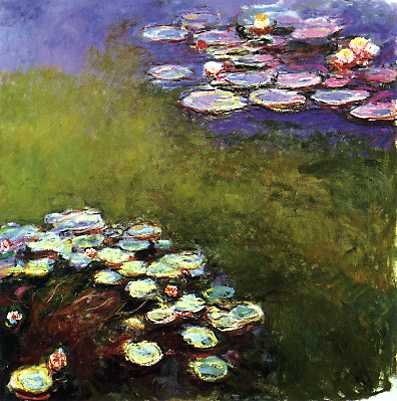
Nymphéas
(1916) Oil on canvas
Claude Monet
Musée Marmottan Monet
The Minneapolis Institute of Arts Web site has an interesting education section for young students called Object in Focus. One of the “objects” is Beauford’s raincoat painting Untitled (1954), which students are encouraged to compare and contrast to Monet’s The Japanese Bridge (c. 1923-1925). Both paintings are part of the museum’s permanent collection.

Untitled (raincoat painting)
Beauford Delaney
(1954) Oil on raincoat fragment
Minneapolis Institute of Arts
Minneapolis Institute of Arts
Photo courtesy of Sue Canterbury

The Japanese Bridge
(ca. 1923-1925) Claude Monet
Minneapolis Institute of Arts
The Michael Rosenfeld Gallery showed three of Beauford’s paintings in a 2009 exposition called Abstract Expressionism: Further Evidence. The catalog for this show describes Beauford’s Paris abstractions as “lyrical, colorful, [and] non-objective” and “pure and simplified expressions of light.” It goes on to say that “the paintings have clear ties to Monet’s studies of light…”
I believe that Beauford would have been first in line to see the current Monet exposition at the Grand Palais – if he could have gotten a ticket! I plan to go to the Orangerie to see Monet’s murals in honor of the occasion.
It's Not What You Think!
David Leeming indicates in his biography Amazing Grace that Beauford was rarely painted nudes because of his shyness. This makes the remembrance below, provided by Burt Reinfrank, even more interesting!
It was a beautiful, sunny autumn afternoon when I knocked on Beauford’s studio door. I heard the echo of Beauford’s voice back in the studio saying “I’m coming.” I could hear him shuffling to the door. It opened and Beauford, with hand outstretched, said “Come in.” I did and, as I looked down the narrow corridor, with white sheets hanging on both sides, into the studio, I saw a naked young man standing facing me full frontal reaching for his pants saying “It's not what you think, it's not what you think!” I hadn’t thought anything at that point, and Beauford was unperturbed.
As it happened, the young man (American) had recently been a guest of Jimmy Baldwin at his house in St. Paul de Vence, as had Beauford at the same time. While there, Beauford had started but not finished a nude portrait of him, which was now on an easel where Beauford was continuing to work on it.

My entrance had interrupted this sitting so we all sat down to a tea Beauford made for us. The young man (about 30) was from the western U.S. and lived on a property where the boundaries of three states came together. He regaled us with stories of that region.
That was the only time I saw this young man (circa 1965). But recently, in 2010, I saw a photograph of a group of Delaney paintings in a store room, one of which was a portrait of a nude man. I wonder if it is the finished version of “It’s not what you think”?
that Beauford was rarely painted nudes because of his shyness. This makes the remembrance below, provided by Burt Reinfrank, even more interesting!*******************
It was a beautiful, sunny autumn afternoon when I knocked on Beauford’s studio door. I heard the echo of Beauford’s voice back in the studio saying “I’m coming.” I could hear him shuffling to the door. It opened and Beauford, with hand outstretched, said “Come in.” I did and, as I looked down the narrow corridor, with white sheets hanging on both sides, into the studio, I saw a naked young man standing facing me full frontal reaching for his pants saying “It's not what you think, it's not what you think!” I hadn’t thought anything at that point, and Beauford was unperturbed.
As it happened, the young man (American) had recently been a guest of Jimmy Baldwin at his house in St. Paul de Vence, as had Beauford at the same time. While there, Beauford had started but not finished a nude portrait of him, which was now on an easel where Beauford was continuing to work on it.

Beauford's Paint Box
© Discover Paris!
My entrance had interrupted this sitting so we all sat down to a tea Beauford made for us. The young man (about 30) was from the western U.S. and lived on a property where the boundaries of three states came together. He regaled us with stories of that region.
That was the only time I saw this young man (circa 1965). But recently, in 2010, I saw a photograph of a group of Delaney paintings in a store room, one of which was a portrait of a nude man. I wonder if it is the finished version of “It’s not what you think”?
A Redhead in His Bed
Burt Reinfrank kindly sent the following anecdote about Beauford in his later years, when he was living at the studio on rue Vercingétorix. He indicated that this is a story that is told by others as well as himself.

It was a fall Saturday morning. Signs of a colder winter to come were in the air. Beauford’s health and his mental state had been slowly failing. The question was how much longer could he continue to live on his own? I had signed him up for a local version of Meals on Wheels, which worked for a while. But he had started to drink again. Some of his friends said squatters were trying to move into his studio.
I approached his door with a certain apprehension. At my knock I heard Beauford’s shuffle. The door opened and Beauford led me into his studio. On the small table by the arm chair were a couple of partly filled glasses of red wine and an almost empty wine bottle. The bed, with its traditional top cover of a white sheet, was made up but as I looked harder it seemed there was something in it and at the head, sticking out from the top of the sheet, a mass of long red hair. I thought “Good God. Beauford has a redheaded women in his bed.”
Beauford said nothing, and as I surveyed the scene the head from which the hair came slowly worked its way out of the bed. It was not a woman but a younger man along in his 30s who introduced himself as "Michael" and immediately went into the kitchen and made us all a coffee. Apparently he’d moved in with Beauford a short time before. He prepared Beauford’s food and they were obviously drinking a lot of red wine.
This was certainly one of the “squatters” I had heard mentioned in a negative way, but I thought this was what Beauford needed considering the condition he was in. Apart from the wine, the “squatter” got the food, prepared it, kept Beauford company, etc.
For some time, each time I visited I would give Beauford some cash which was a part of a payment for a painting I had bought from him. I now started giving the cash directly to Michael to pay for the food etc. he bought for the two of them. I trusted him and it worked well as long as it lasted.
Some said squatters might be stealing Beauford’s work. I asked Michael what he saw and he said no one had been by the studio except a young woman who came in, picked up a painting and left. She and Beauford seemed to know each other as they kissed both on her coming and going. I couldn’t think of anyone that Beauford knew who was young enough to meet that young lady’s description. To me, who she was still remains a mystery.
After Michael’s departure some weeks later Beauford’s health continued to decline.
********************

Beauford at his rue Vercingétorix studio, 1972
It was a fall Saturday morning. Signs of a colder winter to come were in the air. Beauford’s health and his mental state had been slowly failing. The question was how much longer could he continue to live on his own? I had signed him up for a local version of Meals on Wheels, which worked for a while. But he had started to drink again. Some of his friends said squatters were trying to move into his studio.
I approached his door with a certain apprehension. At my knock I heard Beauford’s shuffle. The door opened and Beauford led me into his studio. On the small table by the arm chair were a couple of partly filled glasses of red wine and an almost empty wine bottle. The bed, with its traditional top cover of a white sheet, was made up but as I looked harder it seemed there was something in it and at the head, sticking out from the top of the sheet, a mass of long red hair. I thought “Good God. Beauford has a redheaded women in his bed.”
Beauford said nothing, and as I surveyed the scene the head from which the hair came slowly worked its way out of the bed. It was not a woman but a younger man along in his 30s who introduced himself as "Michael" and immediately went into the kitchen and made us all a coffee. Apparently he’d moved in with Beauford a short time before. He prepared Beauford’s food and they were obviously drinking a lot of red wine.
This was certainly one of the “squatters” I had heard mentioned in a negative way, but I thought this was what Beauford needed considering the condition he was in. Apart from the wine, the “squatter” got the food, prepared it, kept Beauford company, etc.
For some time, each time I visited I would give Beauford some cash which was a part of a payment for a painting I had bought from him. I now started giving the cash directly to Michael to pay for the food etc. he bought for the two of them. I trusted him and it worked well as long as it lasted.
Some said squatters might be stealing Beauford’s work. I asked Michael what he saw and he said no one had been by the studio except a young woman who came in, picked up a painting and left. She and Beauford seemed to know each other as they kissed both on her coming and going. I couldn’t think of anyone that Beauford knew who was young enough to meet that young lady’s description. To me, who she was still remains a mystery.
After Michael’s departure some weeks later Beauford’s health continued to decline.
"Soul Brother" or The Haynes Restaurant Portrait
Below is another remembrance of Burt Reinfrank about Beauford. This one concerns a Delaney portrait at Haynes’ Restaurant.

We heard there was a Delaney painting hanging in Haynes Restaurant. I telephoned to confirm this and was told that the painting was a Delaney self-portrait. I knew that Haynes and Beauford had known one another, so I was curious to see it. I made a dinner reservation for 8 pm on March 9, 2001.
That evening, we found the Delaney portrait hanging on the wall of the dining room above the banquettes. It was well lit from above. Upon seeing the painting, I said to the young man and woman who greeted us and showed us to a table that if this was the restaurant’s Delaney portrait, it was not a self-portrait.

The personnel of the restaurant were aware that the painting had a certain value. They said that some months before, a woman from Atlanta had come by to see the painting. As she was organizing a Delaney exhibition, she asked if it might be loaned or sold. Her request was denied.
While not a Beauford self-portrait, the Haynes painting seemed familiar nonetheless. To investigate further, I looked over photographs that I had taken in Beauford’s studio years before. In a photo from January 1968, I saw the portrait from Haynes restaurant on the wall behind Beauford, who was seated on his bed. I remember the portrait had hung for some weeks on the studio wall, during which time Beauford made a few changes. These are visible in the photograph of the finished painting that I took at Haynes’ Restaurant in 2001.

Over the years that I visited Beauford in his studio, I saw many portraits hanging on the wall. They were waiting to be worked on further, to be signed off as sold, or given away. I heard recently that the Haynes’ Delaney had “Soul Brother” written on the back of the canvas. As I never saw the back of the painting at Beauford’s studio or at Haynes Restaurant, I cannot comment on this.
Haynes’ was the longest standing African-American-owned restaurant in Paris. For many years, Leroy Haynes regaled his customers with great Southern cuisine and his larger-than-life persona at 3, rue Clauzel in the 9th arrondissement. After his death in 1986, his widow Maria continued the tradition. Haynes’ Restaurant permanently closed its doors in 2009.

Haynes' Restaurant
© Discover Paris!
********************
We heard there was a Delaney painting hanging in Haynes Restaurant. I telephoned to confirm this and was told that the painting was a Delaney self-portrait. I knew that Haynes and Beauford had known one another, so I was curious to see it. I made a dinner reservation for 8 pm on March 9, 2001.
That evening, we found the Delaney portrait hanging on the wall of the dining room above the banquettes. It was well lit from above. Upon seeing the painting, I said to the young man and woman who greeted us and showed us to a table that if this was the restaurant’s Delaney portrait, it was not a self-portrait.

“Man with Cigarette” portrait at Haynes Restaurant
© 2001 Burton Reinfrank
The personnel of the restaurant were aware that the painting had a certain value. They said that some months before, a woman from Atlanta had come by to see the painting. As she was organizing a Delaney exhibition, she asked if it might be loaned or sold. Her request was denied.
While not a Beauford self-portrait, the Haynes painting seemed familiar nonetheless. To investigate further, I looked over photographs that I had taken in Beauford’s studio years before. In a photo from January 1968, I saw the portrait from Haynes restaurant on the wall behind Beauford, who was seated on his bed. I remember the portrait had hung for some weeks on the studio wall, during which time Beauford made a few changes. These are visible in the photograph of the finished painting that I took at Haynes’ Restaurant in 2001.

Beauford and “Man with Cigarette” portrait
© 1968 Burton Reinfrank
Over the years that I visited Beauford in his studio, I saw many portraits hanging on the wall. They were waiting to be worked on further, to be signed off as sold, or given away. I heard recently that the Haynes’ Delaney had “Soul Brother” written on the back of the canvas. As I never saw the back of the painting at Beauford’s studio or at Haynes Restaurant, I cannot comment on this.
Beauford and the Reinfrank Portrait
Burt Reinfrank was a close personal friend of Beauford. When I started this blog, Burt graciously consented to contribute remembrances of events and encounters with Beauford from time to time. I am pleased to share one of these below.
I had never thought of having a portrait done of myself. But in September 1966, when I saw the portrait Beauford was working on at his easel (a portrait of James Speyer, Curator of Twentieth-Century Art at the Art Institute of Chicago, and brother of Darthea Speyer), I asked Beauford if he would paint one of me of the same size He said he would, but stipulated, “You’ll have to bring me the canvas.” (Beauford was using a “60 F,” or “60 Figure,” canvas for the Speyer painting. “60 F” was an indication of the size and shape of the canvas, which measures 130 x 97 cm, or roughly 51 x 38 inches).
The following Saturday when I came by Beauford’s studio, Speyer’s portrait was still on the easel, but the color of the background and that of Speyer’s sweater had been reversed. When I mentioned this, Beauford said that when Speyer saw what he had done, he asked Beauford to reverse the colors. Beauford obliged him. Speyer soon left France for Chicago with the finished portrait, which he hung in the entry of home there (see Art in America, July-August 1967, page 40.)

A winter morning some months later, I arrived at Beauford’s studio with a 60 Figure white canvas, which Beauford immediately put on his easel. He sat me in a chair, picked up a piece of charcoal, sat down behind the canvas, and started to draw and talk. I realized immediately that I should have had a tape recorder with me. He talked about everything: his ancestral mix, his family, life experiences—some pleasant, some the opposite—but all with his understanding of their deeper meaning.
After one and one-half hours, Beauford stopped and said, “Come and have a look.” The drawing was superb! I thought to myself, “This is so good that I want to keep it as a drawing.” I said this to Beauford, who nodded but seemed to want to start painting immediately. I had my camera with me, so I took several shots of the drawing before I left. When I returned a week later, the drawing had disappeared under paint. The only remembrance I have of it is a photograph that I took just after completion (see photo below).

Although Beauford saw me from time to time while he was working on the portrait, the only time I ever posed for it was during the sitting for the original charcoal drawing. I told Beauford at the start of the project that I was not looking for a likeness, but rather, a “great portrait.”

The finished painting first went on public view in a retrospective of Beauford’s work at the American Cultural Center in an evening dedicated to Beauford on March 21, 1969. It was next shown in the exhibition “Twin Cities Collects” from September 2000 to January 2001 at the Walker Art Center in Minneapolis, Minnesota. The portrait appeared again on exhibition as part of the Delaney retrospective, “Beauford Delaney: From New York to Paris,” which began at the Minneapolis Institute of Arts in November 2004, traveled to the Knoxville Museum of Art and the Greenville County Museum of Art in 2005, and ended at the Philadelphia Museum of Art in January 2006.

********************
I had never thought of having a portrait done of myself. But in September 1966, when I saw the portrait Beauford was working on at his easel (a portrait of James Speyer, Curator of Twentieth-Century Art at the Art Institute of Chicago, and brother of Darthea Speyer), I asked Beauford if he would paint one of me of the same size He said he would, but stipulated, “You’ll have to bring me the canvas.” (Beauford was using a “60 F,” or “60 Figure,” canvas for the Speyer painting. “60 F” was an indication of the size and shape of the canvas, which measures 130 x 97 cm, or roughly 51 x 38 inches).
The following Saturday when I came by Beauford’s studio, Speyer’s portrait was still on the easel, but the color of the background and that of Speyer’s sweater had been reversed. When I mentioned this, Beauford said that when Speyer saw what he had done, he asked Beauford to reverse the colors. Beauford obliged him. Speyer soon left France for Chicago with the finished portrait, which he hung in the entry of home there (see Art in America, July-August 1967, page 40.)

James Speyer
1966, Oil on canvas
Collection of Anstiss and Ronald Kruek, Chicago
From the catalog Beauford Delaney: The Color Yellow (2002)
A winter morning some months later, I arrived at Beauford’s studio with a 60 Figure white canvas, which Beauford immediately put on his easel. He sat me in a chair, picked up a piece of charcoal, sat down behind the canvas, and started to draw and talk. I realized immediately that I should have had a tape recorder with me. He talked about everything: his ancestral mix, his family, life experiences—some pleasant, some the opposite—but all with his understanding of their deeper meaning.
After one and one-half hours, Beauford stopped and said, “Come and have a look.” The drawing was superb! I thought to myself, “This is so good that I want to keep it as a drawing.” I said this to Beauford, who nodded but seemed to want to start painting immediately. I had my camera with me, so I took several shots of the drawing before I left. When I returned a week later, the drawing had disappeared under paint. The only remembrance I have of it is a photograph that I took just after completion (see photo below).
Photo of Beauford Delaney drawing of Burton Reinfrank
© Burton Reinfrank
Although Beauford saw me from time to time while he was working on the portrait, the only time I ever posed for it was during the sitting for the original charcoal drawing. I told Beauford at the start of the project that I was not looking for a likeness, but rather, a “great portrait.”

Burton Reinfrank
1968, Oil on canvas
Image courtesy of Burton Reinfrank
The finished painting first went on public view in a retrospective of Beauford’s work at the American Cultural Center in an evening dedicated to Beauford on March 21, 1969. It was next shown in the exhibition “Twin Cities Collects” from September 2000 to January 2001 at the Walker Art Center in Minneapolis, Minnesota. The portrait appeared again on exhibition as part of the Delaney retrospective, “Beauford Delaney: From New York to Paris,” which began at the Minneapolis Institute of Arts in November 2004, traveled to the Knoxville Museum of Art and the Greenville County Museum of Art in 2005, and ended at the Philadelphia Museum of Art in January 2006.

Photo of the Reinfrank Portrait at the
Minneapolis Institute of Arts Exhibit
Minneapolis Institute of Arts Exhibit
© 2005 Robert Meier
Anatomy of an Art Exposition - Part 2
Last week, I brought you Sue Canterbury’s story of how she came to know Beauford’s work and decided to create the 2004-2005 one-show Beauford Delaney: From New York to Paris. This week’s posting brings you many of the behind-the-scenes details of the Minneapolis Institute of Arts (MIA) show.

Les Amis: How much space was devoted to the show?
Sue Canterbury: It was originally intended for a smaller gallery but, as luck would have it, the large special exhibition galleries became available due to alterations in the museum’s exhibition schedule (about a year before the show) and Delaney became the main event at the MIA in the fall of 2004.
Les Amis: How was it decided which paintings would be included in the show?
Sue Canterbury: I'm the person who made the selection. While the "From New York to Paris" transition was the heart of the show, I felt it was necessary to “bookend” the works I had rediscovered between what had preceded and followed them so people would be able to witness the stylistic developments and transitions in Beauford’s art. With the early Paris works restored to his history, it no longer seemed as if one was dealing with two artists but with an artist whose late abstracted figurative works of New York were not that far removed from the early, fully abstract works that would follow once he was in Paris.
Les Amis: What is the process for requesting loans of paintings (and perhaps documents or other items) for a show?
Sue Canterbury: Loans generally need to be place at least a year out from a show. Sometimes the odd thing can be slipped in later, but as the catalogue has to be written and edited far in advance, loans need to be in place as soon as possible. Dealers (Michael Rosenfeld, Patrick Albano, etc.), as well as Sylvain Briet, were helpful in passing on loan requests to private collectors.
Les Amis: How were the persons who wrote essays for the catalog selected?
Sue Canterbury: Ann Gibson had already written about Beauford on a couple occasions. I liked her work and was interested in her covering the New York figurative years. I was interested in having Michael Plante cover the late Paris years. I wanted to cover Delaney's transitional works of 1953-1960 as that period was key to the inquiry I wanted to make. I wanted to involve Sylvain Briet on the project because he and Philippe had uncovered and amassed an incredible amount of information. After Philippe’s untimely death, Sylvain had continued to compile what I consider the most thorough chronology of Beauford's life, work, exhibition history, etc.
Les Amis: Who decided what would be on the cover of the catalog?
Sue Canterbury: I'm guilty! That's a detail of a very special painting. It is the painting that was given to the Institute by Jacques and Solange du Closel. Until proven otherwise, it is the first known fully abstract expressionist work from Paris. It is also one of three paintings he did on 'canvas' made from the raincoat that Billy and Irene Rose gave him before he sailed from New York. Unfortunately, I don't know where the other two are or even if they still exist.

Les Amis: How is mounting a retrospective different than mounting a group exhibit?
Sue Canterbury: Well, it allows you to concentrate on one artist and one story. I should mention however, that Beauford Delaney: From New York to Paris was not a retrospective. I didn't cover the Knoxville or Boston years. Again, my interest was in the lost works of early Paris. I just added New York at the front, and post-1960 works at the end to give people a clear picture of his stylistic development.
Les Amis: What, if anything, was different about mounting the Delaney one-man show compared to other expositions that you have worked on?
Sue Canterbury: Because Delaney died only in 1979, there were still many people present who had known him. It gave immediacy to the project that is generally lacking when working on art or artists or much earlier periods or centuries. Thus, I was hearing all about Delaney directly from individuals who had known him well and cared deeply for him. The project took me on quite the ride. In New York, I visited with the artist Paul Jenkins, who called up Al Hirschfeld and asked if he had time to meet me. There I was the next day discussing Beauford and the exhibition. Or, there’s the time I arrived in Paris on a courier trip and, in hopes of finding Sylvain Briet had attempted to contact him prior to leaving Minneapolis. I had left my contact info of where I would be in Paris not knowing if he would get the message. The day I arrived I received a call from Sylvain in my Paris hotel room, with him asking me if I could catch a train to Normandy the next day to come and meet him. And, off I went.
Les Amis: Who decided which partner museums the show would travel to?
Sue Canterbury: Complex. I called several museums that I felt might be interested and sent out exhibition proposals. Knoxville, as his hometown, seemed a no-brainer. Greenville County Museum in South Carolina, on the other hand, hadn't been in my plans but they wanted the show AND they had the fantastic Washington Square work that I wanted to borrow. Philadelphia had a history with Beauford. He had been there and had painted portraits of individuals there. Of course, Richard Gibson was also from Philly. Additionally, Philadelphia is always keen to get good exhibitions and materials on African-American artists.
Les Amis: How was it decided how long the show would be exhibited at each museum?
Sue Canterbury: The duration of exhibitions is pretty standard. Most museums will run their shows on a 10- or 12-week schedule. Due to the recent economic downturn, however, some museums have been prolonging the length of their shows when possible.
Les Amis: Was there much need for collaboration among these museums regarding presentation of the works, etc., or were they simply packed up and shipped from one place to the next?
Sue Canterbury: There can be collaboration. It depends on the situation. Generally, label text copy (what you read on the label next to the painting), and didactic panel copy (a large panel of text that gives the visitor an overview of the works in that gallery) are provided as part of the rental contract in a traveling show and are sent to the next venue for each institution to produce according to their own practices or protocols. The venues generally try to follow the intellectual concept (respect for which is also part of the rental contract), but a hang also is heavily influenced by the space and architectural demands of each museum’s exhibition galleries.
The one thing that was consistent at all four venues was the special pedestal that housed the raincoat painting. It allowed people to look at the back of the work so they could see the double-stitched seam and the top-stitched pocket, etc.


Les Amis: How was the show financed?
Sue Canterbury: While museums set budgets, they're always desperate for alternate funding sources. In my case, The MIA applied for grants from the Henry Luce Foundation and the Judith Rothschild Foundation. (The Rothschild Foundation stipulates that any artist project they fund depends on the artist having died after 1978. Beauford just made it...1979.)
Les Amis: Are expositions expected to make money for the institutions exhibiting them?
Sue Canterbury: That is a dream to which most museums aspire but rarely see fulfilled. Generally, exhibitions don't make a profit or even break even. An institution generally hopes simply to defray expenses with tickets at the door, etc. In this exhibition's case, the Luce and Rothschild grants took a big bite out the projected budget expenses. Also, the rental fees paid by each of the travel venues were very helpful.
Les Amis: Was Beauford’s show profitable?
Sue Canterbury: Ultimately not, in the financial sense. Minneapolis will never have the amazing number of visitors that one sees at the Orsay, the Met, or the National Gallery. Its numbers are thought good if they are in the range of 60,000. Anything above that is pretty outstanding. Delaney pulled in about 22,000 visitors. However, when I realized that 22,000 people paid to see a show about an artist they had never heard of before, I actually felt rather good about the final count. (I still have people comment to me about the Delaney exhibition having been their favorite—and they aren’t even aware thatI was the curator of the exhibition. That makes me feel good. Also, the exhibition was awarded best exhibition of the year by a local magazine.)
On another level, the exhibition built an important bridge to the local African-American community. On yet another, very meaningful level, we also received the raincoat painting as a gift from the Du Closel's in appreciation of our doing the show on Beauford. People love that painting and the story. Another measure of success, I should add, is that the catalogue sold out completely. It's out of print. I recall that Philadelphia had to ask for additional catalogues beyond the number allotted in their contract.

ArtsMIA Web page for Beauford’s show
Les Amis: How much space was devoted to the show?
Sue Canterbury: It was originally intended for a smaller gallery but, as luck would have it, the large special exhibition galleries became available due to alterations in the museum’s exhibition schedule (about a year before the show) and Delaney became the main event at the MIA in the fall of 2004.
Les Amis: How was it decided which paintings would be included in the show?
Sue Canterbury: I'm the person who made the selection. While the "From New York to Paris" transition was the heart of the show, I felt it was necessary to “bookend” the works I had rediscovered between what had preceded and followed them so people would be able to witness the stylistic developments and transitions in Beauford’s art. With the early Paris works restored to his history, it no longer seemed as if one was dealing with two artists but with an artist whose late abstracted figurative works of New York were not that far removed from the early, fully abstract works that would follow once he was in Paris.
Les Amis: What is the process for requesting loans of paintings (and perhaps documents or other items) for a show?
Sue Canterbury: Loans generally need to be place at least a year out from a show. Sometimes the odd thing can be slipped in later, but as the catalogue has to be written and edited far in advance, loans need to be in place as soon as possible. Dealers (Michael Rosenfeld, Patrick Albano, etc.), as well as Sylvain Briet, were helpful in passing on loan requests to private collectors.
Les Amis: How were the persons who wrote essays for the catalog selected?
Sue Canterbury: Ann Gibson had already written about Beauford on a couple occasions. I liked her work and was interested in her covering the New York figurative years. I was interested in having Michael Plante cover the late Paris years. I wanted to cover Delaney's transitional works of 1953-1960 as that period was key to the inquiry I wanted to make. I wanted to involve Sylvain Briet on the project because he and Philippe had uncovered and amassed an incredible amount of information. After Philippe’s untimely death, Sylvain had continued to compile what I consider the most thorough chronology of Beauford's life, work, exhibition history, etc.
Les Amis: Who decided what would be on the cover of the catalog?
Sue Canterbury: I'm guilty! That's a detail of a very special painting. It is the painting that was given to the Institute by Jacques and Solange du Closel. Until proven otherwise, it is the first known fully abstract expressionist work from Paris. It is also one of three paintings he did on 'canvas' made from the raincoat that Billy and Irene Rose gave him before he sailed from New York. Unfortunately, I don't know where the other two are or even if they still exist.

ArtsMIA Catalog Cover
Les Amis: How is mounting a retrospective different than mounting a group exhibit?
Sue Canterbury: Well, it allows you to concentrate on one artist and one story. I should mention however, that Beauford Delaney: From New York to Paris was not a retrospective. I didn't cover the Knoxville or Boston years. Again, my interest was in the lost works of early Paris. I just added New York at the front, and post-1960 works at the end to give people a clear picture of his stylistic development.
Les Amis: What, if anything, was different about mounting the Delaney one-man show compared to other expositions that you have worked on?
Sue Canterbury: Because Delaney died only in 1979, there were still many people present who had known him. It gave immediacy to the project that is generally lacking when working on art or artists or much earlier periods or centuries. Thus, I was hearing all about Delaney directly from individuals who had known him well and cared deeply for him. The project took me on quite the ride. In New York, I visited with the artist Paul Jenkins, who called up Al Hirschfeld and asked if he had time to meet me. There I was the next day discussing Beauford and the exhibition. Or, there’s the time I arrived in Paris on a courier trip and, in hopes of finding Sylvain Briet had attempted to contact him prior to leaving Minneapolis. I had left my contact info of where I would be in Paris not knowing if he would get the message. The day I arrived I received a call from Sylvain in my Paris hotel room, with him asking me if I could catch a train to Normandy the next day to come and meet him. And, off I went.
Les Amis: Who decided which partner museums the show would travel to?
Sue Canterbury: Complex. I called several museums that I felt might be interested and sent out exhibition proposals. Knoxville, as his hometown, seemed a no-brainer. Greenville County Museum in South Carolina, on the other hand, hadn't been in my plans but they wanted the show AND they had the fantastic Washington Square work that I wanted to borrow. Philadelphia had a history with Beauford. He had been there and had painted portraits of individuals there. Of course, Richard Gibson was also from Philly. Additionally, Philadelphia is always keen to get good exhibitions and materials on African-American artists.
Les Amis: How was it decided how long the show would be exhibited at each museum?
Sue Canterbury: The duration of exhibitions is pretty standard. Most museums will run their shows on a 10- or 12-week schedule. Due to the recent economic downturn, however, some museums have been prolonging the length of their shows when possible.
Les Amis: Was there much need for collaboration among these museums regarding presentation of the works, etc., or were they simply packed up and shipped from one place to the next?
Sue Canterbury: There can be collaboration. It depends on the situation. Generally, label text copy (what you read on the label next to the painting), and didactic panel copy (a large panel of text that gives the visitor an overview of the works in that gallery) are provided as part of the rental contract in a traveling show and are sent to the next venue for each institution to produce according to their own practices or protocols. The venues generally try to follow the intellectual concept (respect for which is also part of the rental contract), but a hang also is heavily influenced by the space and architectural demands of each museum’s exhibition galleries.
The one thing that was consistent at all four venues was the special pedestal that housed the raincoat painting. It allowed people to look at the back of the work so they could see the double-stitched seam and the top-stitched pocket, etc.

Pedestal for raincoat painting
Display at Knoxville Museum of Art
Photo courtesy of Sue Canterbury

Untitled (raincoat painting) by Beauford Delaney
(1954) Oil on raincoat fragment
Photo courtesy of Sue Canterbury

Untitled (raincoat painting - rear) by Beauford Delaney
(1954) Oil on raincoat fragment
Photo courtesy of Sue Canterbury
Les Amis: How was the show financed?
Sue Canterbury: While museums set budgets, they're always desperate for alternate funding sources. In my case, The MIA applied for grants from the Henry Luce Foundation and the Judith Rothschild Foundation. (The Rothschild Foundation stipulates that any artist project they fund depends on the artist having died after 1978. Beauford just made it...1979.)
Les Amis: Are expositions expected to make money for the institutions exhibiting them?
Sue Canterbury: That is a dream to which most museums aspire but rarely see fulfilled. Generally, exhibitions don't make a profit or even break even. An institution generally hopes simply to defray expenses with tickets at the door, etc. In this exhibition's case, the Luce and Rothschild grants took a big bite out the projected budget expenses. Also, the rental fees paid by each of the travel venues were very helpful.
Les Amis: Was Beauford’s show profitable?
Sue Canterbury: Ultimately not, in the financial sense. Minneapolis will never have the amazing number of visitors that one sees at the Orsay, the Met, or the National Gallery. Its numbers are thought good if they are in the range of 60,000. Anything above that is pretty outstanding. Delaney pulled in about 22,000 visitors. However, when I realized that 22,000 people paid to see a show about an artist they had never heard of before, I actually felt rather good about the final count. (I still have people comment to me about the Delaney exhibition having been their favorite—and they aren’t even aware thatI was the curator of the exhibition. That makes me feel good. Also, the exhibition was awarded best exhibition of the year by a local magazine.)
On another level, the exhibition built an important bridge to the local African-American community. On yet another, very meaningful level, we also received the raincoat painting as a gift from the Du Closel's in appreciation of our doing the show on Beauford. People love that painting and the story. Another measure of success, I should add, is that the catalogue sold out completely. It's out of print. I recall that Philadelphia had to ask for additional catalogues beyond the number allotted in their contract.
Anatomy of an Art Exposition - Part 1
Sue Canterbury was the curator of the magnificent exhibit entitled Beauford Delaney: From New York to Paris that originated at the Minneapolis Institute of Arts (November 21, 2004 – February 20, 2005) and was subsequently presented by the Knoxville Museum of Art (April 8 – June 25, 2005), the Greenville County Museum of Art (August 3 – October 2, 2005), and the Philadelphia Museum of Art (November 12, 2005 – January 28, 2006).

As a novice to the art world, I was curious to learn how this latest one-man exposition of Beauford’s work was conceived of and put together. Sue graciously explained this to me, beginning with how she discovered Beauford’s work:

Sue chose to do the Delaney exposition because of her rapidly growing passion for Beauford’s work. It was her responsibility to 1) craft the concept; 2) locate the objects in order to develop an object checklist for the exhibition; 3) find new information through research of old catalogues, books, magazines, etc) and, in the case of Beauford by talking to people who actually had known him, etc.; and 4) arrange for the conservation of several objects. An example is the Richard Gibson portrait, the conservation of which was performed by a London conservator. Many works were in need of cleaning or required framing. Two works were in extremely rough shape and needed major intervention. Sue feels very gratified that these works were saved for posterity.
The budget for the exhibition was very slim and, consequently, a great deal of Sue’s research had to be piggy-backed onto courier trips to New York, London, and Paris. (An institution that borrows paintings from another institution for an exhibition pays for a courier to accompany the work to its facility.). Sue would often tack on a few extra days to extend the time available for research, interviews, and visits with collectors.
Next week: The behind-the-scenes details of the Minneapolis Institute of Arts (MIA) show.

ArtsMIA Web page for Beauford’s show
As a novice to the art world, I was curious to learn how this latest one-man exposition of Beauford’s work was conceived of and put together. Sue graciously explained this to me, beginning with how she discovered Beauford’s work:
I arrived at the Minneapolis Institute of Arts in the summer of 1998. Sometime during my first year, I met Burt and Patricia Reinfrank. If I recall correctly how things unfolded, they had contacted my boss and I (my boss having arrived about 9 months before I ) with an interest in lending Jazz Quartet (1945) by Delaney for display in our permanent galleries. (It's worth noting that before meeting them, I had never heard of Beauford Delaney.)

Jazz Quartet
Beauford Delaney
(1946) Oil on canvas
Courtesy of Burt and Patricia Reinfrank
As I learned more through them, Burt floated the idea of an exhibition. I was intrigued by the idea for the following reasons: 1) Delaney was an artist with an interesting body of work but of whom I had never heard; 2) I was particularly engaged by what I saw as his (then) two bodies work--the New York figurative and the ca. 1960 and after abstract expressionist works. I felt as though I was viewing the work of two different artists. Where was the stylistic bridge between the New York and Paris works? The link was absent in all the literature I had seen thus far.
That last bit (#2) was what particularly intrigued me. I always have to find a hook to any project I choose to undertake. The quest to uncover new connections is what drives my passion about something. I'm not interested in covering material already treated by other exhibitions.Sue went on to say that while curators can sometimes be assigned projects, they much prefer to choose their own. It is the curator's job to make a compelling case for a proposed project to colleagues and the museum director. Once a presentation of the proposal is made, and if the project is approved, then the framework of budgets and schedules can be put in place so all phases will come together in a timely manner.
Sue chose to do the Delaney exposition because of her rapidly growing passion for Beauford’s work. It was her responsibility to 1) craft the concept; 2) locate the objects in order to develop an object checklist for the exhibition; 3) find new information through research of old catalogues, books, magazines, etc) and, in the case of Beauford by talking to people who actually had known him, etc.; and 4) arrange for the conservation of several objects. An example is the Richard Gibson portrait, the conservation of which was performed by a London conservator. Many works were in need of cleaning or required framing. Two works were in extremely rough shape and needed major intervention. Sue feels very gratified that these works were saved for posterity.
The budget for the exhibition was very slim and, consequently, a great deal of Sue’s research had to be piggy-backed onto courier trips to New York, London, and Paris. (An institution that borrows paintings from another institution for an exhibition pays for a courier to accompany the work to its facility.). Sue would often tack on a few extra days to extend the time available for research, interviews, and visits with collectors.
Next week: The behind-the-scenes details of the Minneapolis Institute of Arts (MIA) show.
Beauford's Works at Christie's Paris -- The Auction

Christie's Paris
© Discover Paris!
The auction of the Darthea Speyer collection at Christie's Paris took place on Wednesday, 7 July 2010. Six Delaney paintings were among the 432 works sold.
I was fortunate enough to be able to see Beauford's works at Christie's before the auction. The photo below shows the portraits as they were displayed in the Salon Matignon IV.

Beauford's Portraits at Christie's Paris
© Discover Paris!

The two abstractions were harder to photograph due to their placement in the hallway outside Salon Matignon IV, where there was terrible glare as well as unavoidable reflections.

Untitled
(not dated) Pastel on paper
© Discover Paris!
Untitled (dedicated to Darthea Speyer)
(1961) Ink, inkwash, and aquarelle on paper
© Discover Paris!The ink, inkwash, and aquarelle painting is dated 1961, not 1981 as reported in the catalog. In last week's posting, I noted that either a mistake had been made in the catalog's notation (Beauford died in 1979), or he was unaware of the year when he created the painting (he had suffered a severe mental crisis several weeks prior to painting it). The former is true - the label text posted next to the painting at Christie's had been corrected by hand.

Signature for Untitled (dedicated to Darthea Speyer)
(1961) Ink, inkwash, and aquarelle on paper
© Discover Paris!

Label for Untitled (dedicated to Darthea Speyer)
(1961) Ink, inkwash, and aquarelle on paper
© Discover Paris!
In last week's posting and in the one called Beauford at Galerie Darthea Speyer, I reported that the Beauford Delaney paintings held by Galerie Darthea Speyer would be donated to the Smithsonian. I now have clarification on this issue - Mme Emmanuelle Gelzer-Remy, a former employee of the gallery, has informed me that only the gallery's documents related to Beauford have been donated to the Smithsonian Institution Archives. The paintings were held by Christie's, until today's sale.

Salle James Christie (auction room) at Christie's Paris
© Discover Paris!
As for the auction itself, Beauford's works went very quickly. It was apparent that people were prepared to bid on them ahead of time, because most of the bids came in by phone or Internet. Beauford's untitled pastel commanded the greatest price – 10,000 euros / ~$12,500. His portrait of Jean Genet sold for 8,500 euros / ~$10,625. The ink, ink wash, and aquarelle went for 7,000 euros / ~$8,750, and the other portraits sold for 6500 euros to 7500 euros (~$8125 to $9375). The sale of all six pieces took only ten minutes!
Beauford's Works at Christie's Paris
In July, Christie's Paris is auctioning an incredible selection of art works and personal items owned by Darthea Speyer. The Darthea Speyer Gallery closed its doors permanently at the beginning of this year, and the Christie's auction is part of the total liquidation of the gallery's collection.

Among the collection are six paintings by Beauford. See pages 38-39 of Christie's e-catalog for a listing of these works. Two of them are abstractions and the remaining four are portraits. The price range for the abstractions is $2700 to $5300, while the range for the portraits is $11,000 to $20,000. The portrait of Vassili Pikoula (see below)—displayed at the American Cultural Center in 1961, the Darthea Speyer Gallery in 1973 and 1992, the Studio Museum in Harlem in 1978, and the First American Triennal at Maubeuge in 1993—is the most expensive of the portraits available for purchase.

The astute observer will notice that there is an anomaly in the catalog listing for Entry 262, a vividly colored ink, ink wash, and aquarelle abstraction. The dedication indicated for this painting—"Beauford Delaney Mallorca 1981 for miss Darthea Speyer"—is dated two years after Beauford's death! In fact, Beauford visited Majorca in the summer of 1961, the year that he suffered a severe mental breakdown while on his way to Greece. He was to have enjoyed an artistic "sabbatical" there, which had been arranged by Darthea Speyer. After several days of hospitalization, Speyer arranged for Beauford to return to France. His dear friends Charley and Gita Boggs then took him to Spain to help him recover from that breakdown. Either the person who provided the information for the Entry 262 misread Beauford's dedication, or Beauford himself was not aware of what year it was when he created this painting.
When I spoke with a representative of the Speyer Gallery in January of this year, I was told that the gallery would donate its collection of Delaneys to the Smithsonian Institute. At the time of this writing, I do not know if some of these Delaneys were in fact donated so that the paintings on auction at Christie's represent the remainder of the Speyer collection, or if none of the Delaneys were donated to the Smithsonian.
The Christie's auction will be held on July 7, 2010 at 2 PM. The entire Speyer collection will be on public display on the following dates:
Saturday, July 3 – 10 AM to 6 PM
Monday, July 5 – 10 AM to 6 PM
Tuesday, July 6 – 10 AM to 6 PM
Wednesday, July 7 – 10 AM to 12 Noon
For those living in Paris, or visiting during the first week of July, this represents a rare opportunity to see Beauford's works in person—an occasion not to be missed!
Christie's
9, avenue Matignon
75008 Paris
Tel: 33(0)1 40 76 85 85

Beauford and Darthea
Invitation card for 1973 exhibit at Galerie Darthea Speyer
Courtesy of Galerie Darthea Speyer
Among the collection are six paintings by Beauford. See pages 38-39 of Christie's e-catalog for a listing of these works. Two of them are abstractions and the remaining four are portraits. The price range for the abstractions is $2700 to $5300, while the range for the portraits is $11,000 to $20,000. The portrait of Vassili Pikoula (see below)—displayed at the American Cultural Center in 1961, the Darthea Speyer Gallery in 1973 and 1992, the Studio Museum in Harlem in 1978, and the First American Triennal at Maubeuge in 1993—is the most expensive of the portraits available for purchase.

Courtesy of Galerie Darthea Speyer
The astute observer will notice that there is an anomaly in the catalog listing for Entry 262, a vividly colored ink, ink wash, and aquarelle abstraction. The dedication indicated for this painting—"Beauford Delaney Mallorca 1981 for miss Darthea Speyer"—is dated two years after Beauford's death! In fact, Beauford visited Majorca in the summer of 1961, the year that he suffered a severe mental breakdown while on his way to Greece. He was to have enjoyed an artistic "sabbatical" there, which had been arranged by Darthea Speyer. After several days of hospitalization, Speyer arranged for Beauford to return to France. His dear friends Charley and Gita Boggs then took him to Spain to help him recover from that breakdown. Either the person who provided the information for the Entry 262 misread Beauford's dedication, or Beauford himself was not aware of what year it was when he created this painting.
When I spoke with a representative of the Speyer Gallery in January of this year, I was told that the gallery would donate its collection of Delaneys to the Smithsonian Institute. At the time of this writing, I do not know if some of these Delaneys were in fact donated so that the paintings on auction at Christie's represent the remainder of the Speyer collection, or if none of the Delaneys were donated to the Smithsonian.
The Christie's auction will be held on July 7, 2010 at 2 PM. The entire Speyer collection will be on public display on the following dates:
Saturday, July 3 – 10 AM to 6 PM
Monday, July 5 – 10 AM to 6 PM
Tuesday, July 6 – 10 AM to 6 PM
Wednesday, July 7 – 10 AM to 12 Noon
For those living in Paris, or visiting during the first week of July, this represents a rare opportunity to see Beauford's works in person—an occasion not to be missed!
Christie's
9, avenue Matignon
75008 Paris
Tel: 33(0)1 40 76 85 85