

Beauford's "Fontana"
In the posting entitled Burt and Pat Reinfrank Remember Beauford, I mentioned that Burt relayed an anecdote to me about a painting that Beauford created in the style of the slash series of artist Lucio Fontana. Here is an image of the painting:

Untitled
(ca. 1960-61) Gouache on paper
Photo courtesy of Burt and Pat Reinfrank
and here is the story:
Beauford often brought gifts when he was invited to people's homes. He gave the painting shown above to James and Gloria Jones at Christmas in 1960 or 1961. It is inscribed as a gift to "Jimmy and Gloria Jones." (James Jones was one of four independent collectors of Beauford's works in Paris — the others were Ahmed Bioud, Solange du Closel, and the Reinfranks.)
After Jones' death, Gloria Jones gave most of the Jones' collection to Darthea Speyer to sell.
Years later, the gouache shown above was put up for sale on Ebay. Burt saw the black strokes in the painting that mimic the cuts in Lucio Fontana's works and remembered that he and Beauford had discussed Fontana's "slash style" at around the time that the painting is dated. He believes that Beauford created this untitled work soon after that conversation.
The painting did not sell on Ebay and Burt was able to obtain it offline from the person who put the work up for sale.

(ca. 1960-61) Gouache on paper
Photo courtesy of Burt and Pat Reinfrank
and here is the story:
Beauford often brought gifts when he was invited to people's homes. He gave the painting shown above to James and Gloria Jones at Christmas in 1960 or 1961. It is inscribed as a gift to "Jimmy and Gloria Jones." (James Jones was one of four independent collectors of Beauford's works in Paris — the others were Ahmed Bioud, Solange du Closel, and the Reinfranks.)
After Jones' death, Gloria Jones gave most of the Jones' collection to Darthea Speyer to sell.
Years later, the gouache shown above was put up for sale on Ebay. Burt saw the black strokes in the painting that mimic the cuts in Lucio Fontana's works and remembered that he and Beauford had discussed Fontana's "slash style" at around the time that the painting is dated. He believes that Beauford created this untitled work soon after that conversation.
The painting did not sell on Ebay and Burt was able to obtain it offline from the person who put the work up for sale.
Beauford at the Armory Show 2012
The Armory Show was held from March 8-11, 2012 at Piers 92 and 94 in Manhattan. Pier 92 was dedicated to international dealers specializing in historically significant Modern and contemporary art. The Michael Rosenfeld Gallery had exhibit space at Pier 92 and showed three of Beauford's paintings among the works of forty artists:

Untitled
(1958) Gouache on paper
25 1/2" x 19 5/8", signed and dated
© Estate of Beauford Delaney
Courtesy of Michael Rosenfeld Gallery LLC, New York , NY

Untitled
(1959) Gouache on paper
25 5/8" x 19 3/4", signed and dated
© Estate of Beauford Delaney
Courtesy of Michael Rosenfeld Gallery LLC, New York , NY

Untitled
(1959) Gouache on paper
25" x 19 5/8", signed and dated
© Estate of Beauford Delaney
Courtesy of Michael Rosenfeld Gallery LLC, New York , NY
All of these works were produced during Beauford's Paris years, when he lived in the suburban town of Clamart. During the summer of 1958, he began using color in his paintings to convey the tumult of his inner life - to embrace and confront it as opposed to repelling it through painting as he had done previously. By the end of the year, he was preparing for two group shows to be held in 1959.

(1958) Gouache on paper
25 1/2" x 19 5/8", signed and dated
© Estate of Beauford Delaney
Courtesy of Michael Rosenfeld Gallery LLC, New York , NY

(1959) Gouache on paper
25 5/8" x 19 3/4", signed and dated
© Estate of Beauford Delaney
Courtesy of Michael Rosenfeld Gallery LLC, New York , NY

(1959) Gouache on paper
25" x 19 5/8", signed and dated
© Estate of Beauford Delaney
Courtesy of Michael Rosenfeld Gallery LLC, New York , NY
All of these works were produced during Beauford's Paris years, when he lived in the suburban town of Clamart. During the summer of 1958, he began using color in his paintings to convey the tumult of his inner life - to embrace and confront it as opposed to repelling it through painting as he had done previously. By the end of the year, he was preparing for two group shows to be held in 1959.
Beauford at the Whitney Studio Galleries - 1930
According to David A. Leeming, author of Amazing Grace: A Life of Beauford Delaney :
:
Beauford's first major break as a painter came in January 1930 when he approached a woman named Mungo Park about his work. Park worked at the Whitney Studio Galleries, which would become the Whitney Museum of American Art the following year.
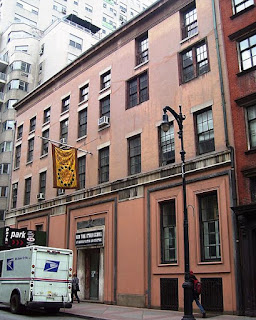
Original location of the Whitney Studio Galleries
8-12 West 8th Street, Manhattan
Photo by Beyond My Ken from Wikipedia
Park looked at Beauford's portfolio of drawings and introduced him to Juliana Force, director of purchasing and exhibition at the Whitney. Force offered Beauford the chance to exhibit his art at a four-person show that ran from February 26 to March 8, 1930, with the only stipulation being that he produce additional pieces for the event. He worked diligently, and entered the exhibit with three oil portraits and nine pastels.

Juliana Force
Photo from Flickr
Beauford won first prize at this show for a pastel drawing of Billy Pierce, who was his employer at the time. Pierce was the owner of a dance school where Beauford had begun making a name for himself with his pastel and charcoal drawings of the school's dancers and clients. These drawings were part of the portfolio that Beauford showed to Mungo Park to earn a place in the show.
The remaining drawings that Beauford entered in the Whitney show were all awarded honorable mention.
As a result of his interaction with Miss Park and Mrs. Force, the Whitney offered Beauford a job as caretaker and offered him living space and a studio in the basement of the building. This was the beginning of his stay in Greenwich Village.
:Beauford's first major break as a painter came in January 1930 when he approached a woman named Mungo Park about his work. Park worked at the Whitney Studio Galleries, which would become the Whitney Museum of American Art the following year.

8-12 West 8th Street, Manhattan
Photo by Beyond My Ken from Wikipedia
Park looked at Beauford's portfolio of drawings and introduced him to Juliana Force, director of purchasing and exhibition at the Whitney. Force offered Beauford the chance to exhibit his art at a four-person show that ran from February 26 to March 8, 1930, with the only stipulation being that he produce additional pieces for the event. He worked diligently, and entered the exhibit with three oil portraits and nine pastels.

Photo from Flickr
Beauford won first prize at this show for a pastel drawing of Billy Pierce, who was his employer at the time. Pierce was the owner of a dance school where Beauford had begun making a name for himself with his pastel and charcoal drawings of the school's dancers and clients. These drawings were part of the portfolio that Beauford showed to Mungo Park to earn a place in the show.
The remaining drawings that Beauford entered in the Whitney show were all awarded honorable mention.
As a result of his interaction with Miss Park and Mrs. Force, the Whitney offered Beauford a job as caretaker and offered him living space and a studio in the basement of the building. This was the beginning of his stay in Greenwich Village.
Beauford at the Roko Gallery for Negro History Week 1949
For Les Amis' last blog posting for Black History Month 2012, I am pleased that I have unearthed a tidbit of information to share about Beauford and the celebration of African-American history in the U.S. I found it in David Leeming's biography entitled Amazing Grace: A Life of Beauford Delaney .
.
Beauford exhibited paintings at the now defunct Roko Gallery in February 1949 in a group show of African-American artists as a celebration of Negro History Week. One of the works shown was his Still Life with Pears (aka Still Life with Fruit), shown below:

Still Life with Pears
(1946) Oil on canvas
Image from the Artsmia.org Website
This painting was particularly admired by art critic Elaine de Koonig, who described it as being a "violent impasto."
According to Leeming, most of the paintings that Beauford entered into this show were "expressionistic." But he also exhibited a painting of a "specifically African-American subject" called Harlem Blue. It depicted a nighttime Harlem scene that Beauford rendered in the style of his Greene Street paintings.
.Beauford exhibited paintings at the now defunct Roko Gallery in February 1949 in a group show of African-American artists as a celebration of Negro History Week. One of the works shown was his Still Life with Pears (aka Still Life with Fruit), shown below:

(1946) Oil on canvas
Image from the Artsmia.org Website
This painting was particularly admired by art critic Elaine de Koonig, who described it as being a "violent impasto."
According to Leeming, most of the paintings that Beauford entered into this show were "expressionistic." But he also exhibited a painting of a "specifically African-American subject" called Harlem Blue. It depicted a nighttime Harlem scene that Beauford rendered in the style of his Greene Street paintings.
Two Beauford Delaneys Sold at 2012 African-American Fine Art Auction
As I reported a couple of weeks ago, Swann Galleries proposed three Beauford Delaney works it its February 2012 African-American Fine Art auction. Here are the results:
Lot 22 (my favorite of the three paintings) sold for $15,000*, the lower limit of the estimated sales price.

Lot 22
Untitled (Abstract Composition)
(1961) Oil monotype on heavy wove paper
Photo courtesy of Swann Auction Galleries
Lot 129 is unsold.

Lot 129
Untitled
(1962) Gouache and watercolor on wove paper
Photo courtesy of Swann Auction Galleries
Lot 130 sold for $14,000*. The upper limit of the estimated sale price was $15,000.

Lot 130
Untitled (Abstraction in Green)
(1964) Gouache on thick wove paper
Photo courtesy of Swann Auction Galleries
Swann Galleries generally holds two African-American Fine Art auctions each year - one in February and one in October. If any of Beauford's works will be offered for sale during the next auction, I'll report on it here!
*At auction, there are two prices--the hammer price, or the price at which the item sells during the auction, and the price with the buyer's premium. All auction houses have a buyer's premium that the buyer pays to the auction house on top of the hammer price. Swann's premium is 20%. The prices indicated in this article are hammer prices.
Lot 22 (my favorite of the three paintings) sold for $15,000*, the lower limit of the estimated sales price.

Untitled (Abstract Composition)
(1961) Oil monotype on heavy wove paper
Photo courtesy of Swann Auction Galleries
Lot 129 is unsold.

Untitled
(1962) Gouache and watercolor on wove paper
Photo courtesy of Swann Auction Galleries
Lot 130 sold for $14,000*. The upper limit of the estimated sale price was $15,000.

Untitled (Abstraction in Green)
(1964) Gouache on thick wove paper
Photo courtesy of Swann Auction Galleries
Swann Galleries generally holds two African-American Fine Art auctions each year - one in February and one in October. If any of Beauford's works will be offered for sale during the next auction, I'll report on it here!
*At auction, there are two prices--the hammer price, or the price at which the item sells during the auction, and the price with the buyer's premium. All auction houses have a buyer's premium that the buyer pays to the auction house on top of the hammer price. Swann's premium is 20%. The prices indicated in this article are hammer prices.
Where to Find Beauford’s Art: Bill Hodges Gallery
Bill Hodges is a champion of Beauford’s art. He has shown Beauford’s work in past expositions at his Manhattan gallery and presents images of ten Beauford Delaney paintings on his Web site.
One of the paintings shown on the site – Woman in White – is in Hodges’ personal collection:

Woman in White
(1964-65) Oil on canvas
Photo from Bill Hodges Gallery Web site
Several images on the Web site are found in two catalogs from the past expositions in which Hodges showcased Beauford’s work. They are entitled African American Artists - III and Abstractionist Visions: Works on Paper. A third catalog – African-American Artists - II – contains images that are not displayed on line.
I found the images from Abstractionists Visions to be absolutely stunning! Unfortunately, I am not able to reproduce them for you on this blog. To see some of them, visit www.billhodgesgallery.com/aaindex.html and click on Beauford’s name. (I have noted that the images in the catalog are much more vibrant and powerful than the ones online.)
Hodges makes several observations about Beauford’s paintings in the Abstractionists Visions catalog. He states that Beauford’s “use of strong and vibrant colors is utterly remarkable,” and expresses his conviction that the strength of the works on paper that he included in the exposition “far exceed many works on canvas.” He goes even further, stating that he had “yet to see a canvas by Delaney that exceeds the vigor of the works on pages 5, 6, and 7” (from left to right, images #3, #6, and #8 of the reproductions of abstract paintings on the Web site).
Contrary to what is indicated on the Web site, the painting below (which was not included in any of the catalogs) has not yet been sold.

Untitled*
Abstraction in Pink, Yellow, and Green
(1964) Oil on paper
Photo from Bill Hodges Gallery Web site
To see Woman in White, and to pick up your catalogs, visit the Bill Hodges Gallery:
Bill Hodges Gallery
24 West 57th St.
New York, NY 10019
Tel: 212-333-2640
Fax: 212-333-2644
Gallery Hours
Tuesday to Friday: 10am-6pm
Saturday: 12:30pm-5:30pm
*A viewing of Untitled can be requested by calling the gallery in advance of your visit.
One of the paintings shown on the site – Woman in White – is in Hodges’ personal collection:

(1964-65) Oil on canvas
Photo from Bill Hodges Gallery Web site
Several images on the Web site are found in two catalogs from the past expositions in which Hodges showcased Beauford’s work. They are entitled African American Artists - III and Abstractionist Visions: Works on Paper. A third catalog – African-American Artists - II – contains images that are not displayed on line.
I found the images from Abstractionists Visions to be absolutely stunning! Unfortunately, I am not able to reproduce them for you on this blog. To see some of them, visit www.billhodgesgallery.com/aaindex.html and click on Beauford’s name. (I have noted that the images in the catalog are much more vibrant and powerful than the ones online.)
Hodges makes several observations about Beauford’s paintings in the Abstractionists Visions catalog. He states that Beauford’s “use of strong and vibrant colors is utterly remarkable,” and expresses his conviction that the strength of the works on paper that he included in the exposition “far exceed many works on canvas.” He goes even further, stating that he had “yet to see a canvas by Delaney that exceeds the vigor of the works on pages 5, 6, and 7” (from left to right, images #3, #6, and #8 of the reproductions of abstract paintings on the Web site).
Contrary to what is indicated on the Web site, the painting below (which was not included in any of the catalogs) has not yet been sold.

Abstraction in Pink, Yellow, and Green
(1964) Oil on paper
Photo from Bill Hodges Gallery Web site
To see Woman in White, and to pick up your catalogs, visit the Bill Hodges Gallery:
Bill Hodges Gallery
24 West 57th St.
New York, NY 10019
Tel: 212-333-2640
Fax: 212-333-2644
Gallery Hours
Tuesday to Friday: 10am-6pm
Saturday: 12:30pm-5:30pm
*A viewing of Untitled can be requested by calling the gallery in advance of your visit.
Where to Find Beauford's Art: Swann Galleries 2012 African-American Fine Art Sale
As I reported in my first article about Swann Galleries last October, the auction house launched its department of African-American Fine Art in 2007. Swann Galleries is the only major auction house conducting regular sales of African-American fine art today. The works that it sells are consigned by individuals, libraries, schools, museums, and dealers the world over. Thus far, Swann Galleries has put twenty-eight (28) of Beauford’s paintings up for auction.
For the February 2012 African-American Fine Art auction, Swann Galleries is proposing three Beauford Delaney works that were painted when Beauford lived in Paris. The gallery catalog notes that his Paris paintings reflect “a sensitivity to light and a quieter voice than the noise and tumult depicted in his views of Greenwich Village.”
The first one (my favorite of the three) is an oil painting in blue, black, orange, and yellow:
Lot 22
Untitled (Abstract Composition)
(1961) Oil monotype on heavy wove paper
Photo courtesy of Swann Auction Galleries
It is signed, dated and inscribed "La ...." in ink at the lower right. No further description of the work is provided. The estimated sale price is $15,000 to $25,000.
The second and third paintings are studies in green:
Lot 129
Untitled
(1962) Gouache and watercolor on wove paper
Photo courtesy of Swann Auction Galleries
Lot 130
Untitled (Abstraction in Green)
(1964) Gouache on thick wove paper
Photo courtesy of Swann Auction Galleries
The catalog describes Lot 129 as “lush” and “atmospheric” and indicates that the painting is signed and dated in ink at the lower right. It quotes art historian Michael D. Plante as saying the following about the work: "nothing is described nor contoured; the viewer is left to be seduced by Delaney's painterly touch." The estimated sale price is $10,000 - $15,000.
The catalog description of Lot 130 is limited to the notation that the painting is signed in red ink and dated in blue ink at the lower right. The estimated sale price is $10,000 - $15,000.
The African-American Fine Art auction will be held on February 16, 2012. To find out about the buying process, visit the following page on the gallery’s Web site: http://www.swanngalleries.com/buying2.cgi.
After the auction is over, I will report on which of the abovementioned paintings sold and at what price.
For the February 2012 African-American Fine Art auction, Swann Galleries is proposing three Beauford Delaney works that were painted when Beauford lived in Paris. The gallery catalog notes that his Paris paintings reflect “a sensitivity to light and a quieter voice than the noise and tumult depicted in his views of Greenwich Village.”
The first one (my favorite of the three) is an oil painting in blue, black, orange, and yellow:
Untitled (Abstract Composition)
(1961) Oil monotype on heavy wove paper
Photo courtesy of Swann Auction Galleries
It is signed, dated and inscribed "La ...." in ink at the lower right. No further description of the work is provided. The estimated sale price is $15,000 to $25,000.
The second and third paintings are studies in green:
Untitled
(1962) Gouache and watercolor on wove paper
Photo courtesy of Swann Auction Galleries
Untitled (Abstraction in Green)
(1964) Gouache on thick wove paper
Photo courtesy of Swann Auction Galleries
The catalog describes Lot 129 as “lush” and “atmospheric” and indicates that the painting is signed and dated in ink at the lower right. It quotes art historian Michael D. Plante as saying the following about the work: "nothing is described nor contoured; the viewer is left to be seduced by Delaney's painterly touch." The estimated sale price is $10,000 - $15,000.
The catalog description of Lot 130 is limited to the notation that the painting is signed in red ink and dated in blue ink at the lower right. The estimated sale price is $10,000 - $15,000.
The African-American Fine Art auction will be held on February 16, 2012. To find out about the buying process, visit the following page on the gallery’s Web site: http://www.swanngalleries.com/buying2.cgi.
After the auction is over, I will report on which of the abovementioned paintings sold and at what price.
Where to Find Beauford's Art: High Museum of Art
The High Museum of Art in Atlanta holds a single work by Beauford - a portrait of Richard A. Long.

The museum's Web site has the following to say about the painting:
Richard wrote a tribute to Beauford during the time that Les Amis de Beauford Delaney was raising money for Beauford's tombstone. Access it by clicking here.
Les Amis also recorded Richard's reminiscences on Beauford on video:
Special Video 1
Special Video 2
The High Museum of Art mounted an exposition of Beauford's works entitled Beauford Delaney: The Color Yellow, which hung at the museum from February 9 through May 5, 2002.

Catalog cover for The Color Yellow
It traveled to the Studio Museum in Harlem (July 10 - September 15, 2002), the Anacostia Museum and Center for African History and Culture at the Smithsonian Institution (October 11 - December 30, 2002), and the Fogg Art Museum at Harvard University (February 8 - May 4, 2003). The catalog for the exposition included a poem that Richard dedicated to Beauford called "Ascending."

Portrait of Richard A. Long
(1965) Oil on canvas
The museum's Web site has the following to say about the painting:
This quarter-length portrait of Long is painted with intense shades of yellow against a soft blue background. It is a tender portrait of a friend that illustrates both the promise of a future unfettered by racial strife and the burgeoning talent of its young subject.
Richard wrote a tribute to Beauford during the time that Les Amis de Beauford Delaney was raising money for Beauford's tombstone. Access it by clicking here.
Les Amis also recorded Richard's reminiscences on Beauford on video:
Special Video 2
The High Museum of Art mounted an exposition of Beauford's works entitled Beauford Delaney: The Color Yellow, which hung at the museum from February 9 through May 5, 2002.

It traveled to the Studio Museum in Harlem (July 10 - September 15, 2002), the Anacostia Museum and Center for African History and Culture at the Smithsonian Institution (October 11 - December 30, 2002), and the Fogg Art Museum at Harvard University (February 8 - May 4, 2003). The catalog for the exposition included a poem that Richard dedicated to Beauford called "Ascending."
Beauford and the Influence of Paul Cézanne
Beauford was quite interested in the modernist style of painting. He was particularly enamored of the works of Claude Monet, but also loved those of Paul Cézanne. His cityscape entitled Central Park, dated 1950, was described by art critic Mark Lane as being "like Van Gogh in brushing, but like Cézanne in fête-champêtre (garden party) spirit."

Central Park note card*
Pomegranate
According to David Leeming (Beauford's sole biographer), Beauford was encouraged by his friend Stuart Davis to study the works of Cézanne, Gauguin, Matisse, Picasso, and Van Gogh. Leeming indicates that there is a "Cézanne-like distortion of forms and perspective" in the first of Beauford's Greene Street paintings that portrays a "below-the-surface reality," and that Beauford had been deeply influenced by European painting since the 1930s - 20+ years before moving to France. Leeming found the names of Cézanne and other artists such as Renoir and Modigliani written in Beauford's sketchbook journal of the 1940s.
The Musée du Luxembourg is currently hosting an exposition of Cézanne's works called Cézanne et Paris. It was organized in collaboration with the Petit Palais in Paris, and benefits from the loan of several paintings by the Musée d'Orsay. This expo presents an excellent opportunity to view the works of an artist that heavily influenced Beauford's style and palette. It runs until February 26, 2012.
Musée du Luxembourg
Open every day
9:00 AM to 10:00 PM Friday through Monday
10:00 AM to 8:00 PM Tuesday through Thursday
Full price: 12 euros
Reduced price: 7.50 euros
Family ticket (2 adults et 2 children from 13 to 25 years of age): 31.50 euros
*Pomegranate sells a folio of ten (10) note cards bearing images of two of Beauford's paintings: Washington Square and Central Park. Find them at http://www.pomegranate.com/0873.html.

Pomegranate
According to David Leeming (Beauford's sole biographer), Beauford was encouraged by his friend Stuart Davis to study the works of Cézanne, Gauguin, Matisse, Picasso, and Van Gogh. Leeming indicates that there is a "Cézanne-like distortion of forms and perspective" in the first of Beauford's Greene Street paintings that portrays a "below-the-surface reality," and that Beauford had been deeply influenced by European painting since the 1930s - 20+ years before moving to France. Leeming found the names of Cézanne and other artists such as Renoir and Modigliani written in Beauford's sketchbook journal of the 1940s.
The Musée du Luxembourg is currently hosting an exposition of Cézanne's works called Cézanne et Paris. It was organized in collaboration with the Petit Palais in Paris, and benefits from the loan of several paintings by the Musée d'Orsay. This expo presents an excellent opportunity to view the works of an artist that heavily influenced Beauford's style and palette. It runs until February 26, 2012.
Musée du Luxembourg
Open every day
9:00 AM to 10:00 PM Friday through Monday
10:00 AM to 8:00 PM Tuesday through Thursday
Full price: 12 euros
Reduced price: 7.50 euros
Family ticket (2 adults et 2 children from 13 to 25 years of age): 31.50 euros
*Pomegranate sells a folio of ten (10) note cards bearing images of two of Beauford's paintings: Washington Square and Central Park. Find them at http://www.pomegranate.com/0873.html.
Beauford's Trustees
In January 1976, a French judge created a "trusteeship" to handle Beauford's affairs. Beauford had been admitted to Saint-Anne's, a psychiatric institution, several months before. He eventually died there.
The judge appointed seven of Beauford's closest friends as members of the panel of trustees: James Baldwin, Solange du Closel, Burt Reinfrank, Bernard Hassell, Darthea Speyer, Ahmed Bioud, and James LeGros.
Beauford created portraits of at least six of the seven trustees prior to entering Sainte-Anne's. (I have never seen or heard of a portrait of James LeGros.) I honor them on Beauford's behalf in this blog posting by presenting their portraits below.

James Baldwin
1963 Pastel on paper
National Portrait Gallery, Smithsonian Institute

Mme du Closel No. 4
1972 Pastel on paper
G. R. N'Namdi Gallery

Burton Reinfrank
1968 Oil on canvas
Image courtesy of Burton Reinfrank

Bernard Hassell
ca. 1971 Oil on canvas
Private collection

Darthea
1965 Oil on canvas
Image courtesy of Galerie Darthea Speyer

Ahmed Bioud
1964 Oil on canvas
© Estate of Beauford Delaney
Courtesy of Michael Rosenfeld Gallery, LLC, New York , NY
The judge appointed seven of Beauford's closest friends as members of the panel of trustees: James Baldwin, Solange du Closel, Burt Reinfrank, Bernard Hassell, Darthea Speyer, Ahmed Bioud, and James LeGros.
Beauford created portraits of at least six of the seven trustees prior to entering Sainte-Anne's. (I have never seen or heard of a portrait of James LeGros.) I honor them on Beauford's behalf in this blog posting by presenting their portraits below.

1963 Pastel on paper
National Portrait Gallery, Smithsonian Institute

1972 Pastel on paper
G. R. N'Namdi Gallery

1968 Oil on canvas
Image courtesy of Burton Reinfrank

ca. 1971 Oil on canvas
Private collection

1965 Oil on canvas
Image courtesy of Galerie Darthea Speyer

1964 Oil on canvas
© Estate of Beauford Delaney
Courtesy of Michael Rosenfeld Gallery, LLC, New York , NY
Why Are So Many of Beauford's Paintings in Museum Storage?
In my search for Beauford’s art in museums around the world, I have discovered that most of his work is not being displayed. Rather, it is in storage. (At the Whitney Museum of American Art, all of the Delaneys are in storage.) The more I searched, the more I began to wonder why. For those museums that present some pieces but not others, I wondered how they selected which one(s) to hang.
I asked a museum curator who is quite knowledgeable about Beauford and his works about this and received a detailed reply that I have paraphrased below. According to her:
The first thing to understand is that permanent collection gallery space at any and every museum is limited. Because the goal of museums is to convey as much of the story of art history within its purview (decades, centuries, etc), a certain amount of space has to be allotted to each movement, each period, etc. There may only be the space of one gallery available to show some movements.

Photo of Beauford Delaney: From New York to Paris exposition
Display at Knoxville Museum of Art (2005)
Photo courtesy of Sue Canterbury
Works by the most famous artists are assured of exposure. “Big name” artists such as Jackson Pollack are generally favored over artists such as Beauford (both are abstract expressionist painters from the same time period) because Pollock carries more name recognition and may serve as a bigger draw as far as attendance is concerned.
Whether something is displayed also depends on the strength of the work. Not everything an artist creates is equal – all have their "off" days or experiments. A curator wants the best representations of the artist's work on view to show the artist at his or her peak. The goal is to always raise the bar of quality of the gallery overall.
If a museum owns several works by an artist and they all are reasonably good, one or maybe two will be hung. Assuming the museum doesn't have enough space to indulge in an installation of all the holdings for this artist (which most places don't), it could opt to rotate works every once in awhile to show all of them.
Works on paper cannot be permanently displayed. Watercolors fade with too much exposure and the paper used in prints and drawings can often start to brown prematurely with too much light exposure (depending on acidity content of the paper). I learned about this firsthand when I viewed the watercolor and gouache painting below at the Art Institute of Chicago. It is located in the museum's Prints and Drawings department. The colors of the work are badly faded, so the department keeps it covered and in the dark.

Photo of “Untitled” (1961) by Beauford Delaney
© Discover Paris!
The condition of the work also figures into the decision on whether to display it. Showing a damaged or dirty work would not serve the interests or image of the artist; most people cannot imagine what the work would look like without the damage and the dirt. As an example, viewing a painting with yellowed varnish is like looking at the work through a yellow filter: it extracts the blues from the colors. Thus, blue looks green, green looks yellow, red looks orangish and orange looks yellowish. Fresh yellow looks like dirty harvest gold. White, of course, looks yellowish. Thus, the palette of the painting is completely askew from what the artist intended. This altered color palette can even alter the way in which we read perspective and distance within a painting.
Add to this the fact that most museums are strapped for conservation funds to repair and clean paintings and other works. Things get dirty just by being displayed. Sometimes film deposits caused by the HVAC (heating, ventilation, and air conditioning) system settle on the surfaces, "clouding" the appearance. There are the children who run uncontrolled by their parents and touch things, leaving prints (the oils from which collect dust and dirt and disrupt the continuity of surface appearance), write on them, sneeze on them, or even run into them, causing dishing or tears in a canvas. Museums prioritize the cleaning of the most important works that are already on display (iconic works, works by the most famous artists). Condition and upkeep is an endless, circular process.
Sometimes, a work by an artist may not fit well into the “narrative” or the aesthetic arrangement of the room in which it would be displayed – it clashes with the other works in the room because of its color palette or spirit.
We can’t forget about the “politics” of art – certain works on display could be on loan to the museum from an important donor/foundation that “requires” them to be on view. Otherwise, the donor could withdraw the artwork and possibly decide not to make permanent gifts of the desired pieces to the museum.
Finally, a curator may not like a particular artist's work and thus, decides to put it into storage.
So the fact that Beauford’s work is “off view” at certain institutions may not be an arbitrary decision. For specific answers, it is necessary to contact the individual institutions to find out why they are keeping their Delaneys in storage.
I asked a museum curator who is quite knowledgeable about Beauford and his works about this and received a detailed reply that I have paraphrased below. According to her:
The first thing to understand is that permanent collection gallery space at any and every museum is limited. Because the goal of museums is to convey as much of the story of art history within its purview (decades, centuries, etc), a certain amount of space has to be allotted to each movement, each period, etc. There may only be the space of one gallery available to show some movements.

Display at Knoxville Museum of Art (2005)
Photo courtesy of Sue Canterbury
Works by the most famous artists are assured of exposure. “Big name” artists such as Jackson Pollack are generally favored over artists such as Beauford (both are abstract expressionist painters from the same time period) because Pollock carries more name recognition and may serve as a bigger draw as far as attendance is concerned.
Whether something is displayed also depends on the strength of the work. Not everything an artist creates is equal – all have their "off" days or experiments. A curator wants the best representations of the artist's work on view to show the artist at his or her peak. The goal is to always raise the bar of quality of the gallery overall.
If a museum owns several works by an artist and they all are reasonably good, one or maybe two will be hung. Assuming the museum doesn't have enough space to indulge in an installation of all the holdings for this artist (which most places don't), it could opt to rotate works every once in awhile to show all of them.
Works on paper cannot be permanently displayed. Watercolors fade with too much exposure and the paper used in prints and drawings can often start to brown prematurely with too much light exposure (depending on acidity content of the paper). I learned about this firsthand when I viewed the watercolor and gouache painting below at the Art Institute of Chicago. It is located in the museum's Prints and Drawings department. The colors of the work are badly faded, so the department keeps it covered and in the dark.

© Discover Paris!
The condition of the work also figures into the decision on whether to display it. Showing a damaged or dirty work would not serve the interests or image of the artist; most people cannot imagine what the work would look like without the damage and the dirt. As an example, viewing a painting with yellowed varnish is like looking at the work through a yellow filter: it extracts the blues from the colors. Thus, blue looks green, green looks yellow, red looks orangish and orange looks yellowish. Fresh yellow looks like dirty harvest gold. White, of course, looks yellowish. Thus, the palette of the painting is completely askew from what the artist intended. This altered color palette can even alter the way in which we read perspective and distance within a painting.
Add to this the fact that most museums are strapped for conservation funds to repair and clean paintings and other works. Things get dirty just by being displayed. Sometimes film deposits caused by the HVAC (heating, ventilation, and air conditioning) system settle on the surfaces, "clouding" the appearance. There are the children who run uncontrolled by their parents and touch things, leaving prints (the oils from which collect dust and dirt and disrupt the continuity of surface appearance), write on them, sneeze on them, or even run into them, causing dishing or tears in a canvas. Museums prioritize the cleaning of the most important works that are already on display (iconic works, works by the most famous artists). Condition and upkeep is an endless, circular process.
Sometimes, a work by an artist may not fit well into the “narrative” or the aesthetic arrangement of the room in which it would be displayed – it clashes with the other works in the room because of its color palette or spirit.
We can’t forget about the “politics” of art – certain works on display could be on loan to the museum from an important donor/foundation that “requires” them to be on view. Otherwise, the donor could withdraw the artwork and possibly decide not to make permanent gifts of the desired pieces to the museum.
Finally, a curator may not like a particular artist's work and thus, decides to put it into storage.
So the fact that Beauford’s work is “off view” at certain institutions may not be an arbitrary decision. For specific answers, it is necessary to contact the individual institutions to find out why they are keeping their Delaneys in storage.
Where to Find Beauford's Art: Whitney Museum of American Art
The Whitney Museum of American Art in Manhattan holds five paintings by Beauford. I was able to obtain information and images for four of them.
Among these works is the self-portrait that graces the cover of the David A. Leeming biography Amazing Grace: A Life of Beauford Delaney.

Auto-portrait
(1965) Oil on canvas
The museum supplied the following text about the painting:
Beauford undoubtedly painted this self-portrait in his studio on rue Vercingétorix.
Two of the Whitney’s paintings date from Beauford’s New York years:

Untitled
(1948) Oil on canvas

Untitled
(1950) Pastel on paper
Beauford's history with the Whitney began in New York in January 1930, a couple of months after he moved to New York from Boston. He approached a woman at the Whitney Studio Galleries (the forerunner of today’s museum) with his portfolio and was introduced to Mrs. Juliana Force, the director of purchasing and exhibitions, as a result. Mrs. Force immediately offered him a spot in a four-person show. Beauford displayed three oil portraits and nine pastels at this show. He won first prize for one of his portraits and honorable mention for the pastels that he submitted and received positive reviews from the press. Following the exhibition, the Whitney offered him a job as the studio’s caretaker and telephone operator, as well as studio and living space in the basement.
Paris Window (below) may well depict the rooftop across the street from the Hotel des Ecoles, where Beauford lived from 1953 until 1956. Regarding the location of the room, his friend Richard Gibson said, “If I remember rightly, the room was on the top floor and looked northwards over the rue Delambre. Actually, it was hard to see the street because of the guttering in the front of the floor. “

Paris Window
(1953) Pastel on paper
Beauford left this studio after an altercation with the owners of the hotel. Beauford had cooked a meal for several friends one night in December – James Baldwin, Bernard Hassell, Richard Olney, and Mary Painter – and they had a rousing good time fueled by the cognac that Baldwin brought along for the party. Baldwin did not leave Beauford’s room when the others did, and the hotel owners accused Beauford of having an overnight guest without paying for his stay. Beauford got angry and vowed to move. He vacated the premises for an apartment that Baldwin found for him in the nearby town of Clamart.
None of Beauford’s paintings are currently on display at the Whitney Museum. Scholars may view the works by appointment. To do so, contact Amy Weiss at amy_weiss[at]whitney[dot]org.
Among these works is the self-portrait that graces the cover of the David A. Leeming biography Amazing Grace: A Life of Beauford Delaney.

(1965) Oil on canvas
The museum supplied the following text about the painting:
Delaney painted Auto-portrait when in his mid-sixties, while living in a studio that his friends helped him acquire in Paris. It was one of the most fertile phases of his career, even though he was recovering from a nervous breakdown he has suffered in 1961. In his self-portrait, Delaney seems uncertain, anxious, troubled. A cigarette hangs from the corner of his mouth, as if forgotten. The hardships of his life can be traced in the craggy, heavy lines of his face. His eyes, bordered in thick, black paint, are just slightly out of alignment, giving him an unsettled, searching look.
Beauford undoubtedly painted this self-portrait in his studio on rue Vercingétorix.
Two of the Whitney’s paintings date from Beauford’s New York years:

(1948) Oil on canvas

(1950) Pastel on paper
Beauford's history with the Whitney began in New York in January 1930, a couple of months after he moved to New York from Boston. He approached a woman at the Whitney Studio Galleries (the forerunner of today’s museum) with his portfolio and was introduced to Mrs. Juliana Force, the director of purchasing and exhibitions, as a result. Mrs. Force immediately offered him a spot in a four-person show. Beauford displayed three oil portraits and nine pastels at this show. He won first prize for one of his portraits and honorable mention for the pastels that he submitted and received positive reviews from the press. Following the exhibition, the Whitney offered him a job as the studio’s caretaker and telephone operator, as well as studio and living space in the basement.
Paris Window (below) may well depict the rooftop across the street from the Hotel des Ecoles, where Beauford lived from 1953 until 1956. Regarding the location of the room, his friend Richard Gibson said, “If I remember rightly, the room was on the top floor and looked northwards over the rue Delambre. Actually, it was hard to see the street because of the guttering in the front of the floor. “

(1953) Pastel on paper
Beauford left this studio after an altercation with the owners of the hotel. Beauford had cooked a meal for several friends one night in December – James Baldwin, Bernard Hassell, Richard Olney, and Mary Painter – and they had a rousing good time fueled by the cognac that Baldwin brought along for the party. Baldwin did not leave Beauford’s room when the others did, and the hotel owners accused Beauford of having an overnight guest without paying for his stay. Beauford got angry and vowed to move. He vacated the premises for an apartment that Baldwin found for him in the nearby town of Clamart.
None of Beauford’s paintings are currently on display at the Whitney Museum. Scholars may view the works by appointment. To do so, contact Amy Weiss at amy_weiss[at]whitney[dot]org.
Where to Find Beauford's Art: Midwestern US
Several museums in the Midwest hold works by Beauford:
Minneapolis Institute of Arts - Minneapolis, MN
Art Institute of Chicago - Chicago, IL
University of Michigan Museum of Art - Ann Arbor, MI
University of Iowa Museum of Art - Iowa City, IA
The Minneapolis Institute of Arts (MIA) produced the most recent one-man show of Beauford's work. It was mounted in 2004 and traveled to three U.S. museums (Knoxville Museum of Art, Greenville County Museum of Art, Philadelphia Museum of Art) before closing in January 2006.

Please refer to the following articles published on the Les Amis blog to learn more about this exposition:
Anatomy of an Art Exposition - Part 1
Anatomy of an Art Exposition - Part 2
MIA holds three works by Beauford. The best known is the untitled abstract expressionist painting (1954) that Beauford created on a fragment of an old raincoat that he used for canvas. Its viewing location is listed as G375 on the MIA Web site. MIA holds two additional works by Beauford that are not currently on view:
Abstract composition (1955) Gouache and watercolor
Ciel (Sky) (1960) Color Screenprint.
I have presented the works held by the Art Institute of Chicago in a previous posting:
Beauford at the Art Institute of Chicago
including a close look at the astonishing self-portrait that hangs there.
The University of Michigan Museum of Art holds three paintings by Beauford. Street Scene (1951) and House through Trees (1952) are oil paintings that predate his Paris years.


Beauford painted Composition (1960) during the time he lived in Clamart. Though it was a turbulent year for him, it was also an active one - his works were shown in a one-man show and a group show at the Facchetti Gallery and two additional group shows in Paris.

The University of Iowa Museum of Art holds an untitled Beauford Delaney painting that dates from 1929. It is classified as a drawing, and is not currently on view. The orange and brown hues in this work remind me of autumn.

Though this painting predates what is defined as Beauford's abstract expressionist period, you can see that it is definitely an abstract work. Indeed, biographer David A. Leeming indicates in Amazing Grace: A Life of Beauford Delaney that "in the 1920s Beauford was already flirting with a more abstract approach to painting."
Minneapolis Institute of Arts - Minneapolis, MN
Art Institute of Chicago - Chicago, IL
University of Michigan Museum of Art - Ann Arbor, MI
University of Iowa Museum of Art - Iowa City, IA
The Minneapolis Institute of Arts (MIA) produced the most recent one-man show of Beauford's work. It was mounted in 2004 and traveled to three U.S. museums (Knoxville Museum of Art, Greenville County Museum of Art, Philadelphia Museum of Art) before closing in January 2006.

Please refer to the following articles published on the Les Amis blog to learn more about this exposition:
Anatomy of an Art Exposition - Part 1
Anatomy of an Art Exposition - Part 2
MIA holds three works by Beauford. The best known is the untitled abstract expressionist painting (1954) that Beauford created on a fragment of an old raincoat that he used for canvas. Its viewing location is listed as G375 on the MIA Web site. MIA holds two additional works by Beauford that are not currently on view:
Abstract composition (1955) Gouache and watercolor
Ciel (Sky) (1960) Color Screenprint.
I have presented the works held by the Art Institute of Chicago in a previous posting:
Beauford at the Art Institute of Chicago
including a close look at the astonishing self-portrait that hangs there.
The University of Michigan Museum of Art holds three paintings by Beauford. Street Scene (1951) and House through Trees (1952) are oil paintings that predate his Paris years.

Street Scene
(1951) Oil on canvas

House through Trees (Yaddo)
(1952) Oil on canvas
Beauford painted Composition (1960) during the time he lived in Clamart. Though it was a turbulent year for him, it was also an active one - his works were shown in a one-man show and a group show at the Facchetti Gallery and two additional group shows in Paris.

Composition
(1960) Gouache on paper
The University of Iowa Museum of Art holds an untitled Beauford Delaney painting that dates from 1929. It is classified as a drawing, and is not currently on view. The orange and brown hues in this work remind me of autumn.

Untitled
(1929) Watercolor
The University of Iowa Museum of Art
Gift of the Estate of James Lechay, 2003.5
Gift of the Estate of James Lechay, 2003.5
Though this painting predates what is defined as Beauford's abstract expressionist period, you can see that it is definitely an abstract work. Indeed, biographer David A. Leeming indicates in Amazing Grace: A Life of Beauford Delaney that "in the 1920s Beauford was already flirting with a more abstract approach to painting."
Beauford and the Catalog of American Portraits
In researching last week's posting about Beauford's works at the National Portrait Gallery, I learned about the Catalog of American Portraits. Known by the acronym CAP, it maintains records of historically significant American portraits - those made of notable American subjects or created by notable American artists.
CAP has been cataloging portraits since 1971, when it initiated a survey of public and private collections across the country. Its surveyors travel to participating collections to examine the portraits firsthand and to gather additional information on each work.

Beauford's name appears eleven (11) times in the CAP search database. Three James Baldwin portraits, the portraits of May Swenson and Ethel Waters (discussed in last week's posting), and two O'Keeffe portraits of Beauford are catalogued. The remainder of the works consists of three self-portraits of Beauford and his portrait of Rosa Parks. The owners of all works are listed and photos of a few of the works are presented.
The owner of the three self-portraits and the Rosa Parks portrait is listed as Philippe Briet Inc. Philippe and Sylvain Briet operated an art gallery in Manhattan during the 1980s and 90s and worked diligently to bring Beauford's paintings to the attention of the art world. Click here to read the article that Les Amis published about the Briet Brothers in January 2010.
Philippe wrote an essay about Beauford that he addressed to Sylvain in 1995. In it, he writes of the essence of Beauford's art and spirit. The article (in French) can be found in Philippe Briet: Art Art Art, the catalog created for the 2007 exposition of the same name presented by the Lower Normandy region of France.
CAP has been cataloging portraits since 1971, when it initiated a survey of public and private collections across the country. Its surveyors travel to participating collections to examine the portraits firsthand and to gather additional information on each work.
Beauford's name appears eleven (11) times in the CAP search database. Three James Baldwin portraits, the portraits of May Swenson and Ethel Waters (discussed in last week's posting), and two O'Keeffe portraits of Beauford are catalogued. The remainder of the works consists of three self-portraits of Beauford and his portrait of Rosa Parks. The owners of all works are listed and photos of a few of the works are presented.
The owner of the three self-portraits and the Rosa Parks portrait is listed as Philippe Briet Inc. Philippe and Sylvain Briet operated an art gallery in Manhattan during the 1980s and 90s and worked diligently to bring Beauford's paintings to the attention of the art world. Click here to read the article that Les Amis published about the Briet Brothers in January 2010.
Philippe wrote an essay about Beauford that he addressed to Sylvain in 1995. In it, he writes of the essence of Beauford's art and spirit. The article (in French) can be found in Philippe Briet: Art Art Art, the catalog created for the 2007 exposition of the same name presented by the Lower Normandy region of France.
Beauford at the Smithsonian Institution - Part 2
Last week's posting presented works by Beauford and papers relevant to Beauford at the Smithsonian Institution's Museum of American Art and Archives of American Art, respectively. This week, we'll look at the holdings of the National Portrait Gallery.
I've written several times about Beauford's portrait of James Baldwin that is held by the National Portrait Gallery. The Gallery owns two additional portraits by Beauford - one of Ethel Waters and one of poet May Swenson.
The Waters portrait is a pastel on paper, dated 1940. Acquired in February 2011, it is listed as a "prominent work" in a fact sheet published by the Smithsonian in September 2011. There is no image of the portrait displayed on the Gallery's Web site; however, the grayscale image below can be found in Amazing Grace: A Life of Beauford Delaney, David A. Leeming's biography of Beauford.

Ethel Waters
(1940) Pastel on Paper
Leeming indicates that Beauford began creating a series of charcoal and pastel drawings of "jazz musicians and other important figures" in the late 1930s at the urging of W. C. Handy. Waters, Duke Ellington, and Louis Armstrong were among them.
There is an image of the May Swenson portrait online at the Catalog of American Portraits Web site:

May Swenson
(1960) Pastel and chalk on paper
Swenson and Beauford met at the Yaddo Art Colony in Saratoga Springs in 1950. Swenson and her daughter visited Beauford in Paris in 1954.
The National Portrait Gallery also owns one of Georgia O'Keeffe's masterful pastel portraits of Beauford, which I wrote about in the August 2010 issue of this blog.

Beauford Delaney
Georgia O'Keeffe
(1943) Pastel on paper
Click here to listen to the audio recording that the National Portrait Gallery has posted about the portrait.
I've written several times about Beauford's portrait of James Baldwin that is held by the National Portrait Gallery. The Gallery owns two additional portraits by Beauford - one of Ethel Waters and one of poet May Swenson.
The Waters portrait is a pastel on paper, dated 1940. Acquired in February 2011, it is listed as a "prominent work" in a fact sheet published by the Smithsonian in September 2011. There is no image of the portrait displayed on the Gallery's Web site; however, the grayscale image below can be found in Amazing Grace: A Life of Beauford Delaney
, David A. Leeming's biography of Beauford.
(1940) Pastel on Paper
Leeming indicates that Beauford began creating a series of charcoal and pastel drawings of "jazz musicians and other important figures" in the late 1930s at the urging of W. C. Handy. Waters, Duke Ellington, and Louis Armstrong were among them.
There is an image of the May Swenson portrait online at the Catalog of American Portraits Web site:

(1960) Pastel and chalk on paper
Swenson and Beauford met at the Yaddo Art Colony in Saratoga Springs in 1950. Swenson and her daughter visited Beauford in Paris in 1954.
The National Portrait Gallery also owns one of Georgia O'Keeffe's masterful pastel portraits of Beauford, which I wrote about in the August 2010 issue of this blog.

Georgia O'Keeffe
(1943) Pastel on paper
Click here to listen to the audio recording that the National Portrait Gallery has posted about the portrait.
Beauford at the Smithsonian Institution - Part 1
As part of my mission to provide you with information about where Beauford's works can be found in the U.S. and around the world, I am bringing you a two-part accounting of works by and about Beauford that are held at the Smithsonian Institution.
Earlier this year, I published a guest posting by Jason Steiber of the Smithsonian's Archives of American Art about the museum’s acquisition of Darthea Speyer's papers, which contain several items related to Beauford. This article lists nine additional collections of archives that are relevant to Beauford's life and art.
The American Art Museum and the Renwick Gallery hold two of Beauford's paintings, neither of which is currently on display. One is an undated abstraction - a gouache on paper that was donated to the museum. The other is Can Fire in the Park, dated 1946 and painted in oil on canvas. It was purchased by the museum.

Can Fire in the Park
(1946) Oil on canvas
In a brief biography of Beauford written by Lynda Roscoe Hartigan and formerly posted on the museum's Web site, the following description of this painting can be found:
In another brief biography currently found on the Web site, Regenia A. Perry indicates that Beauford earned the title "dean of American Negro painters living abroad" during his Paris years.
Next week, I'll present the works held by the National Portrait Gallery.
(Article updated on October 22, 2017)
Earlier this year, I published a guest posting by Jason Steiber of the Smithsonian's Archives of American Art about the museum’s acquisition of Darthea Speyer's papers, which contain several items related to Beauford. This article lists nine additional collections of archives that are relevant to Beauford's life and art.
The American Art Museum and the Renwick Gallery hold two of Beauford's paintings, neither of which is currently on display. One is an undated abstraction - a gouache on paper that was donated to the museum. The other is Can Fire in the Park, dated 1946 and painted in oil on canvas. It was purchased by the museum.

(1946) Oil on canvas
In a brief biography of Beauford written by Lynda Roscoe Hartigan and formerly posted on the museum's Web site, the following description of this painting can be found:
In Can Fire in the Park, [SAAM 1989.23] anonymous men gather near a source of heat, light, and camaraderie. This disturbingly contemporary vignette conveys a legacy of deprivation linked not only to the Depression years after 1929 but also to the longstanding disenfranchisement of black Americans, portrayed here as social outcasts. At the lower left and upper right, objects that suggest street signs also function as arrows symbolically pointing the way up and out of desolation. Despite its sober subject,the scene crackles with energy, the culmination of Delaney's sharp pure colors, thickly applied paints, and taut, schematic patterning. Abandoning the precise realism of his early academic training, Delaney developed a lyrically expressive style that drew upon his love of musical rhythms and his improvisational use of color. Works such as Can Fire in the Park hover between representation and abstraction as that style evolved during the 1940s.
In another brief biography currently found on the Web site, Regenia A. Perry indicates that Beauford earned the title "dean of American Negro painters living abroad" during his Paris years.
Next week, I'll present the works held by the National Portrait Gallery.
(Article updated on October 22, 2017)
Where to find Beauford's Art: Swann Galleries
Swann Galleries launched its African-American Fine Art department in 2007. It is the only major auction house conducting regular sales of African-American fine art today. The works that it sells are consigned by individuals, libraries, schools, museums, and dealers the world over.
Since 2007, Swann Galleries has put twenty-eight (28) of Beauford’s paintings up for auction. Over 60% of them sold, with prices ranging from $8,400 to $102,000. Here are a few images of works that sold:

Street Sweeper (Le Balayeur)
(1968) Oil on canvas
Photo courtesy of Swann Galleries
Swann Galleries describes this painting as “poetic and modernist,” and says that it is a “culmination of Beauford Delaney's important work in both figurative and abstract painting in Paris, and an outstanding example of his later work.” The author of this description considered that Beauford portrayed himself metaphorically in this work as “an isolated man of African descent working in a foreign place, with the broom representing the artist's paint brush.”
Street Sweeper (Le Balayeur) was auctioned in February 2011. The sale price was $96,000.
The painting below was auctioned this month (October 2011). It sold for $9600.

Untitled (Gray, Red and Yellow Abstraction)
(1962) Gouache and watercolor on cream wove paper
Photo courtesy of Swann Galleries
Swann Galleries' Web site indicates that the auction house acquired this work directly from Beauford’s brother, Joseph. The date of acquisition was not mentioned.
The work below is an abstract expressionist painting in which Beauford’s favorite color – yellow – predominates. The sale value from its auction in February 2008 was $102,000.

Untitled
(ca. 1958) Oil on canvas
Photo courtesy of Swann Galleries
Additional images of the Beauford Delaney paintings auctioned by Swann Galleries can be found on their Web site. Look for them in the online auction catalogs for February 2007, February 2008, February 2009, February 2010, October 2010, February 2011, and October 2011. In addition, see the catalog for an auction held in June 2010 entitled Out of the Blue: Modern Art and Jazz, where Beauford’s Untitled (Composition in Blue) sold for $19,200.
The prices that you see will see in the catalogs for the works discussed above are lower than those quoted in this article. Swann Galleries' Hillary Brody explained why:
Swann Galleries reports the "hammer price" for each painting in its catalogs, while prices that include the buyer's premium can be found on its sales results page.
Swann Galleries’ African-American Fine Art auctions are generally held in February and October of each year. Items that are up for sale can be viewed at the auction house for several days prior to each auction. The auction house encourages any and all interested parties to come to their facility to visit the preview exhibitions.
Swann Galleries
104 East 25th Street
New York, NY 10010
Telephone: 212-254-4710
Since 2007, Swann Galleries has put twenty-eight (28) of Beauford’s paintings up for auction. Over 60% of them sold, with prices ranging from $8,400 to $102,000. Here are a few images of works that sold:

(1968) Oil on canvas
Photo courtesy of Swann Galleries
Swann Galleries describes this painting as “poetic and modernist,” and says that it is a “culmination of Beauford Delaney's important work in both figurative and abstract painting in Paris, and an outstanding example of his later work.” The author of this description considered that Beauford portrayed himself metaphorically in this work as “an isolated man of African descent working in a foreign place, with the broom representing the artist's paint brush.”
Street Sweeper (Le Balayeur) was auctioned in February 2011. The sale price was $96,000.
The painting below was auctioned this month (October 2011). It sold for $9600.

(1962) Gouache and watercolor on cream wove paper
Photo courtesy of Swann Galleries
Swann Galleries' Web site indicates that the auction house acquired this work directly from Beauford’s brother, Joseph. The date of acquisition was not mentioned.
The work below is an abstract expressionist painting in which Beauford’s favorite color – yellow – predominates. The sale value from its auction in February 2008 was $102,000.

(ca. 1958) Oil on canvas
Photo courtesy of Swann Galleries
Additional images of the Beauford Delaney paintings auctioned by Swann Galleries can be found on their Web site. Look for them in the online auction catalogs for February 2007, February 2008, February 2009, February 2010, October 2010, February 2011, and October 2011. In addition, see the catalog for an auction held in June 2010 entitled Out of the Blue: Modern Art and Jazz, where Beauford’s Untitled (Composition in Blue) sold for $19,200.
The prices that you see will see in the catalogs for the works discussed above are lower than those quoted in this article. Swann Galleries' Hillary Brody explained why:
At auction, there are two prices--the hammer price, or the price at which the item sells during the auction, and the price with the buyer's premium. All auction houses have a buyer's premium that the buyer pays to the auction house on top of the hammer price. Swann's premium is 20%.
Swann Galleries reports the "hammer price" for each painting in its catalogs, while prices that include the buyer's premium can be found on its sales results page.
Swann Galleries’ African-American Fine Art auctions are generally held in February and October of each year. Items that are up for sale can be viewed at the auction house for several days prior to each auction. The auction house encourages any and all interested parties to come to their facility to visit the preview exhibitions.
Swann Galleries
104 East 25th Street
New York, NY 10010
Telephone: 212-254-4710
Where to Find Beauford's Art: New England
If you live in New England, or are planning a visit there, note that you can see works by Beauford at the following museums:
Worcester Art Museum - Worcester, Massachusetts
Wadsworth Atheneum Museum of Art - Hartford, Connecticut
Bowdoin College Museum of Art - Brunswick, Maine
The Worcester Art Museum holds a portrait entitled Portrait of Gaylord. It is on view in the Rose Gallery on the fourth floor of the museum.

Portrait of Gaylord
(1944) Oil on canvas mounted on artist board
Here is the description of the painting furnished by the museum:
The Wadsworth Atheneum Museum of Art owns an abstract expressionist painting by Beauford that it currently holds in storage.

Untitled (Green)
(1961) Oil on canvas
This work was selected to be shown in the exposition The Color Yellow, mounted by the High Museum of Art in Atlanta, Georgia in 2002. The exhibit traveled to the Studio Museum in Harlem, the Anacostia Museum and Center for African History and Culture at the Smithsonian, and the Fogg Art Museum at Harvard University. The Wadsworth Atheneum museum describes it as “an abstracted composition of pink and green swirls.”
Those wishing to see this painting should contact Patricia Hickson, Curator of Contemporary Art at the Wadsworth Atheneum museum.
The work owned by the Bowdoin College Museum of Art is an abstract expressionist painting that was given to the museum by halley k. harrisburg (alumma of Bowdoin, Class of 1990) and Michael Rosenfeld. It is not currently on view.

Untitled
(1960) Oil on canvas
I will update this posting when I am able to obtain further information about the paintings at the Bowdoin College Museum of Art and the Wadsworth Atheneum Museum of Art.
Worcester Art Museum - Worcester, Massachusetts
Wadsworth Atheneum Museum of Art - Hartford, Connecticut
Bowdoin College Museum of Art - Brunswick, Maine
The Worcester Art Museum holds a portrait entitled Portrait of Gaylord. It is on view in the Rose Gallery on the fourth floor of the museum.

(1944) Oil on canvas mounted on artist board
Here is the description of the painting furnished by the museum:
When Beauford Delaney moved to New York City in 1929 he quickly fell in with the writers and artists of the time including Charles Alston, Henry Miller, James Baldwin, and musicians Louis Armstrong, Duke Ellington, and Marian Anderson. Throughout his life he painted portraits of the friends he had made, though the identity of some, including Gaylord in this painting, remains a mystery. Gaylord is thought to have been a musician, a pianist with two fingers missing on one hand, who played at a club that Beauford frequented. To the right of Gaylord’s face is an image of a piano player, perhaps Gaylord himself, while on the left is a figure, possibly Delaney, standing in front of an easel. This work, with its bright colors and swirled brushstrokes is reminiscent of one of Delaney’s main influences: Vincent van Gogh.
The Wadsworth Atheneum Museum of Art owns an abstract expressionist painting by Beauford that it currently holds in storage.

(1961) Oil on canvas
This work was selected to be shown in the exposition The Color Yellow, mounted by the High Museum of Art in Atlanta, Georgia in 2002. The exhibit traveled to the Studio Museum in Harlem, the Anacostia Museum and Center for African History and Culture at the Smithsonian, and the Fogg Art Museum at Harvard University. The Wadsworth Atheneum museum describes it as “an abstracted composition of pink and green swirls.”
Those wishing to see this painting should contact Patricia Hickson, Curator of Contemporary Art at the Wadsworth Atheneum museum.
The work owned by the Bowdoin College Museum of Art is an abstract expressionist painting that was given to the museum by halley k. harrisburg (alumma of Bowdoin, Class of 1990) and Michael Rosenfeld. It is not currently on view.

(1960) Oil on canvas
I will update this posting when I am able to obtain further information about the paintings at the Bowdoin College Museum of Art and the Wadsworth Atheneum Museum of Art.
Where to Find Beauford's Art: Museums in the Tri-state Area
Those living in the tri-state area (Pennsylvania, New Jersey, and Delaware) will be pleased to learn that there are three museums that hold works by Beauford!
I've already presented the portrait of James Baldwin at the Philadelphia Museum of Art in a recent posting. There is a second painting by Beauford at this museum as well. It is an oil-on-canvas portrait of two women named Marian and Betty. Though neither painting is currently being displayed, you can get a close-up view of them on the PMA Web site by clicking on the hyperlinks in this paragraph.
There are two pieces at the Newark Museum: The Burning Bush (1941) and Portrait of a Man (1943).

The Burning Bush
(1941) Oil on paperboard

Portrait of a Man
(1943) Pastel on paper
Only The Burning Bush is currently displayed for public view. It can be found in the American Art section. The museum provided the following description of it:
If you would like to arrange a private viewing Portrait of a Man, you may make a request in advance of your visit. The museum makes every effort to accommodate various scholars and individuals. The staff needs to know the reason and the nature of inquiry of every individual so that it can better serve you.
The Delaware Art Museum holds a Delaney on reserve. It was given to the museum by Michael Rosenfeld in 1995.

Untitled
(1961) Oil on canvas
The museum provides this description:
*******
Share this posting by clicking on one of the social media buttons below.
Be sure to leave your comments in the space below!
I've already presented the portrait of James Baldwin at the Philadelphia Museum of Art in a recent posting. There is a second painting by Beauford at this museum as well. It is an oil-on-canvas portrait of two women named Marian and Betty. Though neither painting is currently being displayed, you can get a close-up view of them on the PMA Web site by clicking on the hyperlinks in this paragraph.
There are two pieces at the Newark Museum: The Burning Bush (1941) and Portrait of a Man (1943).

(1941) Oil on paperboard

(1943) Pastel on paper
Only The Burning Bush is currently displayed for public view. It can be found in the American Art section. The museum provided the following description of it:
The Burning Bush deals with the biblical subject from the Book of Exodus. This multicolored painting has a wonderful expressive style that vibrantly evokes the underlying energies animating this subject. The paint is applied very thickly on the surface, which may not come across in the photographs.
If you would like to arrange a private viewing Portrait of a Man, you may make a request in advance of your visit. The museum makes every effort to accommodate various scholars and individuals. The staff needs to know the reason and the nature of inquiry of every individual so that it can better serve you.
The Delaware Art Museum holds a Delaney on reserve. It was given to the museum by Michael Rosenfeld in 1995.

(1961) Oil on canvas
The museum provides this description:
This 1961 painting was produced in Paris. It is inscribed “pour mon frère M. Bigud [?]” and bears the label of Paul Facchetti’s Paris gallery. Like many of Delaney’s paintings from this period, it features subtly modulated color and active brushwork. The small canvas is covered from edge to edge in shades of yellow, white, and pale green. From a distance, it seems to resolve into a pattern, but, as the viewer approaches, the artist’s delicate touch becomes apparent. In some areas, the weave of the canvas is exposed, while in others thick, scumbled paint projects from the surface. With its monochromatic palette, active surface, and all-over composition, this painting fits comfortably into the abstract expressionist idiom.
Share this posting by clicking on one of the social media buttons below.
Be sure to leave your comments in the space below!
Beauford at the Centre Pompidou
I recently discovered that the Centre Pompidou is in possession of one of Beauford's paintings:

Untitled
Beauford Delaney
(1957) Oil on canvas, 1.62 m x 1.14 m
(C) Collection Centre Pompidou, Dist. RMN / Philippe Migeat
This is a phenomenal work; when I first saw the image of it, I was dazzled! I wanted to go immediately to the Pompidou Center to see it, but unfortunately, I learned that the painting is not currently being displayed.
The painting was donated sous reserve d'usufruit (under usufruct) to the museum in 1994 by M. and Mme du Closel, who were devoted patrons of Beauford for much of his life in Paris. "Usufruct" means that the museum has the legal right to use and derive profit or benefit from the painting, as long as it is not damaged. Ownership is retained by the du Closels until their death.

Beauford Delaney
(1957) Oil on canvas, 1.62 m x 1.14 m
(C) Collection Centre Pompidou, Dist. RMN / Philippe Migeat
This is a phenomenal work; when I first saw the image of it, I was dazzled! I wanted to go immediately to the Pompidou Center to see it, but unfortunately, I learned that the painting is not currently being displayed.
The painting was donated sous reserve d'usufruit (under usufruct) to the museum in 1994 by M. and Mme du Closel, who were devoted patrons of Beauford for much of his life in Paris. "Usufruct" means that the museum has the legal right to use and derive profit or benefit from the painting, as long as it is not damaged. Ownership is retained by the du Closels until their death.