

CREATING DARK RAPTURE - NARRATIVE
by George Henry
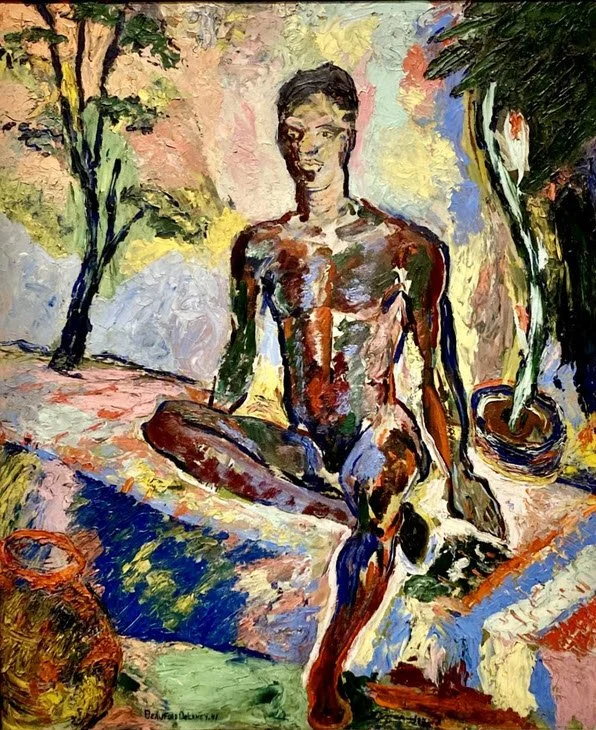
Dark Rapture
(1941) Oil on masonite
Collection of halley k harrisburg and Michael Rosenfeld, New York
© Estate of Beauford Delaney
by permission of Derek L. Spratley, Esquire,
Court Appointed Administrator
Courtesy of Michael Rosenfeld Gallery LLC, New York, NY
Following Washington Square Park I, I wanted Dark Rapture to have a distinctly different feeling and edge. To me, Beauford Delaney’s painting of the same name feels introspective, dark, and brooding, yet it still manages to emanate the signature warmth and brilliant light characterizing so much of his work. In my composition, I set out to capture this unique balance, alongside the surreal atmosphere of the painting and the deep, resonant humanity evoked by Delaney's focus on James Baldwin.
To begin the composition, I collected a series of field recordings around the historical address of Delaney’s studio at 181 Greene Street. While the original studio is long gone, I captured the contemporary sounds of the block: the muffled conversations of passersby, passing cars, distant construction, birds, and other aural ephemera. Channeling Delaney’s spirit, I stumbled upon a small nearby community garden, where the dense foliage and isolated sounds immediately recalled the textured plants and vivid background of Dark Rapture.
After gathering these environmental textures, I began building the piece around a simple yet defiant piano progression. In contrast to Washington Square Park I, I gave the piano a dual purpose. Beyond its traditional harmonic role of providing foundational chords and melodies, it served as a textural instrument. By treating the piano with dynamic reverb tails and reversed phrases, I generated shimmering, swirling layers that mirrored the deliberate brushstrokes of Delaney’s canvas.
Once this roomy, atmospheric foundation was established, I introduced spacious orchestral instruments alongside a heavy synthesized bass layer. I wanted to deliberately strike a balance between elements that felt expansive and grounded in the natural world, and those that felt surreal, electronic, and artificial. This juxtaposition created a clear tension, echoing the striking visual contrasts within the painting itself.
After this initial burst of creation, I found myself creatively stuck. The composition swelled to a massive sonic peak after a minute, but I was unsure how to naturally de-escalate the energy and move the piece forward. Ultimately, I decided to strip away the dense orchestration and return to the foundational piano, resolving the initial chord progression that had gradually faded into the background.
As the arrangement opened up, I began to hear a rhythmic arrangement of nylon string guitars. These acoustic guitars became the key to de-escalating the heavy synthetic textures, reinforcing the piano, and guiding the piece toward a natural conclusion. From there, I spent several weeks recording, rearranging, and dialing in the mix. Through subtle adjustments to reverb sends, dynamic control, and ambient processing, hundreds of microscopic tweaks eventually glued the disparate halves of the composition together.
Throughout the process, my discussions with Dr. Wells about Delaney’s studio as a tangible physical location remained at the forefront of my mind. I deliberately selected instruments and recording techniques that would capture the physical reality of my own workspace. By leaving in the sound of my chair creaking, the low hum of the air conditioner, and the ambient noise of the room, I rooted the music in a real, lived space rather than presenting a pristine, isolated track.
The biggest challenge was balancing this intimate, beautifully flawed humanity with the composition's swirling, surreal energy. Blending raw room sounds with expansive atmospheric elements initially felt jarring and required careful massaging. Yet throughout, I remained committed to this new approach, catching and pivoting whenever I subconsciously drifted back toward the familiar techniques of Washington Square Park I. Ultimately, I am deeply satisfied with the duality the piece captures and the breadth of techniques I discovered along the way.