

Maya Keys: Finding a Musical Voice for Beauford Delaney's
Untitled (1959)
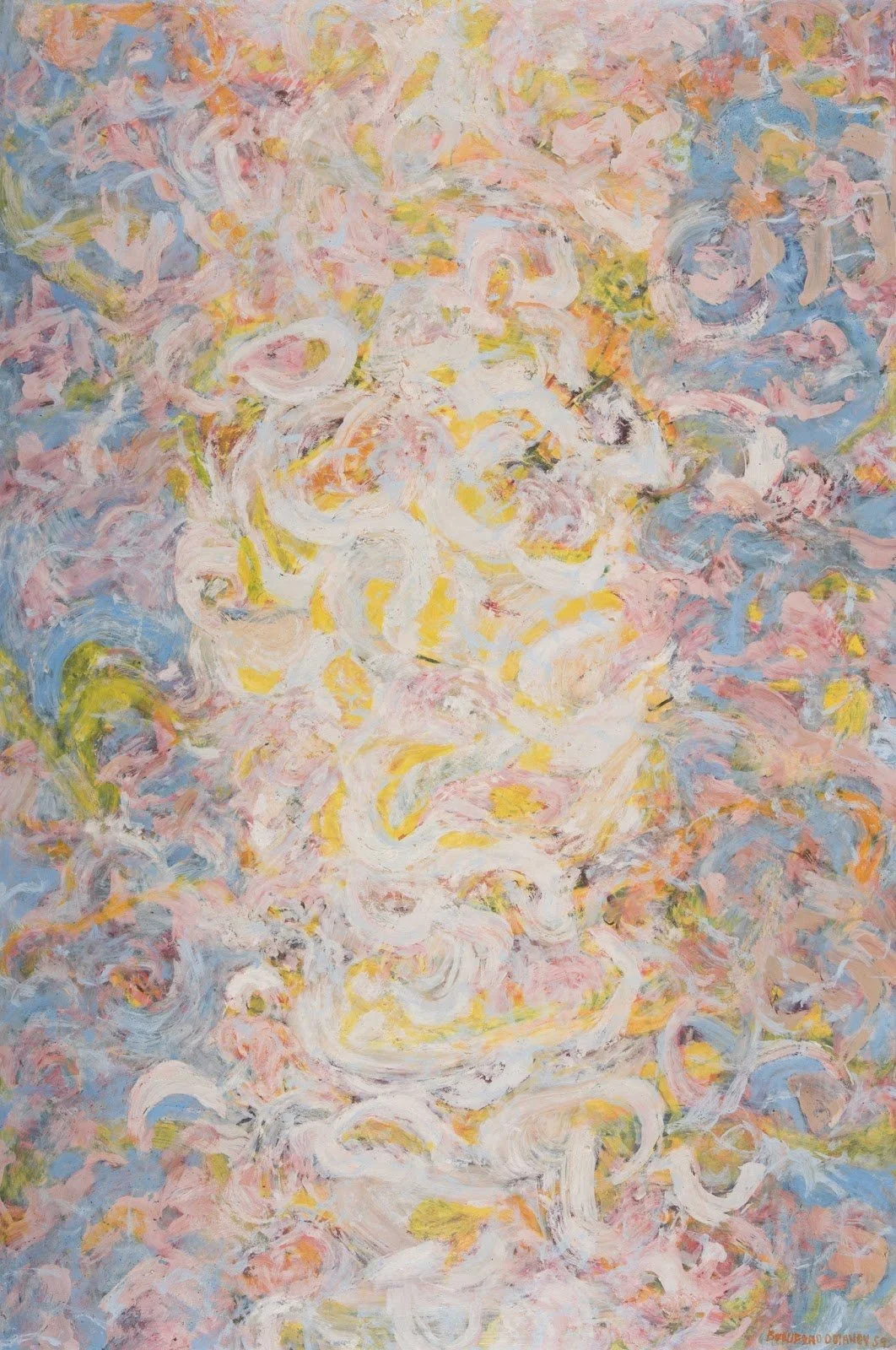
Untitled
(1959) Oil on canvas
© Estate of Beauford Delaney
by permission of Derek L. Spratley, Esquire,
Court Appointed Administrator
Courtesy of Michael Rosenfeld Gallery, LLC, New York, NY
What happens when a musician spends time with a painting and allows the work to guide her toward a musical response?
For Maya Keys, a flutist and recent graduate of the Sorbonne in Paris and the Music Conservatory at Issy-les-Moulineaux, the answer began with ten images of paintings and works on paper by Beauford Delaney. She was given no titles or background information about the works. Instead, she was invited to look, return to the images over time, and notice which ones continued to draw her attention.
Three works emerged as particularly compelling.
The first reminded Maya of "a beam of light" and had, in her words, a "whimsical, magical feel." The sixth evoked the calm of a small city at night. The seventh brought to mind The Yellow Wallpaper, a short story by Charlotte Perkins Gilman that she had read in high school.
But the first painting continued to stand apart.
Maya was especially drawn to Delaney's use of color and the way light seemed to move through the center of the composition. Her response was influenced by her longstanding interest in Impressionism, a movement in which the interplay of light, color, and brushwork plays a central role. She saw connections between Delaney's work and artists including Monet, Manet, Degas, and Renoir.
At first, Maya described the painting simply as something that was pleasing to look at. After spending additional time with her three selections, however, her relationship with the first work changed.
"My first-choice painting has evolved from something that is quite pleasing to look at to something I want to express musically via improvisation."
That evolution became the heart of her experience.
From pairing to improvisation
The original invitation was to select a piece of existing music that Maya felt could be paired with the painting. But almost immediately, she realized that this approach did not feel appropriate for the work she had chosen.
She was not interested simply in finding music that sounded as though it "went with" Delaney's painting. She wanted to create something that arose from what she herself experienced while looking at it.
"When I first saw the painting," she explained, "I felt that it was so unique that pairing existing music with it would not really do it justice."
"My hope is to create an improvisation that reflects what I truly feel when I look at the artwork that I have chosen."
As she continued to contemplate the painting, her preference for improvisation became even stronger. She did not want to begin with a musical idea already in her head, but rather, to look at the work and play what emerged spontaneously:
"I want to just create right then and there and just let it flow."
Seeing light, hearing light
Although she was working from a digital reproduction of Untitled (1959) rather than the physical painting, she did not feel distanced from the work. The vivid colors and, particularly, the treatment of light drew her into the image.
"I just felt really immersed in it," she said. "Kind of like I'm inside of it."
That sense of immersion led Maya toward an intriguing musical idea. She began thinking about how she might create what she called "acoustic representations of light" within her sound.
Her goal was not to reproduce the painting through music, but to respond to the visual experience of encountering it—to translate something about Delaney's handling of light and color into an entirely different artistic language.
In this sense, Maya's response moves in a direction opposite to one of the ways Delaney's work has sometimes been understood. Delaney's relationship to music is often discussed in terms of translating musical experience into visual form. Maya found herself wondering how she might take something she encountered visually and allow it to become sound – she wanted to “give a voice to the artwork.”
When asked whether she felt she was responding primarily to the painting itself or engaging in a conversation with Delaney through the work, Maya was clear:
"As an artist, I responded more to the painting itself."
She was inspired by the way Delaney "experiments and plays with light and color" and wanted to create something musically in reaction to what she was seeing.
History deepens the encounter
After Maya had selected her three works, she was given additional material about Delaney, including a timeline of his life and articles about Untitled (1959).
Learning more about Delaney did not overturn her initial interpretation of the work. Instead, it confirmed her instincts about the painting's relationship to Impressionism. She also became more aware of Delaney's life in Paris, his connection to the artistic community there, and the ways his upbringing and personal life shaped his experience.
Reading Delaney’s biographical information also created a more personal connection for Maya. Learning about his experiences made her feel "more sympathetic and empathetic" toward him. His decision to leave the United States for France resonated with her because she recognized in it her own desire to seek another place in which to live and create.
Yet the painting itself remained at the center of her response.
A process worth repeating
Looking back on the experience, Maya said that the part she enjoyed most was the process of choosing the works and gradually narrowing her selections—from ten, to three, and finally to Untitled (1959). She felt that the amount of time she was given to live with the works was about right and did not feel rushed by the process.
Her experience demonstrates something important about creative encounters across disciplines: the outcome cannot always be known in advance.
Maya began the project expecting to find a piece of music to accompany a painting. Instead, the painting prompted her to reconsider the premise itself. She discovered that an existing work of music felt too mediated, too removed from her immediate response. Improvisation offered another possibility—the freedom to look, listen inwardly, and allow the music to emerge in the moment.
What began as an exercise in pairing ultimately became an act of translation: from color to sound, from light to musical gesture, and from one artist's visual language into another artist's musical imagination.
Maya began by looking at a painting.
She ended by listening for its light.