CREATING THE CONVERGENCE - NARRATIVE
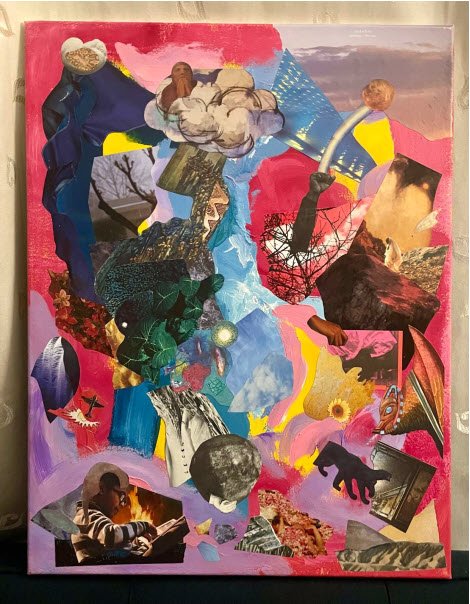
The Convergence
Zwa Inyoni
(2026) Mixed media on canvas
The Convergence, by Zwa Inyoni, is the first completed work in Resonance: Visual Art in Conversation, a new component of The Beauford Delaney Project that invites visual artists to engage with Beauford's work through their own creative practices.
The Encounter
Inyoni began his Resonance project by considering a selection of Beauford's abstract works and identifying the two that resonated most strongly with him.
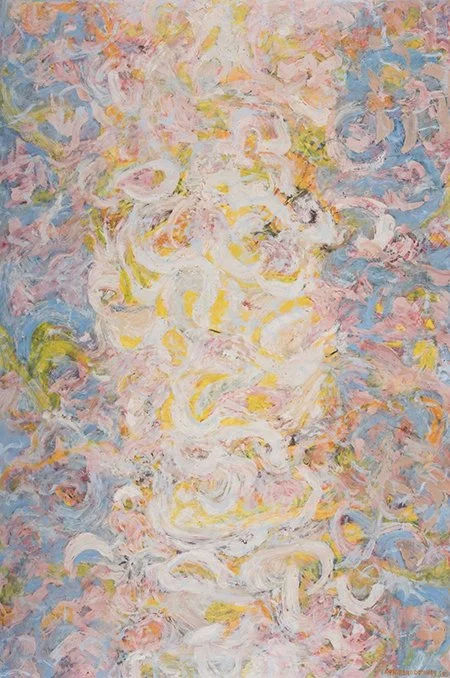
Of the first (Untitled, 1959), he wrote that he could almost see "a script in white in the middle" and further described it as follows:
It feels like sounds becoming words before they’ve been fully formed. I am choosing it because it is very emotive but in a calm and serene way and the colors are beautiful together. It is almost like the idealized childhood through photos of a time one cannot remember but must be reminded of … by the nature of said recollection, words are being added to a time without words.
The loopiness … feels like an invitation to imagination.
Untitled
(1959) Oil on canvas
Mint Museum
Charlotte, NC, USA
© Estate of Beauford Delaney
by permission of Derek L. Spratley, Esquire,
Court Appointed Administrator
Courtesy of Michael Rosenfeld Gallery, LLC, New York, NY
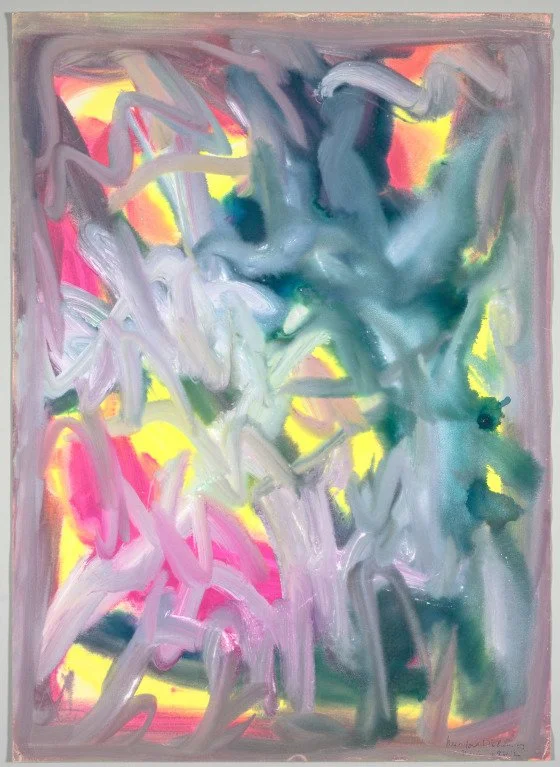
The second work (Untitled, 1962) evoked a very different response. Inyoni again saw something resembling utterances, but this time the marks felt sharper and “less eager to be understood.” He compared them to graffiti: visual language that may be incomprehensible to outsiders but carries meaning for those who create it and those who know how to read it.
Untitled
(1962) Gouache
Cleveland Museum of Art
Cleveland, OH, USA
© Estate of Beauford Delaney
by permission of Derek L. Spratley, Esquire,
Court Appointed Administrator
Courtesy of Michael Rosenfeld Gallery, LLC, New York, NY
Inyoni selected both works because they “feel like script (calligraphy, handwriting) which represents our words.” He ultimately selected the gouache as the starting point for his creative response, initially drawn to its colors and then increasingly to its broad brushstrokes. He imagined creating a collage in which images would interact with the painted surface and anticipated the challenge of shifting his usual palette of warm colors and B&W images to something that would complement the vibrant fluorescence of the work.
Changing the Plan
Inyoni's original concept was to use a reproduction of Beauford's painting as the foundation for his collage. When he learned that this approach raised copyright concerns, he had to reconsider the task before him.
Rather than abandon the project, he changed his approach.
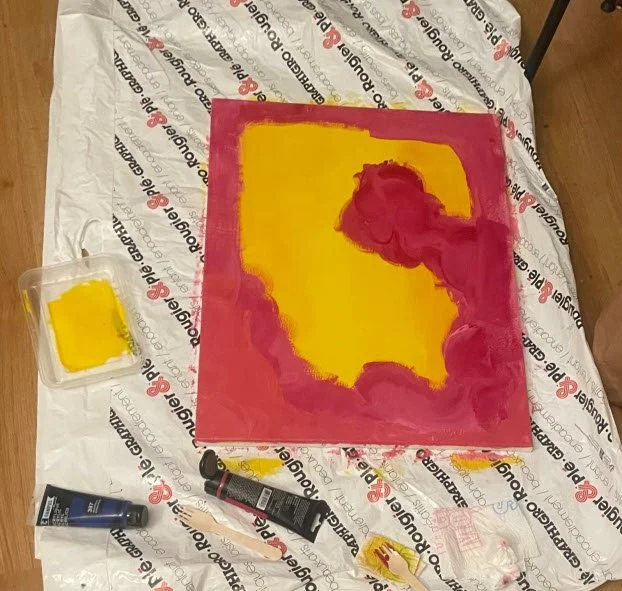
He created his own painted canvas, drawing from what he had encountered in Beauford's work, and used that original painting as the foundation for his collage.
The first stage is relatively spare: a field of yellow surrounded by deep pink and red, with the beginnings of a form emerging from the right edge into the center of the canvas.
Image courtesy of the artist
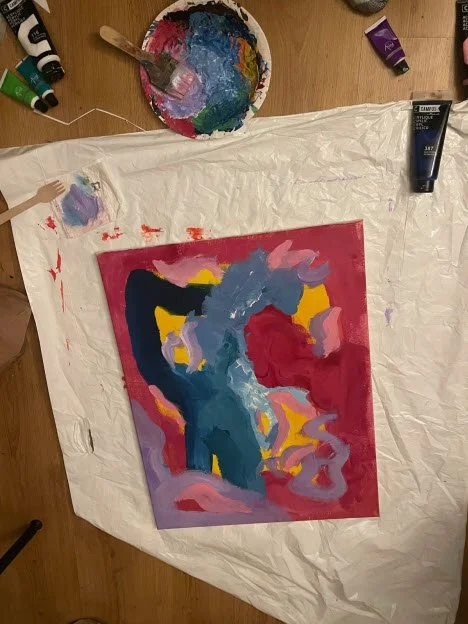
From there, the painting developed through successive layers of color.
Image courtesy of the artist
As Inyoni worked, the painted surface became increasingly complex. Blues, purples, pinks, yellows, and reds accumulated across the canvas, creating a field of overlapping forms and strokes.
This process raised his awareness of Beauford's technical prowess as an artist.
Inyoni said that, because he is not a painter himself, he had not initially considered the degree of skill involved in mixing paint and controlling a brush. The broad brushstrokes in Beauford’s work that first attracted him because they seemed to create space for collage elements became something he had to negotiate through his own making. He began to understand the difficulty of achieving the kind of painterly effects he had admired in Beauford's work.
From Painting to Collage
Once the painted foundation was established, Inyoni began introducing the images that would transform the work into a collage.
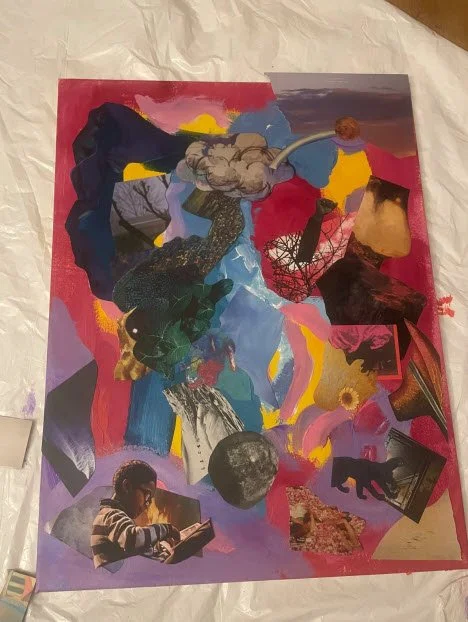
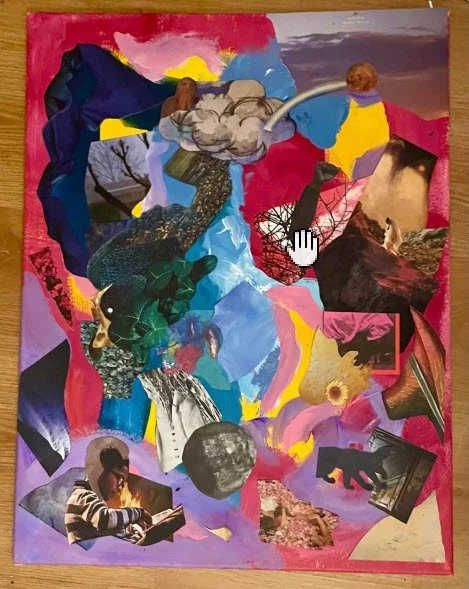
The composition became a meeting place for painted gestures and photographic and printed fragments that converse with each other and the vivid colors on the canvas, and the work continued to evolve through layering and experimentation.
Images courtesy of the artist
By this stage, the original painted surface had become a map through which the collage elements moved. The relationship between the painted and photographic elements was no longer simply one of background and foreground; the two components interacted across the canvas.
The Convergence was the final result.
A Conversation That Continues
For Inyoni, the significance of this project already extends beyond the finished collage.
He describes this creative experience as moving him away from trying to reproduce Beauford's approach toward a process of exploration, saying that his encounter with Beauford's painting provided an opportunity to investigate what he could discover and accomplish through his own materials and methods.
His journey began with two abstract works that suggested language.
It resulted in a work that is entirely his own, while bearing the traces of a creative encounter with Beauford’s work.
And it led him to adopt a new approach to collage; he is currently creating a series of works that begin with him painting on canvas.
The Power of Resonance
Inyoni’s experience is the first example of the power and beauty of Resonance: Visual Art in Conversation.
The program does not ask participating contemporary artists to reproduce Beauford's work or to imitate his style.
It invites them to engage in sustained observation—to notice something, question it, then follow it and see where it leads them.
About the Artist
Zwa Inyoni is a collage artist from Los Angeles whose work explores social discontent, fragments of memory, and propaganda. He is currently enrolled at the American University of Paris as a master’s student in International Affairs.