

CREATING WASHINGTON SQUARE I - NARRATIVE
by George Henry
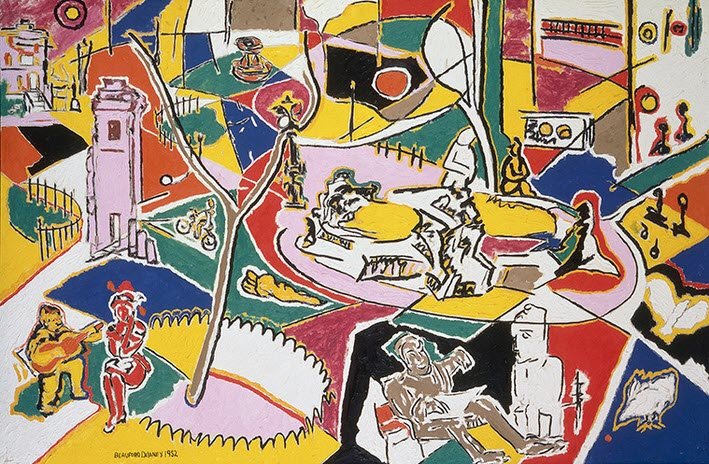
Untitled (Washington Square)
(1952) Oil on canvas
Greenville County Museum of Art
Greenville, SC
© Estate of Beauford Delaney
by permission of Derek L. Spratley, Esquire,
Court Appointed Administrator
Courtesy of Michael Rosenfeld Gallery, LLC, New York, NY
The process of creating my song, “Washington Square I,” was both winding and direct. I had a clear idea of what I hoped it would become but it took weeks of tweaking, pondering, and communing with Beauford Delaney’s work to create what you hear today.
During one of our first conversations, Dr. Wells and I discussed recording the sounds of painting as a way of bringing an aural dimension to walking tours of the locations that Beauford frequented in New York City. Immediately after our meeting, I thought about how field recordings of the places Beauford frequented in present day New York City could reinvigorate his works while drawing a natural comparison between the world that he existed and created in and the world we live in today. During our next meeting, we came together and decided that my internship would focus on the creation of several musical compositions based on a handful of Beauford’s works. The pieces I created would use field recordings of my own creative environment as well as locations within New York City that Beauford frequented as a way of embracing his lineage and reactivate the themes his works explored in a sonic context.
For my first composition, I selected Beauford Delaney’s 1952 painting Washington Square. The painting initially caught my interest with its dynamic composition, confident color palette, and overall intriguing aura. Every time I returned to the painting, I saw a new detail and felt something slightly different emerge from within me. By focusing on Washington Square, the painting also felt like a natural bridge between the physical location of the park and Beauford’s own interpretation and interactions with the space.
To gather field recordings for the piece, I visited the park several times over the course of a few weeks recording its sounds during various times of day. I initially had a plan of recording each of the sounds I could see within the painting (i.e. birds, guitars/horn players, etc.). But when I reached the park, I felt called to simply sit and record the world as it moved around me. Using this approach I recorded jazz students performing, a busking painter having an existential crisis, conversations between friends, skateboarders, singers, and many other subjects.
After collecting field recordings, I began the composition process by using one of my longer recordings as a foundation then improvising some piano melodies/chords on top of it. Once the piano was in place I heard orchestral strings and added cello, violin, viola and a few other synthesizers, pads, and string instruments. I made a second pass over the span of the next few weeks adding other string elements, picking through the field recordings for other ephemera that I enjoyed, and adjusting the dynamics of the arrangement. Once I had figured out those foundational layers I added nylon, acoustic, and baritone guitars that I recorded in my room before finally resampling parts of the composition through a guitar pedal and mixing/mastering my work.
One of the biggest challenges while making this composition was translating and interpreting Beauford’s visuals as sounds. Throughout the process I found myself constantly balancing between capturing what I imagined Beauford’s experiences at the park would have been and what I was actually experiencing. I also struggled with conveying the current soundscape of the park while also remaining conscious of how it may have sounded in the past. Creating sounds that captured abstract concepts like the color yellow and Beauford’s visual motifs was also difficult due to the sheer subjectivity of my interpretations. There were many moments where I had to trust my intuition and the feelings evoked by Beauford’s work which brought a referential aspect to the whole process that I didn’t expect.
Though challenging, I thoroughly enjoyed creating “Washington Square I.” It’s been a few years since I scored visual art, and it was a cathartic challenge to produce for a painting and environment simultaneously.