

CREATING WASHINGTON SQUARE II - NARRATIVE
by George Henry
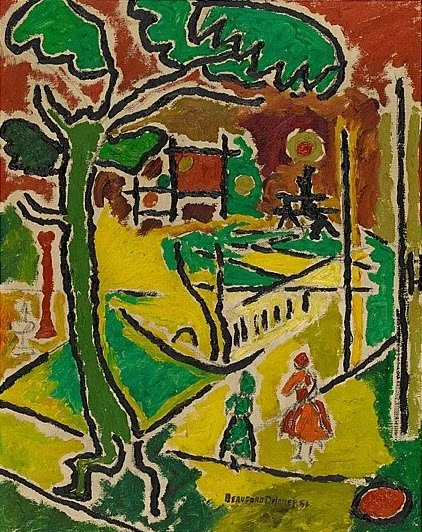
Untitled (Washington Square Park)
(1951) Oil on canvas
© Estate of Beauford Delaney
by permission of Derek L. Spratley, Esquire,
Court Appointed Administrator
Courtesy of Michael Rosenfeld Gallery, LLC, New York, NY
As the final installment in this trilogy and a direct companion to “Washington Square I,” “Washington Square II” was designed to bring the project to a meaningful close while pushing me in new musical directions.
This piece had the most tumultuous journey to completion. I initially began working on it toward the end of “Washington Square I,” focusing on Beauford Delaney’s Composition 16 (1954–1956), which he created after moving from New York to Paris. The painting is abstract and deeply textural, with thick yellow, red, and green brushstrokes creating swirled layers and peaks across the canvas. Though I found the artwork striking, whenever I sat down to compose I couldn't find a clear emotional or structural anchor to respond to. I tried translating its visual textures and colors directly into gestures and sounds, but nothing resonated. Setting the piece aside, I returned to finish “Washington Square I” and “Dark Rapture,” though the question of a subject for the third composition still eluded me.
When I revisited the project, Dr. Wells and I decided to shift directions, selecting an artwork that would anchor all three pieces in the physical New York locations where Beauford lived and created. Shortly after stepping away from Composition 16, I discovered Untitled (1951). The painting felt like both a sibling and an inverse to Washington Square (1952). With its dominant palette of greens and browns, narrower vertical frame, and expressive brushwork, it carried a grounded, confident presence. It read like a naive precursor to Washington Square (1952) while emanating its same energy. This “familial” connection made Untitled (1951) the ideal inspiration for the final piece grounding the trilogy while bridging its past and future.
For one final time, I returned to Washington Square Park to gather field recordings: the ambient hum of the city, chirping birds, strumming guitars, busking musicians, and passing fragments of conversation. While collecting audio had become second nature by this stage, listening back still revealed unexpected textures and intimate sonic details.
Unlike my process with the earlier compositions, I had a clear arrangement for “Washington Square II” before recording. During the final weeks of working on “Dark Rapture,” I had experimented with alternate guitar tunings and landed on a riff in 5/4 time. It didn’t fit that piece, but I saved it for the final piece hoping it would fit in somehow. Around the same time, I was eager to adapt a compositional technique inspired by Hakushi Hasegawa’s piano ballad, Forbidden Thing (Kimmotsu). In the piece, Hasegawa plays a kind of "piano engine" that drones beneath another piano playing a rhythmic melodic line. I loved the interplay between the two elements and used that structure as well as the riff as the foundation for “Washington Square II.”
Toward the end of the process, Dr. Wells introduced me to the prolific flutist Maya Keys, who graciously contributed her playing. Manipulating and weaving her musical ideas into the composition was a deeply liberating experience. It offered a refreshing shift away from analyzing my own performance and opened up the music in ways I could not have achieved alone.
Looking back across this entire process, I am immensely grateful to have spent the summer working alongside the Wells International Foundation. Laying the groundwork for the Art and Sound in Conversation component of the Beauford Delaney project has been deeply enriching, and building upon his legacy while connecting with fellow scholars and developing my own practice has truly been a privilege.
Watch and listen to “Washington Square II” HERE.