

From Soundscapes to Composition
George Henry’s Summer 2026 Internship with
The Beauford Delaney Project
This summer, The Beauford Delaney Project welcomed George Henry as an intern through the Wells International Foundation’s Summer 2026 Internship Program. A recent graduate of Amherst College, where they double majored in Black Studies and Computer Science, George brought to the project an unusually rich combination of interests in Black studies, technology, music production, archival reclamation, and sound.
What began as an exploration of Beauford Delaney’s relationship with New York City ultimately became something more ambitious: the creation of original musical compositions that resulted from George’s conversations with Beauford’s visual art.
The project was initially conceived as a series of soundscapes based on locations in New York City associated with Beauford’s life. George planned to visit these sites, capture their contemporary sounds, and use those recordings to evoke the environments in which Beauford lived and worked.
But, as the summer unfolded, the project evolved.
Rather than simply documenting the sounds of places connected to Beauford, George began asking what might happen when those sounds became material for musical composition. The result was the beginning of Art & Sound in Conversation, a new component of The Beauford Delaney Project that invites artists to respond creatively to Beauford’s work while drawing upon research, place, and their own artistic practices.
George’s first composition, “Washington Square I,” was inspired by Beauford’s Washington Square (1952).
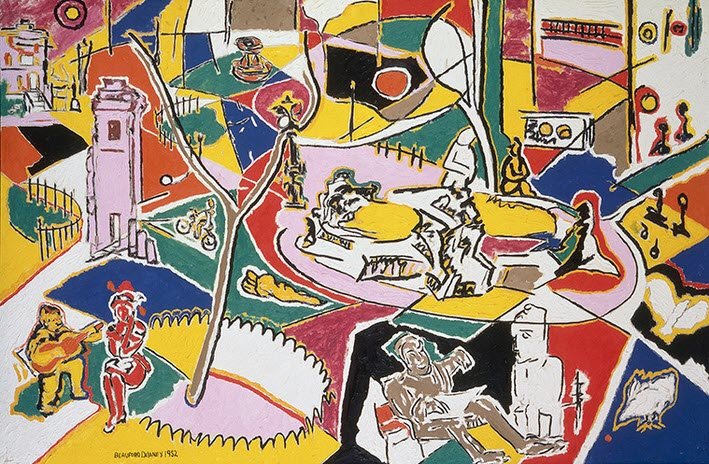
Untitled (Washington Square)
(1952) Oil on canvas
Greenville County Museum of Art
Greenville, SC
© Estate of Beauford Delaney
by permission of Derek L. Spratley, Esquire,
Court Appointed Administrator
Courtesy of Michael Rosenfeld Gallery, LLC, New York, NY
Working in Washington Square Park, they gathered environmental recordings and combined them with musical elements including guitar, piano, and strings. The resulting work does not attempt to reproduce or literally interpret Beauford’s painting. Instead, it offers another way of entering the world suggested by the painting—through movement, atmosphere, texture, and sound.
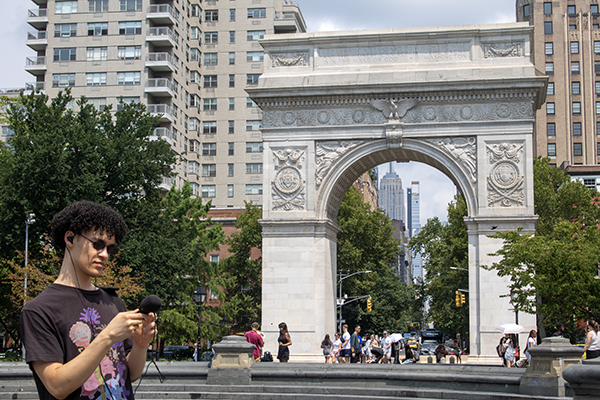
George Henry recording environmental sounds in Washington Square Park
© Wells International Foundation
The process also demonstrated one of the possibilities at the heart of The Beauford Delaney Project: that scholarship need not end with written analysis. Research can become material for artistic inquiry, and artistic inquiry can, in turn, open new ways of understanding an artist and the places that shaped their life.
Listen to “Washington Square I.”
George then created “Dark Rapture,” another original composition. It was inspired by Beauford’s iconic portrait of James Baldwin.
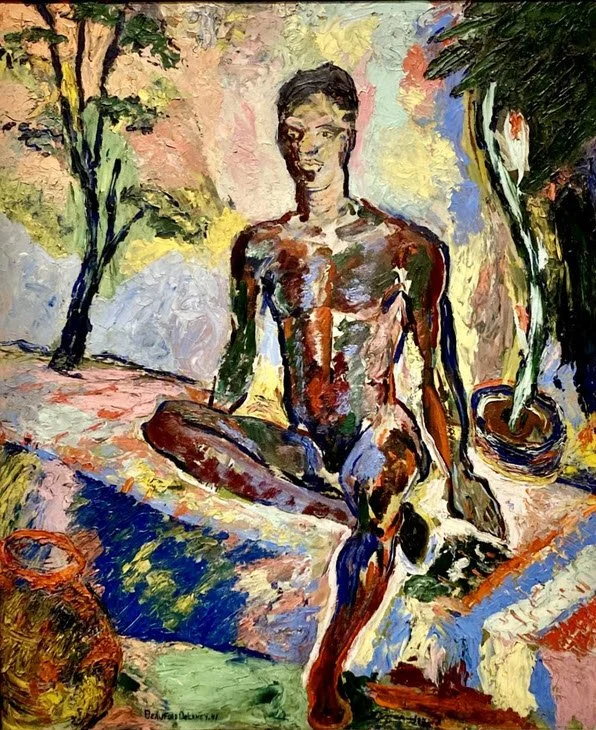
Dark Rapture
(1941) Oil on masonite
Collection of halley k harrisburg and Michael Rosenfeld, New York
© Estate of Beauford Delaney
by permission of Derek L. Spratley, Esquire,
Court Appointed Administrator
Courtesy of Michael Rosenfeld Gallery LLC, New York, NY
With this composition, George explored another set of ideas and sounds that emerged during their experimentation.
He also envisioned the environment in which Beauford painted Baldwin, based on the well-known photo of Beauford in his Greene Street studio.
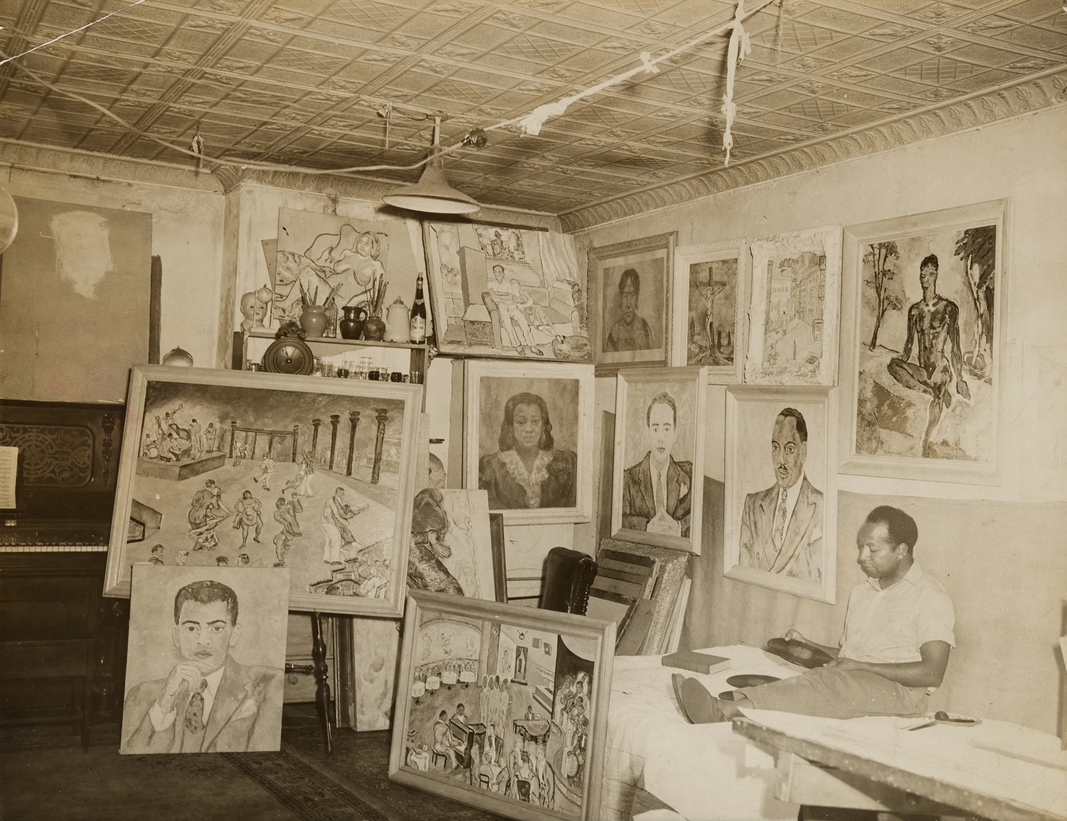
Beauford in his Greene Street studio, New York City, 1944
© Estate of Beauford Delaney
by permission of Derek L. Spratley, Esquire,
Court Appointed Administrator
Held in the Beauford Delaney Papers,
MS.3967,
Betsey B. Creekmore Special Collections and University Archives,
University of Tennessee, Knoxville.
George’s “Washington Square II” was inspired by Beauford’s 1951 depiction of Washington Square Park. For this work, they returned to ideas and sounds from both earlier compositions that they felt did not belong in those works. Some of that material found a new home in “Washington Square II.”
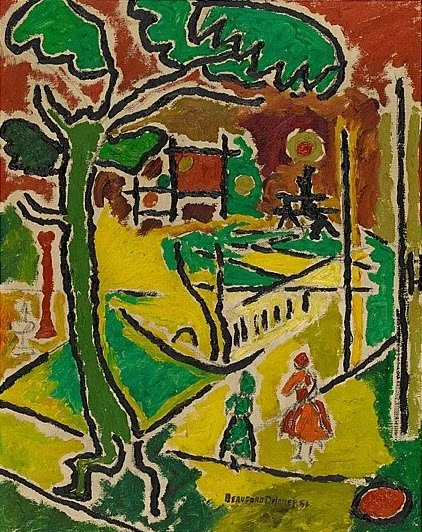
Untitled (Washington Square Park)
(1951) Oil on canvas
© Estate of Beauford Delaney
by permission of Derek L. Spratley, Esquire,
Court Appointed Administrator
Courtesy of Michael Rosenfeld Gallery, LLC, New York, NY
The second Washington Square composition expanded the project's collaborative dimension, bringing other artists and their environments directly into the creative process.
As part of the project, WIF arranged for George to visit the studio of visual artist Khalif Tarik Thompson, whose own work is deeply informed by Beauford’s life and artistic legacy. George interviewed Khalif about his work and his interest in Beauford. Khalif happened to have several visitors in the studio that day, and the conversations and laughter in the background were captured in the recording. Snippets of that ambient sound ultimately found their way into “Washington Square II,” transforming an encounter with another artist into part of the composition itself.
George also invited flutist Maya Keys to contribute an improvised flute performance to “Washington Square II.” Her contribution became part of the finished work, adding another voice to George’s exploration of the relationship between visual art, place, and sound.
Listen to “Washington Square II.”
These experiences prompted WIF to think more intentionally about how future interns might identify and engage artists, scholars, and other contributors whose knowledge, perspectives, and creative practices can enrich their work.
They also demonstrated something fundamental about interdisciplinary practice: collaboration does not always simply add another perspective to a project. Sometimes, it becomes part of the work itself.
Just as important as the finished compositions was the process through which George developed them. Throughout the summer, George faithfully maintained a weekly project journal to document the evolution of their work. Their approach combined independent research, visual observation, field recording, reflection, experimentation, and musical production. The internship became not simply an opportunity to produce finished works, but also an opportunity to test how interdisciplinary methods might generate new forms of scholarship.
The experimentation is now documented, in part, through Studio Notes, a companion component of The Beauford Delaney Project. While Art & Sound in Conversation presents the finished creative works, Studio Notes opens a window onto the creative processes behind them. Together, the two provide both the work and a way of understanding how it came into being.
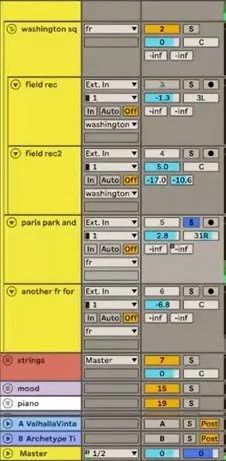
Component of Studio Notes
George’s internship demonstrated the value of giving an emerging scholar and artist room to follow an idea as it develops. The evolution from soundscapes to compositions was not simply a change in terminology. It reflected a deeper discovery about what George could contribute to the project and what the project could become.
Perhaps most significantly, George’s internship embodies a principle central to The Beauford Delaney Project: scholarship can be a generative act. Looking closely at Beauford’s paintings, researching his life, walking through places he knew, listening to those environments, and experimenting with sound did not simply produce information about Beauford. They produced something new.
That is the spirit of Art & Sound in Conversation: not to illustrate Beauford’s work, but to enter into dialogue with it.
As we prepare to bring The Beauford Delaney Project to audiences in Knoxville, George’s work offers a glimpse of what this initiative can become. It demonstrates how young scholars and artists can engage with Delaney across disciplines and generations—and how technology and creative practice can help bring archival and historical inquiry into the present.
The conversation continues.