

Brief Musings on Beauford and James Baldwin

Baldwin, Beauford, and Lucien Happersberger in Paris, 1953
Photo from James Baldwin by David Leeming
Baldwin owed a great deal to his friendship with Beauford. In the introduction to The Price of the Ticket, he states that his career began when his life in Greenwich Village began, and that this life began when he met Beauford. He describes how he walked into color and into music when he walked into Beauford’s studio at 181 Greene Street. In his inimitable style, he pays tribute to the man whose unshakable example of “courage and integrity, humility and passion” gave him the strength to survive and the ability to hope for a future.
Much later, Baldwin would become Beauford’s source of strength during Beauford's “Paris Years.” It was Baldwin’s turn to introduce Beauford to people around town in the early days, and to provide council and comfort when Beauford more frequently became depressed or distraught.

Beauford and James Baldwin at the American Cultural Center
(1970s) United States Information Service
He would do this (or at least attempt to do this) in the face of his own emotional crises. Baldwin would “send for” Beauford when his friend suffered psychological episodes or physical illness, having Beauford join him in Saint-Paul de Vence. But at the very end, Baldwin did not attend Beauford’s funeral due to illness and other problems. He deeply regretted this, and spoke of his feelings in an interview with his secretary and biographer, David Leeming.
Beauford would paint Baldwin many times. Here are a few examples:

Dark Rapture, as it appears in Amazing Grace
Portrait (oil on board) dates from 1941

Portrait of James Baldwin
Beauford Delaney
(1945) Oil on canvas
Philadelphia Museum of Art

James Baldwin
Beauford Delaney
(1963) Pastel on Paper
National Portrait Gallery, Smithsonian Institute
As do all of Beauford’s portraits, these paintings of James Baldwin depict much more than his physical likeness. They express Baldwin’s “life essence” as Beauford saw it at various stages of Baldwin’s life – his accomplishments, his insecurities, his hopes and dreams. They also represent the deepest, most profound expressions of Beauford’s love for Baldwin.
Beauford and the Influence of Claude Monet
Everyone in Paris who has an interest in art is talking about Claude Monet these days. The huge retrospective of this revered Impressionist painter at the Grand Palais is sold out through the end of the exposition on January 24, 2011! Not to mention the fact that the 170th anniversary of his birth (November 14, 1840) was just a few days ago, and the 84th anniversary of his death (December 5, 1926) is rapidly approaching. Amidst the buzz, I thought it appropriate to look at how Monet’s work influenced Beauford.
Beauford first saw Monet’s work in Boston, shortly after Monet died. The exposition was held in the studio of American artist John Singer Sargent, whose work also influenced Beauford. In the biography Amazing Grace , author David Leeming indicates that Beauford “found a serious attempt to understand the effects of different stages of daylight on color and form” in Monet’s paintings. Citing Monet’s Water Lily (French translation: Nymphéas) series, Leeming also states that Monet’s view of light as subject matter during his later years is suggestive of the abstract expressionism that Beauford would adopt years later.
In the catalog for the 2004-2005 Minneapolis Institute of Arts exposition Beauford Delaney: From New York to Paris , curator Sue Canterbury notes that Beauford arrived in Paris the same year that the Orangerie, home to Monet’s famous murals, was reopened (1953). She says that French gallery owner Paul Facchetti attested to the fascination that Americans had for Monet, and that they “all rushed like flies to one place: the Orangerie” to see the famous murals. Notes for her essay on Beauford’s “transatlantic transformation” indicate that Beauford mentioned Monet to his biographer Leeming on several occasions, and that friends of Beauford (including Ed Clark) believe that Monet’s work influenced Beauford’s early experiments with abstraction in Paris.

In the same catalog, Michael D. Plante states that Beauford may have seen Monet’s paintings at the Orangerie in September, the month that he arrived in Paris. He describes in detail how Monet’s influence can be seen in Beauford’s paintings as early as 1954.
Richard A. Long arranged two visits with Beauford to see Monet’s works during the early 1970s – first to the Orangerie, and then to the Marmottan (not yet called Musée Marmottan Monet) shortly after the opening of the Monet galleries there.

The Minneapolis Institute of Arts Web site has an interesting education section for young students called Object in Focus. One of the “objects” is Beauford’s raincoat painting Untitled (1954), which students are encouraged to compare and contrast to Monet’s The Japanese Bridge (c. 1923-1925). Both paintings are part of the museum’s permanent collection.


The Michael Rosenfeld Gallery showed three of Beauford’s paintings in a 2009 exposition called Abstract Expressionism: Further Evidence. The catalog for this show describes Beauford’s Paris abstractions as “lyrical, colorful, [and] non-objective” and “pure and simplified expressions of light.” It goes on to say that “the paintings have clear ties to Monet’s studies of light…”
I believe that Beauford would have been first in line to see the current Monet exposition at the Grand Palais – if he could have gotten a ticket! I plan to go to the Orangerie to see Monet’s murals in honor of the occasion.
Beauford first saw Monet’s work in Boston, shortly after Monet died. The exposition was held in the studio of American artist John Singer Sargent, whose work also influenced Beauford. In the biography Amazing Grace
, author David Leeming indicates that Beauford “found a serious attempt to understand the effects of different stages of daylight on color and form” in Monet’s paintings. Citing Monet’s Water Lily (French translation: Nymphéas) series, Leeming also states that Monet’s view of light as subject matter during his later years is suggestive of the abstract expressionism that Beauford would adopt years later.In the catalog for the 2004-2005 Minneapolis Institute of Arts exposition Beauford Delaney: From New York to Paris
, curator Sue Canterbury notes that Beauford arrived in Paris the same year that the Orangerie, home to Monet’s famous murals, was reopened (1953). She says that French gallery owner Paul Facchetti attested to the fascination that Americans had for Monet, and that they “all rushed like flies to one place: the Orangerie” to see the famous murals. Notes for her essay on Beauford’s “transatlantic transformation” indicate that Beauford mentioned Monet to his biographer Leeming on several occasions, and that friends of Beauford (including Ed Clark) believe that Monet’s work influenced Beauford’s early experiments with abstraction in Paris.
Nymphéas (detail)
(1920-1926) Oil on canvas
Claude Monet
Musée de l’Orangerie
Claude Monet
Musée de l’Orangerie
In the same catalog, Michael D. Plante states that Beauford may have seen Monet’s paintings at the Orangerie in September, the month that he arrived in Paris. He describes in detail how Monet’s influence can be seen in Beauford’s paintings as early as 1954.
Richard A. Long arranged two visits with Beauford to see Monet’s works during the early 1970s – first to the Orangerie, and then to the Marmottan (not yet called Musée Marmottan Monet) shortly after the opening of the Monet galleries there.
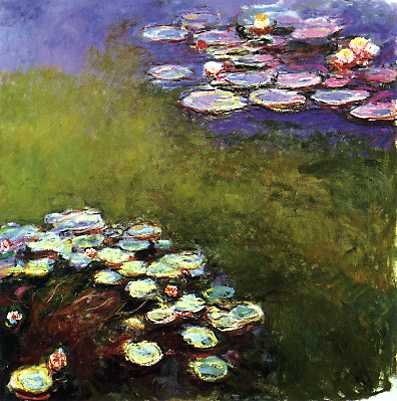
Nymphéas
(1916) Oil on canvas
Claude Monet
Musée Marmottan Monet
The Minneapolis Institute of Arts Web site has an interesting education section for young students called Object in Focus. One of the “objects” is Beauford’s raincoat painting Untitled (1954), which students are encouraged to compare and contrast to Monet’s The Japanese Bridge (c. 1923-1925). Both paintings are part of the museum’s permanent collection.

Untitled (raincoat painting)
Beauford Delaney
(1954) Oil on raincoat fragment
Minneapolis Institute of Arts
Minneapolis Institute of Arts
Photo courtesy of Sue Canterbury

The Japanese Bridge
(ca. 1923-1925) Claude Monet
Minneapolis Institute of Arts
The Michael Rosenfeld Gallery showed three of Beauford’s paintings in a 2009 exposition called Abstract Expressionism: Further Evidence. The catalog for this show describes Beauford’s Paris abstractions as “lyrical, colorful, [and] non-objective” and “pure and simplified expressions of light.” It goes on to say that “the paintings have clear ties to Monet’s studies of light…”
I believe that Beauford would have been first in line to see the current Monet exposition at the Grand Palais – if he could have gotten a ticket! I plan to go to the Orangerie to see Monet’s murals in honor of the occasion.
It's Not What You Think!
David Leeming indicates in his biography Amazing Grace that Beauford was rarely painted nudes because of his shyness. This makes the remembrance below, provided by Burt Reinfrank, even more interesting!
It was a beautiful, sunny autumn afternoon when I knocked on Beauford’s studio door. I heard the echo of Beauford’s voice back in the studio saying “I’m coming.” I could hear him shuffling to the door. It opened and Beauford, with hand outstretched, said “Come in.” I did and, as I looked down the narrow corridor, with white sheets hanging on both sides, into the studio, I saw a naked young man standing facing me full frontal reaching for his pants saying “It's not what you think, it's not what you think!” I hadn’t thought anything at that point, and Beauford was unperturbed.
As it happened, the young man (American) had recently been a guest of Jimmy Baldwin at his house in St. Paul de Vence, as had Beauford at the same time. While there, Beauford had started but not finished a nude portrait of him, which was now on an easel where Beauford was continuing to work on it.

My entrance had interrupted this sitting so we all sat down to a tea Beauford made for us. The young man (about 30) was from the western U.S. and lived on a property where the boundaries of three states came together. He regaled us with stories of that region.
That was the only time I saw this young man (circa 1965). But recently, in 2010, I saw a photograph of a group of Delaney paintings in a store room, one of which was a portrait of a nude man. I wonder if it is the finished version of “It’s not what you think”?
that Beauford was rarely painted nudes because of his shyness. This makes the remembrance below, provided by Burt Reinfrank, even more interesting!*******************
It was a beautiful, sunny autumn afternoon when I knocked on Beauford’s studio door. I heard the echo of Beauford’s voice back in the studio saying “I’m coming.” I could hear him shuffling to the door. It opened and Beauford, with hand outstretched, said “Come in.” I did and, as I looked down the narrow corridor, with white sheets hanging on both sides, into the studio, I saw a naked young man standing facing me full frontal reaching for his pants saying “It's not what you think, it's not what you think!” I hadn’t thought anything at that point, and Beauford was unperturbed.
As it happened, the young man (American) had recently been a guest of Jimmy Baldwin at his house in St. Paul de Vence, as had Beauford at the same time. While there, Beauford had started but not finished a nude portrait of him, which was now on an easel where Beauford was continuing to work on it.

Beauford's Paint Box
© Discover Paris!
My entrance had interrupted this sitting so we all sat down to a tea Beauford made for us. The young man (about 30) was from the western U.S. and lived on a property where the boundaries of three states came together. He regaled us with stories of that region.
That was the only time I saw this young man (circa 1965). But recently, in 2010, I saw a photograph of a group of Delaney paintings in a store room, one of which was a portrait of a nude man. I wonder if it is the finished version of “It’s not what you think”?
A Redhead in His Bed
Burt Reinfrank kindly sent the following anecdote about Beauford in his later years, when he was living at the studio on rue Vercingétorix. He indicated that this is a story that is told by others as well as himself.

It was a fall Saturday morning. Signs of a colder winter to come were in the air. Beauford’s health and his mental state had been slowly failing. The question was how much longer could he continue to live on his own? I had signed him up for a local version of Meals on Wheels, which worked for a while. But he had started to drink again. Some of his friends said squatters were trying to move into his studio.
I approached his door with a certain apprehension. At my knock I heard Beauford’s shuffle. The door opened and Beauford led me into his studio. On the small table by the arm chair were a couple of partly filled glasses of red wine and an almost empty wine bottle. The bed, with its traditional top cover of a white sheet, was made up but as I looked harder it seemed there was something in it and at the head, sticking out from the top of the sheet, a mass of long red hair. I thought “Good God. Beauford has a redheaded women in his bed.”
Beauford said nothing, and as I surveyed the scene the head from which the hair came slowly worked its way out of the bed. It was not a woman but a younger man along in his 30s who introduced himself as "Michael" and immediately went into the kitchen and made us all a coffee. Apparently he’d moved in with Beauford a short time before. He prepared Beauford’s food and they were obviously drinking a lot of red wine.
This was certainly one of the “squatters” I had heard mentioned in a negative way, but I thought this was what Beauford needed considering the condition he was in. Apart from the wine, the “squatter” got the food, prepared it, kept Beauford company, etc.
For some time, each time I visited I would give Beauford some cash which was a part of a payment for a painting I had bought from him. I now started giving the cash directly to Michael to pay for the food etc. he bought for the two of them. I trusted him and it worked well as long as it lasted.
Some said squatters might be stealing Beauford’s work. I asked Michael what he saw and he said no one had been by the studio except a young woman who came in, picked up a painting and left. She and Beauford seemed to know each other as they kissed both on her coming and going. I couldn’t think of anyone that Beauford knew who was young enough to meet that young lady’s description. To me, who she was still remains a mystery.
After Michael’s departure some weeks later Beauford’s health continued to decline.
********************

Beauford at his rue Vercingétorix studio, 1972
It was a fall Saturday morning. Signs of a colder winter to come were in the air. Beauford’s health and his mental state had been slowly failing. The question was how much longer could he continue to live on his own? I had signed him up for a local version of Meals on Wheels, which worked for a while. But he had started to drink again. Some of his friends said squatters were trying to move into his studio.
I approached his door with a certain apprehension. At my knock I heard Beauford’s shuffle. The door opened and Beauford led me into his studio. On the small table by the arm chair were a couple of partly filled glasses of red wine and an almost empty wine bottle. The bed, with its traditional top cover of a white sheet, was made up but as I looked harder it seemed there was something in it and at the head, sticking out from the top of the sheet, a mass of long red hair. I thought “Good God. Beauford has a redheaded women in his bed.”
Beauford said nothing, and as I surveyed the scene the head from which the hair came slowly worked its way out of the bed. It was not a woman but a younger man along in his 30s who introduced himself as "Michael" and immediately went into the kitchen and made us all a coffee. Apparently he’d moved in with Beauford a short time before. He prepared Beauford’s food and they were obviously drinking a lot of red wine.
This was certainly one of the “squatters” I had heard mentioned in a negative way, but I thought this was what Beauford needed considering the condition he was in. Apart from the wine, the “squatter” got the food, prepared it, kept Beauford company, etc.
For some time, each time I visited I would give Beauford some cash which was a part of a payment for a painting I had bought from him. I now started giving the cash directly to Michael to pay for the food etc. he bought for the two of them. I trusted him and it worked well as long as it lasted.
Some said squatters might be stealing Beauford’s work. I asked Michael what he saw and he said no one had been by the studio except a young woman who came in, picked up a painting and left. She and Beauford seemed to know each other as they kissed both on her coming and going. I couldn’t think of anyone that Beauford knew who was young enough to meet that young lady’s description. To me, who she was still remains a mystery.
After Michael’s departure some weeks later Beauford’s health continued to decline.
"Soul Brother" or The Haynes Restaurant Portrait
Below is another remembrance of Burt Reinfrank about Beauford. This one concerns a Delaney portrait at Haynes’ Restaurant.

We heard there was a Delaney painting hanging in Haynes Restaurant. I telephoned to confirm this and was told that the painting was a Delaney self-portrait. I knew that Haynes and Beauford had known one another, so I was curious to see it. I made a dinner reservation for 8 pm on March 9, 2001.
That evening, we found the Delaney portrait hanging on the wall of the dining room above the banquettes. It was well lit from above. Upon seeing the painting, I said to the young man and woman who greeted us and showed us to a table that if this was the restaurant’s Delaney portrait, it was not a self-portrait.

The personnel of the restaurant were aware that the painting had a certain value. They said that some months before, a woman from Atlanta had come by to see the painting. As she was organizing a Delaney exhibition, she asked if it might be loaned or sold. Her request was denied.
While not a Beauford self-portrait, the Haynes painting seemed familiar nonetheless. To investigate further, I looked over photographs that I had taken in Beauford’s studio years before. In a photo from January 1968, I saw the portrait from Haynes restaurant on the wall behind Beauford, who was seated on his bed. I remember the portrait had hung for some weeks on the studio wall, during which time Beauford made a few changes. These are visible in the photograph of the finished painting that I took at Haynes’ Restaurant in 2001.

Over the years that I visited Beauford in his studio, I saw many portraits hanging on the wall. They were waiting to be worked on further, to be signed off as sold, or given away. I heard recently that the Haynes’ Delaney had “Soul Brother” written on the back of the canvas. As I never saw the back of the painting at Beauford’s studio or at Haynes Restaurant, I cannot comment on this.
Haynes’ was the longest standing African-American-owned restaurant in Paris. For many years, Leroy Haynes regaled his customers with great Southern cuisine and his larger-than-life persona at 3, rue Clauzel in the 9th arrondissement. After his death in 1986, his widow Maria continued the tradition. Haynes’ Restaurant permanently closed its doors in 2009.

Haynes' Restaurant
© Discover Paris!
********************
We heard there was a Delaney painting hanging in Haynes Restaurant. I telephoned to confirm this and was told that the painting was a Delaney self-portrait. I knew that Haynes and Beauford had known one another, so I was curious to see it. I made a dinner reservation for 8 pm on March 9, 2001.
That evening, we found the Delaney portrait hanging on the wall of the dining room above the banquettes. It was well lit from above. Upon seeing the painting, I said to the young man and woman who greeted us and showed us to a table that if this was the restaurant’s Delaney portrait, it was not a self-portrait.

“Man with Cigarette” portrait at Haynes Restaurant
© 2001 Burton Reinfrank
The personnel of the restaurant were aware that the painting had a certain value. They said that some months before, a woman from Atlanta had come by to see the painting. As she was organizing a Delaney exhibition, she asked if it might be loaned or sold. Her request was denied.
While not a Beauford self-portrait, the Haynes painting seemed familiar nonetheless. To investigate further, I looked over photographs that I had taken in Beauford’s studio years before. In a photo from January 1968, I saw the portrait from Haynes restaurant on the wall behind Beauford, who was seated on his bed. I remember the portrait had hung for some weeks on the studio wall, during which time Beauford made a few changes. These are visible in the photograph of the finished painting that I took at Haynes’ Restaurant in 2001.

Beauford and “Man with Cigarette” portrait
© 1968 Burton Reinfrank
Over the years that I visited Beauford in his studio, I saw many portraits hanging on the wall. They were waiting to be worked on further, to be signed off as sold, or given away. I heard recently that the Haynes’ Delaney had “Soul Brother” written on the back of the canvas. As I never saw the back of the painting at Beauford’s studio or at Haynes Restaurant, I cannot comment on this.
Beauford and the Reinfrank Portrait
Burt Reinfrank was a close personal friend of Beauford. When I started this blog, Burt graciously consented to contribute remembrances of events and encounters with Beauford from time to time. I am pleased to share one of these below.
I had never thought of having a portrait done of myself. But in September 1966, when I saw the portrait Beauford was working on at his easel (a portrait of James Speyer, Curator of Twentieth-Century Art at the Art Institute of Chicago, and brother of Darthea Speyer), I asked Beauford if he would paint one of me of the same size He said he would, but stipulated, “You’ll have to bring me the canvas.” (Beauford was using a “60 F,” or “60 Figure,” canvas for the Speyer painting. “60 F” was an indication of the size and shape of the canvas, which measures 130 x 97 cm, or roughly 51 x 38 inches).
The following Saturday when I came by Beauford’s studio, Speyer’s portrait was still on the easel, but the color of the background and that of Speyer’s sweater had been reversed. When I mentioned this, Beauford said that when Speyer saw what he had done, he asked Beauford to reverse the colors. Beauford obliged him. Speyer soon left France for Chicago with the finished portrait, which he hung in the entry of home there (see Art in America, July-August 1967, page 40.)

A winter morning some months later, I arrived at Beauford’s studio with a 60 Figure white canvas, which Beauford immediately put on his easel. He sat me in a chair, picked up a piece of charcoal, sat down behind the canvas, and started to draw and talk. I realized immediately that I should have had a tape recorder with me. He talked about everything: his ancestral mix, his family, life experiences—some pleasant, some the opposite—but all with his understanding of their deeper meaning.
After one and one-half hours, Beauford stopped and said, “Come and have a look.” The drawing was superb! I thought to myself, “This is so good that I want to keep it as a drawing.” I said this to Beauford, who nodded but seemed to want to start painting immediately. I had my camera with me, so I took several shots of the drawing before I left. When I returned a week later, the drawing had disappeared under paint. The only remembrance I have of it is a photograph that I took just after completion (see photo below).

Although Beauford saw me from time to time while he was working on the portrait, the only time I ever posed for it was during the sitting for the original charcoal drawing. I told Beauford at the start of the project that I was not looking for a likeness, but rather, a “great portrait.”

The finished painting first went on public view in a retrospective of Beauford’s work at the American Cultural Center in an evening dedicated to Beauford on March 21, 1969. It was next shown in the exhibition “Twin Cities Collects” from September 2000 to January 2001 at the Walker Art Center in Minneapolis, Minnesota. The portrait appeared again on exhibition as part of the Delaney retrospective, “Beauford Delaney: From New York to Paris,” which began at the Minneapolis Institute of Arts in November 2004, traveled to the Knoxville Museum of Art and the Greenville County Museum of Art in 2005, and ended at the Philadelphia Museum of Art in January 2006.

********************
I had never thought of having a portrait done of myself. But in September 1966, when I saw the portrait Beauford was working on at his easel (a portrait of James Speyer, Curator of Twentieth-Century Art at the Art Institute of Chicago, and brother of Darthea Speyer), I asked Beauford if he would paint one of me of the same size He said he would, but stipulated, “You’ll have to bring me the canvas.” (Beauford was using a “60 F,” or “60 Figure,” canvas for the Speyer painting. “60 F” was an indication of the size and shape of the canvas, which measures 130 x 97 cm, or roughly 51 x 38 inches).
The following Saturday when I came by Beauford’s studio, Speyer’s portrait was still on the easel, but the color of the background and that of Speyer’s sweater had been reversed. When I mentioned this, Beauford said that when Speyer saw what he had done, he asked Beauford to reverse the colors. Beauford obliged him. Speyer soon left France for Chicago with the finished portrait, which he hung in the entry of home there (see Art in America, July-August 1967, page 40.)

James Speyer
1966, Oil on canvas
Collection of Anstiss and Ronald Kruek, Chicago
From the catalog Beauford Delaney: The Color Yellow (2002)
A winter morning some months later, I arrived at Beauford’s studio with a 60 Figure white canvas, which Beauford immediately put on his easel. He sat me in a chair, picked up a piece of charcoal, sat down behind the canvas, and started to draw and talk. I realized immediately that I should have had a tape recorder with me. He talked about everything: his ancestral mix, his family, life experiences—some pleasant, some the opposite—but all with his understanding of their deeper meaning.
After one and one-half hours, Beauford stopped and said, “Come and have a look.” The drawing was superb! I thought to myself, “This is so good that I want to keep it as a drawing.” I said this to Beauford, who nodded but seemed to want to start painting immediately. I had my camera with me, so I took several shots of the drawing before I left. When I returned a week later, the drawing had disappeared under paint. The only remembrance I have of it is a photograph that I took just after completion (see photo below).
Photo of Beauford Delaney drawing of Burton Reinfrank
© Burton Reinfrank
Although Beauford saw me from time to time while he was working on the portrait, the only time I ever posed for it was during the sitting for the original charcoal drawing. I told Beauford at the start of the project that I was not looking for a likeness, but rather, a “great portrait.”

Burton Reinfrank
1968, Oil on canvas
Image courtesy of Burton Reinfrank
The finished painting first went on public view in a retrospective of Beauford’s work at the American Cultural Center in an evening dedicated to Beauford on March 21, 1969. It was next shown in the exhibition “Twin Cities Collects” from September 2000 to January 2001 at the Walker Art Center in Minneapolis, Minnesota. The portrait appeared again on exhibition as part of the Delaney retrospective, “Beauford Delaney: From New York to Paris,” which began at the Minneapolis Institute of Arts in November 2004, traveled to the Knoxville Museum of Art and the Greenville County Museum of Art in 2005, and ended at the Philadelphia Museum of Art in January 2006.

Photo of the Reinfrank Portrait at the
Minneapolis Institute of Arts Exhibit
Minneapolis Institute of Arts Exhibit
© 2005 Robert Meier
Anatomy of an Art Exposition - Part 2
Last week, I brought you Sue Canterbury’s story of how she came to know Beauford’s work and decided to create the 2004-2005 one-show Beauford Delaney: From New York to Paris. This week’s posting brings you many of the behind-the-scenes details of the Minneapolis Institute of Arts (MIA) show.

Les Amis: How much space was devoted to the show?
Sue Canterbury: It was originally intended for a smaller gallery but, as luck would have it, the large special exhibition galleries became available due to alterations in the museum’s exhibition schedule (about a year before the show) and Delaney became the main event at the MIA in the fall of 2004.
Les Amis: How was it decided which paintings would be included in the show?
Sue Canterbury: I'm the person who made the selection. While the "From New York to Paris" transition was the heart of the show, I felt it was necessary to “bookend” the works I had rediscovered between what had preceded and followed them so people would be able to witness the stylistic developments and transitions in Beauford’s art. With the early Paris works restored to his history, it no longer seemed as if one was dealing with two artists but with an artist whose late abstracted figurative works of New York were not that far removed from the early, fully abstract works that would follow once he was in Paris.
Les Amis: What is the process for requesting loans of paintings (and perhaps documents or other items) for a show?
Sue Canterbury: Loans generally need to be place at least a year out from a show. Sometimes the odd thing can be slipped in later, but as the catalogue has to be written and edited far in advance, loans need to be in place as soon as possible. Dealers (Michael Rosenfeld, Patrick Albano, etc.), as well as Sylvain Briet, were helpful in passing on loan requests to private collectors.
Les Amis: How were the persons who wrote essays for the catalog selected?
Sue Canterbury: Ann Gibson had already written about Beauford on a couple occasions. I liked her work and was interested in her covering the New York figurative years. I was interested in having Michael Plante cover the late Paris years. I wanted to cover Delaney's transitional works of 1953-1960 as that period was key to the inquiry I wanted to make. I wanted to involve Sylvain Briet on the project because he and Philippe had uncovered and amassed an incredible amount of information. After Philippe’s untimely death, Sylvain had continued to compile what I consider the most thorough chronology of Beauford's life, work, exhibition history, etc.
Les Amis: Who decided what would be on the cover of the catalog?
Sue Canterbury: I'm guilty! That's a detail of a very special painting. It is the painting that was given to the Institute by Jacques and Solange du Closel. Until proven otherwise, it is the first known fully abstract expressionist work from Paris. It is also one of three paintings he did on 'canvas' made from the raincoat that Billy and Irene Rose gave him before he sailed from New York. Unfortunately, I don't know where the other two are or even if they still exist.

Les Amis: How is mounting a retrospective different than mounting a group exhibit?
Sue Canterbury: Well, it allows you to concentrate on one artist and one story. I should mention however, that Beauford Delaney: From New York to Paris was not a retrospective. I didn't cover the Knoxville or Boston years. Again, my interest was in the lost works of early Paris. I just added New York at the front, and post-1960 works at the end to give people a clear picture of his stylistic development.
Les Amis: What, if anything, was different about mounting the Delaney one-man show compared to other expositions that you have worked on?
Sue Canterbury: Because Delaney died only in 1979, there were still many people present who had known him. It gave immediacy to the project that is generally lacking when working on art or artists or much earlier periods or centuries. Thus, I was hearing all about Delaney directly from individuals who had known him well and cared deeply for him. The project took me on quite the ride. In New York, I visited with the artist Paul Jenkins, who called up Al Hirschfeld and asked if he had time to meet me. There I was the next day discussing Beauford and the exhibition. Or, there’s the time I arrived in Paris on a courier trip and, in hopes of finding Sylvain Briet had attempted to contact him prior to leaving Minneapolis. I had left my contact info of where I would be in Paris not knowing if he would get the message. The day I arrived I received a call from Sylvain in my Paris hotel room, with him asking me if I could catch a train to Normandy the next day to come and meet him. And, off I went.
Les Amis: Who decided which partner museums the show would travel to?
Sue Canterbury: Complex. I called several museums that I felt might be interested and sent out exhibition proposals. Knoxville, as his hometown, seemed a no-brainer. Greenville County Museum in South Carolina, on the other hand, hadn't been in my plans but they wanted the show AND they had the fantastic Washington Square work that I wanted to borrow. Philadelphia had a history with Beauford. He had been there and had painted portraits of individuals there. Of course, Richard Gibson was also from Philly. Additionally, Philadelphia is always keen to get good exhibitions and materials on African-American artists.
Les Amis: How was it decided how long the show would be exhibited at each museum?
Sue Canterbury: The duration of exhibitions is pretty standard. Most museums will run their shows on a 10- or 12-week schedule. Due to the recent economic downturn, however, some museums have been prolonging the length of their shows when possible.
Les Amis: Was there much need for collaboration among these museums regarding presentation of the works, etc., or were they simply packed up and shipped from one place to the next?
Sue Canterbury: There can be collaboration. It depends on the situation. Generally, label text copy (what you read on the label next to the painting), and didactic panel copy (a large panel of text that gives the visitor an overview of the works in that gallery) are provided as part of the rental contract in a traveling show and are sent to the next venue for each institution to produce according to their own practices or protocols. The venues generally try to follow the intellectual concept (respect for which is also part of the rental contract), but a hang also is heavily influenced by the space and architectural demands of each museum’s exhibition galleries.
The one thing that was consistent at all four venues was the special pedestal that housed the raincoat painting. It allowed people to look at the back of the work so they could see the double-stitched seam and the top-stitched pocket, etc.


Les Amis: How was the show financed?
Sue Canterbury: While museums set budgets, they're always desperate for alternate funding sources. In my case, The MIA applied for grants from the Henry Luce Foundation and the Judith Rothschild Foundation. (The Rothschild Foundation stipulates that any artist project they fund depends on the artist having died after 1978. Beauford just made it...1979.)
Les Amis: Are expositions expected to make money for the institutions exhibiting them?
Sue Canterbury: That is a dream to which most museums aspire but rarely see fulfilled. Generally, exhibitions don't make a profit or even break even. An institution generally hopes simply to defray expenses with tickets at the door, etc. In this exhibition's case, the Luce and Rothschild grants took a big bite out the projected budget expenses. Also, the rental fees paid by each of the travel venues were very helpful.
Les Amis: Was Beauford’s show profitable?
Sue Canterbury: Ultimately not, in the financial sense. Minneapolis will never have the amazing number of visitors that one sees at the Orsay, the Met, or the National Gallery. Its numbers are thought good if they are in the range of 60,000. Anything above that is pretty outstanding. Delaney pulled in about 22,000 visitors. However, when I realized that 22,000 people paid to see a show about an artist they had never heard of before, I actually felt rather good about the final count. (I still have people comment to me about the Delaney exhibition having been their favorite—and they aren’t even aware thatI was the curator of the exhibition. That makes me feel good. Also, the exhibition was awarded best exhibition of the year by a local magazine.)
On another level, the exhibition built an important bridge to the local African-American community. On yet another, very meaningful level, we also received the raincoat painting as a gift from the Du Closel's in appreciation of our doing the show on Beauford. People love that painting and the story. Another measure of success, I should add, is that the catalogue sold out completely. It's out of print. I recall that Philadelphia had to ask for additional catalogues beyond the number allotted in their contract.

ArtsMIA Web page for Beauford’s show
Les Amis: How much space was devoted to the show?
Sue Canterbury: It was originally intended for a smaller gallery but, as luck would have it, the large special exhibition galleries became available due to alterations in the museum’s exhibition schedule (about a year before the show) and Delaney became the main event at the MIA in the fall of 2004.
Les Amis: How was it decided which paintings would be included in the show?
Sue Canterbury: I'm the person who made the selection. While the "From New York to Paris" transition was the heart of the show, I felt it was necessary to “bookend” the works I had rediscovered between what had preceded and followed them so people would be able to witness the stylistic developments and transitions in Beauford’s art. With the early Paris works restored to his history, it no longer seemed as if one was dealing with two artists but with an artist whose late abstracted figurative works of New York were not that far removed from the early, fully abstract works that would follow once he was in Paris.
Les Amis: What is the process for requesting loans of paintings (and perhaps documents or other items) for a show?
Sue Canterbury: Loans generally need to be place at least a year out from a show. Sometimes the odd thing can be slipped in later, but as the catalogue has to be written and edited far in advance, loans need to be in place as soon as possible. Dealers (Michael Rosenfeld, Patrick Albano, etc.), as well as Sylvain Briet, were helpful in passing on loan requests to private collectors.
Les Amis: How were the persons who wrote essays for the catalog selected?
Sue Canterbury: Ann Gibson had already written about Beauford on a couple occasions. I liked her work and was interested in her covering the New York figurative years. I was interested in having Michael Plante cover the late Paris years. I wanted to cover Delaney's transitional works of 1953-1960 as that period was key to the inquiry I wanted to make. I wanted to involve Sylvain Briet on the project because he and Philippe had uncovered and amassed an incredible amount of information. After Philippe’s untimely death, Sylvain had continued to compile what I consider the most thorough chronology of Beauford's life, work, exhibition history, etc.
Les Amis: Who decided what would be on the cover of the catalog?
Sue Canterbury: I'm guilty! That's a detail of a very special painting. It is the painting that was given to the Institute by Jacques and Solange du Closel. Until proven otherwise, it is the first known fully abstract expressionist work from Paris. It is also one of three paintings he did on 'canvas' made from the raincoat that Billy and Irene Rose gave him before he sailed from New York. Unfortunately, I don't know where the other two are or even if they still exist.

ArtsMIA Catalog Cover
Les Amis: How is mounting a retrospective different than mounting a group exhibit?
Sue Canterbury: Well, it allows you to concentrate on one artist and one story. I should mention however, that Beauford Delaney: From New York to Paris was not a retrospective. I didn't cover the Knoxville or Boston years. Again, my interest was in the lost works of early Paris. I just added New York at the front, and post-1960 works at the end to give people a clear picture of his stylistic development.
Les Amis: What, if anything, was different about mounting the Delaney one-man show compared to other expositions that you have worked on?
Sue Canterbury: Because Delaney died only in 1979, there were still many people present who had known him. It gave immediacy to the project that is generally lacking when working on art or artists or much earlier periods or centuries. Thus, I was hearing all about Delaney directly from individuals who had known him well and cared deeply for him. The project took me on quite the ride. In New York, I visited with the artist Paul Jenkins, who called up Al Hirschfeld and asked if he had time to meet me. There I was the next day discussing Beauford and the exhibition. Or, there’s the time I arrived in Paris on a courier trip and, in hopes of finding Sylvain Briet had attempted to contact him prior to leaving Minneapolis. I had left my contact info of where I would be in Paris not knowing if he would get the message. The day I arrived I received a call from Sylvain in my Paris hotel room, with him asking me if I could catch a train to Normandy the next day to come and meet him. And, off I went.
Les Amis: Who decided which partner museums the show would travel to?
Sue Canterbury: Complex. I called several museums that I felt might be interested and sent out exhibition proposals. Knoxville, as his hometown, seemed a no-brainer. Greenville County Museum in South Carolina, on the other hand, hadn't been in my plans but they wanted the show AND they had the fantastic Washington Square work that I wanted to borrow. Philadelphia had a history with Beauford. He had been there and had painted portraits of individuals there. Of course, Richard Gibson was also from Philly. Additionally, Philadelphia is always keen to get good exhibitions and materials on African-American artists.
Les Amis: How was it decided how long the show would be exhibited at each museum?
Sue Canterbury: The duration of exhibitions is pretty standard. Most museums will run their shows on a 10- or 12-week schedule. Due to the recent economic downturn, however, some museums have been prolonging the length of their shows when possible.
Les Amis: Was there much need for collaboration among these museums regarding presentation of the works, etc., or were they simply packed up and shipped from one place to the next?
Sue Canterbury: There can be collaboration. It depends on the situation. Generally, label text copy (what you read on the label next to the painting), and didactic panel copy (a large panel of text that gives the visitor an overview of the works in that gallery) are provided as part of the rental contract in a traveling show and are sent to the next venue for each institution to produce according to their own practices or protocols. The venues generally try to follow the intellectual concept (respect for which is also part of the rental contract), but a hang also is heavily influenced by the space and architectural demands of each museum’s exhibition galleries.
The one thing that was consistent at all four venues was the special pedestal that housed the raincoat painting. It allowed people to look at the back of the work so they could see the double-stitched seam and the top-stitched pocket, etc.

Pedestal for raincoat painting
Display at Knoxville Museum of Art
Photo courtesy of Sue Canterbury

Untitled (raincoat painting) by Beauford Delaney
(1954) Oil on raincoat fragment
Photo courtesy of Sue Canterbury

Untitled (raincoat painting - rear) by Beauford Delaney
(1954) Oil on raincoat fragment
Photo courtesy of Sue Canterbury
Les Amis: How was the show financed?
Sue Canterbury: While museums set budgets, they're always desperate for alternate funding sources. In my case, The MIA applied for grants from the Henry Luce Foundation and the Judith Rothschild Foundation. (The Rothschild Foundation stipulates that any artist project they fund depends on the artist having died after 1978. Beauford just made it...1979.)
Les Amis: Are expositions expected to make money for the institutions exhibiting them?
Sue Canterbury: That is a dream to which most museums aspire but rarely see fulfilled. Generally, exhibitions don't make a profit or even break even. An institution generally hopes simply to defray expenses with tickets at the door, etc. In this exhibition's case, the Luce and Rothschild grants took a big bite out the projected budget expenses. Also, the rental fees paid by each of the travel venues were very helpful.
Les Amis: Was Beauford’s show profitable?
Sue Canterbury: Ultimately not, in the financial sense. Minneapolis will never have the amazing number of visitors that one sees at the Orsay, the Met, or the National Gallery. Its numbers are thought good if they are in the range of 60,000. Anything above that is pretty outstanding. Delaney pulled in about 22,000 visitors. However, when I realized that 22,000 people paid to see a show about an artist they had never heard of before, I actually felt rather good about the final count. (I still have people comment to me about the Delaney exhibition having been their favorite—and they aren’t even aware thatI was the curator of the exhibition. That makes me feel good. Also, the exhibition was awarded best exhibition of the year by a local magazine.)
On another level, the exhibition built an important bridge to the local African-American community. On yet another, very meaningful level, we also received the raincoat painting as a gift from the Du Closel's in appreciation of our doing the show on Beauford. People love that painting and the story. Another measure of success, I should add, is that the catalogue sold out completely. It's out of print. I recall that Philadelphia had to ask for additional catalogues beyond the number allotted in their contract.
Anatomy of an Art Exposition - Part 1
Sue Canterbury was the curator of the magnificent exhibit entitled Beauford Delaney: From New York to Paris that originated at the Minneapolis Institute of Arts (November 21, 2004 – February 20, 2005) and was subsequently presented by the Knoxville Museum of Art (April 8 – June 25, 2005), the Greenville County Museum of Art (August 3 – October 2, 2005), and the Philadelphia Museum of Art (November 12, 2005 – January 28, 2006).

As a novice to the art world, I was curious to learn how this latest one-man exposition of Beauford’s work was conceived of and put together. Sue graciously explained this to me, beginning with how she discovered Beauford’s work:

Sue chose to do the Delaney exposition because of her rapidly growing passion for Beauford’s work. It was her responsibility to 1) craft the concept; 2) locate the objects in order to develop an object checklist for the exhibition; 3) find new information through research of old catalogues, books, magazines, etc) and, in the case of Beauford by talking to people who actually had known him, etc.; and 4) arrange for the conservation of several objects. An example is the Richard Gibson portrait, the conservation of which was performed by a London conservator. Many works were in need of cleaning or required framing. Two works were in extremely rough shape and needed major intervention. Sue feels very gratified that these works were saved for posterity.
The budget for the exhibition was very slim and, consequently, a great deal of Sue’s research had to be piggy-backed onto courier trips to New York, London, and Paris. (An institution that borrows paintings from another institution for an exhibition pays for a courier to accompany the work to its facility.). Sue would often tack on a few extra days to extend the time available for research, interviews, and visits with collectors.
Next week: The behind-the-scenes details of the Minneapolis Institute of Arts (MIA) show.

ArtsMIA Web page for Beauford’s show
As a novice to the art world, I was curious to learn how this latest one-man exposition of Beauford’s work was conceived of and put together. Sue graciously explained this to me, beginning with how she discovered Beauford’s work:
I arrived at the Minneapolis Institute of Arts in the summer of 1998. Sometime during my first year, I met Burt and Patricia Reinfrank. If I recall correctly how things unfolded, they had contacted my boss and I (my boss having arrived about 9 months before I ) with an interest in lending Jazz Quartet (1945) by Delaney for display in our permanent galleries. (It's worth noting that before meeting them, I had never heard of Beauford Delaney.)

Jazz Quartet
Beauford Delaney
(1946) Oil on canvas
Courtesy of Burt and Patricia Reinfrank
As I learned more through them, Burt floated the idea of an exhibition. I was intrigued by the idea for the following reasons: 1) Delaney was an artist with an interesting body of work but of whom I had never heard; 2) I was particularly engaged by what I saw as his (then) two bodies work--the New York figurative and the ca. 1960 and after abstract expressionist works. I felt as though I was viewing the work of two different artists. Where was the stylistic bridge between the New York and Paris works? The link was absent in all the literature I had seen thus far.
That last bit (#2) was what particularly intrigued me. I always have to find a hook to any project I choose to undertake. The quest to uncover new connections is what drives my passion about something. I'm not interested in covering material already treated by other exhibitions.Sue went on to say that while curators can sometimes be assigned projects, they much prefer to choose their own. It is the curator's job to make a compelling case for a proposed project to colleagues and the museum director. Once a presentation of the proposal is made, and if the project is approved, then the framework of budgets and schedules can be put in place so all phases will come together in a timely manner.
Sue chose to do the Delaney exposition because of her rapidly growing passion for Beauford’s work. It was her responsibility to 1) craft the concept; 2) locate the objects in order to develop an object checklist for the exhibition; 3) find new information through research of old catalogues, books, magazines, etc) and, in the case of Beauford by talking to people who actually had known him, etc.; and 4) arrange for the conservation of several objects. An example is the Richard Gibson portrait, the conservation of which was performed by a London conservator. Many works were in need of cleaning or required framing. Two works were in extremely rough shape and needed major intervention. Sue feels very gratified that these works were saved for posterity.
The budget for the exhibition was very slim and, consequently, a great deal of Sue’s research had to be piggy-backed onto courier trips to New York, London, and Paris. (An institution that borrows paintings from another institution for an exhibition pays for a courier to accompany the work to its facility.). Sue would often tack on a few extra days to extend the time available for research, interviews, and visits with collectors.
Next week: The behind-the-scenes details of the Minneapolis Institute of Arts (MIA) show.
Beauford's Works at Christie's Paris -- The Auction

Christie's Paris
© Discover Paris!
The auction of the Darthea Speyer collection at Christie's Paris took place on Wednesday, 7 July 2010. Six Delaney paintings were among the 432 works sold.
I was fortunate enough to be able to see Beauford's works at Christie's before the auction. The photo below shows the portraits as they were displayed in the Salon Matignon IV.

Beauford's Portraits at Christie's Paris
© Discover Paris!

The two abstractions were harder to photograph due to their placement in the hallway outside Salon Matignon IV, where there was terrible glare as well as unavoidable reflections.

Untitled
(not dated) Pastel on paper
© Discover Paris!
Untitled (dedicated to Darthea Speyer)
(1961) Ink, inkwash, and aquarelle on paper
© Discover Paris!The ink, inkwash, and aquarelle painting is dated 1961, not 1981 as reported in the catalog. In last week's posting, I noted that either a mistake had been made in the catalog's notation (Beauford died in 1979), or he was unaware of the year when he created the painting (he had suffered a severe mental crisis several weeks prior to painting it). The former is true - the label text posted next to the painting at Christie's had been corrected by hand.

Signature for Untitled (dedicated to Darthea Speyer)
(1961) Ink, inkwash, and aquarelle on paper
© Discover Paris!

Label for Untitled (dedicated to Darthea Speyer)
(1961) Ink, inkwash, and aquarelle on paper
© Discover Paris!
In last week's posting and in the one called Beauford at Galerie Darthea Speyer, I reported that the Beauford Delaney paintings held by Galerie Darthea Speyer would be donated to the Smithsonian. I now have clarification on this issue - Mme Emmanuelle Gelzer-Remy, a former employee of the gallery, has informed me that only the gallery's documents related to Beauford have been donated to the Smithsonian Institution Archives. The paintings were held by Christie's, until today's sale.

Salle James Christie (auction room) at Christie's Paris
© Discover Paris!
As for the auction itself, Beauford's works went very quickly. It was apparent that people were prepared to bid on them ahead of time, because most of the bids came in by phone or Internet. Beauford's untitled pastel commanded the greatest price – 10,000 euros / ~$12,500. His portrait of Jean Genet sold for 8,500 euros / ~$10,625. The ink, ink wash, and aquarelle went for 7,000 euros / ~$8,750, and the other portraits sold for 6500 euros to 7500 euros (~$8125 to $9375). The sale of all six pieces took only ten minutes!
Beauford's Works at Christie's Paris
In July, Christie's Paris is auctioning an incredible selection of art works and personal items owned by Darthea Speyer. The Darthea Speyer Gallery closed its doors permanently at the beginning of this year, and the Christie's auction is part of the total liquidation of the gallery's collection.

Among the collection are six paintings by Beauford. See pages 38-39 of Christie's e-catalog for a listing of these works. Two of them are abstractions and the remaining four are portraits. The price range for the abstractions is $2700 to $5300, while the range for the portraits is $11,000 to $20,000. The portrait of Vassili Pikoula (see below)—displayed at the American Cultural Center in 1961, the Darthea Speyer Gallery in 1973 and 1992, the Studio Museum in Harlem in 1978, and the First American Triennal at Maubeuge in 1993—is the most expensive of the portraits available for purchase.

The astute observer will notice that there is an anomaly in the catalog listing for Entry 262, a vividly colored ink, ink wash, and aquarelle abstraction. The dedication indicated for this painting—"Beauford Delaney Mallorca 1981 for miss Darthea Speyer"—is dated two years after Beauford's death! In fact, Beauford visited Majorca in the summer of 1961, the year that he suffered a severe mental breakdown while on his way to Greece. He was to have enjoyed an artistic "sabbatical" there, which had been arranged by Darthea Speyer. After several days of hospitalization, Speyer arranged for Beauford to return to France. His dear friends Charley and Gita Boggs then took him to Spain to help him recover from that breakdown. Either the person who provided the information for the Entry 262 misread Beauford's dedication, or Beauford himself was not aware of what year it was when he created this painting.
When I spoke with a representative of the Speyer Gallery in January of this year, I was told that the gallery would donate its collection of Delaneys to the Smithsonian Institute. At the time of this writing, I do not know if some of these Delaneys were in fact donated so that the paintings on auction at Christie's represent the remainder of the Speyer collection, or if none of the Delaneys were donated to the Smithsonian.
The Christie's auction will be held on July 7, 2010 at 2 PM. The entire Speyer collection will be on public display on the following dates:
Saturday, July 3 – 10 AM to 6 PM
Monday, July 5 – 10 AM to 6 PM
Tuesday, July 6 – 10 AM to 6 PM
Wednesday, July 7 – 10 AM to 12 Noon
For those living in Paris, or visiting during the first week of July, this represents a rare opportunity to see Beauford's works in person—an occasion not to be missed!
Christie's
9, avenue Matignon
75008 Paris
Tel: 33(0)1 40 76 85 85

Beauford and Darthea
Invitation card for 1973 exhibit at Galerie Darthea Speyer
Courtesy of Galerie Darthea Speyer
Among the collection are six paintings by Beauford. See pages 38-39 of Christie's e-catalog for a listing of these works. Two of them are abstractions and the remaining four are portraits. The price range for the abstractions is $2700 to $5300, while the range for the portraits is $11,000 to $20,000. The portrait of Vassili Pikoula (see below)—displayed at the American Cultural Center in 1961, the Darthea Speyer Gallery in 1973 and 1992, the Studio Museum in Harlem in 1978, and the First American Triennal at Maubeuge in 1993—is the most expensive of the portraits available for purchase.

Courtesy of Galerie Darthea Speyer
The astute observer will notice that there is an anomaly in the catalog listing for Entry 262, a vividly colored ink, ink wash, and aquarelle abstraction. The dedication indicated for this painting—"Beauford Delaney Mallorca 1981 for miss Darthea Speyer"—is dated two years after Beauford's death! In fact, Beauford visited Majorca in the summer of 1961, the year that he suffered a severe mental breakdown while on his way to Greece. He was to have enjoyed an artistic "sabbatical" there, which had been arranged by Darthea Speyer. After several days of hospitalization, Speyer arranged for Beauford to return to France. His dear friends Charley and Gita Boggs then took him to Spain to help him recover from that breakdown. Either the person who provided the information for the Entry 262 misread Beauford's dedication, or Beauford himself was not aware of what year it was when he created this painting.
When I spoke with a representative of the Speyer Gallery in January of this year, I was told that the gallery would donate its collection of Delaneys to the Smithsonian Institute. At the time of this writing, I do not know if some of these Delaneys were in fact donated so that the paintings on auction at Christie's represent the remainder of the Speyer collection, or if none of the Delaneys were donated to the Smithsonian.
The Christie's auction will be held on July 7, 2010 at 2 PM. The entire Speyer collection will be on public display on the following dates:
Saturday, July 3 – 10 AM to 6 PM
Monday, July 5 – 10 AM to 6 PM
Tuesday, July 6 – 10 AM to 6 PM
Wednesday, July 7 – 10 AM to 12 Noon
For those living in Paris, or visiting during the first week of July, this represents a rare opportunity to see Beauford's works in person—an occasion not to be missed!
Christie's
9, avenue Matignon
75008 Paris
Tel: 33(0)1 40 76 85 85
Beauford at the Art Institute of Chicago
Last week, I had the pleasure of presenting “Beauford Delaney: From Paris to Beyond” at the G. R. N’Namdi Gallery. The talk was extremely well received, and I was proud to announce to the audience that Les Amis de Beauford Delaney has reached its fundraising goal.
I was also pleased to announce that, earlier in the day, I had had the opportunity to visit the Art Institute of Chicago to see the Beauford Delaney works that this museum owns. The trip was most educational and enjoyable! The museum holds three paintings, two of which are not on public display.
I have already presented the 1944 self-portrait that hangs in Gallery 262 at the Art Institute of Chicago in previous blog postings (You've Got the Eye; Cid Corman's Poetic Tribute to Beauford). But a friend recently visited the gallery and took some extraordinary photos of the painting, and I would like to share them with you here. Note the very heavy streaks of paint that Beauford used to create this image of himself.
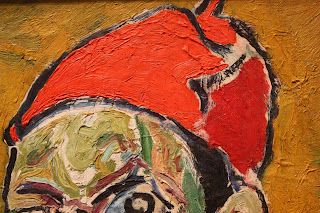


As vivid and compelling as these photos are, the painting itself is even more striking!
A second work (see image below) is in storage. I made an appointment with the American Art department to see it. Associate Curator Sarah Kelly took me into the basement of the museum and located the room in which the painting is stored. We looked at it for several minutes together. There is no signature or date on the front of the painting, but the date “1965” was indicated in pencil on the rear of the painting. Other information about the date and acquisition was presented on two labels affixed to the rear of the work. The work itself is a conglomerate of curves, swipes, and splotches of paint in varying shades of green, yellow, and melon. I thought that I saw two cowboys amidst the colorful swirls!

Sarah accompanied me to the Prints and Drawings Department, where I saw the third Delaney that is owned by the museum. Though it is a painting, the museum has classified it as a drawing because it is painted with a transparent medium (watercolor) and is on paper. The Prints and Drawings department is equipped to store and display such works, which require special preservation. Works held by this department are displayed for three months, and then placed back into storage to preserve them.

Curator Mark Pascale talked with me at length about this painting, which is untitled. He said that the colors of the painting were greatly faded, and showed me how to recognize the fading of the “cream wove”paper that Beauford used for this work as well. Mark described watercolor as a “fugitive medium,” and said that it has “inherent vice.” I found this description (which indicates the fragile nature of watercolor) amusing, and Mark said that the first time he heard it, it amused him as well.
As well as watercolor, Beauford also used gouache for this painting. Gouache is a mixture of opaque white paint with watercolor. This mixture can be made transparent by adding water.
Beauford painted this work for his friends Miriam and Palmer Hayden. His inscription—Pour Mariam & Palmer with love Beauford—and the date—“ ’61”—are barely visible. The painting was acquired from the Haydens by artist and art historian Semella Lewis, who in turn presented it to an art dealer, who sold it to the museum.
I highly recommend a visit to the Art Institute of Chicago to see Beauford’s works. You may phone the Prints and Drawings Department for an appointment to see the watercolor and gouache painting. The American Art Department may also grant a request to see the oil painting that is in storage, but only if you visit alone.
I was also pleased to announce that, earlier in the day, I had had the opportunity to visit the Art Institute of Chicago to see the Beauford Delaney works that this museum owns. The trip was most educational and enjoyable! The museum holds three paintings, two of which are not on public display.
I have already presented the 1944 self-portrait that hangs in Gallery 262 at the Art Institute of Chicago in previous blog postings (You've Got the Eye; Cid Corman's Poetic Tribute to Beauford). But a friend recently visited the gallery and took some extraordinary photos of the painting, and I would like to share them with you here. Note the very heavy streaks of paint that Beauford used to create this image of himself.
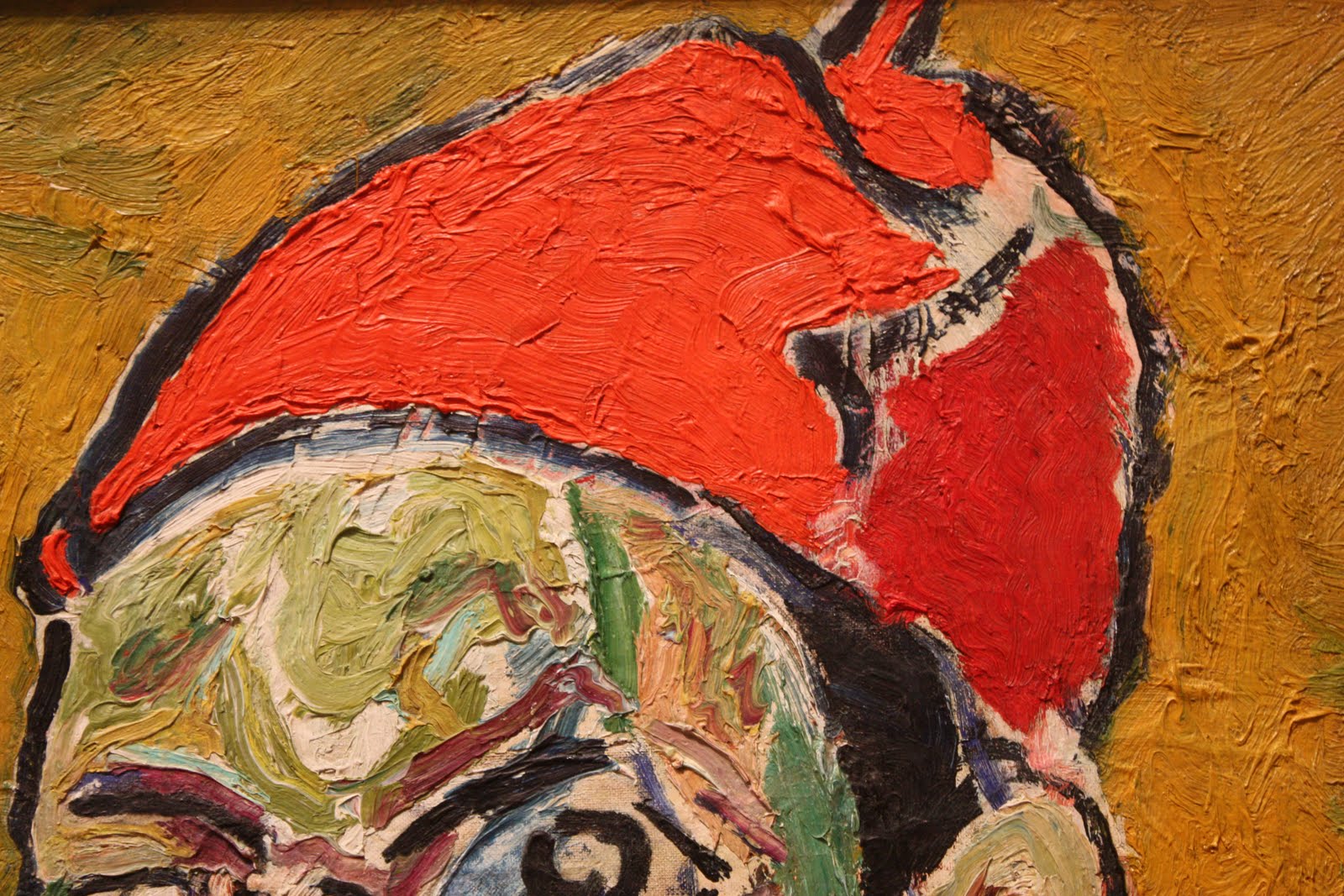


Photos of Beauford's 1944 Self-portrait
Photos courtesy of Tim Paulson
As vivid and compelling as these photos are, the painting itself is even more striking!
A second work (see image below) is in storage. I made an appointment with the American Art department to see it. Associate Curator Sarah Kelly took me into the basement of the museum and located the room in which the painting is stored. We looked at it for several minutes together. There is no signature or date on the front of the painting, but the date “1965” was indicated in pencil on the rear of the painting. Other information about the date and acquisition was presented on two labels affixed to the rear of the work. The work itself is a conglomerate of curves, swipes, and splotches of paint in varying shades of green, yellow, and melon. I thought that I saw two cowboys amidst the colorful swirls!

Untitled by Beauford Delaney
(1965) Oil on canvas
Image courtesy of the Art Institute of Chicago
Sarah accompanied me to the Prints and Drawings Department, where I saw the third Delaney that is owned by the museum. Though it is a painting, the museum has classified it as a drawing because it is painted with a transparent medium (watercolor) and is on paper. The Prints and Drawings department is equipped to store and display such works, which require special preservation. Works held by this department are displayed for three months, and then placed back into storage to preserve them.

Photo of “Untitled” (1961) by Beauford Delaney
© Discover Paris!
Curator Mark Pascale talked with me at length about this painting, which is untitled. He said that the colors of the painting were greatly faded, and showed me how to recognize the fading of the “cream wove”paper that Beauford used for this work as well. Mark described watercolor as a “fugitive medium,” and said that it has “inherent vice.” I found this description (which indicates the fragile nature of watercolor) amusing, and Mark said that the first time he heard it, it amused him as well.
As well as watercolor, Beauford also used gouache for this painting. Gouache is a mixture of opaque white paint with watercolor. This mixture can be made transparent by adding water.
Beauford painted this work for his friends Miriam and Palmer Hayden. His inscription—Pour Mariam & Palmer with love Beauford—and the date—“ ’61”—are barely visible. The painting was acquired from the Haydens by artist and art historian Semella Lewis, who in turn presented it to an art dealer, who sold it to the museum.
I highly recommend a visit to the Art Institute of Chicago to see Beauford’s works. You may phone the Prints and Drawings Department for an appointment to see the watercolor and gouache painting. The American Art Department may also grant a request to see the oil painting that is in storage, but only if you visit alone.
"You've Got the Eye"
In a recent posting of an anecdote about Beauford, Burt Reinfrank indicated that Beauford would frequently say to Burt, "You've got the eye."
While this may have been true in the context that Beauford was speaking—Burt could easily distinguish original Delaneys from copies or fraudulent pieces)—in fact, it is Beauford who “had the eye.” Whether or not he knew it consciously, we may never know. But one can certainly see it in his paintings, and particularly in his self-portraits.
In Beauford’s formative years as an artist, capturing likeness was his primary goal in portraiture. But during his New York years, he began to take painterly liberties with his portraits of Harlem residents, and in his Paris years, his portraits of others reflected his increasing concern with color and the “inner light” of his subjects in opposition to likeness. Author David Leeming cites an example of this attitude in Amazing Grace, the only biography of Beauford in print thus far. In an exchange between Beauford and Elwood Peterson regarding Peterson’s portrait, Beauford states:
Sue Canterbury, curator of the Minneapolis Institute of Arts exposition entitled Beauford Delaney: From New York to Paris, states in her essay on Beauford’s life and work that “One eye sees without; the other within.” She elaborated on this comment for today’s blog posting, saying that she wished to draw attention to the difference between two types of vision that one might attribute to Beauford—one being the reading of external phenomena, and the other, reading/seeing on a deeper plane of meaning that one might call that spiritual or cosmic. Burt Reinfrank, a great friend of Beauford and a contributor to this blog, believes that Beauford was connected to humanity in a way that transcends our worldly consciousness, and stated that Beauford often spoke of “the cosmos.”
In looking at a series of Beauford’s self-portraits, the astute observer will note that there is often asymmetry in Beauford’s eyes. This irregularity differs from portrait to portrait, and is not a reflection of any physical disfigurement in Beauford’s face. Perhaps this is Beauford's way, consciously or subconsciously, of depicting the two types of vision described above.


While this may have been true in the context that Beauford was speaking—Burt could easily distinguish original Delaneys from copies or fraudulent pieces)—in fact, it is Beauford who “had the eye.” Whether or not he knew it consciously, we may never know. But one can certainly see it in his paintings, and particularly in his self-portraits.
In Beauford’s formative years as an artist, capturing likeness was his primary goal in portraiture. But during his New York years, he began to take painterly liberties with his portraits of Harlem residents, and in his Paris years, his portraits of others reflected his increasing concern with color and the “inner light” of his subjects in opposition to likeness. Author David Leeming cites an example of this attitude in Amazing Grace
, the only biography of Beauford in print thus far. In an exchange between Beauford and Elwood Peterson regarding Peterson’s portrait, Beauford states:If you wanted an exact likeness you could have gone to a photographer…when you sing you become eighteen again, and that’s what I wanted to capture.Peterson offered to buy the painting, but Beauford refused payment, giving the painting to his subject instead.
Sue Canterbury, curator of the Minneapolis Institute of Arts exposition entitled Beauford Delaney: From New York to Paris
, states in her essay on Beauford’s life and work that “One eye sees without; the other within.” She elaborated on this comment for today’s blog posting, saying that she wished to draw attention to the difference between two types of vision that one might attribute to Beauford—one being the reading of external phenomena, and the other, reading/seeing on a deeper plane of meaning that one might call that spiritual or cosmic. Burt Reinfrank, a great friend of Beauford and a contributor to this blog, believes that Beauford was connected to humanity in a way that transcends our worldly consciousness, and stated that Beauford often spoke of “the cosmos.”In looking at a series of Beauford’s self-portraits, the astute observer will note that there is often asymmetry in Beauford’s eyes. This irregularity differs from portrait to portrait, and is not a reflection of any physical disfigurement in Beauford’s face. Perhaps this is Beauford's way, consciously or subconsciously, of depicting the two types of vision described above.
In his 1944 self-portrait, Beauford has represented his right eye as being entirely white. His left eye is larger than the right, rhomboid in shape, and one gets the impression that it has no lid. The pupil is light-colored and the surrounding iris black. In his 1950 self-portrait, it is the right eye that is smaller, with a black iris and no apparent pupil, while the left eye is a grayish tan with a clear tan iris and a dark pupil.
In his 1964 self-portrait, Beauford had retained the proportions that he used in his 1950 self-portrait. His face is gaunt, making the white of the almond-shaped left eye seem sunken in and the white of that eye more gleaming.

Self-portrait
Oil on canvas (1964)
Collection of the Reinfrank Family
In his 1972 portrait, he returns to marked asymmetry, this time accentuated by the fullness of his face. The left eye is larger and higher than the right, the iris is thin and the pupil large and light-colored—even mottled.

Self-portrait
Gouache on paper (1972)
Collection of David Leeming
Catherine St. John, a professor at Berkeley College in New Jersey and author of the essay “A Narrative of Belonging: The Art of Beauford Delaney and Glen Ligon,” describes the white eye in the 1944 self-portrait as “vacant,” and refers to the “monocular stare” that philosopher Jacques Derrida evoked in his Memoirs of the Blind: The Self-Portrait and Other Ruins – “a single eye open and fixed firmly on its own image, seeing nothing, nothing but an eye which prevents it from seeing anything at all.” St. John poses the rhetorical question “Are Delaney’s self-portraits attempts to find his own identity in his own image?”
In my opinion, Beauford’s numerous self-portraits are some of his most extraordinary oeuvre. (The ones presented here are but a few of them.) I encourage you to search for images of these works on line or to view them in person at museums and judge for yourself.
Beauford's Makonde Figure at the Armory Show Modern in NYC
The Michael Rosenfeld Gallery is exhibiting Beauford's Makonde Figure, a signed and dated painting of an African sculpture, among numerous other works at the Armory Show Modern in Manhattan. Dates and times are as follows:
Thursday, March 4 - Noon to 8 PM
Friday, March 5 - Noon to 8 PM
Saturday, March 6 - Noon to 8 PM
Sunday, March 7 - Noon to 7 PM
The Armory Show Modern is being held at Twelvth Avenue and Fifty-fifth Street, NYC. The Michael Rosenfeld Gallery will be at Booth #237 - Pier 92. For more information, phone the gallery at 212-247-0082, or send e-mail to website (at) michaelrosenfeldart (dot) com.
Thursday, March 4 - Noon to 8 PM
Friday, March 5 - Noon to 8 PM
Saturday, March 6 - Noon to 8 PM
Sunday, March 7 - Noon to 7 PM
The Armory Show Modern is being held at Twelvth Avenue and Fifty-fifth Street, NYC. The Michael Rosenfeld Gallery will be at Booth #237 - Pier 92. For more information, phone the gallery at 212-247-0082, or send e-mail to website (at) michaelrosenfeldart (dot) com.
Beauford and the Michael Rosenfeld Gallery
The Michael Rosenfeld Gallery, located at 24 West 57 Street, opened its doors in Manhattan in 1989. It acquired its first Beauford Delaney painting – an untitled portrait – soon afterward, and has been a champion of Beauford’s work ever since. To date, the gallery has mounted twenty-five expositions that have included paintings by Beauford, including two solo expositions of selected abstract works.
Michael Rosenfeld’s wife and partner, halley k harrisburg, is the director of the Michael Rosenfeld Gallery. She kindly consented to grant me an interview to provide insight into why the gallery is such a fervent supporter of Beauford’s œuvre.
The story begins with the adolescent Michael Rosenfeld, a precocious youth with an unquenchable thirst for knowledge of art history and artists. He would spend hours roaming the city to look at and buy art objects, and developed relationships with vendors and galleries around town – including many on Madison Avenue. He poured over old ads and archives of artistic works in libraries and museums, noted the names of artists whose work interested him, and sought these artists out. When they consented to meet with him, they were invariably surprised to find that a teenager presented himself for the rendezvous. Michael would put himself through college by buying and selling art.
Many of the paintings that Michael Rosenfeld acquired during his youth were created by African-American artists. He often did not know this at the time that he obtained the works – it was only later that he became aware of the “African-American artist” and the struggles that faced such artists in the American art world, and began to recognize the names of particular artists in this light.

Michael and halley visited the Paul Facchetti Gallery in Paris during the mid-1990s. Facchetti was a major supporter of Beauford during his Paris years and held several of his works, and Michael and halley purchased several of Beauford’s paintings from Facchetti during that trip. These became the nexus of the Michael Rosenfeld Gallery Delaney collection. Michael and halley also established relationships with Darthea Speyer and others in Paris who supported Beauford and his art. Since that time, they have actively sought to acquire authentic Delaney paintings (halley indicated that there are numerous counterfeit works on the market today), with the intent to sell them to museums as well as to private collectors. They are also eager to make Beauford’s work available to museums for exhibitions.
_MRosenfeldGallery.jpg)
In 1995, the gallery held its first solo exposition of Beauford’s paintings. It was entitled Beauford Delaney: 1960s Paris Abstractions, and it ran from September 14 - November 11. At the time, the scant press that Beauford’s work had received concerned his figurative paintings, such as those shown at the Studio Museum in Harlem in 1978. In this context, to mount a solo exposition exclusively composed of abstract works could be considered audacious. halley indicated that this exposition was very poorly attended, and stated her conviction that this was because the public could not comprehend the significance of abstract art produced by an “African-American artist.”
MRosenfeld+Gallery.jpg)
halley stated that the gallery feels privileged to have handled so many of Beauford’s paintings. When asked what makes his work desirable for the gallery, her passion for it burst forth as she spoke of Beauford’s electric palette, and the raw emotion, sheer integrity, and consistency of intent of his œuvre. She stated that Beauford’s approach to portraits, landscapes, his representations of Washington Square, and his abstractions are quintessentially his own; and that each work of art that he produced was an external representation of all the opportunities, hardships, and relationships that he had experienced in life up to the moment that he set his brush to canvas. She and Michael believe that Beauford is one of the most important of all 20th-century American painters.

The Michael Rosenfeld Gallery is a supporter of the mission of Les Amis de Beauford Delaney to place a permanent marker at Beauford’s grave at Thiais Cemetery. Please join them in supporting our effort! Send your donation check, made payable to Les Amis de Beauford Delaney, to us at one of the following addresses:
US Dollar donations:
Monique Y. Wells
Les Amis de Beauford Delaney
11503 Sandhurst
Houston, TX 77048
USA
Euro donations:
Monique Y. Wells
Les Amis de Beauford Delaney
52, rue Lhomond
75005 Paris
FRANCE
Michael Rosenfeld’s wife and partner, halley k harrisburg, is the director of the Michael Rosenfeld Gallery. She kindly consented to grant me an interview to provide insight into why the gallery is such a fervent supporter of Beauford’s œuvre.
The story begins with the adolescent Michael Rosenfeld, a precocious youth with an unquenchable thirst for knowledge of art history and artists. He would spend hours roaming the city to look at and buy art objects, and developed relationships with vendors and galleries around town – including many on Madison Avenue. He poured over old ads and archives of artistic works in libraries and museums, noted the names of artists whose work interested him, and sought these artists out. When they consented to meet with him, they were invariably surprised to find that a teenager presented himself for the rendezvous. Michael would put himself through college by buying and selling art.
Many of the paintings that Michael Rosenfeld acquired during his youth were created by African-American artists. He often did not know this at the time that he obtained the works – it was only later that he became aware of the “African-American artist” and the struggles that faced such artists in the American art world, and began to recognize the names of particular artists in this light.

Beauford Delaney (1901-1979)
Ahmed Bioud, 1964
oil on canvas
39 1/4" x 32", signed
© Estate of Beauford Delaney; Courtesy of Michael Rosenfeld Gallery, LLC, New York , NY
Michael and halley visited the Paul Facchetti Gallery in Paris during the mid-1990s. Facchetti was a major supporter of Beauford during his Paris years and held several of his works, and Michael and halley purchased several of Beauford’s paintings from Facchetti during that trip. These became the nexus of the Michael Rosenfeld Gallery Delaney collection. Michael and halley also established relationships with Darthea Speyer and others in Paris who supported Beauford and his art. Since that time, they have actively sought to acquire authentic Delaney paintings (halley indicated that there are numerous counterfeit works on the market today), with the intent to sell them to museums as well as to private collectors. They are also eager to make Beauford’s work available to museums for exhibitions.
_MRosenfeldGallery.jpg)
Beauford Delaney (1901-1979)
Exchange Place, 1943
oil on panel
33 1/4" x 45 1/2", signed
© Estate of Beauford Delaney; Courtesy of Michael Rosenfeld Gallery, LLC, New York , NY
In 1995, the gallery held its first solo exposition of Beauford’s paintings. It was entitled Beauford Delaney: 1960s Paris Abstractions, and it ran from September 14 - November 11. At the time, the scant press that Beauford’s work had received concerned his figurative paintings, such as those shown at the Studio Museum in Harlem in 1978. In this context, to mount a solo exposition exclusively composed of abstract works could be considered audacious. halley indicated that this exposition was very poorly attended, and stated her conviction that this was because the public could not comprehend the significance of abstract art produced by an “African-American artist.”
MRosenfeld+Gallery.jpg)
Beauford Delaney (1901-1979)
Untitled, 1960
oil on canvas
51" x 38", signed
© Estate of Beauford Delaney; Courtesy of Michael Rosenfeld Gallery, LLC, New York , NY
halley stated that the gallery feels privileged to have handled so many of Beauford’s paintings. When asked what makes his work desirable for the gallery, her passion for it burst forth as she spoke of Beauford’s electric palette, and the raw emotion, sheer integrity, and consistency of intent of his œuvre. She stated that Beauford’s approach to portraits, landscapes, his representations of Washington Square, and his abstractions are quintessentially his own; and that each work of art that he produced was an external representation of all the opportunities, hardships, and relationships that he had experienced in life up to the moment that he set his brush to canvas. She and Michael believe that Beauford is one of the most important of all 20th-century American painters.

Beauford Delaney in his Vercingetonix Studio, c.1967
© Estate of Beauford Delaney; Courtesy of Michael Rosenfeld Gallery, LLC, New York , NY
The Michael Rosenfeld Gallery is a supporter of the mission of Les Amis de Beauford Delaney to place a permanent marker at Beauford’s grave at Thiais Cemetery. Please join them in supporting our effort! Send your donation check, made payable to Les Amis de Beauford Delaney, to us at one of the following addresses:
US Dollar donations:
Monique Y. Wells
Les Amis de Beauford Delaney
11503 Sandhurst
Houston, TX 77048
USA
Euro donations:
Monique Y. Wells
Les Amis de Beauford Delaney
52, rue Lhomond
75005 Paris
FRANCE
Beauford and the Briet Brothers
Philippe Briet (1959-1997) was a French gallery owner and publisher who was passionate about the work of Beauford Delaney. His brother Sylvain shares that passion to this day. Sylvain Briet graciously consented to speak with me about the work that he and Philippe undertook during the late 1980s through the mid 1990s to lift Beauford’s works from obscurity and promote them. (He also contributed the photos in this posting; they are not to be reproduced elsewhere or otherwise utilized without his express permission.)
Philippe Briet’s passion for art was born when he was a high school student in Caen, Normandy in 1977. He organized several exhibitions of modern and contemporary art at his school, including the works of great painters such as Chagall and Sonia Delaunay. He befriended Sonia Delaunay in Paris in 1978, and she generously created a poster for one of his shows. At his tender age, he would meet artistic greats such as Salvador Dalí, Marc Chagall, and Andy Warhol. By the time he was 22 years old, Philippe was responsible for the contemporary art program for the City of Caen, and organized a traveling exhibit of contemporary French art in Africa for the French Ministry of Foreign Affairs. He would later befriend painter Jean-Michel Basquiat in New York, and earnestly support this artist when his work was not yet popular.


Briet moved to New York in 1985, and opened the Philippe Briet Gallery in SoHo, Manhattan in 1987. One Sunday in April 1988, Philippe took Sylvain and some friends to the Studio Museum in Harlem, and was surprised to find it closed. The gallery’s bookstore was open, however, and inside, Philippe’s attention was drawn to a tall pile of books with an orange cover bearing a black and white photo of a man whose face he had not seen before. This was a stack of catalogs for the Studio Museum in Harlem’s retrospective of Beauford’s works, organized by Richard A. Long in 1978. Beauford’s photo was on the cover. The catalogs were on sale for $1.00.

Sylvain indicated that Philippe was entranced by the depth of Beauford’s expression on the cover, and the images of the works that he saw in that catalog. Feeling the importance of that moment, he bought a copy for each of his friends. He later contacted Mary Schmidt Campbell, New York City Commissioner of Cultural Affairs and former Executive Director of the Studio Museum, to learn more about this amazing painter, and discovered that Beauford was deceased. Campbell would introduce Philippe to several persons who knew Beauford personally, including Solange du Closel, Richard Long, and Al Hirschfeld. Captivated and impassioned by Beauford’s work, Philippe moved heaven and earth to organize and present the first Beauford Delaney exposition since 1978. Entitled Beauford Delaney [1901-1979]: From Tennessee to Paris, this show was presented in November 1988. It included roughly ten works from New York and Paris, including a portrait of Solange du Closel and a magnificant painting of Washington Square in New York.

According to Sylvain, Philippe felt that people were much more cognizant and appreciative of Beauford’s personality than they were of his art. Philippe embarked on a treasure hunt of sorts, finding some of Beauford’s paintings in the homes of persons who had purchased them long ago and, not realizing their artistic value, stored them in basements or closets. He recovered several that were in less-than-optimal condition, paid fair market value for them, and had these paintings restored. His mission was to acquire Beauford’s works to showcase, not to sell, and to convince museums and the art press of the importance of these works.
Sylvain joined his brother in New York, and together the two men pursued the work of operating a new SoHo gallery, which opened on Broadway in October 1989 with Don’t You Know by Now, a show curated by jazz musician Ornette Coleman. Philippe and Sylvain would mount two retrospectives of Beauford’s work: A Retrospective: Fifty Years of Light (1991) and Beauford Delaney: The New York Years (1994). Forty-seven paintings were hung at the latter exhibit, which was a remarkable feat given that only œuvre created between 1929 and 1953 were shown. Most of these works were being shown for the first time in over fifty years.


In 1995, Philippe Briet collaborated with American poet Cid Corman and American curator and publisher Richard Milazzo to create a book of poetry dedicated to Beauford. Called Tributary (Edgewise Press, 1999), it contains fifty poems and five color reproductions of Beauford’s paintings. In 1995, Philippe also wrote a draft essay about Beauford that he did not have the opportunity to finalize. It would eventually be published in the catalog for the 2007 art exhibit entitled Philippe Briet: Art. Art. Art., which was organized by Sylvain for the Région Basse-Normandie in honor of the 10th anniversary of his brother’s death and presented at the Abbaye-aux-Dames in Caen, France.

Sylvain Briet has followed the status of Beauford’s gravesite since 2002. He continues to hope that Beauford’s remains will someday be transferred to Montparnasse Cemetery, the burial ground closest to where Beauford spent most of his life in Paris, and where James Baldwin wanted to see his friend buried. He is following the progress of Les Amis de Beauford Delaney regarding the placement of a permanent marker at the tomb at Thiais Cemetery.
Philippe Briet’s passion for art was born when he was a high school student in Caen, Normandy in 1977. He organized several exhibitions of modern and contemporary art at his school, including the works of great painters such as Chagall and Sonia Delaunay. He befriended Sonia Delaunay in Paris in 1978, and she generously created a poster for one of his shows. At his tender age, he would meet artistic greats such as Salvador Dalí, Marc Chagall, and Andy Warhol. By the time he was 22 years old, Philippe was responsible for the contemporary art program for the City of Caen, and organized a traveling exhibit of contemporary French art in Africa for the French Ministry of Foreign Affairs. He would later befriend painter Jean-Michel Basquiat in New York, and earnestly support this artist when his work was not yet popular.

Philippe Briet (right) and his art teacher at the Sonia Delaunay exposition (1978)
© Sylvain Briet

Philippe Briet (left) and Sonia Delaunay (1979)
© Sylvain Briet
Briet moved to New York in 1985, and opened the Philippe Briet Gallery in SoHo, Manhattan in 1987. One Sunday in April 1988, Philippe took Sylvain and some friends to the Studio Museum in Harlem, and was surprised to find it closed. The gallery’s bookstore was open, however, and inside, Philippe’s attention was drawn to a tall pile of books with an orange cover bearing a black and white photo of a man whose face he had not seen before. This was a stack of catalogs for the Studio Museum in Harlem’s retrospective of Beauford’s works, organized by Richard A. Long in 1978. Beauford’s photo was on the cover. The catalogs were on sale for $1.00.

Cover of the Studio Museum in Harlem catalog (1978)
Courtesy of Sylvain Briet
Sylvain indicated that Philippe was entranced by the depth of Beauford’s expression on the cover, and the images of the works that he saw in that catalog. Feeling the importance of that moment, he bought a copy for each of his friends. He later contacted Mary Schmidt Campbell, New York City Commissioner of Cultural Affairs and former Executive Director of the Studio Museum, to learn more about this amazing painter, and discovered that Beauford was deceased. Campbell would introduce Philippe to several persons who knew Beauford personally, including Solange du Closel, Richard Long, and Al Hirschfeld. Captivated and impassioned by Beauford’s work, Philippe moved heaven and earth to organize and present the first Beauford Delaney exposition since 1978. Entitled Beauford Delaney [1901-1979]: From Tennessee to Paris, this show was presented in November 1988. It included roughly ten works from New York and Paris, including a portrait of Solange du Closel and a magnificant painting of Washington Square in New York.

Interior of the invitation card for the 1988 exposition
Courtesy of Sylvain Briet
According to Sylvain, Philippe felt that people were much more cognizant and appreciative of Beauford’s personality than they were of his art. Philippe embarked on a treasure hunt of sorts, finding some of Beauford’s paintings in the homes of persons who had purchased them long ago and, not realizing their artistic value, stored them in basements or closets. He recovered several that were in less-than-optimal condition, paid fair market value for them, and had these paintings restored. His mission was to acquire Beauford’s works to showcase, not to sell, and to convince museums and the art press of the importance of these works.
Sylvain joined his brother in New York, and together the two men pursued the work of operating a new SoHo gallery, which opened on Broadway in October 1989 with Don’t You Know by Now, a show curated by jazz musician Ornette Coleman. Philippe and Sylvain would mount two retrospectives of Beauford’s work: A Retrospective: Fifty Years of Light (1991) and Beauford Delaney: The New York Years (1994). Forty-seven paintings were hung at the latter exhibit, which was a remarkable feat given that only œuvre created between 1929 and 1953 were shown. Most of these works were being shown for the first time in over fifty years.

A Retrospective: Fifty Years of Light (1991)
© Sylvain Briet

Philippe Briet (right) and Richard Long at the 1991 exposition
© Sylvain Briet
None of the works shown at either of these exhibits were for sale. The shows drew the attention of major newspapers and magazines (The New York Times, The New Yorker, Village Voice, Art in America, New York Magazine, Amsterdam News, Arts Magazine...), as art critics noted the quality of the works and posed the question "Why did Beauford Delaney disappear from American art history?" Shortly after this exposition ended, the Briet brothers closed the gallery and began to publish books about artists and their work.

Beauford Delaney: The New York Years (1994)
© Sylvain Briet

Haywood "Bill" Rivers at the 1994 exposition
© Sylvain Briet

Philippe (left) shows Brice Porter a self-portrait of Beauford at the 1994 exposition
© Sylvain Briet
In 1995, Philippe Briet collaborated with American poet Cid Corman and American curator and publisher Richard Milazzo to create a book of poetry dedicated to Beauford. Called Tributary (Edgewise Press, 1999), it contains fifty poems and five color reproductions of Beauford’s paintings. In 1995, Philippe also wrote a draft essay about Beauford that he did not have the opportunity to finalize. It would eventually be published in the catalog for the 2007 art exhibit entitled Philippe Briet: Art. Art. Art., which was organized by Sylvain for the Région Basse-Normandie in honor of the 10th anniversary of his brother’s death and presented at the Abbaye-aux-Dames in Caen, France.

Cover of the Philippe Briet: Art. Art. Art. catalog
Courtesy of Sylvain Briet
Sylvain Briet has followed the status of Beauford’s gravesite since 2002. He continues to hope that Beauford’s remains will someday be transferred to Montparnasse Cemetery, the burial ground closest to where Beauford spent most of his life in Paris, and where James Baldwin wanted to see his friend buried. He is following the progress of Les Amis de Beauford Delaney regarding the placement of a permanent marker at the tomb at Thiais Cemetery.
Beauford at Galerie Darthea Speyer
Darthea Speyer is an extraordinary woman whose passion and vision changed the landscape of Paris’ art scene. She worked as exhibit officer for the United States Information Services at the American Embassy and helped to found the American Cultural Center in the rue de Dragon. Subsequently, during the midst of the May 1968 riots, she established an art gallery in the heart of Saint-Germain des Prés. Her brother, A. James Speyer, designed the space, and brother and sister worked together to plan the expositions.


Galerie Darthea Speyer
© Discover Paris!
Beauford and Darthea Speyer met in the fall of 1956, when Speyer purchased a watercolor that Beauford painted during his summer in Ibiza that year. She would later organize a group exhibition that included Beauford’s works at the American Cultural Center in 1966, and host two solo exhibitions of his work at her gallery. She was a staunch supporter of Beauford during good times and bad, and often commissioned him to paint portraits of herself and her family to provide him with work. She was a member of the trustee panel that handled Beauford’s affairs during his last years, which were spent at Saint Anne’s Hospital.

Darthea
Beauford Delaney
Oil on canvas (1965)
Courtesy of Galerie Darthea Speyer
The 1973 solo exposition at the Speyer Gallery was quite successful and received positive reviews. Beauford’s portraits commanded the most attention. Among them were works depicting Jean Genet, Ahmed Bioud, and James Baldwin. Speyer also selected several abstract and semi-abstract paintings to exhibit, including many that featured African themes. The exposition ran from February 6 through March 2.

Invitation card for 1973 exhibit at Galerie Darthea Speyer
Courtesy of Galerie Darthea Speyer
Not much is written about the 1992 solo exposition at the Speyer Gallery. However, in the invitation card for the exhibit, Speyer tenderly eulogizes Beauford. She speaks of his coming almost each day to her office at the American Cultural Center, and then to the gallery. She states how he happily and quickly captured the images of her family and friends on canvas. She laments the shadow that descended upon his spirit and eventually led to his commitment at Saint Anne’s.

Invitation card for 1992 exhibit at Galerie Darthea Speyer
Courtesy of Galerie Darthea Speyer
Galerie Darthea Speyer permanently closed its doors at the end of 2009. It will donate its remaining works by Beauford to the Smithsonian Institute in Washington, D.C.

Beauford and Darthea
Invitation card for 1973 exhibit at Galerie Darthea Speyer
Courtesy of Galerie Darthea Speyer