

Delia Delaney - Beauford's Beloved Mother
In celebration of Mother's Day 2018, I decided to devote this week's blog post to Beauford's beloved mother, Delia Delaney.
The first three pages of the first chapter in Beauford's biography, Amazing Grace: A Life of Beauford Delaney , are devoted to "Delia Johnson Delaney, a strict, proud woman who upheld what she saw as the Christian virtues."

Image of 1953 portrait of Delia Delaney from
Amazing Grace: A Life of Beauford Delaney
In reading these pages, we learn that Delia was born into slavery in February 1865, that she never learned to read or write, and that she loved singing old songs and telling stories about plantation life and the Civil War days. She instilled in her children the value of education and the evils of racism.
We also learn that she was naturally artistic and that she never revealed her sufferings to the world at large. These are two traits that she passed on to Beauford.
Beauford captured his mother's likeness many times, from a 1922 watercolor that he created under Lloyd Branson's tutelage in Knoxville, to later portraits done from memory after Delia's passing in 1958.
I have posted images of two of these portraits on this blog several times over the years:
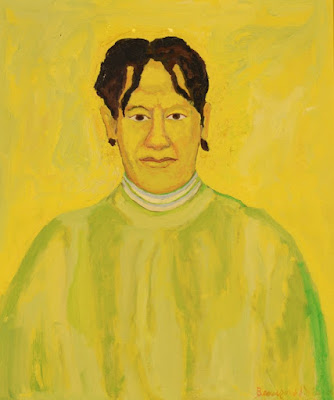
Portrait of Delia Delaney
(1964) Oil on canvas
Knoxville Museum of Art
© Estate of Beauford Delaney
by permission of Derek L. Spratley, Esquire,
Court Appointed Administrator

Portrait of Delia Delaney
(1933) Pastel on paper
Knoxville Museum of Art
© Estate of Beauford Delaney
by permission of Derek L. Spratley, Esquire,
Court Appointed Administrator
Another portrait of Delia is part of the private collection of painter Danny Simmons:

Portrait of the Artist’s Mother
(1930) Pencil, ink and watercolor on paper
© Estate of Beauford Delaney,
by permission of Derek L. Spratley, Esquire,
Court Appointed Administrator
In Amazing Grace, biographer David Leeming describes Delia as being "the dominant force for stability" in Beauford's life. When she died, he wrote to his friend Larry Wallrich that he hoped to "gather [himself] together" and "use some of the heritage of endurance left me by her."
Happy Mother's Day from Les Amis de Beauford Delaney!
The first three pages of the first chapter in Beauford's biography, Amazing Grace: A Life of Beauford Delaney
, are devoted to "Delia Johnson Delaney, a strict, proud woman who upheld what she saw as the Christian virtues."
Amazing Grace: A Life of Beauford Delaney
In reading these pages, we learn that Delia was born into slavery in February 1865, that she never learned to read or write, and that she loved singing old songs and telling stories about plantation life and the Civil War days. She instilled in her children the value of education and the evils of racism.
We also learn that she was naturally artistic and that she never revealed her sufferings to the world at large. These are two traits that she passed on to Beauford.
Beauford captured his mother's likeness many times, from a 1922 watercolor that he created under Lloyd Branson's tutelage in Knoxville, to later portraits done from memory after Delia's passing in 1958.
I have posted images of two of these portraits on this blog several times over the years:

(1964) Oil on canvas
Knoxville Museum of Art
© Estate of Beauford Delaney
by permission of Derek L. Spratley, Esquire,
Court Appointed Administrator

(1933) Pastel on paper
Knoxville Museum of Art
© Estate of Beauford Delaney
by permission of Derek L. Spratley, Esquire,
Court Appointed Administrator
Another portrait of Delia is part of the private collection of painter Danny Simmons:

(1930) Pencil, ink and watercolor on paper
© Estate of Beauford Delaney,
by permission of Derek L. Spratley, Esquire,
Court Appointed Administrator
In Amazing Grace, biographer David Leeming describes Delia as being "the dominant force for stability" in Beauford's life. When she died, he wrote to his friend Larry Wallrich that he hoped to "gather [himself] together" and "use some of the heritage of endurance left me by her."
Happy Mother's Day from Les Amis de Beauford Delaney!
Beauford and Larry Calcagno: The Letters
In August 2016, Wells International Foundation intern, Sojourner Ahébée, wrote a poignant article about the correspondence between Beauford and his dear friend, Larry Calcagno:
A Boundless Love: Beauford Delaney's Letters to Larry Calcagno

An Artistic Friendship:
Beauford Delaney and Lawrence Calcagno
Catalog cover for art exposition
Palmer Museum of Art (2001)
Calcagno's nephew, Tom Gibson, recently sent me copies of several letters kept at the Calcagno archive in Poughkeepsie, NY that were exchanged by these two men. In reading them, I felt the strong tug at my heartstrings that I did when I read Sojourner's description of the thoughts and feelings that Beauford and Calcagno shared.
Today, I'm sharing a few lines from an undated letter that Beauford wrote to Larry, which he likely penned in early 1970. Calcagno had recently undergone surgery.
Beauford opens with the following:
"Just received your wonderful letter [—] 'wonderful' because all of your letters are ...
"Your going to beautiful Porto [sic] Rico naturally restores your physical and creative sources and the rest among those wonderful people together with the marvelous ocean and Sun is where you should remain as long as you feel like letting nature, embrace you and all her magic will remake you free and happy living a great physical and creative life."
In this passage, the kinship between these soul mates is tangible.
Beauford goes on to talk of his recent visit to Knoxville to see his family and the work that occupied his life and sustained his morale after his return to Paris. He mentions the demolition of the Gare Montparnasse and its replacement by "an enormous Bldg 55 stories high."

Tour Montparnasse seen from Arc de Triomphe (2012)
CC-BY-SA 3.0
Author: Ввласенко
He acknowledges that changes in the city landscape are necessary but notes that "the ancient charm makes many of us nostalgie 'smile'."
He then addresses the subject of art and what it means to him and Calcagno:
"...I believe that all that we are now has always been and the exploration of working with our art and of course its also our way of life bringing to it as much of its inimgma [sic] is deathless and teaches us patience and courage ... I begin to believe that the various visions and dreams release themselves so we may be fecund and capable of creating sometimes that which is universal."
This letter, which is signed
"Love, Love, Love to you dear Larry and write when you can[.] be well and happy Beauford"
is but one of many in the Calcagno archive that sing with the deep love and respect that these two artists had for each other.

Portrait of a Young Man (Larry Calcagno)
(1953) Oil on canvas
© Estate of Beauford Delaney
by permission of Derek L. Spratley, Esquire,
Court Appointed Administrator
For more articles about Beauford and Larry Calcagno, click on the links below.
Beauford and Larry Calcagno
Larry Calcagno's Portrait of Beauford
Beauford in Spain
A Boundless Love: Beauford Delaney's Letters to Larry Calcagno

Beauford Delaney and Lawrence Calcagno
Catalog cover for art exposition
Palmer Museum of Art (2001)
Calcagno's nephew, Tom Gibson, recently sent me copies of several letters kept at the Calcagno archive in Poughkeepsie, NY that were exchanged by these two men. In reading them, I felt the strong tug at my heartstrings that I did when I read Sojourner's description of the thoughts and feelings that Beauford and Calcagno shared.
Today, I'm sharing a few lines from an undated letter that Beauford wrote to Larry, which he likely penned in early 1970. Calcagno had recently undergone surgery.
Beauford opens with the following:
"Just received your wonderful letter [—] 'wonderful' because all of your letters are ...
"Your going to beautiful Porto [sic] Rico naturally restores your physical and creative sources and the rest among those wonderful people together with the marvelous ocean and Sun is where you should remain as long as you feel like letting nature, embrace you and all her magic will remake you free and happy living a great physical and creative life."
In this passage, the kinship between these soul mates is tangible.
Beauford goes on to talk of his recent visit to Knoxville to see his family and the work that occupied his life and sustained his morale after his return to Paris. He mentions the demolition of the Gare Montparnasse and its replacement by "an enormous Bldg 55 stories high."

CC-BY-SA 3.0
Author: Ввласенко
He acknowledges that changes in the city landscape are necessary but notes that "the ancient charm makes many of us nostalgie 'smile'."
He then addresses the subject of art and what it means to him and Calcagno:
"...I believe that all that we are now has always been and the exploration of working with our art and of course its also our way of life bringing to it as much of its inimgma [sic] is deathless and teaches us patience and courage ... I begin to believe that the various visions and dreams release themselves so we may be fecund and capable of creating sometimes that which is universal."
This letter, which is signed
"Love, Love, Love to you dear Larry and write when you can[.] be well and happy Beauford"
is but one of many in the Calcagno archive that sing with the deep love and respect that these two artists had for each other.

(1953) Oil on canvas
© Estate of Beauford Delaney
by permission of Derek L. Spratley, Esquire,
Court Appointed Administrator
For more articles about Beauford and Larry Calcagno, click on the links below.
Beauford and Larry Calcagno
Larry Calcagno's Portrait of Beauford
Beauford in Spain
Beauford's Playlist
Over the years, I've posted several articles about Beauford's love of music. He appreciated all kinds of music, from classical to gospel.
The children who participate in the Classes Duo Paris / Knoxville project are learning about Beauford's life as well as his art. As they begin to explore abstract painting, they are being inspired by the works shown in the 2016 Resonance of Form and Vibration of Color exhibition.
To further inspire them, I sent the Classes Duo educators YouTube links to several recordings of music that Beauford appreciated with the intent of having them share the songs with the students. One of the educators - Elise Brunet of the CASPE 6/14 office in Paris - was inspired to create a Beauford Delaney playlist on YouTube so the kids can listen to an uninterrupted medley of songs while they paint!
The selections are based on information found in the Beauford Delaney biography, Amazing Grace: A Life of Beauford Delaney. They include specific songs mentioned in the book, such as "I'm Glad Salvation is Free" and "Saturday Night Function," as well as other songs by artists that Beauford loved.

Mahalia Jackson - "I"m Glad Salvation is Free"
Screenshot from YouTube video
Listen to the playlist here: Beauford Delaney's Playlist.
The children who participate in the Classes Duo Paris / Knoxville project are learning about Beauford's life as well as his art. As they begin to explore abstract painting, they are being inspired by the works shown in the 2016 Resonance of Form and Vibration of Color exhibition.
To further inspire them, I sent the Classes Duo educators YouTube links to several recordings of music that Beauford appreciated with the intent of having them share the songs with the students. One of the educators - Elise Brunet of the CASPE 6/14 office in Paris - was inspired to create a Beauford Delaney playlist on YouTube so the kids can listen to an uninterrupted medley of songs while they paint!
The selections are based on information found in the Beauford Delaney biography, Amazing Grace: A Life of Beauford Delaney
. They include specific songs mentioned in the book, such as "I'm Glad Salvation is Free" and "Saturday Night Function," as well as other songs by artists that Beauford loved.
Screenshot from YouTube video
Listen to the playlist here: Beauford Delaney's Playlist.
Beauford and Joseph Delaney to Be Honored in Knoxville
As a direct result of inspiration stemming from the two plaques that honor Beauford in the Montparnasse district of Paris, members of the Gathering Light movement in Knoxville have received approval for the installation of a double-sided marker that honors Beauford and his brother Joseph near the original Delaney home.
The Calvin M. McClung Historical Collection at the East Tennessee History Center in Knoxville is the sponsor for the proposed historical marker.

East Tennessee History Center
© Wells International Foundation
The Beck Cultural Exchange Center and the Knoxville Museum of Art are co-sponsors of the request.

Beck Cultural Exchange Center
© Wells International Foundation

Knoxville Museum of Art
© Wells International Foundation
The proposed location for the marker is the corner of E. Summit Hill Drive SE and Patton St (the preferred location) or directly across the street on the opposite side of E. Summit Hill Drive SE.
The placement is as near as the co-sponsors can get to Beauford's birthplace on E. Vine Street, which was destroyed by urban "renewal" between 1959 and 1974.

Proposed location of Delaney marker
Google map
The proposed text that honors Beauford reads as follows:
BEAUFORD DELANEY
1901 – 1979
Beauford Delaney is considered one of the
greatest abstract painters of the 20th century.
Battling poverty, racial prejudice, and mental
illness, he achieved acclaim for his expressive
portraits, cityscapes, and abstractions.
Beauford was an African American artist, one
of ten children born to Delia and John Samuel
Delaney at 815 East Vine Avenue, Knoxville,
near this site, but he spent most of his life in
New York City and Paris, forming lifelong
friendships with James Baldwin, Henry Miller,
and other luminaries. Beauford Delaney is buried
in Cimetière Parisien de Thiais.
The proposed text for Joseph is as follows:
JOSEPH DELANEY
1904 – 1991
Born near this site, African American artist
Joseph Delaney, like his older brother Beauford,
studied under local artist Lloyd Branson. In 1930
Joseph began his studies in New York at the Art
Students League. Joseph spent the next
56 years painting portraits and scenes of
urban life in lower Manhattan. In 1986, he
returned to Knoxville and served as artist in
residence at University of Tennessee until his
death in 1991. His works are in the collection of
the Smithsonian American Art Museum and other
major museums. Joseph Delaney is buried in
Greenwood Cemetery, Knoxville.

Image of a portrait of Joseph Delaney
by Beauford Delaney
in Amazing Grace: A Life of Beauford Delaney
by David A. Leeming
The co-sponsors hope that the installation will take place in March / April 2018. They have submitted a follow-up request to have a single marker placed for Beauford and a second marker for Joseph on opposite sides of the street. The text for each marker would face oncoming traffic.
The Calvin M. McClung Historical Collection at the East Tennessee History Center in Knoxville is the sponsor for the proposed historical marker.

© Wells International Foundation
The Beck Cultural Exchange Center and the Knoxville Museum of Art are co-sponsors of the request.

© Wells International Foundation

© Wells International Foundation
The proposed location for the marker is the corner of E. Summit Hill Drive SE and Patton St (the preferred location) or directly across the street on the opposite side of E. Summit Hill Drive SE.
The placement is as near as the co-sponsors can get to Beauford's birthplace on E. Vine Street, which was destroyed by urban "renewal" between 1959 and 1974.

Google map
The proposed text that honors Beauford reads as follows:
1901 – 1979
Beauford Delaney is considered one of the
greatest abstract painters of the 20th century.
Battling poverty, racial prejudice, and mental
illness, he achieved acclaim for his expressive
portraits, cityscapes, and abstractions.
Beauford was an African American artist, one
of ten children born to Delia and John Samuel
Delaney at 815 East Vine Avenue, Knoxville,
near this site, but he spent most of his life in
New York City and Paris, forming lifelong
friendships with James Baldwin, Henry Miller,
and other luminaries. Beauford Delaney is buried
in Cimetière Parisien de Thiais.
The proposed text for Joseph is as follows:
1904 – 1991
Born near this site, African American artist
Joseph Delaney, like his older brother Beauford,
studied under local artist Lloyd Branson. In 1930
Joseph began his studies in New York at the Art
Students League. Joseph spent the next
56 years painting portraits and scenes of
urban life in lower Manhattan. In 1986, he
returned to Knoxville and served as artist in
residence at University of Tennessee until his
death in 1991. His works are in the collection of
the Smithsonian American Art Museum and other
major museums. Joseph Delaney is buried in
Greenwood Cemetery, Knoxville.

by Beauford Delaney
in Amazing Grace: A Life of Beauford Delaney
by David A. Leeming
The co-sponsors hope that the installation will take place in March / April 2018. They have submitted a follow-up request to have a single marker placed for Beauford and a second marker for Joseph on opposite sides of the street. The text for each marker would face oncoming traffic.
Beauford and the Delaney Family in Jefferson City, Tennessee
Beauford's father, John Samuel (Brother) Delaney, was a Methodist Episcopal preacher and a barber. In 1905, he was called to serve as pastor at the Boyd Chapel Methodist Church in Jefferson City and the entire family moved there - Delaney, his wife, Delia, and their nine children. Beauford was only three or four years old at the time.
David A. Leeming, author of Amazing Grace: A Life of Beauford Delaney, says the following about the family's Jefferson City abode:
Delia Naomi Delaney, the tenth and last of the Delaney siblings, was born in Jefferson City. She died in 1909 at eight months of age.

Photo of the Delaney Family, 1909
Top, left to right: Samuel Emery, John Samuel, Delia
Bottom, left to right: Joseph, Ogust Mae, Beauford, Naomi
Photo from du Closel archive
Image © Discover Paris!
Boyd Chapel recently celebrated its 150th anniversary of existence.

150th Anniversary Celebration Banner
Detail from photo by Standard Banner, Jefferson City, TN
Stephen Wicks, Barbara W. and Bernard E. Bernstein Curator at the Knoxville Museum of Art, was invited to speak at their celebration on September 16. Members of the Delaney family were in the audience.

Stephen Wicks Speaks at 150th Anniversary Celebration
Photo courtesy of Reverend Dr. Andrew Smith,
pastor of Boyd Chapel UMC
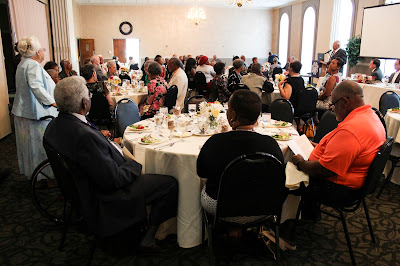
Attendees at 150th Anniversary Celebration
Photo courtesy of Reverend Dr. Andrew Smith,
pastor of Boyd Chapel UMC

Stephen Wicks at table (second from left);
Delaney family member in foreground
Photo courtesy of Reverend Dr. Andrew Smith,
pastor of Boyd Chapel UMC
During his presentation, Wicks made the argument that Beauford and his brother Joseph began their artistic paths at Boyd Chapel as they spent time "shaping figures of red clay in the parsonage yard and drawing biblical illustrations on their Sunday school programs."
The Delaney family remained in Jefferson City until 1915, when they returned to their original home at 815 East Vine Street in Knoxville. The building that Boyd Chapel UMC currently occupies was constructed in 1922.
David A. Leeming, author of Amazing Grace: A Life of Beauford Delaney
, says the following about the family's Jefferson City abode:Sam was installed as the pastor of the Boyd Chapel Methodist church. His only pay was help with the rent for the "parsonage" the family lived in near the church ... The house was quite small, but it had a large vegetable garden as well as a huge front yard for the young children to play in. This would be home for five years.
Delia Naomi Delaney, the tenth and last of the Delaney siblings, was born in Jefferson City. She died in 1909 at eight months of age.

Top, left to right: Samuel Emery, John Samuel, Delia
Bottom, left to right: Joseph, Ogust Mae, Beauford, Naomi
Photo from du Closel archive
Image © Discover Paris!
Boyd Chapel recently celebrated its 150th anniversary of existence.

Detail from photo by Standard Banner, Jefferson City, TN
Stephen Wicks, Barbara W. and Bernard E. Bernstein Curator at the Knoxville Museum of Art, was invited to speak at their celebration on September 16. Members of the Delaney family were in the audience.

Photo courtesy of Reverend Dr. Andrew Smith,
pastor of Boyd Chapel UMC

Photo courtesy of Reverend Dr. Andrew Smith,
pastor of Boyd Chapel UMC

Delaney family member in foreground
Photo courtesy of Reverend Dr. Andrew Smith,
pastor of Boyd Chapel UMC
During his presentation, Wicks made the argument that Beauford and his brother Joseph began their artistic paths at Boyd Chapel as they spent time "shaping figures of red clay in the parsonage yard and drawing biblical illustrations on their Sunday school programs."
The Delaney family remained in Jefferson City until 1915, when they returned to their original home at 815 East Vine Street in Knoxville. The building that Boyd Chapel UMC currently occupies was constructed in 1922.
Beauford's Reflections on Leaving New York
In August 1953, Beauford left New York City for what he planned as an extended visit to Europe. A week prior to his departure, he wrote the following in his journal as he pondered his upcoming voyage:
He never returned to New York.
Today I present several images of works from Beauford's New York years that, in my view, reflect some of the emotions expressed in this poignant passage.

Can Fire in the Park
(1946) Oil on canvas
© Estate of Beauford Delaney
by permission of Derek L. Spratley, Esquire,
Court Appointed Administrator

Earth Mother
(1950) Oil on canvas
© Estate of Beauford Delaney
by permission of Derek L. Spratley, Esquire,
Court Appointed Administrator

Dark Rapture
(1941) Oil on canvas
© Estate of Beauford Delaney
by permission of Derek L. Spratley, Esquire,
Court Appointed Administrator

Portrait of Delia Delaney
(1933) Pastel on paper
© Estate of Beauford Delaney
by permission of Derek L. Spratley, Esquire,
Court Appointed Administrator

Burning Bush
(1941) Oil on paperboard
© Estate of Beauford Delaney
by permission of Derek L. Spratley, Esquire,
Court Appointed Administrator
*Passage quoted from Amazing Grace: A Life of Beauford Delaney, by David A. Leeming.
reflecting on many things—feelings of nostalgia and apprehension, of love and sorrow, of joy and regret, of things known and unknown, of a rededication of faith hope and love, of willingness to accept the challenge and do the best I can with it*
He never returned to New York.
Today I present several images of works from Beauford's New York years that, in my view, reflect some of the emotions expressed in this poignant passage.

(1946) Oil on canvas
© Estate of Beauford Delaney
by permission of Derek L. Spratley, Esquire,
Court Appointed Administrator

(1950) Oil on canvas
© Estate of Beauford Delaney
by permission of Derek L. Spratley, Esquire,
Court Appointed Administrator

(1941) Oil on canvas
© Estate of Beauford Delaney
by permission of Derek L. Spratley, Esquire,
Court Appointed Administrator

(1933) Pastel on paper
© Estate of Beauford Delaney
by permission of Derek L. Spratley, Esquire,
Court Appointed Administrator

(1941) Oil on paperboard
© Estate of Beauford Delaney
by permission of Derek L. Spratley, Esquire,
Court Appointed Administrator
*Passage quoted from Amazing Grace: A Life of Beauford Delaney
, by David A. Leeming. I Can't Go Home...

Beauford on the deck of the SS Liberté*
Photo from Amazing Grace: A Life of Beauford Delaney
I can't go home because I never really left ... I sailed to France sixteen years ago, but I've never left America. The body goes somewhere, that's all ...
The above quote was Beauford's response to a reporter who asked him in 1969 if, as a Negro, he felt he should go home to America where the action is.
In fact, part of Beauford's heart, mind, and soul always remained in his hometown of Knoxville, Tennessee. From the moment he left Knoxville to move to Boston in 1923 until his commitment to Sainte-Anne's Hospital in Paris in 1975, Beauford consistently, if not frequently, reached back to Knoxville for emotional and spiritual sustenance.

Image from KnoxNews.com Archive
Beauford and his brother Joseph returned to Knoxville in 1933. Both were living in New York City at the time. They were much admired and their accomplishments were touted by those in their community.
In 1938, he wrote "disjointed letters" to his mother Delia during a time of financial crisis and she reacted by writing to Joseph to tell him to take care of Beauford.
In 1941, he visited Knoxville briefly at around Christmas time and in 1950, he took the train from New York to Knoxville to see his mother.

(1964) Oil on canvas
Photo courtesy of Case Antiques
© Estate of Beauford Delaney
by permission of Derek L. Spratley, Esquire,
Court Appointed Administrator
His last visit as a resident of the U.S. was in August 1953, shortly before he shut down his New York studio and moved to Paris. Biographer David Leeming says that during this visit, Beauford "asked many questions about family history and went through family papers, as if this would be a last chance to do so."
Beauford's last visit to Knoxville took place in December 1969. By this time, he was so mentally fragile that he relied on others to make his travel arrangements. He somehow made it to Knoxville despite many mishaps along the way and was taken to the Delaney home by a taxi driver who knew his family. He celebrated his birthday there, went to church with his family, and painted. He left for Paris on January 14, 1970 and would never see the United States again.
Beauford's relatives visited him in Paris as well. Joseph came most frequently, but his brother Emery, his sister-in-law Gertrude, and his niece Imogene came in 1964. Joseph and Beauford's niece, Ogust Mae, attended Beauford's funeral.
*The creator of this photo is unknown to Les Amis de Beauford Delaney. We consider its publication in this blog post to be "fair use" according to U.S. copyright law (used for a non-profit educational purpose; no significant effect on the potential market for the work).
Beauford in "Psychology and Art" - Part 3
Continued from Part 2.
As part of my interview with Dr. Robert Brubaker, Head of the Psychology department at Eastern Kentucky University, about Beauford and the Psychology of Art course that he conducts in Paris, I asked Dr. Brubaker how Beauford's childhood experiences influenced his creative achievements - positively or negatively.

Standing: from left to right - Samuel Emery, John Samuel (father), and Delia (mother)
Seated: from left to right - Joseph, Ogust Mae, Beauford, Naomi
Photo from du Closel archive
Image © Discover Paris!
He responded as follows:
There is research to suggest that there are some childhood and family factors that are more common among especially creative people than among the less creative. One that seems relevant for Beauford is having had creative or aesthetically inclined parents.
David Leeming tells us that Delia Delaney was a creative person – a seamstress, a quilt-maker, and a singer.

Beauford Delaney
(1933) Oil on canvas
Knoxville Museum of Art, Knoxville, TN
Beauford’s younger brother Joseph was an artist, his older brother Samuel Emery sang, as did Beauford and his other siblings. The Delaney family seemed to appreciate and value artistic expression.

by Beauford Delaney
in Amazing Grace: A Life of Beauford Delaney
by David A. Leeming
Having had a mentor in childhood also seems important. Beauford received early encouragement from his employer at the sign painting shop. He was introduced to the artist Lloyd Branson, who recognized Beauford’s talent and ability, provided art lessons, shared with him his appreciation of light, encouraged him to pursue his art studies in Boston, and facilitated his move to that city.
Portrait of Lloyd Branson
ca. 1911
Image in public domain
His mother’s strong belief in Christian values and morality seemed to help Beauford deal with psychological distress caused by the voices that tormented him. Of course those same values, held by his father as well, may also have contributed to the guilt and conflict he felt over his sexuality for the remainder of his life. To the extent that these feelings motivated his art (painting helped him manage the voices he heard), they contributed to his artistic development.
Leeming also notes that Delia “…never revealed her suffering to others” and that she instilled that same quality in Beauford. It's possible that this encouraged him to express otherwise unacknowledged psychological distress in a less direct way, through his painting.

To read Part 1 of this article, click HERE.
Beauford in "Psychology and Art" - Part 2
Continued from Part 1.
Dr. Robert Brubaker and the students attending the Kentucky Institute of International Studies course on Psychology and Art are living in a hostel across the street from Sainte-Anne's Hospital, where Beauford spent the last four years of his life. They will visit the hospital to learn about art therapy and view artwork created by hospital patients.

© Discover Paris!
Dr. Brubaker feels very fortunate to have had the opportunity to visit Sainte-Anne’s Hospital as part of the Psychology of Art class since 2007. The specific agenda varies from year to year, but he and the students typically meet with Dr. Anne-Marie Dubois, Head of the Centre d’Etude de l’Expression clinic and an internationally recognized expert on art therapy. Dr. Dubois talks about the work of her clinic, its history, and about the art collection of the Museum of Art History and History (formerly called the Musée Singer-Polignac) of Sainte-Anne Hospital. She also shares some pieces from the collection - these are works created by persons with mental illness and donated to the museum (not those who are patients in the art therapy clinics).

© Discover Paris!
The Centre d'Etude de l'Expression was formed in 1952 and has operated as a French non-profit organization since 1973. It offers therapeutic expression workshops that incorporate art (and other means of expression, such as writing) into the therapeutic process. Work produced by the workshop participants, while part of the Centre’s collection, is not shared with the public.
The museum is only open to the public during planned exhibitions, the Journées du Patrimoine, and the Nuit Européene des Musées. The collection is stored in an archives located on the hospital grounds. Catalogs from previous exhibits and reproductions (postcards) are available for purchase at the museum. Dr. Dubois has authored a four-volume series of books on the collection (De l’art des fous a l’oeuvre d’art) illustrated with numerous stunning images of many of the works.
This year, Brubaker plans to ask if there are any works by Beauford in the hospital's collection.
I asked whether Dr. Brubaker thinks Beauford's "pathology" is reflected in his work. He responded:
Well, that’s another of those controversial issues. I will preface my response with the disclaimer that I am neither a Beauford Delaney scholar nor an art historian or critic. Based on my reading of what empirical research there is on the topic, I’m certainly not convinced it is possible to look at a piece of art and determine whether the artist had a mental illness or not (except, perhaps, in cases of severe cognitive impairment). I’m also very dubious about the validity of interpreting specific elements of a painting or drawing as symbolic of internal psychological conflicts or turmoil. The data from studies of the validity of projective drawing techniques have convincingly debunked that assertion.
I suspect that such interpretations reveal more about the person doing the interpreting than it does about the artist. Paintings reflect what the artist chooses to tell us. It’s one thing if Delaney tells us, as noted in the catalog of The Color Yellow exhibit, that he believed yellow is “… the color of light, healing, and redemption.” It’s quite another if we observe his use of yellow and draw that conclusion on our own.

© Discover Paris!
The entirety of the artist is reflected in his/her work. I don’t think there’s any justification for according “pathology”any special status.
Brubaker does not believe there is a way to know that Beauford struggled with psychological disturbances without prior knowledge of his history. He says that if he knew nothing about Beauford Delaney and noted Beauford's extensive use of yellow in his work, he might suggest that it reflects Beauford's bright, sunny, warm-hearted personality ... or he could just as easily argue that it was a form of masking or compensating for or dealing with depression and unhappiness. He says there are no characteristics of “art of the mentally ill.”
I asked Dr. Brubaker whether he thinks there is a "common significance" for the use of the color "yellow" based on his studies of various artists. While he said that he doesn't feel qualified to offer an opinion on this question, he mentioned the "obvious parallel" between Beauford's use of the color and Van Gogh's "seeming affinity for yellow (the sunflower paintings, the yellow house in Arles), particularly at a time when Van Gogh was more hopeful about his future." He now believes he needs to explore this issue more carefully:
Given the central role the color "yellow" has played in discussions of Delaney’s paintings as well is in those of Van Gogh, particularly during the period he (Van Gogh) spent in Arles, a more careful consideration of the psychological aspects of color is warranted.
To read Part 3 of this article, click HERE.
Beauford in "Psychology and Art" - Part 1
This course will explore selected topics in the psychology of art within the context of 19th and 20th century painting (primarily painters working in Paris). Artists of particular interest include van Gogh, Picasso, Cezanne, Utrillo, Toulouse-Lautrec, Gauguin, Monet, Delaney, and Modigliani.
The above statements are found at the beginning of the course description for the Kentucky Institute for International Studies* course entitled "Psy 299 Topics: Psychology of Art" being held in Paris this summer.
Dr. Robert Brubaker, Professor and Chair of the Department of Psychology at Eastern Kentucky University, is leading this study abroad course. This year, he is including Beauford in the syllabus for the first time. He contacted Les Amis to ask about resources and materials that he could use to enhance his students' experience.

© Discover Paris!
I suggested the "Beauford Delaney's Montparnasse" commemorative walking tour to Dr. Brubaker and arranged to meet him to learn more about the course. He graciously agreed to an interview about his interest in Beauford and his reasons for including Beauford in "Psychology and Art."
During the course, Dr. Brubaker and his students discuss a number of questions/issues/beliefs about the relationship between an artist’s psychological functioning and his/her work. To bring these issues to life and to provide some context, Brubaker likes to introduce the students to several artists who were known to have struggled with psychological disorders. He looks for artists with personal stories that will engage students and help them recognize the complexity of the relationship between mental illness and creativity.
Knowing something about the artist as a whole person and not someone defined by illness enriches our understanding of his/her work. It helps begin to dispel stereotypes about people with mental illness and about artists.
Because the course is taught in Paris, Brubaker selects artists who have some connection to the city. He says that being able to show students where the artists lived and worked, their favorite hangouts, their grave sites, scenes they painted, etc., further humanizes them. Two artists he always incorporates into the class are Vincent Van Gogh and Maurice Utrillo. Others, e.g., Modigliani, Toulouse Lautrec, Gauguin, Picasso, are included to illustrate certain points.
Until recently, Brubaker had only been aware of Beauford in the most general sense from studying art history. He knew Beauford was an American artist and was familiar with a few of his works (notably Can Fire in the Park). He found that Beauford’s life story, his struggles with mental illness, his circle of friends, the aesthetic appeal of his art, his connection with Paris, and his origins in Tennessee (not far from Kentucky) made him an excellent addition to the course.
Over the past few months, Dr. Brubaker read David A. Leeming’s biography, Amazing Grace: A Life of Beauford Delaney, and the catalogs from two Delaney exhibits, Beauford Delaney: From NY to Paris and Beauford Delaney: The Color Yellow. He has read most of the posts on the Les Amis blog and a number of miscellaneous articles discovered online. He is adding Amazing Grace and the Les Amis blog to the bibliography for the course.
The blog led Brubaker to visit Knoxville to see the Gathering Light exhibition currently on display at the Knoxville Museum of Art prior to bringing his students to Paris. I asked him how that visit informed what he is having the students explore regarding Beauford's life and art. He responded:
The students and I explore the nature of creativity and the creative process – Do creative persons share particular personality characteristics, is creativity an inherent trait (some people have it, some don’t) or is it a skill to be learned? do creative ideas spring forth fully formed (inspired) or are they the product of experimentation and shaping and hard work?
What I found particularly interesting in the exhibition from a psychological perspective were the sketchbooks that are on display. I’m fascinated by artists’ sketchbooks because I think they often give us some insight into their thought processes. The quick sketches and notes suggest how the artist plays with ideas prior to putting brush to canvas or paper. For the same reason, the series of self-portrait studies were particularly interesting to me. I will share those observations during our class discussions.
I mentioned to Dr. Brubaker that "Psychology and Art" is a perfect example of STEAM (science, technology, engineering, art, and mathematics) education and asked him how much time he has his students spend looking at art during the course. He said they spend a great deal of time looking at images of art that accompany class presentations/lectures and they go on excursions to art museums to see works in person.
In addition, Brubaker uses images of paintings to illustrate how our brains process visual art – the neurological, perceptual, and cognitive processes that allow us to see, understand, and respond to a visual stimulus as a piece of art. When he mentioned that he had not been able to identify any works by Beauford that are on display in Paris, I organized a visit to the Galerie Intemporel so he and his students could see Beauford's art in person.
The image below shows Dr. Brubaker (far left) the students, and gallery owner Laurence Choko (far right) standing in front of Beauford's Portrait of Vassili Pikoula.

Galerie Intemporel
© Discover Paris!

(1970) Oil on canvas
© Estate of Beauford Delaney
by permission of Derek L. Spratley, Esquire,
Court Appointed Administrator

© Discover Paris!
To successfully complete the Psychology and Art course, students must write a final examination consisting of eight questions that Brubaker provides in advance. These questions reflect important questions studied by psychologists and others interested in art and artists. Brubaker expects students to describe various theories and points of view held by the experts and to present and evaluate the evidence supporting those positions. As an example, he cites the great interest in the question of whether the incidence of psychopathology is greater among artists and other creative people than it is in the general populations. There are published studies supporting this proposition and studies that disagree.
Brubaker says that because debates surrounding these questions often focus on criticisms of the methodology employed in the scientific studies used to explore them, there is no one "correct" answer for any of the exam questions.
At the end of our interview, Brubaker emphasized that he has only begun to study Beauford's life and work. "As we consider Delaney in the context of the psychology of art, I will be learning along with my students," he said.

© Discover Paris!
*KIIS is a consortium of colleges and universities in Kentucky and some surrounding states, including Eastern Kentucky University.
Read Part 2 of this article HERE.
Read Part 3 of this article HERE.
"Bringing Delaney Home" at the Knoxville Museum of Art
Two weeks ago, I wrote about a pilot project inspired by Beauford's art and life called Bringing Beauford Delaney Home. It was conducted at West View Elementary School in Knoxville, TN.
The Knoxville Museum of Art (KMA) is currently displaying the artwork created by the students who participated in that project as part of its Celebrate School Art Programs.

Hanging the students' art
Image courtesy of the Knoxville Museum of Art

Information panel
Image courtesy of the Knoxville Museum of Art
The information panel for the exhibition reads as follows (text reproduced with the permission of the museum):

Student self-portraits
Image courtesy of the Knoxville Museum of Art

Student abstracts
Image courtesy of the Knoxville Museum of Art

Collaborative student abstract
Image courtesy of the Knoxville Museum of Art
Bringing Delaney Home will hang in KMA's Education Gallery until June 30, 2017.
The Knoxville Museum of Art (KMA) is currently displaying the artwork created by the students who participated in that project as part of its Celebrate School Art Programs.

Image courtesy of the Knoxville Museum of Art

Image courtesy of the Knoxville Museum of Art
The information panel for the exhibition reads as follows (text reproduced with the permission of the museum):
The summer exhibition features West View Elementary students in the grade K-5. This art exhibition at KMA highlights the fundamental importance of the arts in the school curricula, an essential component to the healthy development and complete education of our young people.
Through a partnership with The Great Schools Partnership Community Schools Program, Knoxville Chapter of the Links, Inc., and the KMA, students at West View Elementary were able to spend six weeks learning about Beauford Delaney, one of Knoxville's greatest abstract painters of the 20th century.
The students studied the use of bold bright colors, and the color "yellow" one of Delaney's favorite colors. The students self-portraits are inspired by Beauford's yellow portraits.

Image courtesy of the Knoxville Museum of Art
The students also studied Beauford's abstract paintings from Paris, which inspired them to create abstract collages pieced together from many other abstract paintings they created.

Image courtesy of the Knoxville Museum of Art
The large mixed-media piece is a collaborative painting made by all 26 students who participated in the Bringing Delaney Home project.

Image courtesy of the Knoxville Museum of Art
The students began the project knowing little or nothing about Beauford Delaney, but are now big fans of his artworks and are willing to share their new knowledge. On the learning expedition to the KMA, the students were excited to finally see the original work created by Delaney in person.
Bringing Delaney Home will hang in KMA's Education Gallery until June 30, 2017.
Beauford's Art Inspires Knoxville Elementary School Students

Image courtesy of The Links Incorporated, Knoxville Chapter
"Bringing Beauford Delaney Home" is an educational program that is part of Gathering Light: The Beauford Delaney Project, the multifaceted community project that has taken Beauford's hometown of Knoxville by storm. It is designed to teach the children of Knoxville and Knox County about Beauford's life and work and inspire them to create their own art based on what they learn about him.
The Knoxville Museum of Art (KMA), the Knoxville chapter of The Links, Incorporated, and West View Elementary School worked together to implement the pilot program, which took place from February 2 through March 31 at the school and the museum.
Twenty-six (26) children, grades K-5, participated in the program. Members of the Knoxville, TN chapter of The Links, Incorporated volunteered to assist West View Elementary School educators at student workshops.
The program began on February 2 with a parent-children workshop, where Chief Curator Stephen Wicks of KMA presented an overview of Beauford's work and asked questions of the audience to gauge interest and comprehension. The children created woven abstract mats for the event.

Image courtesy of Link Sylvia Peters

Image courtesy of Link Sylvia Peters
On February 16, students participated in a workshop during which they studied the elements of art such as line, shading, shape, and learned how these are used to create landscapes. They also learned about abstract art, with Beauford's work serving as an example.
KMA hosted a Family Fun Day on February 16, where entry to the museum was free. The museum offered door prizes and organized art activities, face painting, and a magic show for attendees.
Additional student art workshops were held at West View Elementary on February 23 and March 2.
On March 9, students were given a KMA tour to see Beauford's work hanging in the "Changing Fortunes, Changing Scenes" section of the permanent exhibition called Higher Ground in the museum's gallery.

Image courtesy of Link Sylvia Peters

Image courtesy of Link Sylvia Peters

Image courtesy of Link Sylvia Peters
"Bringing Beauford Delaney Home" culminated on the evening of March 30, when West View Elementary hosted Arts Night. The school proudly displayed the works that the children created throughout the eight-week program.

Image courtesy of The Links Incorporated, Knoxville Chapter

Image courtesy of The Links Incorporated, Knoxville Chapter

Image courtesy of The Links Incorporated, Knoxville Chapter
These works will be hung in the Children's Gallery at KMA in June 2017.
Due to the success of the pilot program, the Beauford Delaney Project Council is determined to take "Bringing Beauford Delaney Home" into additional schools as early as September 2017 and to expand the program to students in grades 6-12.
Beauford in Jules B. Farber's James Baldwin - Escape from America, Exile in Provence
Jules B. Farber's book, James Baldwin - Escape from America, Exile in Provence, is a story woven from over seventy interviews with friends, associates, and lovers of James Baldwin about the seventeen years (1970-1987) that Baldwin lived in the French provincial town of Saint-Paul-de-Vence. It is MUST READ for those wanting to better understand Baldwin's thoughts, fears, actions, and works written during these last years of his life.

James Baldwin - Escape from America, Exile in Provence
Book cover
Farber begins his account by explaining how Baldwin moved into a homestead owned by an elderly spinster named Jeanne Faure. He describes how Baldwin first occupied "a basement flat in the old stables, accessible through a small, narrow passage under the kitchen" and went on to "buy" rooms in the house to provide a place to stay for his personal entourage and his myriad visitors. Baldwin and Mademoiselle Faure developed a deep friendship over the years and it was commonly known that she wished the property to go to Baldwin upon her death. In 2007, the Baldwin family lost a 20-year legal battle over ownership of the property to Mlle Faure's housekeeper/caretaker, Mme Josette Bazzini.
Farber describes Baldwin's underground apartment (the same space used as a studio by Georges Braque) as having three of Beauford's paintings on the wall. He says that two of the paintings were portraits of Baldwin

Portrait of James Baldwin
(1971) Oil on canvas
Bequest of James Baldwin to Clark Atlanta University Art Galleries
© Estate of Beauford Delaney
by permission of Derek L. Spratley, Esquire,
Court Appointed Administrator
Image courtesy of Clark Atlanta University Art Galleries
Note: Some question whether the person depicted in this portrait is indeed Baldwin.
and that the third was a portrait of Foster White, a former lover of Baldwin.
Beauford spent a great deal of time at this place, particularly when he was in need of physical and psychological care and healing. He would stay there for weeks at a time, surrounded by Baldwin, Bernard Hassell, and frequently, Baldwin's brother, David - all people who loved him and looked out for him.

From left to right: David Baldwin, James Baldwin, and Beauford
© Estate of Beauford Delaney
by permission of Derek L. Spratley, Esquire,
Court Appointed Administrator
Sketching and painting the scenery of the area were part of his "therapy."

Saint-Paul-de-Vence
Creative Commons License - Dynamosquito

Village (St. Paul de Vence)
(1972) Oil on canvas
Bequest of James Baldwin to Clark Atlanta University Art Galleries
© Estate of Beauford Delaney
by permission of Derek L. Spratley, Esquire,
Court Appointed Administrator
Image courtesy of Clark Atlanta University Art Galleries
Sadly, the land and buildings are now greatly deteriorated. The extensions of the original house have been destroyed by the current owner, a developer who has the intent to construct luxury apartments there.

House and extension wing
Image courtesy of His Place in Provence

House with wing removed
Image courtesy of His Place in Provence
An organization called His Place in Provence is working to prevent the unfortunate transformation of this centuries-old, historical site. If successful, they will preserve a part of Beauford's history and legacy alongside those of Baldwin.
In Chapter 1, Farber includes details of an interview with Richard A. Long, a dear friend of Baldwin and Beauford, in which Long described bringing Beauford to Saint-Paul-de-Vence in 1973 (the year was actually 1972). Long indicated that the only other time he returned to the town was after Baldwin's death, when he inventoried the artworks that Baldwin had bequeathed to Clark Atlanta University. Among these works were several by Beauford.
A couple of brief mentions of Beauford in Chapters 1 and 5 indicate that he was also at Saint-Paul-de-Vence in 1974 and that he was not well at that time.
Pages 130-132 in Chapter 6 are devoted to anecdotes surrounding Beauford's placement in Sainte-Anne's Hospital in Paris and the depressing effect this had on Baldwin. Coupled with the public attack on Baldwin made in Le Canard Enchaîné, a satirical French newspaper, about his care of Beauford, Baldwin's concern for Beauford's deterioration detrimentally affected his work on the novel Just Above My Head.
Two B&W photos in the central section of the book reference Beauford. One is of Baldwin sitting in his underground office beneath Beauford's portrait of him.

James Baldwin in his house in Saint-Paul-de-Vence
Creative Commons Attribution
OT Saint Paul de Vence
The other is a Max Petrus photo of Baldwin and Beauford at Sainte-Anne's Hospital.
In Chapter 11 - "Black Music: Gospel, Blues, and all that Jazz," Farber credits Beauford with exposing Baldwin to secular black music in 1940. He quotes extensively from Baldwin's introduction to The Price of the Ticket, where Baldwin talks of "walking into music" when he visited Beauford's Greenwich Village apartment for the first time. This music would influence Baldwin's ability to write and the content of his writing for the rest of his life.

Book cover
Farber begins his account by explaining how Baldwin moved into a homestead owned by an elderly spinster named Jeanne Faure. He describes how Baldwin first occupied "a basement flat in the old stables, accessible through a small, narrow passage under the kitchen" and went on to "buy" rooms in the house to provide a place to stay for his personal entourage and his myriad visitors. Baldwin and Mademoiselle Faure developed a deep friendship over the years and it was commonly known that she wished the property to go to Baldwin upon her death. In 2007, the Baldwin family lost a 20-year legal battle over ownership of the property to Mlle Faure's housekeeper/caretaker, Mme Josette Bazzini.
Farber describes Baldwin's underground apartment (the same space used as a studio by Georges Braque) as having three of Beauford's paintings on the wall. He says that two of the paintings were portraits of Baldwin

(1971) Oil on canvas
Bequest of James Baldwin to Clark Atlanta University Art Galleries
© Estate of Beauford Delaney
by permission of Derek L. Spratley, Esquire,
Court Appointed Administrator
Image courtesy of Clark Atlanta University Art Galleries
Note: Some question whether the person depicted in this portrait is indeed Baldwin.
and that the third was a portrait of Foster White, a former lover of Baldwin.
Beauford spent a great deal of time at this place, particularly when he was in need of physical and psychological care and healing. He would stay there for weeks at a time, surrounded by Baldwin, Bernard Hassell, and frequently, Baldwin's brother, David - all people who loved him and looked out for him.

© Estate of Beauford Delaney
by permission of Derek L. Spratley, Esquire,
Court Appointed Administrator
Sketching and painting the scenery of the area were part of his "therapy."

Creative Commons License - Dynamosquito

(1972) Oil on canvas
Bequest of James Baldwin to Clark Atlanta University Art Galleries
© Estate of Beauford Delaney
by permission of Derek L. Spratley, Esquire,
Court Appointed Administrator
Image courtesy of Clark Atlanta University Art Galleries
Sadly, the land and buildings are now greatly deteriorated. The extensions of the original house have been destroyed by the current owner, a developer who has the intent to construct luxury apartments there.

Image courtesy of His Place in Provence

Image courtesy of His Place in Provence
An organization called His Place in Provence is working to prevent the unfortunate transformation of this centuries-old, historical site. If successful, they will preserve a part of Beauford's history and legacy alongside those of Baldwin.
In Chapter 1, Farber includes details of an interview with Richard A. Long, a dear friend of Baldwin and Beauford, in which Long described bringing Beauford to Saint-Paul-de-Vence in 1973 (the year was actually 1972). Long indicated that the only other time he returned to the town was after Baldwin's death, when he inventoried the artworks that Baldwin had bequeathed to Clark Atlanta University. Among these works were several by Beauford.
A couple of brief mentions of Beauford in Chapters 1 and 5 indicate that he was also at Saint-Paul-de-Vence in 1974 and that he was not well at that time.
Pages 130-132 in Chapter 6 are devoted to anecdotes surrounding Beauford's placement in Sainte-Anne's Hospital in Paris and the depressing effect this had on Baldwin. Coupled with the public attack on Baldwin made in Le Canard Enchaîné, a satirical French newspaper, about his care of Beauford, Baldwin's concern for Beauford's deterioration detrimentally affected his work on the novel Just Above My Head.
Two B&W photos in the central section of the book reference Beauford. One is of Baldwin sitting in his underground office beneath Beauford's portrait of him.

Creative Commons Attribution
OT Saint Paul de Vence
The other is a Max Petrus photo of Baldwin and Beauford at Sainte-Anne's Hospital.
In Chapter 11 - "Black Music: Gospel, Blues, and all that Jazz," Farber credits Beauford with exposing Baldwin to secular black music in 1940. He quotes extensively from Baldwin's introduction to The Price of the Ticket, where Baldwin talks of "walking into music" when he visited Beauford's Greenwich Village apartment for the first time. This music would influence Baldwin's ability to write and the content of his writing for the rest of his life.
Beauford and Palmer Hayden
Beauford met Palmer Hayden during his early New York years. They, along with painters Ellis Wilson and Joseph Delaney (Beauford's brother) formed a group called "The Saints."
Beauford and Hayden became lifelong friends. It was Hayden who first gave Beauford the idea to travel to France.
The photograph below was taken at Washington Square in New York City, a location where outdoor art fairs were held for several years.

Photo from the National Archives, Harmon Collection
Thanks to a tip from friend and colleague Michele Simms-Burton, I am able to share a silent video clip during which you can see Beauford and Hayden at this very scene! In the still frame for the video, you can see Beauford walking toward Hayden as Hayden sits at his easel.
Click on the image below to watch the 1:25 minute segment, which is part of a longer video called "A Study of Negro Artists (1936)." Beauford appears for a few seconds beginning at 0:50 seconds into the clip.
Woman in an Abstract Field - After Beauford Delaney
By Sojourner Ahébée
A rising junior at Stanford University, Sojourner Ahébée is an award-winning poet. I asked her to write a poem about a Beauford Delaney work that she found particularly inspiring. "Woman in an Abstract Field - After Beauford Delaney" is the result.

Untitled (Woman in an Abstract Field)
(1966) Oil monotype, with hand-painted additions in oil,
on cream wove paper
Image courtesy of Swann Auction Galleries
© Estate of Beauford Delaney
by permission of Derek L. Spratley, Esquire,
Court Appointed Administrator
field
which is to say open hole where the light fell in
in other words, let us lose our hands here
let us always be what grows --
the sunflower, the pink hands of the hibiscus --
they say field could also mean
carried out in the natural environment,
rather than in a laboratory
which is to say you were a field this morning when the Black woman tapped your back and you didn’t flinch
not from the touch, not from the small request of a few coins as Guadeloupe bloomed off her tongue
though someone who loved you a lot once said don’t stop for anyone in this city…
that’s an invitation
sometimes a field comes with the intent to kill,
Blossoming yellow all over your face and nose
In other words, field artillery is made light as a brush stroke
like there are days you are a woman in a field, a woman walking through a weapon --
perhaps a field of gas
You close your eyes in the heat of the hammam one morning
a woman is rubbing lavender oil down your back
She has just called you out of your name
ma belle, she said
who was this woman you did not know,
who called you beauty with all the intention in her voice
as she slid the oil behind your ears, around a swollen thigh?
Like, it’s hard in this city, how the woman in the metro
walked right through you, how if you weren't there the
black woman would have had to lug her baby’s stroller
all those flights of stairs, how to everyone else she was
not there, how the man by the river actually
thought he could just touch you, how every time they kill
You it looks really small
ma belle
Was is her miraculous sight of you? Her use of the possessive, like you all belonged to each other and the beauty being named? Or just the shape of her mouth when as said MA,
Like is that the open hole where the light fell in, like let her mouth always be a field -- that thing that gives
************
Sojourner Ahébée is a 2016 BOSP Continuation International Fellow for the Haas Center for Public Service at Stanford University. She is currently serving as the Paris intern for the Wells International Foundation.
Read more of Sojourner's work at Sojourner Ahébée.
A rising junior at Stanford University, Sojourner Ahébée is an award-winning poet. I asked her to write a poem about a Beauford Delaney work that she found particularly inspiring. "Woman in an Abstract Field - After Beauford Delaney" is the result.

(1966) Oil monotype, with hand-painted additions in oil,
on cream wove paper
Image courtesy of Swann Auction Galleries
© Estate of Beauford Delaney
by permission of Derek L. Spratley, Esquire,
Court Appointed Administrator
field
which is to say open hole where the light fell in
in other words, let us lose our hands here
let us always be what grows --
the sunflower, the pink hands of the hibiscus --
they say field could also mean
carried out in the natural environment,
rather than in a laboratory
which is to say you were a field this morning when the Black woman tapped your back and you didn’t flinch
not from the touch, not from the small request of a few coins as Guadeloupe bloomed off her tongue
though someone who loved you a lot once said don’t stop for anyone in this city…
that’s an invitation
sometimes a field comes with the intent to kill,
Blossoming yellow all over your face and nose
In other words, field artillery is made light as a brush stroke
like there are days you are a woman in a field, a woman walking through a weapon --
perhaps a field of gas
You close your eyes in the heat of the hammam one morning
a woman is rubbing lavender oil down your back
She has just called you out of your name
ma belle, she said
who was this woman you did not know,
who called you beauty with all the intention in her voice
as she slid the oil behind your ears, around a swollen thigh?
Like, it’s hard in this city, how the woman in the metro
walked right through you, how if you weren't there the
black woman would have had to lug her baby’s stroller
all those flights of stairs, how to everyone else she was
not there, how the man by the river actually
thought he could just touch you, how every time they kill
You it looks really small
ma belle
Was is her miraculous sight of you? Her use of the possessive, like you all belonged to each other and the beauty being named? Or just the shape of her mouth when as said MA,
Like is that the open hole where the light fell in, like let her mouth always be a field -- that thing that gives
Sojourner Ahébée is a 2016 BOSP Continuation International Fellow for the Haas Center for Public Service at Stanford University. She is currently serving as the Paris intern for the Wells International Foundation.
Read more of Sojourner's work at Sojourner Ahébée.
Beauford and Baldwin in Saint-Paul-de-Vence
From The Guardian:
In the Provençal town of Saint-Paul-de-Vence, the picturesque stone house beneath the medieval ramparts is known as “la maison de Jimmy”. The official records office lists it as the ancienne maison Baldwin. . . . Today campaigners are battling to secure the future of his 17th-century house and its grounds, which have been earmarked for development into 18 luxury €1m flats. Two wings of the property on the 10-acre plot have already been demolished, including one in which he wrote.


Baldwin's property at Saint-Paul-de-Vence (2011)
Photos courtesy of Professor Francine Allen, Morehouse College
Beauford visited Baldwin at this property many times. Often, Baldwin had Bernard Hassell or someone else bring Beauford there when Beauford was in the midst of a psychological crisis. He painted the self-portrait shown below during one of those times of crisis.

Self-portrait
(1972) Gouache on paper
Collection of David A. Leeming
© Estate of Beauford Delaney
by permission of Derek L. Spratley, Esquire,
Court Appointed Administrator
In Amazing Grace, biographer David A. Leeming describes Beauford's 1973 stay at the Baldwin house after his hernia operation at a Saint-Paul-de-Vence clinic as being "perhaps Beauford's last truly happy ones." Les Amis would like to see the property preserved out of respect for Beauford's legacy as much as for that of Baldwin.
To learn more about this project, visit http://hisplaceinprovence.org.
In the Provençal town of Saint-Paul-de-Vence, the picturesque stone house beneath the medieval ramparts is known as “la maison de Jimmy”. The official records office lists it as the ancienne maison Baldwin. . . . Today campaigners are battling to secure the future of his 17th-century house and its grounds, which have been earmarked for development into 18 luxury €1m flats. Two wings of the property on the 10-acre plot have already been demolished, including one in which he wrote.


Photos courtesy of Professor Francine Allen, Morehouse College
Beauford visited Baldwin at this property many times. Often, Baldwin had Bernard Hassell or someone else bring Beauford there when Beauford was in the midst of a psychological crisis. He painted the self-portrait shown below during one of those times of crisis.

(1972) Gouache on paper
Collection of David A. Leeming
© Estate of Beauford Delaney
by permission of Derek L. Spratley, Esquire,
Court Appointed Administrator
In Amazing Grace
, biographer David A. Leeming describes Beauford's 1973 stay at the Baldwin house after his hernia operation at a Saint-Paul-de-Vence clinic as being "perhaps Beauford's last truly happy ones." Les Amis would like to see the property preserved out of respect for Beauford's legacy as much as for that of Baldwin.To learn more about this project, visit http://hisplaceinprovence.org.
Beauford Delaney Paints Marian Anderson: A Play
Beauford's portrait of Marian Anderson is undeniably an exquisite work. Award-winning screenwriter, playwright, and two-time Pennsylvania Council on the Arts Fellow Arden Kass* was so inspired by the portrait that she wrote a play about Beauford and Anderson entitled Beauford Delaney Paints Marian Anderson.

Marian Anderson
(1965) Oil on canvas
Virginia Museum of Fine Arts
J. Harwood and Louise B. Cochrane Fund for American Art
© Estate of Beauford Delaney
by permission of Derek L. Spratley, Esquire,
Court Appointed Administrator
I found the play on the Indie Theater Now Web site, purchased it for a mere $1.29, and read it avidly. As the story unfolded, I discovered that Beauford is observing episodes in Anderson's life as he paints her.
Ms. Kass granted Les Amis an interview, which you can read below.
Les Amis: When did you first learn about Beauford Delaney and his work?
Arden Kass: I had been invited to contribute a play about an American woman for a project called "365 Women, 365 plays," and I chose to write about Marian Anderson. I knew that she had lived and worked literally around the corner from my house in Philadelphia, that I walked my dog past her former home frequently -- but I had not taken the time to educate myself about her life and work.
In the course of researching Miss Anderson, I came across a mention of Beauford's portrait and was immediately fascinated by him as an artist and by his unique perspective as a person. I read as much as I could find about him, and realized that his portrait of her, while somewhat abstract, captured her more accurately than so many of the photos, interviews and articles I had come across.
Les Amis: Without giving the story away, what is it about?
Arden Kass: Miss Anderson was a notoriously private person and gave away very little of her personal feelings in interviews. The most insight into her personal passions or feelings seems to come through her music. But in my play everything she does not say in words is visible in Beauford's portrait.
Les Amis: Is Beauford a character in the play? Or are you using his name in the title for some other reason?
Arden Kass: Beauford is a full-fledged character in the play -- everything that happens is filtered through his consciousness and his artistic connection with Anderson's music.
Les Amis: Tell us more about the play.
Arden Kass: I wrote Beauford Delaney Paints Marian Anderson in 2014. It is a one act play that lasts about 25 minutes, maybe 1/2 hour if I incorporate recorded music. It has been published by Indie Theater Now, but due to my busy schedule I have not sought a production of it. However, I may be presenting a staged reading in New York at the NY History Society Library.
For a short play, it's a complex script (like Beauford's portrait, that says everything at once.) It requires several actors but isn't very long, so I am not sure how we would achieve a production unless it was part of a festival, for example. I may revisit it and try to double some of the 7 roles.
A composer recently asked me to work with her to expand the play into a musical, but I'm not certain how we'd create a musical about Marian Anderson without using her own music...
Les Amis: How can people stay abreast of developments about the play?
Arden Kass: I have a website, ardenkass.com -- When something happens, I'll announce it there.
*Arden is a member of the Dramatists Guild and BMI Musical Theatre Workshop in New York. Her most recent theatrical venture, School Play, based entirely on interviews with 100
Pennsylvania residents, has just completed a 15-venue statewide tour. Additional projects include book and lyrics for a musical comedy about the marketing genius who first sold
sexy lingerie to American women in the 1940s (at BMI) and a new one-act about classical singer Marian Anderson slated for a New York reading in 2016.
************
Les Amis de Beauford Delaney, Reid Hall, and the Wells International Foundation (WIF) are partnering to bring an exhibition of original Beauford Delaney works to Reid Hall in Paris in February 2016! WE VALUE YOUR SUPPORT!
To contribute to the show, click HERE.
To sign-up to receive the latest behind-the-scenes news about the show, click HERE.

(1965) Oil on canvas
Virginia Museum of Fine Arts
J. Harwood and Louise B. Cochrane Fund for American Art
© Estate of Beauford Delaney
by permission of Derek L. Spratley, Esquire,
Court Appointed Administrator
I found the play on the Indie Theater Now Web site, purchased it for a mere $1.29, and read it avidly. As the story unfolded, I discovered that Beauford is observing episodes in Anderson's life as he paints her.
Ms. Kass granted Les Amis an interview, which you can read below.
Les Amis: When did you first learn about Beauford Delaney and his work?
Arden Kass: I had been invited to contribute a play about an American woman for a project called "365 Women, 365 plays," and I chose to write about Marian Anderson. I knew that she had lived and worked literally around the corner from my house in Philadelphia, that I walked my dog past her former home frequently -- but I had not taken the time to educate myself about her life and work.
In the course of researching Miss Anderson, I came across a mention of Beauford's portrait and was immediately fascinated by him as an artist and by his unique perspective as a person. I read as much as I could find about him, and realized that his portrait of her, while somewhat abstract, captured her more accurately than so many of the photos, interviews and articles I had come across.
Les Amis: Without giving the story away, what is it about?
Arden Kass: Miss Anderson was a notoriously private person and gave away very little of her personal feelings in interviews. The most insight into her personal passions or feelings seems to come through her music. But in my play everything she does not say in words is visible in Beauford's portrait.
Les Amis: Is Beauford a character in the play? Or are you using his name in the title for some other reason?
Arden Kass: Beauford is a full-fledged character in the play -- everything that happens is filtered through his consciousness and his artistic connection with Anderson's music.
Les Amis: Tell us more about the play.
Arden Kass: I wrote Beauford Delaney Paints Marian Anderson in 2014. It is a one act play that lasts about 25 minutes, maybe 1/2 hour if I incorporate recorded music. It has been published by Indie Theater Now, but due to my busy schedule I have not sought a production of it. However, I may be presenting a staged reading in New York at the NY History Society Library.
For a short play, it's a complex script (like Beauford's portrait, that says everything at once.) It requires several actors but isn't very long, so I am not sure how we would achieve a production unless it was part of a festival, for example. I may revisit it and try to double some of the 7 roles.
A composer recently asked me to work with her to expand the play into a musical, but I'm not certain how we'd create a musical about Marian Anderson without using her own music...
Les Amis: How can people stay abreast of developments about the play?
Arden Kass: I have a website, ardenkass.com -- When something happens, I'll announce it there.
*Arden is a member of the Dramatists Guild and BMI Musical Theatre Workshop in New York. Her most recent theatrical venture, School Play, based entirely on interviews with 100
Pennsylvania residents, has just completed a 15-venue statewide tour. Additional projects include book and lyrics for a musical comedy about the marketing genius who first sold
sexy lingerie to American women in the 1940s (at BMI) and a new one-act about classical singer Marian Anderson slated for a New York reading in 2016.
Les Amis de Beauford Delaney, Reid Hall, and the Wells International Foundation (WIF) are partnering to bring an exhibition of original Beauford Delaney works to Reid Hall in Paris in February 2016! WE VALUE YOUR SUPPORT!
To contribute to the show, click HERE.
To sign-up to receive the latest behind-the-scenes news about the show, click HERE.
To the Light - A Play about Beauford and James Baldwin
Playwright Bil Wright has written a new play about the intricate and sometimes volatile relationship between Beauford and James Baldwin.

James Baldwin and Beauford at the American Cultural Center
Photo: U.S. Information Service
To the Light (A Fantasy Inspired by Two American Geniuses: Baldwin and Delaney) explores the bond between Beauford and Jimmy, imagining their friendship from their first meeting through each of their deaths.
The play will be read at the Harlem Stage Gatehouse on October 7 and 8, 2015. Commissioned in part by the Harlem Stage Fund for New Work, it is being directed by Reginald L. Douglas.
Harlem Stage’s unique focus has been to identify visionary artists of color and support them by commissioning, presenting and producing their work - work that responds to the social and political conditions that shape lives. It has presented performances in traditional and non-traditional theater forms that speak to the Harlem community for years. The opening of The Gatehouse in 2006 enabled them to expand their capacity to present theater through extended play runs.
To the Light
Performance Length: 90 minutes
No Intermission
Age requirement: 18+
Harlem Stage Gatehouse
150 Convent Avenue (at West 135th Street)
New York, NY 10031
October 7 (Wednesday) at 7:30 pm and October 8 (Thursday) at 7:30 pm
Entry fee: FREE with RSVP - Click HERE to reserve!
************
Les Amis de Beauford Delaney and Reid Hall are partnering to bring an exhibition of original Beauford Delaney works to Reid Hall in Paris in February 2016! To sign-up to receive information about this show, click HERE.

Photo: U.S. Information Service
To the Light (A Fantasy Inspired by Two American Geniuses: Baldwin and Delaney) explores the bond between Beauford and Jimmy, imagining their friendship from their first meeting through each of their deaths.
The play will be read at the Harlem Stage Gatehouse on October 7 and 8, 2015. Commissioned in part by the Harlem Stage Fund for New Work, it is being directed by Reginald L. Douglas.
Harlem Stage’s unique focus has been to identify visionary artists of color and support them by commissioning, presenting and producing their work - work that responds to the social and political conditions that shape lives. It has presented performances in traditional and non-traditional theater forms that speak to the Harlem community for years. The opening of The Gatehouse in 2006 enabled them to expand their capacity to present theater through extended play runs.
To the Light
Performance Length: 90 minutes
No Intermission
Age requirement: 18+
Harlem Stage Gatehouse
150 Convent Avenue (at West 135th Street)
New York, NY 10031
October 7 (Wednesday) at 7:30 pm and October 8 (Thursday) at 7:30 pm
Entry fee: FREE with RSVP - Click HERE to reserve!
Les Amis de Beauford Delaney and Reid Hall are partnering to bring an exhibition of original Beauford Delaney works to Reid Hall in Paris in February 2016! To sign-up to receive information about this show, click HERE.
Beauford and Countee Cullen
Beauford was strongly influenced by one of the leading figures of the Harlem Renaissance - Countee Cullen.

Countee Cullen
1941 Carl Van Vechten
Beauford was in his twenties when met Cullen. This was during his "Boston years." The two men were introduced by an affluent black couple, the Roscoe Conkling Bruces, who lived in Cambridge during the 1920s.
Cullen obtained his M. A. at Harvard and Beauford was aware of his writing from pieces that Cullen had published in Crisis and Opportunity magazines. Cullen spoke with Beauford about his desire to go to Paris*. He would make the transatlantic voyage in 1928 with funds from a Guggenheim grant.
According to Beauford's biographer, David A. Leeming:
Beauford encountered Cullen again when he moved to New York City. Cullen encouraged him to read works by Harlem Renaissance writers such as Zora Neale Hurston, Alain Locke, and Claude McKay. The two men would meet at "306," an address on West 141st Street where black artists and intellectuals gathered to discuss issues and voice concerns. Among those who frequented this address were writers Richard Wright, Claude McKay, and Langston Hughes, and artists Jacob Lawrence and Selma Burke.
Beauford and Cullen would never meet in Paris. Cullen died of hypertension and uremia in 1946 and Beauford would journey to Paris for the first time eight years later.
*Palmer Hayden, who visited Paris in 1932, would implant the idea of visiting France in Beauford's already receptive mind.

1941 Carl Van Vechten
Beauford was in his twenties when met Cullen. This was during his "Boston years." The two men were introduced by an affluent black couple, the Roscoe Conkling Bruces, who lived in Cambridge during the 1920s.
Cullen obtained his M. A. at Harvard and Beauford was aware of his writing from pieces that Cullen had published in Crisis and Opportunity magazines. Cullen spoke with Beauford about his desire to go to Paris*. He would make the transatlantic voyage in 1928 with funds from a Guggenheim grant.
According to Beauford's biographer, David A. Leeming:
Beauford was fascinated by Cullen, by his somewhat flamboyant style, and by the idea of Paris. The two men maintained a friendship during the 1930s and 1940s, and Cullen collected a few of Beauford's paintings. After ... his return from Paris, Cullen would become a schoolteacher. It is of coincidental interest that he taught beginning French to a junior high school boy who would become one of Beauford's closest friends-the young James Baldwin.
Beauford encountered Cullen again when he moved to New York City. Cullen encouraged him to read works by Harlem Renaissance writers such as Zora Neale Hurston, Alain Locke, and Claude McKay. The two men would meet at "306," an address on West 141st Street where black artists and intellectuals gathered to discuss issues and voice concerns. Among those who frequented this address were writers Richard Wright, Claude McKay, and Langston Hughes, and artists Jacob Lawrence and Selma Burke.
Beauford and Cullen would never meet in Paris. Cullen died of hypertension and uremia in 1946 and Beauford would journey to Paris for the first time eight years later.
*Palmer Hayden, who visited Paris in 1932, would implant the idea of visiting France in Beauford's already receptive mind.
Beauford and Baldwin in Istanbul
In the summer of 1966, Beauford spent several weeks with James Baldwin in Istanbul. Photographer and filmmaker Sedat Pakay met Beauford at that time and more recently wrote a beautiful tribute to him for the Les Amis blog.
When I informed Pakay that I would visit Istanbul and wished to see the place where Beauford and Baldwin lived, he referred me to Professor Kim Fortuny of Bosphorus University. Professor Fortuny wrote extensively about Baldwin's time in Istanbul in her book, American Writers in Istanbul. She connected me with Professor Ed Pavlic of the University of Georgia, who is a James Baldwin scholar, and we conferred on the exact addresses of Baldwin's residences in 1966. Both are in the Rumeli Hisari quarter, which takes its name from a 15th-century fortress in the area.
When my husband and I made the trip, Professor Fortuny was gracious enough to take us on a walking tour of the area and show us two places where Baldwin lived: a multi-story house on the Bosphorus shore road and a beautiful home - formerly Vefik Pasha's library - perched atop a steep hill.
Ahmed Vefik Pasha was a 19th-century Ottoman statesman and scholar. The building that housed his library is a few hundred yards down a small road from the massive and impressive fortress.

Rumeli Hisari
© Discover Paris!
The Pasha's library is now a private residence that is protected in part by a stone wall. The only glimpse of the grounds that is visible from the entrance is from the vantage point of a small opening in the metal gate.

The Pasha's library (side view)
© Discover Paris!

Grounds of the Pasha's library (viewed from opening in gate)
© Discover Paris!
The multi-story house on the shore road is where Beauford stayed with Baldwin. Biographer David A. Leeming describes it as "the little house on the Bosphorus," where Beauford "loved living with Jimmy, Richard [a friend of Baldwin] and me." Professor Pavlic shared a quote from a letter by Baldwin from this address dated July 26, 1966 that says "Beauford is here, very brown and working well."

House on the Bosphorus road near the strait
© Discover Paris!
Though the Bosphorus shore road beneath the Rumeli Hisari fortress is lined with cafés and quite busy, the neighborhood adjacent to the fortress and the Pasha's library is peaceful and idyllic to this day.

Rumeli Hisari viewed from the Bosphorus shore road
© Discover Paris!

Across the street from the entrance gate for the Pasha's library
© Discover Paris!

Homes near the Pasha's library
© Discover Paris!
The Rumeli Hisari fortress is located several miles north of the old city of Istanbul, which is where most of the major mosques and other attractions are located.

Hagia Sophia museum
© Discover Paris!

Blue Mosque
© Discover Paris!

Ablution fountain - Sultanahmet Hippodrome
© Discover Paris!
Many thanks to Professors Ed Pavlic and Kim Fortuny for sharing their knowledge and to Professor Fortuny for showing us the Rumeli Hisari quarter.
When I informed Pakay that I would visit Istanbul and wished to see the place where Beauford and Baldwin lived, he referred me to Professor Kim Fortuny of Bosphorus University. Professor Fortuny wrote extensively about Baldwin's time in Istanbul in her book, American Writers in Istanbul. She connected me with Professor Ed Pavlic of the University of Georgia, who is a James Baldwin scholar, and we conferred on the exact addresses of Baldwin's residences in 1966. Both are in the Rumeli Hisari quarter, which takes its name from a 15th-century fortress in the area.
When my husband and I made the trip, Professor Fortuny was gracious enough to take us on a walking tour of the area and show us two places where Baldwin lived: a multi-story house on the Bosphorus shore road and a beautiful home - formerly Vefik Pasha's library - perched atop a steep hill.
Ahmed Vefik Pasha was a 19th-century Ottoman statesman and scholar. The building that housed his library is a few hundred yards down a small road from the massive and impressive fortress.

© Discover Paris!
The Pasha's library is now a private residence that is protected in part by a stone wall. The only glimpse of the grounds that is visible from the entrance is from the vantage point of a small opening in the metal gate.

© Discover Paris!

© Discover Paris!
The multi-story house on the shore road is where Beauford stayed with Baldwin. Biographer David A. Leeming describes it as "the little house on the Bosphorus," where Beauford "loved living with Jimmy, Richard [a friend of Baldwin] and me." Professor Pavlic shared a quote from a letter by Baldwin from this address dated July 26, 1966 that says "Beauford is here, very brown and working well."

© Discover Paris!
Though the Bosphorus shore road beneath the Rumeli Hisari fortress is lined with cafés and quite busy, the neighborhood adjacent to the fortress and the Pasha's library is peaceful and idyllic to this day.

© Discover Paris!

© Discover Paris!

© Discover Paris!
The Rumeli Hisari fortress is located several miles north of the old city of Istanbul, which is where most of the major mosques and other attractions are located.

© Discover Paris!

© Discover Paris!

© Discover Paris!
Many thanks to Professors Ed Pavlic and Kim Fortuny for sharing their knowledge and to Professor Fortuny for showing us the Rumeli Hisari quarter.