

Happy Birthday, Beauford!

Beauford was born 109 years ago today!
I am both pleased and a little saddened as I write this posting, because I am honoring Beauford’s beginning as well as announcing an ending of sorts. I am celebrating Beauford today by presenting several of my favorite images of him and his work. But I am also placing the blog on hiatus as of today, and will no longer be bringing you information about this wonderful artist on a regular basis.
You may remember that I broached the subject of retiring the blog last month, in the posting about Les Amis’s first anniversary. In that posting, I said:
I have done my best to find information on Beauford from as many reliable sources as possible, and to present that information with clarity, integrity, and love. But I am running out of sources, and will not diminish the quality of this Web publication just for the sake of continuing on. My goal is to publish through the end of this year, targeting Beauford’s birthday (December 30) as the date of the final posting.
Be assured that I will post noteworthy information as I discover it. And I am certainly willing to publish personal anecdotes about Beauford and other information from credible sources. However, I can no longer actively and efficiently pursue the discovery process.
I will post on milestone dates such as the anniversary of Beauford’s death. I will also begin publishing regularly again if Les Amis decides to pursue one of the projects that I mentioned in the November posting (example: creating a scholarship fund in Beauford’s name). There is some activity underway to create a short film about Beauford, and I hope to have good news about the progression of this project within the next few months. So do check back periodically! Follow the blog or pull its content through RSS so that you do not miss anything.
I encourage you all to purchase a copy of Beauford’s biography – Amazing Grace
 . It is the only book that chronicles Beauford’s life. It is a quick read that captures Beauford’s spirit admirably. Note that Les Amis earns a few cents on each book purchased through the links found in this and other postings, as well as through the link in the sidebar.
Before going on to the images, I would like to thank all the people who contributed to the blog once again – you know who you are – and to say that we will remain in touch through e-mail and Facebook.
Happy Birthday, Beauford! Long live your art and your memory!


(1946) Oil on canvas
Private collection

© Estate of Beauford Delaney; Private Collection


Art Institute of Chicago

Possibly by Gjon Mili

© Estate of Beauford Delaney; Private Collection

(1945) Oil on canvas
Private collection


(1964-65) Oil on canvas
Bill Hodges Gallery, New York

Private collection

(1943) Pastel on paper
Curtis Galleries, Minneapolis, MN
The Beauford Delaney Letters

The Schomburg Center in Manhattan holds an archive of twenty-four pieces of correspondence that pertain to Beauford. They date from 1958-1963. Eighteen of these are personal letters written by Beauford to Lynn Stone, a friend and supporter from his “New York Years.” Biographer David Leeming refers to Stone several times in Amazing Grace
, citing that she visited Beauford in Paris during the summers of 1956 and 1962, and that she was the instigator of the idea that the Urban League sponsor an exposition of Beauford’s works. (This idea would never come to fruition.) He indicates that she gave Beauford a blanket and warm clothes to help him survive the cold winter of 1963 at his rue Vercingétorix studio, and that Beauford wrote to her about his love of reading “wisdom literature of the Far East.”The Schomburg has many additional letters concerning the Urban League exposition. One was written by James Baldwin in his capacity as chairman of the committee charged with raising money for the show. Two were written by Edward C. Califano, the director of Galerie Internationale – an organization that was to be a partner in the exposition. Two others represent correspondence between Lynn Stone and Beauford’s dear friend Charlie Boggs.
The Schomburg archive presents a rare opportunity to view Beauford’s personal papers and to read firsthand his reflections about himself and others as well as his life philosophy. The library Web site lists call number Sc MG 217 as the reference for the archive.
Schomburg Center for Research in Black Culture
515 Malcolm X Boulevard
New York, NY 10037-1801
Telephone: 212-491-2200
Closed Mondays
Colin Gravois Remembers Beauford

Upon arriving in Paris, Colin lived for five years at the Hôtel de Blois at 50, rue Vavin, which was located very near the café Select on boulevard du Montparnasse. (The hotel was a functioning brothel when Colin lived there, with the first three floors being used for "business" and the three upper floors being reserved for long-term residents.) He recalls that the rent was only 10 francs a day – roughly $2 in those times – and that the one franc per day increase that the hotel proprietor charged in 1974 was considered a big deal!
Colin would often have breakfast at the Dôme, which was only a stone’s throw from his hotel. (The café still stands on the corner of boulevard du Montparnasse and rue Delambre.) The Dôme is where he met Beauford in 1968 or 1969. Beauford would come in at around 9 AM every day – alone – to have breakfast, and Colin became accustomed to seeing him there. He remembers being impressed by Beauford’s “beatific smile.” Colin said that Beauford seemed wary that people might try to take advantage of him, so at first he did not attempt to engage Beauford in conversation about personal things.
At that time, the Dôme had a sidewalk terrace (it is enclosed today). Colin recalls that Beauford always wanted to sit on the terrace in the front row, facing the street. In this way, he could watch people as they passed by. Beauford knew lots of people, so he was often quite busy greeting friends and acquaintances when he was at the Dôme.


Eventually, Colin offered to take Beauford back to his studio on rue Vercingétorix in the large black sedan (of the type used for London cabs) that he drove around town. He did this a few times before Beauford invited him up to the studio. Colin recalls that the entrance was au fond de la cour (at the back of the courtyard), and that it was up a flight of stairs. His most vivid memory of the studio is that everything was covered with white sheets.
Colin remembers that Beauford would occasionally take meals at the Coupole, and that he also liked to eat at a restaurant called Les Mille Colonnes on rue de la Gaité. This was not very far from his studio, and it also happened to be a place where Colin and his friends invariably had dinner. Beauford would always join them if he was there. At Les Mille Colonnes, starters and desserts cost only 90 centimes, and main courses cost 3.50 francs. Though these prices were “Beauford's style” (affordable), Colin and his friends would chip in most of the time to take care of Beauford’s bill.
By the early 1970s, Colin began to note early signs of Beauford’s mental deterioration, mostly in the form of forgetfulness. Around 1973, he gave Beauford four large canvases that he has previously used for a promotional event. Beauford was grateful to receive them, and this strengthened the bond between him and Colin.
Colin’s favorite memory of Beauford is of taking him for rides in his big black cab. He named the car “Bill” because the license plate began with the letters “BLL.” Because the space next to the driver was reserved for luggage, Beauford always sat in the back, as a taxi passenger would do. He had an excellent vantage point for viewing the city because the seat was high, and Colin remembers that Beauford would look out the window at the buildings, cars, and pedestrians with a big smile on his face.

Colin was unequivocal when he said that the most important aspects that he remembers of Beauford’s persona were his kindness and gentleness – the same attributes that numerous others have cited in this blog and elsewhere.
Beauford painted a portrait of Colin at the Vercingétorix studio in 1975. Colin sat for Beauford several times as the painting took shape. He remembers being seated in an armchair wearing a green army jacket for the sittings. When it was almost done, Colin had his friend Kathleen photograph him with the painting, with Colin posing in the chair where he sat for the painting and the painting perched behind and above him. Kathleen also took several photographs of Beauford’s studio at that time. Colin said that Beauford’s signature appeared on the painting as though it had been done in pencil.
Colin then went on a trip to the U.S., thinking that he would retrieve the painting upon his return. But by the time he came back to Paris, Beauford had been taken to Saint Anne’s Hospital and his studio had been vacated. Colin never saw the portrait again. He is hoping that his friend Kathleen will be able to find the photos that she took so that he will have some visual record of himself with the painting, as well as the studio.
Upon Beauford’s commitment to Saint Anne’s, James Baldwin most likely moved the painting to an apartment on rue des Anglais in the 5th arrondissement where he stored Beauford’s works and other belongings on a temporary basis. Several of these would later be shown at the Studio Museum in Harlem retrospective organized by Richard A. Long.
In looking at the catalog of that exhibition, I came across an image of a painting called Portrait of a Man in Green. Intrigued by the parallels that I noted in Colin’s description of Beauford’s painting of him and what I saw in the image, I contacted Colin to see if he could identify the portrait.

Beauford Delaney
Studio Museum in Harlem
Both he and his daughter immediately identified Colin as the person represented there! In addition to the physical likeness (curly hair, moustache and goatee) and the armchair and green jacket, Colin said that he always wore his wristwatch on the right arm. The man in Beauford’s portrait also has a wristwatch on the right wrist.
What a fortuitous outcome to my interview!
Beauford Describes Beauford: Beauford's Tribute to Henry Miller
Though the title of the painting shown below is Self Portrait, Burt indicated that he believes it is a composite of Beauford and Henry Miller. What do you think?
**************
After a day out together with Beauford we passed by Beauford’s studio. Beauford said to my first wife Sara, “You type well. I’ve written a homage to Henry Miller but my handwriting is so bad I would really like to send it typed if you could do that for me.” Sara took the handwritten copy and several days later I returned the typed version to Beauford. When I read what Beauford had written to describe how he saw Henry Miller, I thought, “He is describing himself.” I have never met Miller and for Beauford it may be Miller. But for me it is Beauford.

Beauford wrote:
H E N R Y M I L L E R
Henry Miller is a transcentdental [sic] spirit whose vision illumens [sic] the cosmic heritage of mankind. His constant growth of enlightenment includes the unity and obligations of the human family, to honor one and all with patience and understanding of the universal oneness of our varied heritage. His understanding of this unique necessity and truth flows through all of his writing, his painting, and includes varieties of joy, and some patience with the painful human condition in its search for clarity, offering himself to problems, vision and minute observation, arousing intention by awareness and urgency, through methods of philosophical techniques, and finding time to persuade all of us to look back as well as forward into our historical past, and by so doing, augment the present with our findings of the differences and sameness of each epoch, including art, science and philosophy, giving light to the eternal heritage of all mankind, with joy and selflessness, devotion and infinite patience.
What sometimes seems impossible, his faith augments by years of discovery of himself, and with joy accomplishes the almost impossible task of uniting into his art the entire substance of this experience. This source in a work of art has magnetism and engages all mankind, because, like the “sun”, it is eternal and benevolent. Miller reveals to all people that life is a miracle to be lived and exploited to release its fullness.
Beauford Delaney
In conjunction with this posting, I am pleased to announce that Dorothy's Gallery has mounted an exposition called Henry Miller aux jeunes artists d'aujourd'hui that features twenty original works and lithographs by Miller. On Saturday, December 11, at 7:30 PM, the gallery will host an evening performance in homage of Miller's writing and painting entitled Tropique d'Os.
I believe that Beauford would be very pleased!
Dorothy's Gallery
27, rue Keller
75011 Paris
Telephone: 01 43 57 08 51
Internet: http://www.dorothysgallery.com
Email : dorothysgallery@gmail.com
Métro : Bastille, Voltaire
Parking : Ledru Rollin et Opéra Bastille
Open Wednesday through Saturday from 1 PM to 7 PM
Tuesday and Sunday from 4 PM to 7 PM
Brief Musings on Beauford and James Baldwin

Baldwin owed a great deal to his friendship with Beauford. In the introduction to The Price of the Ticket, he states that his career began when his life in Greenwich Village began, and that this life began when he met Beauford. He describes how he walked into color and into music when he walked into Beauford’s studio at 181 Greene Street. In his inimitable style, he pays tribute to the man whose unshakable example of “courage and integrity, humility and passion” gave him the strength to survive and the ability to hope for a future.
Much later, Baldwin would become Beauford’s source of strength during Beauford's “Paris Years.” It was Baldwin’s turn to introduce Beauford to people around town in the early days, and to provide council and comfort when Beauford more frequently became depressed or distraught.

He would do this (or at least attempt to do this) in the face of his own emotional crises. Baldwin would “send for” Beauford when his friend suffered psychological episodes or physical illness, having Beauford join him in Saint-Paul de Vence. But at the very end, Baldwin did not attend Beauford’s funeral due to illness and other problems. He deeply regretted this, and spoke of his feelings in an interview with his secretary and biographer, David Leeming.
Beauford would paint Baldwin many times. Here are a few examples:


As do all of Beauford’s portraits, these paintings of James Baldwin depict much more than his physical likeness. They express Baldwin’s “life essence” as Beauford saw it at various stages of Baldwin’s life – his accomplishments, his insecurities, his hopes and dreams. They also represent the deepest, most profound expressions of Beauford’s love for Baldwin.
Les Amis de Beauford Delaney's First Anniversary!
As president of the association, I am proud to say that we have accomplished every element of the mission that we presented to the government as part of our application for official status:
1. Placement and maintenance of a tombstone for the grave of painter Beauford Delaney, who is buried at the Parisian Cemetery of Thiais.
2. Payment of the renewal fees for his grave.
3. Organization of commemorative or educational events in his honor.
4. Inform the press and the media of his life and accomplishments.

The placement of the tombstone was our overriding goal. I hope that you have all seen the postings about the gravesite ceremony and the reception held at the Marshall Center last month. We now have the funds to pay for the maintenance of the tombstone for a year, as well as to renew Beauford’s concession at Thiais Cemetery. However, we must wait, until January 2011 to establish the maintenance contract with the funeral parlor and to conclude the transaction with the cemetery.

Regarding organizing commemorative or education events in Beauford’s honor, we did extremely well! I have spoken about Beauford three times this year, including a successful presentation at the George R. N’Namdi Gallery in Chicago. Most importantly, we exceeded expectations with the commemorative ceremony and reception held in October!
We have made significant progress in informing the press and the media of Beauford’s life and accomplishments as well. Two newspaper articles (that I know of) were published about our project earlier this year. Prissy Mag, an online magazine, ran a terrific article about the reception that we held at the Marshall Center, and editor Priscilla Lalisse-Jespersen also talked extensively about Beauford, his work, and the Gravesite Project on a radio interview with Paris Expat last month. I revised Wikipedia’s English language page on Beauford with a section called “The Beauford Delaney Burial Site.”
Musician and artist Joe Langley has posted his video of the reception on YouTube. Filmmaker Zachary James Miller is planning to create a short film on Beauford’s life and work for the 2011 Cannes Film Festival, and has already begun work by filming the gravesite ceremony and the reception. And two additional filmmakers have expressed interest in making feature films about Beauford’s life.
The biggest question for Les Amis at present is “Where do we go from here?” Several things are under consideration:
• An annual Beauford Delaney commemoration, to be held in Paris
• Placement of a plaque in Beauford’s honor on a building in Paris
• An exposition of Beauford’s paintings in Paris
• A scholarship to support an art student in Beauford’s name.
Of course, time and money will be required to successfully pursue any one of these projects. I am mulling over the possibilities for fundraising, and even more importantly, for finding people who are willing to help with implementation.
Finally, I am seriously considering retiring this blog! I have done my best to find information on Beauford from as many reliable sources as possible, and to present that information with clarity, integrity, and love. But I am running out of sources, and will not diminish the quality of this Web publication just for the sake of continuing on. My goal is to publish through the end of this year, targeting Beauford’s birthday (December 30) as the date of the final posting.
If any of you have information pertaining to Beauford that you believe is worthy of publication, or if you know of anyone who has such information, please contact me at amisdebeauford[at]yahoo[dot]com. As long as there is something worth publishing, I am willing to write about it!
Beauford and the Influence of Claude Monet
Beauford first saw Monet’s work in Boston, shortly after Monet died. The exposition was held in the studio of American artist John Singer Sargent, whose work also influenced Beauford. In the biography Amazing Grace
, author David Leeming indicates that Beauford “found a serious attempt to understand the effects of different stages of daylight on color and form” in Monet’s paintings. Citing Monet’s Water Lily (French translation: Nymphéas) series, Leeming also states that Monet’s view of light as subject matter during his later years is suggestive of the abstract expressionism that Beauford would adopt years later.In the catalog for the 2004-2005 Minneapolis Institute of Arts exposition Beauford Delaney: From New York to Paris
 , curator Sue Canterbury notes that Beauford arrived in Paris the same year that the Orangerie, home to Monet’s famous murals, was reopened (1953). She says that French gallery owner Paul Facchetti attested to the fascination that Americans had for Monet, and that they “all rushed like flies to one place: the Orangerie” to see the famous murals. Notes for her essay on Beauford’s “transatlantic transformation” indicate that Beauford mentioned Monet to his biographer Leeming on several occasions, and that friends of Beauford (including Ed Clark) believe that Monet’s work influenced Beauford’s early experiments with abstraction in Paris.
Claude Monet
Musée de l’Orangerie
In the same catalog, Michael D. Plante states that Beauford may have seen Monet’s paintings at the Orangerie in September, the month that he arrived in Paris. He describes in detail how Monet’s influence can be seen in Beauford’s paintings as early as 1954.
Richard A. Long arranged two visits with Beauford to see Monet’s works during the early 1970s – first to the Orangerie, and then to the Marmottan (not yet called Musée Marmottan Monet) shortly after the opening of the Monet galleries there.
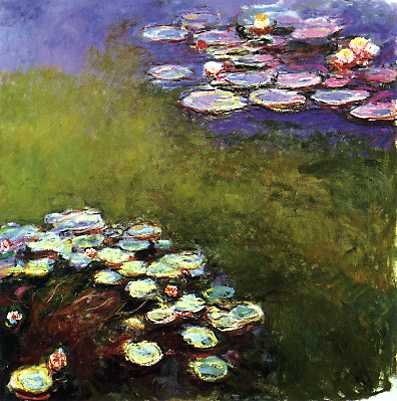
The Minneapolis Institute of Arts Web site has an interesting education section for young students called Object in Focus. One of the “objects” is Beauford’s raincoat painting Untitled (1954), which students are encouraged to compare and contrast to Monet’s The Japanese Bridge (c. 1923-1925). Both paintings are part of the museum’s permanent collection.

Minneapolis Institute of Arts

The Michael Rosenfeld Gallery showed three of Beauford’s paintings in a 2009 exposition called Abstract Expressionism: Further Evidence. The catalog for this show describes Beauford’s Paris abstractions as “lyrical, colorful, [and] non-objective” and “pure and simplified expressions of light.” It goes on to say that “the paintings have clear ties to Monet’s studies of light…”
I believe that Beauford would have been first in line to see the current Monet exposition at the Grand Palais – if he could have gotten a ticket! I plan to go to the Orangerie to see Monet’s murals in honor of the occasion.
It's Not What You Think!
that Beauford was rarely painted nudes because of his shyness. This makes the remembrance below, provided by Burt Reinfrank, even more interesting!It was a beautiful, sunny autumn afternoon when I knocked on Beauford’s studio door. I heard the echo of Beauford’s voice back in the studio saying “I’m coming.” I could hear him shuffling to the door. It opened and Beauford, with hand outstretched, said “Come in.” I did and, as I looked down the narrow corridor, with white sheets hanging on both sides, into the studio, I saw a naked young man standing facing me full frontal reaching for his pants saying “It's not what you think, it's not what you think!” I hadn’t thought anything at that point, and Beauford was unperturbed.
As it happened, the young man (American) had recently been a guest of Jimmy Baldwin at his house in St. Paul de Vence, as had Beauford at the same time. While there, Beauford had started but not finished a nude portrait of him, which was now on an easel where Beauford was continuing to work on it.

My entrance had interrupted this sitting so we all sat down to a tea Beauford made for us. The young man (about 30) was from the western U.S. and lived on a property where the boundaries of three states came together. He regaled us with stories of that region.
That was the only time I saw this young man (circa 1965). But recently, in 2010, I saw a photograph of a group of Delaney paintings in a store room, one of which was a portrait of a nude man. I wonder if it is the finished version of “It’s not what you think”?
A Redhead in His Bed

It was a fall Saturday morning. Signs of a colder winter to come were in the air. Beauford’s health and his mental state had been slowly failing. The question was how much longer could he continue to live on his own? I had signed him up for a local version of Meals on Wheels, which worked for a while. But he had started to drink again. Some of his friends said squatters were trying to move into his studio.
I approached his door with a certain apprehension. At my knock I heard Beauford’s shuffle. The door opened and Beauford led me into his studio. On the small table by the arm chair were a couple of partly filled glasses of red wine and an almost empty wine bottle. The bed, with its traditional top cover of a white sheet, was made up but as I looked harder it seemed there was something in it and at the head, sticking out from the top of the sheet, a mass of long red hair. I thought “Good God. Beauford has a redheaded women in his bed.”
Beauford said nothing, and as I surveyed the scene the head from which the hair came slowly worked its way out of the bed. It was not a woman but a younger man along in his 30s who introduced himself as "Michael" and immediately went into the kitchen and made us all a coffee. Apparently he’d moved in with Beauford a short time before. He prepared Beauford’s food and they were obviously drinking a lot of red wine.
This was certainly one of the “squatters” I had heard mentioned in a negative way, but I thought this was what Beauford needed considering the condition he was in. Apart from the wine, the “squatter” got the food, prepared it, kept Beauford company, etc.
For some time, each time I visited I would give Beauford some cash which was a part of a payment for a painting I had bought from him. I now started giving the cash directly to Michael to pay for the food etc. he bought for the two of them. I trusted him and it worked well as long as it lasted.
Some said squatters might be stealing Beauford’s work. I asked Michael what he saw and he said no one had been by the studio except a young woman who came in, picked up a painting and left. She and Beauford seemed to know each other as they kissed both on her coming and going. I couldn’t think of anyone that Beauford knew who was young enough to meet that young lady’s description. To me, who she was still remains a mystery.
After Michael’s departure some weeks later Beauford’s health continued to decline.
Celebrating Beauford! – The Reception

Both film and photography captured this magical “second act” of the day’s event, which unfolded as the setting sun illuminated the Dome Church and the Eiffel Tower that were visible from the State Office and the adjacent Grand Reception Room.
Approximately fifty persons gathered for the culmination of the celebration of Beauford’s life and art that evening. A beautiful program with photos of Beauford outlined the order of events.

I welcomed everyone, and then presented the U.S. Mission’s new Cultural Attaché, Rafik Mansour. Mr. Mansour spoke eloquently about the African-American presence in Paris, and how Beauford was a perfect example of this presence.

Ammon Hall-Moore sang “God Bless the Child,” followed by personal tributes from Velma Bury and Richard Gibson. ferricia-fatia (vocals) and Sabine Boyer (flute) then performed a moving rendition of “Freedom Day.”


I then presented “Beauford Delaney: From Paris to Beyond” – giving an overview of Beauford’s life that concentrated on his favorite haunts and his studios in Paris, and providing an introduction to his art. Finally, I described the events leading up to the installation of Beauford’s tombstone, and briefly discussed what projects Les Amis de Beauford Delaney might undertake in the future.
Though we were due to vacate the premises at 9 PM, everyone (including the Embassy staff) was having such a good time that we continued to commune in the State Office for another half-hour or so.

As the last few persons descended the Grand Staircase to leave the Hôtel Talleyrand, I could finally embrace the fact that Les Amis de Beauford Delaney has accomplished its mission.
To see more photos of the Celebrating Beauford! reception, click here.
For a video that presents some of the guests at the reception, as well as excerpts of the presentations, click here. Special thanks to Joe Langley for providing Les Amis with this film clip!
Once again, I wholeheartedly thank everyone who helped us to achieve our goal. Les Amis de Beauford Delaney will carry on with its efforts to raise awareness of Beauford’s life and art, and is counting on your continued support!
Celebrating Beauford! – The Gravesite Ceremony
We arrived at the cemetery in good time, and found Beauford’s division (Division 86) freshly manicured for the ceremony. The weather was picture perfect on this brisk autumn day – it was as though Beauford himself had ordered the light that shone on his gravesite and all of us who gathered there to honor him.
There were additional guests who were waiting for us at the gravesite. There was embracing among those who had not seen each other for a while, and everyone took a few moments to look at the tombstone. Then, we began the ceremony.

I welcomed everyone, and then invited The Reverend Doctor Scott Herr from the American Church to come forward. I was particularly pleased that Scott could participate because Beauford’s funeral was held at the American Church, and because he is personally acquainted with the pastor who presided over Beauford’s funeral – Reverend Scott Campbell.
Scott (Herr) said a few words and read a couple of Beauford’s favorite scriptures – Psalm 23 and 1 Corinthians 13. Then, three personal friends of Beauford – Velma Bury, Colin Gravois, and Richard Gibson – gave personal tributes to him.


Singer ferricia-fatia then poured a libation in honor of Beauford, and sang a beautiful rendition of “Come Sunday” with Sabine Boyer accompanying her on the flute.

Finally, I briefly recounted how my first interview with Beauford’s personal friend Burt Reinfrank made me understand that Beauford was not only a man of this world, but also one who experienced life on a higher, cosmic plane. I then laid an arrangement of yellow roses on the tombstone. (According to the David Leeming biography Amazing Grace
, Beauford loved roses.)
The ceremony ended with Scott reciting Richard A. Long’s poem “Ascending,” which was written in Beauford’s honor, and saying a final prayer. Participants took another few minutes to admire the tombstone, and we then regained the bus and car and set out for the Marshall Center in Paris.


To see more photos of the Celebrating Beauford! gravesite ceremony, click here.
Next week: the reception!
Celebrating Beauford at the Hotel Talleyrand
As you can imagine, I am very busy with last minute arrangements! But I wanted to share with you some photos of the venue:


© Discover Paris!


We'll be in the State Room and the Grand Reception Room, and will have a view of place de la Concorde.
Be sure to visit the blog next week to read the full report!
Beauford's Last Studio - Rue Vercingétorix

Beauford's last studio was located at 53, rue Vercingétorix, 75014 Paris. He moved there in 1961, after being released from a psychiatric clinic in Nogent-sur-Marne. Solange du Closel and her husband, who were avid supporters of Beauford, purchased the atelier in their name and reserved it for Beauford's use once he was able to live on his own again.
In Beauford's biography Amazing Grace
, author David Leeming describes the atelier as "a large room with a huge window admitting south light," and mentions that "there was also the luxury of a 'shower bath.'" Beauford covered everything with white sheets, as he had done in previous studios, to provide his preferred atmosphere for painting.Fifty-three rue Vercingétorix no longer exists. The photo below presents the neighborhood's current appearance, with the trees standing in the approximate location of Beauford's building:


By the early to mid 1970s, Beauford's neighborhood had become so run down that the city began demolishing it. Beauford's biography indicates that Madame du Closel interceded with friends in the government to allow Beauford to stay in his apartment as long as possible. His building was torn down some time after he was hospitalized at Sainte-Anne's in 1975.
Henry Miller's 1972 visit with Beauford at rue Vercingétorix was filmed, and rare footage of the exterior and interior of Beauford's lodgings can be seen in the video entitled Henry Miller Odyssey. (Unfortunately, the pertinent segments of the video are not of very good quality.) I snapped some photos of my television screen during the segment:


There are many amusing anecdotes about Beauford and his life at the Vercingétorix studio. In Amazing Grace, Leeming recounts a story about Beauford's refrigerator. He says that Beauford bought it with money that he received from a Fairfield Foundation grant for $3500 in 1964, and that he used it as a storage cabinet!
Burt Reinfrank has shared several anecdotes for this blog, some of which have already been published here. Ed Clark shared one, which I published in last week's posting entitled "Ed Clark Remembers Beauford." I will publish additional anecdotes from Burt and others over the next several weeks.
Ed Clark Remembers Beauford
Clark arrived in Paris in 1952, the year before Beauford settled there. He sailed on the SS Liberté (as Beauford did in 1953), and described the treatment that he received as a passenger traveling third class as being better than he could have ever imagined—great food and wine, waiters dressed in coat and tie, shoe-shine service, movies...
Upon arrival in Paris, Clark settled in the Hôtel des Ecoles on rue Delambre. By the time Beauford arrived and moved into this hotel, Clark had moved across the street to number 22. They first met at the Ecole de la Grande Chaumière, an art school in the neighborhood. Many Americans on the GI Bill studied at this school, and Clark was one of them.


Now, with the passage of time and the advantage of hindsight, Clark considers that Beauford was a genius. He particularly admires Beauford’s self-portrait at the Art Institute of Chicago, stating that the painting “lights up the room.” He recalls a sketch that Beauford did of him during the 50s that he dismissed at the time, but now describes as “powerful.”

Clark recalled minute details about Beauford’s personal habits, such as the fact that he loved spirituals, liked cognac, and did not eat pork. He described Beauford as someone who sketched and painted all the time, noting that he worked quickly. He also described Beauford as a great conversationalist, and said that he shared sage advice with friends and acquaintances.
Though Clark moved from Paris to New York in 1956, he would visit Beauford on subsequent trips to the French capital. He recounted a story about the concierge of the building at 53, rue Vercingétorix, where Beauford has his last studio. At that time, concierges were truly gatekeepers of apartment buildings. Anyone wanting access into the building had to pass by them. Clark mentioned that Beauford’s concierge once asked him whether Beauford was the President of the U.S. or some other important person, given the number of famous people who visited him there.
On that particular occasion, Beauford was entertaining four “important people.” Clark sat with them while they chatted with Beauford. When they left to go to dinner, Beauford beckoned to Clark and began to pull humble provisions from his cabinets—sardines, bread, wine… As they sat down to break bread together, Beauford said, “That’s how one helps another.”
Henry Miller's 1972 Tribute to Beauford
For the first retrospective exposition that Darthea Speyer mounted for Beauford, she invited several of his friends to write a tribute to him. Following are excerpts from the tribute that Henry Miller wrote about his good friend. It is dated September 26, 1972. The original document is now held at the Smithsonian in the Archives of American Art.

Dorothy's Gallery Supports Beauford
Dorothy Polley, owner of Dorothy’s Gallery, is a long-time American expatriate from Norwalk, Connecticut. She launched the gallery at 27, rue Keller in the 11th arrondissement, Paris in 2006. Having already demonstrated her support for Les Amis by contributing to the gravesite fund in the gallery’s name, she was pleased to take this additional step to help the association preserve Beauford’s memory.

Henry Miller and Beauford Delaney were great friends. They first met in New York, when Beauford lived on Greene Street. He and Miller corresponded regularly, both before and after Beauford moved to Paris. Beauford often wrote of how his work was progressing and his emotional state of being, while Miller wrote to encourage Beauford and admonish him (at least once) for giving away works that Miller thought would one day be in great demand. Miller sent Beauford money when times were hard, and visited him whenever he came to Paris. When Beauford was admitted to the Nogent sur Marne clinic for psychiatric therapy in 1962, Miller was denied entry to see his friend, but did speak with Beauford’s physician, Dr. Ferdière. He continued to communicate with Ferdière regarding Beauford’s condition for the next few years. When Beauford died, a message from Miller about his friend was read at the service.
In honor of the Delaney-Miller friendship, Miller’s son, Henry Tony Miller, donated the print to the cause. Sarasota is number 11/100 of the US edition of the painting. It is printed on Arches paper and measures 25.5 x 20 inches.


Dorothy’s Gallery
27, rue Keller
75011 Paris
Telephone: 33 (0)1 43 57 08 51
Internet: http://dorothysgallery.com/art
E-mail: dorothysgallery@gmail.com
Hours: Sunday and Tuesday – 4 PM to 7 PM
Wednesday through Saturday – 1 PM to 7 PM
Closed Mondays.
Appointments possible.
Herb Gentry Serigraph Once Again Up for Auction
You may remember that during our fundraising drive for Beauford's tombstone, we received a remarkable donation from Mary Anne Rose and the Herbert Gentry estate – a beautiful serigraph entitled Simply Green. ArtNet, an organization in Manhattan that describes itself as "the place to buy, sell and research fine art online," put the work up for auction. But it did not sell.
My contact at ArtNet contacted me last month to say that the auction house was willing to try again, and that they would arrange things as quickly as possible. Today, I received a message indicating that the serigraph is once again available for sale. Bidding is now open!

Mary Anne Rose provides the following description of the print:
Always Green was done at the period the artist was working on his final three editions published by GR N’Namdi Gallery in conjunction with his book Herbert Gentry: The Man The Magic The Master. Always Green is among the artist’s final works. This serigraph was printed in 2000 at Lime Grafik in Malmo, Sweden.Always Green will be available for bidding until Tuesday, September 21, 2010 at 2.56 PM Eastern Time. The opening bid is $1500. There is no reserve price. Please click here to visit the ArtNet site and place your bid.
Always Green is about regeneration. In the work of Herbert Gentry, the Green man refers to different aspects of fertility, as well as spiritual growth and transformation. Gentry saw his art as direct contact with the unconscious, and as an artist, he neither consciously determined a work's subjective import nor final appearance. Thus, his works trace states of being and change. The Green Man theme relates to larger paintings like Spiritually Green (1978) and He Seeth All (1962) and On All Sides (1990). Gentry realized his figurative imagery through process and each work evolved out of spontaneous and direct gesture.
Proceeds from the sale will be applied to the cost of the commemorative ceremony and reception that Les Amis is planning for Beauford to "inaugurate" his new tombstone.
Beauford's Tombstone is in Place!

Less than a year after founding Les Amis de Beauford Delaney, I am extremely pleased to announce that Beauford’s tombstone is in place! The inscription reads:
As a reminder, Les Amis was founded in November 2009 with the intent to accomplish the following:
1) Placement and maintenance of a tombstone for the grave of painter Beauford Delaney, who is buried at the Parisian Cemetery of Thiais.With your generosity and moral support, we have accomplished these goals in less than one year! We have the money to renew Beauford’s concession at Thiais Cemetery (to be paid in 2011); we have participated in three commemorative and educational events in his honor thus far in 2010 (hosted by the American Embassy, Paris Soirées, and the G. R. N’Namdi Gallery), and we have been successful in getting articles and blog postings published about Beauford.
2) Payment of the renewal fees for his grave.
3) Organization of commemorative or educational events in his honor.
4) Inform the press and the media of his life and accomplishments.
Most importantly, we have succeeded in placing a simple, yet elegant tombstone at Beauford’s burial place.


Les Amis de Beauford Delaney will hold a commemorative ceremony at Beauford’s gravesite to “inaugurate” the stone and to honor Beauford’s memory. The U.S. Ambassador has indicated his willingness to host a reception following the ceremony. Les Amis and the Ambassador’s staff are currently looking at possible dates for the two events. In the interim, planning for the commemoration is already underway.
Please continue to follow this blog for updates on the ceremony and reception.
Beauford's Ocean Voyage to Paris

I googled the ship’s name and was pleasantly surprised to find lots of interesting information about it! I also found photos that depict the accommodations that Beauford (and fellow artist Herb Gentry) experienced aboard ship.
The Liberté was first christened as the SS Europa. It was a German ocean liner that made transatlantic voyages in five days. Captured by the Americans during World War II, the ship was given to France as part of the reparations that the defeated German nation was forced to pay.
The Europa was repainted in French colors and towed to Le Havre for refitting. It was renovated as a luxury passenger-liner, and was destined to replace France’s pride and joy, the SS Normandie, which was a casualty of the war. The refitting suffered two great setbacks. First, a violent storm wrenched the ship from its berth, causing it to collide with a partially submerged vessel in the harbor. This caused the Europa to sink. It was refloated several months later, towed to Saint Nazaire, and refurbished. A dock fire almost destroyed the ship there in 1949.
Once the fire was extinguished, work on the ship resumed at a feverish pace. Under the auspices of France’s Compagnie Générale Transatlantique (CGT), the newly renamed SS Liberté finally set sail on its maiden voyage to New York City in 1950.

The vessel was quite luxurious, and was the pride of France’s passenger fleet for many years.


African Americans reportedly preferred sailing on French liners because they were better treated aboard these ships than on the rival Cunard British liners and on U.S. ships. Sarah Vaughn and W. E. B. and Shirley DuBois are among many African Americans who made the transatlantic voyage to Europe on the Liberté.


Click here to watch a home video made by passengers on the Liberté (exact date of film unknown).
The Liberté was taken out of service in 1961, with its farewell voyage departing New York and docking in Le Havre. In January 1962, it sailed for Italy, where it was scrapped.
Beauford: The Georgia O'Keeffe Portraits
Portrait of Beauford Delaney
Georgia O'Keeffe
(1943) Pastel on paper
Curtis Galleries, Minneapolis, MN
The Georgia O'Keeffe portraits of Beauford are the most beautiful portrayals of him that I have ever seen. The one shown above is part of the private collection of Curtis Galleries in Minneapolis, Minnesota. There is a second portrait at the National Portrait Gallery at the Smithsonian, and a third at the Philadelphia Museum of Art.
The Smithsonian work, a portrait in profile, is rendered with colors and textures similar to the portrait shown above. The Smithsonian describes the portrait as "reverent", indicating that it "honors Beauford Delaney's magnanimity, perseverance, and courage in the face of difficulty." The Web site image is accompanied by a brief audio commentary that I found to be compelling.
The Philadelphia Museum of Art (PMA) owns a charcoal on paper portrait of Beauford by O'Keeffe.
Untitled (Beauford Delaney)
Georgia O'Keeffe
(c 1940) Charcoal on paper
Philadelphia Museum of Art
This portrait also dates from the 1940s.
PMA's curatorial department of Prints, Drawings, and Photographs generously provide me with the information in their file on the O'Keeffe charcoal portrait, as follows:
The portrait hung in the PMA exposition called Georgia O'Keeffe and Alfred Stieglitz (Feb 7 - May 23, 1999), and in its Beauford Delaney in Context: Selections from the Permanent Collection exposition (Oct 21, 2005 - Jan 3, 2006). Prior to its acquisition by the PMA, the drawing was included in an exhibition at the Whitney Museum of American Art (Oct 8 – Nov 29, 1970) which also travelled to the Art Institute of Chicago (Jan 6-Feb 7, 1971) and the San Francisco Museum of Modern Art ( Mar 15-Apr 30, 1971).
PMA cited the publication Georgia O'Keeffe, Some Memories of Drawings (1988), edited by Doris Bry, in which O'Keeffe wrote:
I first met Beauford Delaney when he was posing for Mary Callery. I found that he was a painter and posed for others because he had no heat in his studio and needed to keep warm. He seemed a very special sort of person so I began drawing him too.
I don’t remember where I worked on him- maybe at Mary’s – maybe in my own place. But I made several drawings and a couple of pastels of him.
The gallery label for the 1999 Georgia O'Keeffe and Alfred Stieglitz exhibit stated the following:
Beauford Delaney was one of only two individuals Georgia O'Keeffe depicted in her career (the other was Alfred Stieglitz's niece, Dorothy Schubart) and that she drew five portraits of him in the early 1940s. A regular at Stieglitz's New York gallery, An American Place, Delaney was particularly impressed by O'Keeffe's work, which he described as "alive and quite amazing." O'Keeffe, in turn, deeply respected Delaney's painting and wrote a tribute to him in the catalogue for his 1973 solo exhibition at Darthea Speyer's gallery in Paris.
For the exposition that Darthea Speyer organized for Beauford in Paris in 1973, Speyer published O'Keeffe's statement along with others from James Jones, James Baldwin, and Henry Miller. O'Keeffe had the following to say:
I knew Beauford Delaney some twenty-six or twenty-eight years ago. He was a very special person—impossible to define. I think of him often as a special experience and always with a feeling that it is fine to know he is living—somewhere—still being his special self—what I do not exactly know, but he is a special kind of thought.
I find that O'Keeffe's exquisite portraits of Beauford are the ultimate expression of this "special kind of thought."