

Fragile Meets Forceful: Beauford Weds Oil and Corrugated Cardboard
During its October 1, 2026 African American Art auction, Swann Auction Galleries sold an unusual Beauford Delaney work.
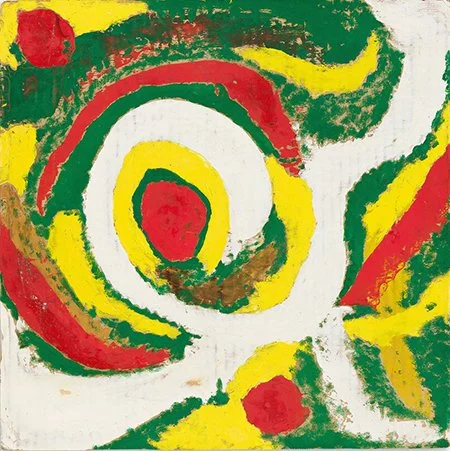
Untitled (Abstraction in Red, Green and Yellow)
(1954) Oil on corrugated cardboard
© Estate of Beauford Delaney
by permission of Derek L. Spratley, Esquire,
Court Appointed Administrator
Courtesy of Michael Rosenfeld Gallery, LLC, New York, NY
The estimated sale price was $12,000 to $18,000.
The work sold for $17,780.00, including a 27% buyer’s premium.
At the time of this writing, Les Amis is only aware of two other works for which Beauford used corrugated cardboard as a support medium.
Both date from the early 1970s.
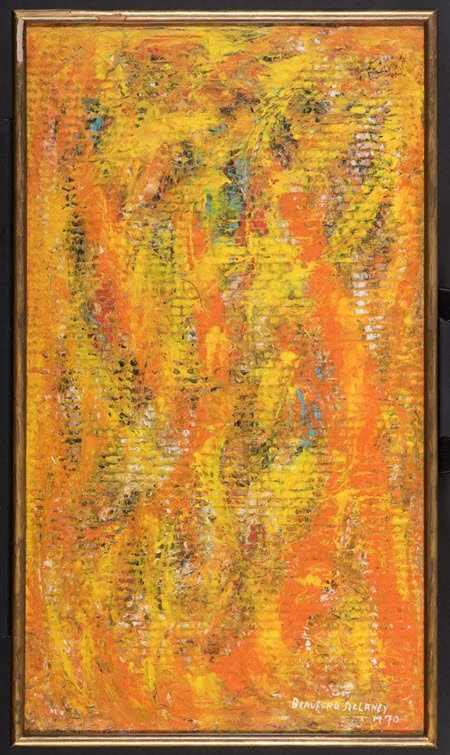
Untitled
(1970) Mixed media on cardboard
Private collection
© Estate of Beauford Delaney
by permission of Derek L. Spratley, Esquire,
Court Appointed Administrator
Courtesy of Michael Rosenfeld Gallery, LLC, New York, NY
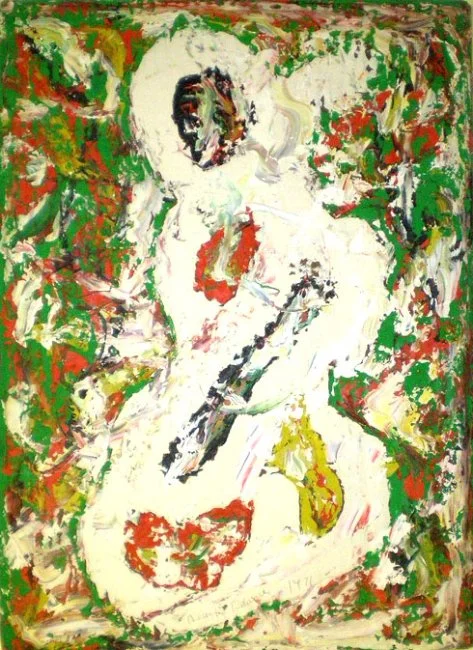
Untitled: Abstract
(1971) Oil on corrugated cardboard
© Estate of Beauford Delaney,
by permission of Derek L. Spratley, Esquire,
Court Appointed Administrator
Image supplied by Levis Fine Art Gallery
Courtesy of Michael Rosenfeld Gallery, LLC, New York, NY
We tend to think of a painting as beginning with a blank surface. Canvas, panel, or paper presents itself to the artist as a relatively passive field awaiting transformation. Corrugated cardboard is different. It arrives with a structure and rhythm of its own.
Beauford may well have used corrugated cardboard for the 1954 painting because he literally could not afford a more traditional support medium (he created his famous raincoat fragment painting that same year).
His selection of this medium 16 to 17 years later may or may not reflect similar choices.
Corrugated cardboard is an unforgiving medium for oil painting. It is fragile (easily compressed), porous (absorbs the oil from the paint, which dulls its finish), and sensitive to atmospheric changes.
The luminosity of Beauford’s corrugated cardboard paintings indicates that he conquered this material.
The 1954 work fairly glows, and one can only imagine the volume of paint he applied to the cardboard to overcome its powerful capacity to turn brilliant oils to lifeless matte surfaces. The viewer’s eye easily follows the broad passages of green, white, and yellow as they move across the composition, punctuated by red accents.
In the 1970 painting, Beauford seems to embrace the corrugation, making it a prominent feature of the finished work. It is almost as though he wanted to remind us that he used this medium to create the piece.
For the 1971 work, Beauford returns to the colors green, white, yellow, and red. The pattern in this painting is “busier” than the one in the 1954 work, with some areas of stippling perhaps echoing the corrugation of the support medium. An intriguing head-like figure appears to emerge from the upper portion of the work.
Whatever the differences among these paintings, they all represent a visual dialogue between structural rigidity and the fluidity that Beauford sought to bring to his work through light.