

Joseph Delaney Remembers Beauford
Joseph Delaney was Beauford’s younger brother. Born in 1904, he and Beauford were the closest in age of the Delaney siblings. Both became artists and were part of a community of artists living in NYC during the Great Depression. Both have their works exhibited at the Knoxville Museum of Art in their hometown of Knoxville, Tennessee.

Image of a portrait of Joseph Delaney
by Beauford Delaney
in Amazing Grace: A Life of Beauford Delaney
by David A. Leeming
Joseph was asked to contribute remarks to the catalog that was published in conjunction with the first retrospective of Beauford’s work, held at the Studio Museum in Harlem in 1978. He described Beauford as “one of the most sensitive and talented of all artists of all times,” and said that if he were to qualify that statement, he would need to explore “all of the qualities which make for the enigma which genius is . . .” He noted that Beauford was recognized early in life as being a special person with unique talents, and that “teachers and other professional people of high rank gave Beauford time and understanding.”

Catalog for Beauford’s 1st Retrospective at the
Studio Museum in Harlem 1978
Joseph also described Beauford as being multitalented, saying that Beauford could “sing like mad,” and play the ukulele, and that he was an excellent mimic. Beauford was the extrovert, while Joseph was the introvert of the two brothers.
Another distinction that Joseph makes in his tribute to his brother is that Beauford developed an appreciation for opera and “other great classics in music and literature.” He states that Beauford was never happier than on the day in 1969 when Joseph visited him in Paris and Beauford took him to the opera.
To read the complete text of Joseph Delaney’s remarks, click on the following link: http://sunsite.utk.edu/delaney/beauford.htm

by Beauford Delaney
in Amazing Grace: A Life of Beauford Delaney
by David A. Leeming
Joseph was asked to contribute remarks to the catalog that was published in conjunction with the first retrospective of Beauford’s work, held at the Studio Museum in Harlem in 1978. He described Beauford as “one of the most sensitive and talented of all artists of all times,” and said that if he were to qualify that statement, he would need to explore “all of the qualities which make for the enigma which genius is . . .” He noted that Beauford was recognized early in life as being a special person with unique talents, and that “teachers and other professional people of high rank gave Beauford time and understanding.”

Studio Museum in Harlem 1978
Joseph also described Beauford as being multitalented, saying that Beauford could “sing like mad,” and play the ukulele, and that he was an excellent mimic. Beauford was the extrovert, while Joseph was the introvert of the two brothers.
Another distinction that Joseph makes in his tribute to his brother is that Beauford developed an appreciation for opera and “other great classics in music and literature.” He states that Beauford was never happier than on the day in 1969 when Joseph visited him in Paris and Beauford took him to the opera.
To read the complete text of Joseph Delaney’s remarks, click on the following link: http://sunsite.utk.edu/delaney/beauford.htm
Larry Calcagno's Portrait of Beauford
Larry Calcagno's portrait of Beauford is one of the rare examples of someone other than Beauford committing Beauford's image to paper. (See the posting on the Georgia O'Keeffe portraits for other examples.)

Portrait of Beauford Delaney
Lawrence Calcagno
(1972) Acrylic
I wrote about Beauford's friendship with Calcagno in April of this year. The first image in that article is the cover of the catalogue from an art exposition that presented Calcagno's and Beauford's works together as a tribute to their friendship. Calcagno's portrait of Beauford was shown in this exposition.
In the introduction for the catalogue, David Leeming wrote an exquisite summary of Beauford's and Calcagno's relationship:
Calcagno and Beauford met in 1953, when Beauford came to Paris. They were introduced by a mutual friend, and they became "devoted colleagues." Correspondence between the two men reveals the depth of their friendship, which grew and was strengthened over twenty-plus years.
Calcagno gave Beauford what is perhaps one of the finest tributes of all in a written description of the episode when Beauford disappeared in 1975 and Calcagno and many others scoured the streets of Paris looking for him:

Lawrence Calcagno
(1972) Acrylic
I wrote about Beauford's friendship with Calcagno in April of this year. The first image in that article is the cover of the catalogue from an art exposition that presented Calcagno's and Beauford's works together as a tribute to their friendship. Calcagno's portrait of Beauford was shown in this exposition.
In the introduction for the catalogue, David Leeming wrote an exquisite summary of Beauford's and Calcagno's relationship:
What Beauford Delaney saw in Larry Calcagno was a soul mate and a lifeline to sanity. What Larry saw in Beauford was a remarkable case of total dedication to the mysterious process by which an individual's external and internal life and the essence of life could be re-created in paint.
Calcagno and Beauford met in 1953, when Beauford came to Paris. They were introduced by a mutual friend, and they became "devoted colleagues." Correspondence between the two men reveals the depth of their friendship, which grew and was strengthened over twenty-plus years.
Calcagno gave Beauford what is perhaps one of the finest tributes of all in a written description of the episode when Beauford disappeared in 1975 and Calcagno and many others scoured the streets of Paris looking for him:
He is about the only person in my life, who gave me generously of deep insights into life—without demanding tribute. A true artist—beyond this world!
Kelli Agodon's Tribute to Beauford
A few days ago, Les Amis de Beauford Delaney received a donation from Kelli Russell Agodon, along with a note of thanks to Les Amis for publishing this blog. When I wrote to thank her for her contribution, she responded that she planned to write about Beauford on her blog, Book of Kells.

On Thursday, July 14th, she did just that.
Kelli's tribute to Beauford is entitled Thankful Thursday - Beauford Delaney, American Artist. In it, she describes him as her "favorite artist that many people have never heard of," and thanks the Les Amis blog for keeping Beauford's memory alive. She includes links to David Leeming's biography of Beauford and to the Artsmia Web site for images of Beauford's work. She states that she is thankful for his art and for being able to share Beauford with her readers.
Thank you, Kelli, for taking the time to write about Beauford and for your heartfelt words!

On Thursday, July 14th, she did just that.
Kelli's tribute to Beauford is entitled Thankful Thursday - Beauford Delaney, American Artist. In it, she describes him as her "favorite artist that many people have never heard of," and thanks the Les Amis blog for keeping Beauford's memory alive. She includes links to David Leeming's biography of Beauford
and to the Artsmia Web site for images of Beauford's work. She states that she is thankful for his art and for being able to share Beauford with her readers.Thank you, Kelli, for taking the time to write about Beauford and for your heartfelt words!
Why Artisan? Thinking about Beauford
By EL Kornegay Jr.
James Baldwin once wrote that what Beauford taught him to see first was not his painting, his art, “that came later,” but the world as Beauford “caused me to see it.”ii It is important that we understand Beauford the artisan so that we might understand his artistic genius and the deep beauty of his art.

Portrait of Beauford Delaney
(ca. 1950)
Possibly by Gjon Mili
If we look at Beauford and his work through the lens that he taught Baldwin to use to view the world, then our initial glance frames him as an artisan who practiced first seeing and then painting. I would say his aim was not to produce fine art for us to regard from a distance, standing behind a velvet rope, while artificial light reflects the sophistication of the one viewing. Rather, Beauford the Artisan wanted to cause us to see something that we do not want to see. He wanted to teach us to see our world and to love even that which is considered the least of it.
It is at second glance that we see Beauford become an artist: a skilled practitioner whose life and work is just beginning to be recognized as “fine art.” His world went unnoticed by most; the darkness he made beautiful mattered only to him, and he remained faithful to what he saw.
It is my guess that this is the way for many who, like Beauford, practiced a craft on the margins where most do not dare to look or experience. They refuse to sacrifice the truth of what they see for the sake of acceptance – for the sake of what we perceive to be art.
Beauford Delaney becomes an artist only after we apprehend what he causes us to see – not before. He becomes an artist only after we have learned the practice of seeing the world – not merely its colors or its dimensions, but the spirit of the light shaping it in our eyes and minds. James Baldwin says of his mentor, “Beauford’s work leads the inner and the outer eye, directly and inexorable, to a new confrontation with reality.”iii

Portrait of James Baldwin
Beauford Delaney
(1945) Oil on canvas
Philadelphia Museum of Art
The artisan gives way to the artist only when we have accepted how he practices seeing the world and paints it. This is what makes Beauford Delaney an artisan who we are beginning to love as an artist and this is what makes his work fine art.
************
i This reflection is in response to the question of why I used “artisan” to describe Beauford Delaney. I am using James Baldwin as an interlocutor to frame this reflection, since it is he that first introduced me to Beauford as the one who taught him to see the world and to paint its beauty with his words. As such, I see myself as a student of both men.
ii James Baldwin, “On the Painter Beauford Delaney” in James Baldwin: Collected Essay, Toni Morrison, ed. (New York, N.Y.: Literary Classics of the United States, Inc., 1998), 721.
iii Ibid, pp.720.
In a previous posting entitled "Beauford Delaney: The Artisan as Witness," EL Kornegay Jr. took a first, insightful look at Beauford's art from the vantage point of his emerging awareness of Beauford's influence on James Baldwin. Here, he elaborates on what he sees as the difference between Beauford as "artist" and Beauford as "artisan."There may seem to be very little difference between the words “artist” and “artisan.” On the surface it is easy to see that the former proceeds from the latter. However, the application of these words can and does mean something different to the one labeling and the one being labeled. Such is the case with Beauford Delaney.i
James Baldwin once wrote that what Beauford taught him to see first was not his painting, his art, “that came later,” but the world as Beauford “caused me to see it.”ii It is important that we understand Beauford the artisan so that we might understand his artistic genius and the deep beauty of his art.

(ca. 1950)
Possibly by Gjon Mili
If we look at Beauford and his work through the lens that he taught Baldwin to use to view the world, then our initial glance frames him as an artisan who practiced first seeing and then painting. I would say his aim was not to produce fine art for us to regard from a distance, standing behind a velvet rope, while artificial light reflects the sophistication of the one viewing. Rather, Beauford the Artisan wanted to cause us to see something that we do not want to see. He wanted to teach us to see our world and to love even that which is considered the least of it.
It is at second glance that we see Beauford become an artist: a skilled practitioner whose life and work is just beginning to be recognized as “fine art.” His world went unnoticed by most; the darkness he made beautiful mattered only to him, and he remained faithful to what he saw.
It is my guess that this is the way for many who, like Beauford, practiced a craft on the margins where most do not dare to look or experience. They refuse to sacrifice the truth of what they see for the sake of acceptance – for the sake of what we perceive to be art.
Beauford Delaney becomes an artist only after we apprehend what he causes us to see – not before. He becomes an artist only after we have learned the practice of seeing the world – not merely its colors or its dimensions, but the spirit of the light shaping it in our eyes and minds. James Baldwin says of his mentor, “Beauford’s work leads the inner and the outer eye, directly and inexorable, to a new confrontation with reality.”iii

Beauford Delaney
(1945) Oil on canvas
Philadelphia Museum of Art
The artisan gives way to the artist only when we have accepted how he practices seeing the world and paints it. This is what makes Beauford Delaney an artisan who we are beginning to love as an artist and this is what makes his work fine art.
i This reflection is in response to the question of why I used “artisan” to describe Beauford Delaney. I am using James Baldwin as an interlocutor to frame this reflection, since it is he that first introduced me to Beauford as the one who taught him to see the world and to paint its beauty with his words. As such, I see myself as a student of both men.
ii James Baldwin, “On the Painter Beauford Delaney” in James Baldwin: Collected Essay, Toni Morrison, ed. (New York, N.Y.: Literary Classics of the United States, Inc., 1998), 721.
iii Ibid, pp.720.
Beauford Painting Auctioned at Doyle New York
Many thanks to DLeopold, who recently shared the following comment on the blog posting about Beauford and Al Hirschfeld:
I visited the Doyle New York Web site and found a single Delaney painting that had been assigned Lot Number 151 and an estimated sale price of $4000 to $6000. It is a pastel on grey/green paper entitled Street Scene, dated 1953 (the year that Beauford sailed for Paris).

Street Scene
Beauford Delaney
(1953) Pastel on paper
The auction was held on June 22, 2011 at 10 AM. Beauford's pastel sold for $37,500!
Hirschfeld and Freeman were instrumental in introducing Delaney to a wide range of friends and collectors, which provided him the means to focus on his art. Several works on paper by Delaney from Hirschfeld's collection will go to the auction block on June 22nd. Check it out at http://www.doylenewyork.com/content/more.asp?id=157.
I visited the Doyle New York Web site and found a single Delaney painting that had been assigned Lot Number 151 and an estimated sale price of $4000 to $6000. It is a pastel on grey/green paper entitled Street Scene, dated 1953 (the year that Beauford sailed for Paris).

Beauford Delaney
(1953) Pastel on paper
The auction was held on June 22, 2011 at 10 AM. Beauford's pastel sold for $37,500!
Beauford and Friends on Greene Street
After reading last week's guest posting by Richard Gibson on sitting for his Delaney portrait, his friend Tony Hagert sent the information below regarding Beauford's studio on Greene Street in New York. It is a wonderful glimpse at what life was like for him, his roommate, Richard Hadlock, and landlord Beauford!

Greene Street
Beauford Delaney
(1940) Oil on canvas
Photo by André Moran from the Artsmia Web site
Actually, Dick Hadlock and I were on the second floor and Beauford on the third. We paid him $35 per month and later found out he was paying $25 for both floors - all from a generous friend, I think, because it was pretty cheap even for those days (1951+).
The first floor at 181 Greene Street was a twine warehouse and not a fashionable address altho' only two blocks from Washington Square, Fifth Avenue, and New York University. There was no hot water so we used to go to Grand Central Station every so often to bathe for 75 cents (plus tip). If we were invited to someone's home, we would ask if it was OK for us to bring our soap and towel, and they could watch if they wanted - or help, even.
Before we moved in, we had to empty out the second floor which was completely filled with bags of ashes from the pot bellied stove on the third floor - several years' worth. I cannot recall how we disposed of them but it must have been by stealth at night because we could not afford to have them hauled away.
Then we repainted the second floor over the four or five haphazard end-of-the-can colors that had been there before the ashes, brought in our old records, and were as happy as clams.

Beauford Delaney
(1940) Oil on canvas
Photo by André Moran from the Artsmia Web site
Actually, Dick Hadlock and I were on the second floor and Beauford on the third. We paid him $35 per month and later found out he was paying $25 for both floors - all from a generous friend, I think, because it was pretty cheap even for those days (1951+).
The first floor at 181 Greene Street was a twine warehouse and not a fashionable address altho' only two blocks from Washington Square, Fifth Avenue, and New York University. There was no hot water so we used to go to Grand Central Station every so often to bathe for 75 cents (plus tip). If we were invited to someone's home, we would ask if it was OK for us to bring our soap and towel, and they could watch if they wanted - or help, even.
Before we moved in, we had to empty out the second floor which was completely filled with bags of ashes from the pot bellied stove on the third floor - several years' worth. I cannot recall how we disposed of them but it must have been by stealth at night because we could not afford to have them hauled away.
Then we repainted the second floor over the four or five haphazard end-of-the-can colors that had been there before the ashes, brought in our old records, and were as happy as clams.
Richard Gibson Sits for a Portrait by Beauford
Richard Gibson met Beauford at the age of sixteen in Philadelphia and considered Beauford a friend and mentor for the rest of his life. Among the things that Beauford helped Gibson accomplish was to get accepted at the Yaddo artists’ community in Sarasota Springs, NY when he was a struggling young writer trying to produce his first book. In this posting, he talks about how Beauford came to paint his portrait, which was eventually hung at a major exposition at the Philadelphia Museum of Art.
****************
I visited Beauford in Paris when I was stationed outside Karlsruhe in the US Army in the last days of the allied occupation. I was fortunate enough to obtain my discharge from the Army without having to go back to the States and instead went straight to Paris, taking an overnight train to see Beauford and William Gardner Smith, another good friend. I found a room in what was then called the Hotel des Ecoles on the rue Delambre, where Beauford was staying in a bedroom that was very light and bright on the top floor. The maids had given him old white sheets to improve the light. He slept and worked in this fairly spacious room, which I remember as overlooking rue Delambre. It was hard to see the street because of the guttering on that floor of the building.
The light in the room was reminiscent of that in Beauford’s Greene Street apartment in Greenwich Village, but the space was far more comfortable. I often visited him at Greene Street and two school friends of mine from Philadelphia actually stayed on the floor above for some months. Beauford’s studio there was damp and poorly heated by a pot-bellied stove, but quite light due to the old white sheets that he scattered over furniture and hung over the dark walls.
It was at the rue Delambre apartment where Beauford said he wanted to do my portrait one day in 1955. I did not have to go to classes at the Sorbonne (where I was trying to learn and perfect my French on the GI Bill) that day.
Beauford’s custom was to listen to music of all kinds – from jazz to Marian Anderson, the great black singer of the day – while working, and so it was that day. I was astounded at how swiftly his brushes moved across the small standard canvas that one found in local Montparnasse art shops. My portrait was completed in two hours. It was little more than a sketch perhaps, but I still treasure it as the best likeness of me as a young man.

Portrait of Richard Gibson
Beauford Delaney
Oil on canvas (1955)
To read Richard’s tribute to Beauford on the Les Amis blog, click here.

Richard Gibson standing next to his portrait at the 2005 exposition
Beauford Delaney: From New York to Paris
Philadelphia Museum of Art
Photo courtesy of Richard Gibson
To read more about the 2005 exposition at the Philadelphia Museum of Art, click on the following links:
http://www.fallonandrosof.com/2005/11/delaney-in-paris-and-philadelphia.html
http://theartblog.org/2005/11/weekly-update-delaneys-embrace/
I visited Beauford in Paris when I was stationed outside Karlsruhe in the US Army in the last days of the allied occupation. I was fortunate enough to obtain my discharge from the Army without having to go back to the States and instead went straight to Paris, taking an overnight train to see Beauford and William Gardner Smith, another good friend. I found a room in what was then called the Hotel des Ecoles on the rue Delambre, where Beauford was staying in a bedroom that was very light and bright on the top floor. The maids had given him old white sheets to improve the light. He slept and worked in this fairly spacious room, which I remember as overlooking rue Delambre. It was hard to see the street because of the guttering on that floor of the building.
The light in the room was reminiscent of that in Beauford’s Greene Street apartment in Greenwich Village, but the space was far more comfortable. I often visited him at Greene Street and two school friends of mine from Philadelphia actually stayed on the floor above for some months. Beauford’s studio there was damp and poorly heated by a pot-bellied stove, but quite light due to the old white sheets that he scattered over furniture and hung over the dark walls.
It was at the rue Delambre apartment where Beauford said he wanted to do my portrait one day in 1955. I did not have to go to classes at the Sorbonne (where I was trying to learn and perfect my French on the GI Bill) that day.
Beauford’s custom was to listen to music of all kinds – from jazz to Marian Anderson, the great black singer of the day – while working, and so it was that day. I was astounded at how swiftly his brushes moved across the small standard canvas that one found in local Montparnasse art shops. My portrait was completed in two hours. It was little more than a sketch perhaps, but I still treasure it as the best likeness of me as a young man.

Beauford Delaney
Oil on canvas (1955)
To read Richard’s tribute to Beauford on the Les Amis blog, click here.

Beauford Delaney: From New York to Paris
Philadelphia Museum of Art
Photo courtesy of Richard Gibson
To read more about the 2005 exposition at the Philadelphia Museum of Art, click on the following links:
http://www.fallonandrosof.com/2005/11/delaney-in-paris-and-philadelphia.html
http://theartblog.org/2005/11/weekly-update-delaneys-embrace/
Beauford’s Works Shown Again in Paris?
Might Beauford’s works be shown again in Paris? If Dorothy Polley of Dorothy’s Gallery has anything to say about it, the answer is a resounding “YES”!
You may remember the name Dorothy Polley from blog postings that I published during 2010. Dorothy’s Gallery generously donated twice to the Beauford Delaney Gravesite Project – first from funds from her gallery itself and then from the proceeds of the sale of a Henry Miller work entitled Sarasota.
Dorothy first became interested in Beauford’s story as a “cause” in which to participate to help preserve the legacy of an American painter. As she organized the sale of Henry Miller’s works for this cause, she discovered Miller’s love for Beauford and developed an interest in him as well. She envisioned having some of Beauford’s work hanging beside Miller’s paintings at the gallery.

Dorothy Polley and Sarasota
© Discover Paris!
While organizing the exhibit of Henry Miller’s work, Dorothy discovered a television documentary of Miller’s visit to Paris for his 80th birthday. Part of this film, entitled Henry Miller Odyssey, was shot in Beauford’s studio on rue Vercingétorix, where she could see Beauford and hear him speak for the first time. She could also see the paintings that hung on the walls of the studio at the time the documentary was filmed. As she learned more about his life and his persona, she decided that Beauford’s work deserved to be shown again in Paris.
Dorothy is a great admirer of James Baldwin, and when she learned what a profound effect Beauford had on Baldwin, she became even more determined to delve deeper into Beauford’s work and to find a way to organize a show featuring his paintings.
When I asked her what draws her to Beauford’s work, Dorothy responded that in painting, portraits have always had a profound effect on her. She finds that Beauford’s portraiture creates an aura of emotion that draws the viewer into the work. Because she likes to show artists who paint in a variety of styles and have a special sense of color, she finds Beauford’s portraits particularly appealing. When I asked Dorothy what she likes about Beauford’s abstracts, she that she was drawn above all to the movement in these paintings, and again, to the profound and poetic sense of color in them.

Mme du Closel
G. R. N’Namdi Gallery
(1964) Pastel on paper
Dorothy is now studying her options for mounting a show that features Beauford. Given that his works are scattered and difficult to obtain, her task will not be an easy one. Possibilities include inviting galleries that possess his works to share an exposition at Dorothy’s Gallery, where she could also hang works of other African-American artists who live or lived in Paris. This would be an exposition of “African-American Artists in Paris – Then and Now.” Alternatively, Dorothy could mount a “museum-type” show at another location in Paris where works would only be on display and not for sale.
I am very pleased that Dorothy’s Gallery is considering hosting an exposition. I stated in my blog posting of November 24, 2010 that instigating an exposition of Beauford’s work in Paris is something that I thought Les Amis de Beauford Delaney might undertake. We have now taken the first small steps in this direction! In future postings on this blog, I will keep you informed of how things are progressing.

Dorothy’s Gallery
27, rue Keller
75011 Paris
Telephone: 33 (0)1 43 57 08 51
Internet: http://dorothysgallery.com/art
E-mail: dorothysgallery@gmail.com
Hours: Sunday and Tuesday – 4 PM to 7 PM
Wednesday through Saturday – 1 PM to 7 PM
Closed Mondays.
Appointments possible.
You may remember the name Dorothy Polley from blog postings that I published during 2010. Dorothy’s Gallery generously donated twice to the Beauford Delaney Gravesite Project – first from funds from her gallery itself and then from the proceeds of the sale of a Henry Miller work entitled Sarasota.
Dorothy first became interested in Beauford’s story as a “cause” in which to participate to help preserve the legacy of an American painter. As she organized the sale of Henry Miller’s works for this cause, she discovered Miller’s love for Beauford and developed an interest in him as well. She envisioned having some of Beauford’s work hanging beside Miller’s paintings at the gallery.

© Discover Paris!
While organizing the exhibit of Henry Miller’s work, Dorothy discovered a television documentary of Miller’s visit to Paris for his 80th birthday. Part of this film, entitled Henry Miller Odyssey, was shot in Beauford’s studio on rue Vercingétorix, where she could see Beauford and hear him speak for the first time. She could also see the paintings that hung on the walls of the studio at the time the documentary was filmed. As she learned more about his life and his persona, she decided that Beauford’s work deserved to be shown again in Paris.
Dorothy is a great admirer of James Baldwin, and when she learned what a profound effect Beauford had on Baldwin, she became even more determined to delve deeper into Beauford’s work and to find a way to organize a show featuring his paintings.
When I asked her what draws her to Beauford’s work, Dorothy responded that in painting, portraits have always had a profound effect on her. She finds that Beauford’s portraiture creates an aura of emotion that draws the viewer into the work. Because she likes to show artists who paint in a variety of styles and have a special sense of color, she finds Beauford’s portraits particularly appealing. When I asked Dorothy what she likes about Beauford’s abstracts, she that she was drawn above all to the movement in these paintings, and again, to the profound and poetic sense of color in them.

G. R. N’Namdi Gallery
(1964) Pastel on paper
Dorothy is now studying her options for mounting a show that features Beauford. Given that his works are scattered and difficult to obtain, her task will not be an easy one. Possibilities include inviting galleries that possess his works to share an exposition at Dorothy’s Gallery, where she could also hang works of other African-American artists who live or lived in Paris. This would be an exposition of “African-American Artists in Paris – Then and Now.” Alternatively, Dorothy could mount a “museum-type” show at another location in Paris where works would only be on display and not for sale.
I am very pleased that Dorothy’s Gallery is considering hosting an exposition. I stated in my blog posting of November 24, 2010 that instigating an exposition of Beauford’s work in Paris is something that I thought Les Amis de Beauford Delaney might undertake. We have now taken the first small steps in this direction! In future postings on this blog, I will keep you informed of how things are progressing.

Dorothy’s Gallery
27, rue Keller
75011 Paris
Telephone: 33 (0)1 43 57 08 51
Internet: http://dorothysgallery.com/art
E-mail: dorothysgallery@gmail.com
Hours: Sunday and Tuesday – 4 PM to 7 PM
Wednesday through Saturday – 1 PM to 7 PM
Closed Mondays.
Appointments possible.
Beauford Delaney: The Artisan as Witness
by EL Kornegay
Delaney lived what he painted. He was a witness in the purest sense of the word, giving us a glimpse into a world we often pity and therefore prefer to gaze upon and understand second-hand. It is the world we thoughtfully remark about how grateful we are to encounter only in passing. Using the darkened corners of a peripheral world, Beauford brought color, light, images, and realities only imagined by some – but lived by him – to the center of the universe. Amongst the deepest blacks, through cascading earth tones, yellows, reds, blues, and abiding pastels; the prickly and soothing geometry of shapes gives witness, in a color-full panoramic voice, to a life obscured.

The Eye
Beauford Delaney
(1965) Oil on canvas
Private Collection
© Discover Paris
Beauford channeled the madness and painted saneness with it. He witnessed that fire from within the gulf of its flames and heat. His soul was charred in deep places and the searing images that emerged give us a glimpse into the mindful beauty that exists alongside the terror of the world in which we live and most often, without any resistance, allow to live in us. Beauford was trying to get it out, to exorcise through his art the pain, anguish, and beauty of one who witnesses a world gone mad and is maddened by it.
James Baldwin said of Delaney, “The reality of his seeing caused me to begin to see.”i This is the gift of Delaney’s work: it gives a “vocabulary of color and sounds” and “beauty even in the metaphorical and literal gutter” to our maddening world.

Dark Rapture
(Portrait of James Baldwin as it appears in Amazing Grace)
(1941) Oil on board
© Discover Paris
Beauford Delaney’s life and work is trying to speak to us: it is trying to get us to say and see something different about our world, ourselves, and the madness we all rationalize as reasonable. To appreciate the work of Beauford Delaney is to accept the beauty of those things – memories and people – we choose to throw away, to allow to lie in the gutter, and to not witness. It is also the acceptance of the idea that the things we hold onto to prove our sanity are, in fact, driving us insane. Delaney provides us a glimpse of beauty, color and sounds of the people, places, and things of the margins. Through Beauford’s artistic witness we are given a picture of sanity that makes the canvas of a maddening world beautiful and normal.
i David Leeming, James Baldwin: A Biography (New York: Henry Holt and Company, 1994), 33-34
EL Kornegay, Jr. is a FTE Fellow and PhD Candidate at Chicago Theological Seminary in Chicago, Illinois, where he is nearing completion of his dissertation on the religious and theological mind of James Baldwin. His awareness and appreciation of Beauford and his work has arisen because of his investigation of Beauford’s influence on Baldwin.I have come to know Beauford Delaney in a marginal and vicarious fashion. I say marginal in the sense that his works give color, shape, contexts and contours to the not-so-readily-apparent minds, bodies, and souls haunting the edges of our social, literal, and artistic worlds. I say vicarious because in his depictions of the margins of these worlds, he boldly exposes those things we are less willing to see and accept in ourselves and the world around us. Into our world and time, Delaney’s witness is slowly being unearthed and made recognizable to those of us whose social and cultural viewpoint obscures the gritty haunts and shadows of a world we mostly view as shockingly entertaining – a world of madness.
Delaney lived what he painted. He was a witness in the purest sense of the word, giving us a glimpse into a world we often pity and therefore prefer to gaze upon and understand second-hand. It is the world we thoughtfully remark about how grateful we are to encounter only in passing. Using the darkened corners of a peripheral world, Beauford brought color, light, images, and realities only imagined by some – but lived by him – to the center of the universe. Amongst the deepest blacks, through cascading earth tones, yellows, reds, blues, and abiding pastels; the prickly and soothing geometry of shapes gives witness, in a color-full panoramic voice, to a life obscured.

Beauford Delaney
(1965) Oil on canvas
Private Collection
© Discover Paris
Beauford channeled the madness and painted saneness with it. He witnessed that fire from within the gulf of its flames and heat. His soul was charred in deep places and the searing images that emerged give us a glimpse into the mindful beauty that exists alongside the terror of the world in which we live and most often, without any resistance, allow to live in us. Beauford was trying to get it out, to exorcise through his art the pain, anguish, and beauty of one who witnesses a world gone mad and is maddened by it.
James Baldwin said of Delaney, “The reality of his seeing caused me to begin to see.”i This is the gift of Delaney’s work: it gives a “vocabulary of color and sounds” and “beauty even in the metaphorical and literal gutter” to our maddening world.

(Portrait of James Baldwin as it appears in Amazing Grace)
(1941) Oil on board
© Discover Paris
Beauford Delaney’s life and work is trying to speak to us: it is trying to get us to say and see something different about our world, ourselves, and the madness we all rationalize as reasonable. To appreciate the work of Beauford Delaney is to accept the beauty of those things – memories and people – we choose to throw away, to allow to lie in the gutter, and to not witness. It is also the acceptance of the idea that the things we hold onto to prove our sanity are, in fact, driving us insane. Delaney provides us a glimpse of beauty, color and sounds of the people, places, and things of the margins. Through Beauford’s artistic witness we are given a picture of sanity that makes the canvas of a maddening world beautiful and normal.
i David Leeming, James Baldwin: A Biography (New York: Henry Holt and Company, 1994), 33-34
Beauford's Portraits
In "A Narrative of Belonging: The Art of Beauford Delaney and Glenn Ligon," Dr. Catherine St. John writes:
When I reread this excerpt from Dr. St. John's paper, I was inspired to look at images of dozens of portraits that Beauford painted during his lifetime. I bring you several below; these have not been displayed previously on the Les Amis blog.

Untitled (Portrait of a Young Woman)
(1934) Color pastels
Private collection

Michael Fraenkel
(1946) Drawing
From Death, A Literary Quarterly Vol 1, No. 1 (Summer 1946)

Marian Anderson
(1965) Oil on Canvas
©2001 Malcolm Varon

Portrait of Bernard Hassell
(ca 1971) Oil on Canvas
Estate of Beauford Delaney

Ella Fitzgerald
(1968) Oil on canvas
The Walter O. Evans Collection of African American Art
Beauford painted pastel portraits of Duke Ellington and W.E.B. DuBois, but I have never found images of them. If any of you have seen these portraits, or images of them, please let me know by leaving a comment below!
It is the expressive single-figure realist portrait that first brought Beauford Delaney critical notice and a measure of success. He loved people. He continued the art of portraiture without interruption throughout his career. His portraits tell a story that is human and real, saying as much about him as those he painted.
When I reread this excerpt from Dr. St. John's paper, I was inspired to look at images of dozens of portraits that Beauford painted during his lifetime. I bring you several below; these have not been displayed previously on the Les Amis blog.

(1934) Color pastels
Private collection

(1946) Drawing
From Death, A Literary Quarterly Vol 1, No. 1 (Summer 1946)

(1965) Oil on Canvas
©2001 Malcolm Varon

(ca 1971) Oil on Canvas
Estate of Beauford Delaney

(1968) Oil on canvas
The Walter O. Evans Collection of African American Art
Beauford painted pastel portraits of Duke Ellington and W.E.B. DuBois, but I have never found images of them. If any of you have seen these portraits, or images of them, please let me know by leaving a comment below!
A Film about Beauford
Since the founding of Les Amis de Beauford Delaney in 2009, I have spoken with several filmmakers who have expressed interest in creating a work about Beauford. Zachary J. Miller of 2 Bulls on the Hill Productions is the first to take concrete action on this idea. He is currently producing a short film (30 minutes or less) about Beauford – the man and the artist. Miller’s goal is to present several aspects of Beauford’s life and a few of the many works that he created while living in Paris.

Zachary J. Miller
© Discover Paris!
Miller is a long time Paris resident. His idea for the film evolved after he donated his services and those of his team to film and photograph Beauford’s gravesite ceremony and reception in October 2010. Since then, he has sought out individuals in Paris who own Delaney paintings, interviewed them, and filmed and photographed the works. He has also interviewed persons who knew Beauford personally, and recorded their anecdotes and other remembrances.
Miller will direct and produce the short film, which does not have a title at present. Because of the volume of footage that he has recorded and the richness of the interviews that he has conducted, he is considering creating a documentary instead of a short film. He will make a final decision about this once he has conducted his final interviews.
The most important and extensive of Miller’s interviews was with Burt Reinfrank, a dear friend of Beauford who spends several months a year in Paris with his wife Pat. Miller and I met with the Reinfranks in their apartment, where we listened to Burt recount numerous stories about his relationship with Beauford, Beauford’s persona, and Beauford’s art.

Miller filming Burt and Pat Reinfrank
in their Paris apartment
© Discover Paris!
Other persons interviewed include Tannie Stovall, co-founder of 2 Bulls on the Hill Productions and a personal acquaintance of Beauford, and Constance Borde, president of Democrats Abroad and owner of a Delaney painting.
2 Bulls on the Hill Productions is an American-owned and operated French film production company with offices in Paris and Saint Tropez. The company produces feature films, documentaries, short films, and programs for television. It regularly participates in the Cannes Film Festival in France and takes part in other international film festivals such as the Raindance Film Festival in the UK as well.

© Discover Paris!
Miller is a long time Paris resident. His idea for the film evolved after he donated his services and those of his team to film and photograph Beauford’s gravesite ceremony and reception in October 2010. Since then, he has sought out individuals in Paris who own Delaney paintings, interviewed them, and filmed and photographed the works. He has also interviewed persons who knew Beauford personally, and recorded their anecdotes and other remembrances.
Miller will direct and produce the short film, which does not have a title at present. Because of the volume of footage that he has recorded and the richness of the interviews that he has conducted, he is considering creating a documentary instead of a short film. He will make a final decision about this once he has conducted his final interviews.
The most important and extensive of Miller’s interviews was with Burt Reinfrank, a dear friend of Beauford who spends several months a year in Paris with his wife Pat. Miller and I met with the Reinfranks in their apartment, where we listened to Burt recount numerous stories about his relationship with Beauford, Beauford’s persona, and Beauford’s art.

in their Paris apartment
© Discover Paris!
Other persons interviewed include Tannie Stovall, co-founder of 2 Bulls on the Hill Productions and a personal acquaintance of Beauford, and Constance Borde, president of Democrats Abroad and owner of a Delaney painting.
2 Bulls on the Hill Productions is an American-owned and operated French film production company with offices in Paris and Saint Tropez. The company produces feature films, documentaries, short films, and programs for television. It regularly participates in the Cannes Film Festival in France and takes part in other international film festivals such as the Raindance Film Festival in the UK as well.
Beauford and Al Hirschfeld

Albert Hirschfeld
Charcoal on paper, Private collection
Image from Beauford Delaney: New York to Paris catalog
Minneapolis Institute of Arts
Al Hirschfeld was a well-known caracaturist and a friend of Beauford. Little detail is available in print about their relationship, but it is evident that Hirschfeld (and his wife, Dolly) were very fond of Beauford and supportive of him as well.
Much of what we know comes from the Leeming biography Amazing Grace: A Life of Beauford Delaney
 . Beauford met Hirschfeld in New York, when Beauford was working as a doorman at the Whitney Studio Galleries (which would become the Whitney Museum). They became friends, and Beauford would go on to sketch Hirschfeld and paint his portrait. Hirschfeld was a part of Beauford's life during the "New York Years," socializing with him and introducing him to people who would become Beauford's patrons and friends as well. He and his wife would also visit Beauford several times in Paris.
Leeming indicates that Hirschfeld, Don Freeman, and other friends helped Beauford through a period of depression that began at the end of 1941. Hirschfeld contributed funds for the ticket that Beauford purchased to sail to France in 1953 and arranged for Beauford to meet people in the art gallery world once he arrived in Paris. He introduced Beauford to Sergei Radamsky, a singer and music teacher with whom Beauford would travel through Europe in 1954. When Beauford needed medical care after his suicide attempt in 1961, Hirschfeld was among the many friends that sent money to settle Beauford's hospital bill.
Al Hirschfeld's papers are held by the Archives of American Art at the Smithsonian. Among them, one finds letters from Beauford to Hirschfeld and a loan agreement from the Studio Museum in Harlem for one of Beauford's works. Two Delaney paintings that were owned by the Hirschfelds' were shown at the Studio Museum's 1978 exposition of Beauford's works: The Time of Your Life and Greene Street.
Special Video: Richard A. Long talks about Beauford - Part 2

In Part 2 of the video, Richard shares the story of how he came to be curator of Beauford's one-man show at the Studio Museum in Harlem in 1979.
Special Video: Richard A. Long Talks about Beauford - Part 1
I was delighted to learn that Beauford's friend Richard A. Long, curator of the first retrospective of Beauford’s works that was mounted at the Studio Museum in Harlem in 1978, would be visiting Paris this week. Tom and I met him at his hotel, where he was gracious enough to allow us to video him talking about Beauford:
Note: The High Museum obtained Beauford's portrait of Richard Long in 2001.
Note: The High Museum obtained Beauford's portrait of Richard Long in 2001.
Beauford in Color
I found this beautiful COLOR photo of Beauford, taken by Carl Van Vechten on March 18, 1953, while surfing the Web last week:

Portrait of Beauford Delaney
© 1953 Carl Van Vechten
Beinecke Rare Book and Manuscript Library, Yale University
I then found a second portrait on another Web site (with no attributions mentioned) a few days later:

Van Vechten undoubtedly took these photos on the same day that he took the black and white photo that has graced the side bar of this blog since its inception in November 2009. He took them only five months before Beauford set sail for Paris on the S. S. Liberté.
Beauford looks quite handsome, doesn't he?

© 1953 Carl Van Vechten
Beinecke Rare Book and Manuscript Library, Yale University
I then found a second portrait on another Web site (with no attributions mentioned) a few days later:

Van Vechten undoubtedly took these photos on the same day that he took the black and white photo that has graced the side bar of this blog since its inception in November 2009. He took them only five months before Beauford set sail for Paris on the S. S. Liberté.
Beauford looks quite handsome, doesn't he?
If you like this posting, share it with your friends on Facebook, Twitter, and elsewhere using one or more of the buttons below!
Beauford at the Art Miami Basel Festival
Laurence Choko, proprietor of the Galerie Intemporel in Paris, displayed the Beauford Delaney painting entitled Portrait de Vasilli Pikoula during her Ten is One exposition at the Art Miami Basel Festival in December 2010.

Exposition Ten is One , Art Basel Miami Festival 2010
Photo courtesy of Galerie Intemporel
Choko has the following to say about Beauford’s work, and about this portrait (shown at the right in the photo above) in particular:
I love the expressionist aspect of Beauford Delaney’s figurative works. The subjects of his portraits often express great emotion, and their vulnerability brings them alive for me.
What I admire in the Portrait de Vasilli Pikoula, which I included in the Ten is One exposition from the Art Basel Miami Festival last December, is the generosity with which he represented his painter friend (Pikoula was a Greek painter). In this portrait, Delaney gives her an aristocratic air – it reminds me of the dignified, old women of the Antilles who carried themselves well regardless of their social position.
Beauford and Larry Calcagno

Catalog cover for art exposition
Palmer Museum of Art (2001)
Larry Calcagno was one of Beauford’s closest friends. They met in Paris through their mutual friend Charley Boggs. Beauford and Calcagno were both artists, both gay men, and both deeply philosophical. Beauford’s biographer, David A. Leeming
, describes their relationship as “intellectually intense, but for the most part physically platonic.”Calcagno had a studio on rue Vercingétorix, the street where Beauford’s patron Mme du Closel would later purchase a studio for Beauford. Beauford spent a great deal of time there before Calcagno returned to the United States. Calcagno gave Beauford several canvases, paper for watercolor paintings, and paints prior to his departure.
See a letter written by Beauford to Calcagno, dated December 1953, below.


Images: Archives of American Art, Smithsonian Instititution
The two men would correspond regularly for many years, with Beauford frequently confiding his emotional difficulties to Calcagno in his writings.
Calcagno returned to Europe in 1955, and invited Beauford to accompany him on the first of several trips that they would take together. He and Beauford traveled to Madrid for Calcagno’s art exposition at the Gallery Clan. Calcagno was able to convince the gallery to mount a show for Beauford in June 1955. It was Beauford’s first solo exposition in Europe, and it was a commercial success. In 1956, Calcagno and Beauford visited Ibiza, Spain, where they met up with James Baldwin and other friends. Calcagno, Darthea Speyer, and Charley Boggs took Beauford on a trip to Venice in 1966, where they attended the Bienniale exposition.

Photo from Amazing Grace: A Life of Beauford Delaney (1998)
Calcagno would frequently send Beauford money with his letters – money that Beauford often desperately needed. When Beauford required hospitalization after his 1961 suicide attempt, Calcagno contributed money to pay for Beauford’s care and came to Paris to visit Beauford during this difficult time. In the spring of 1975, he interrupted his European travels to come to Paris to search for Beauford, who had disappeared. Calcagno wrote of this episode, saying:
He disappeared a couple of times. This time he can’t seem to be located. We called and looked in all the places where one might want to disappear to—I know a lot of them. He must still be alive, his body would have shown up. He has just simply dissolved himself to escape the final cruelty of the world. I weep for him and I bless him!Beauford was eventually found. He was committed to Sainte-Anne’s Hospital soon thereafter.
The relationship between Beauford and Larry Calcagno can be summarized in a single phrase that Beauford wrote in a letter to Calcagno in 1968, in which he described a “deathless kinship that is constant [and] is always alive and close between us.”
More on Beauford's Last Studio - Rue Vercingétorix
You may recall that I published a posting about Beauford's last studio, which was located at 53, rue Vercingétorix in Paris' 14th arrondissement, last year. (Click here to see photos of the neighborhood in its current state as well as photos of the interior of the studio and Beauford and Henry Miller in the courtyard outside.)
I have finally found a photo of the façade of the building that was located at this address!

53, rue Vercingétorix
Photo by Nicholas Breach
The Streets of Paris by Richard Cobb (1980) Pantheon Books
According to Beauford's dear friend Burt Reinfrank, Beauford's studio overlooked a schoolyard. The photo below may represent that same schoolyard.

Abandoned School, rue Vercingétorix
Photo by Nicholas Breach
The Streets of Paris by Richard Cobb (1980) Pantheon Books
Rue Vercingétorix was part of what used to be known as the quartier de Gergovie, which was originally settled by immigrants from Brittany. The photos shown above were taken during the 1970s, at a time when the neighborhood was in steep decline. This was the state of affairs during Beauford's last years there.
I have finally found a photo of the façade of the building that was located at this address!
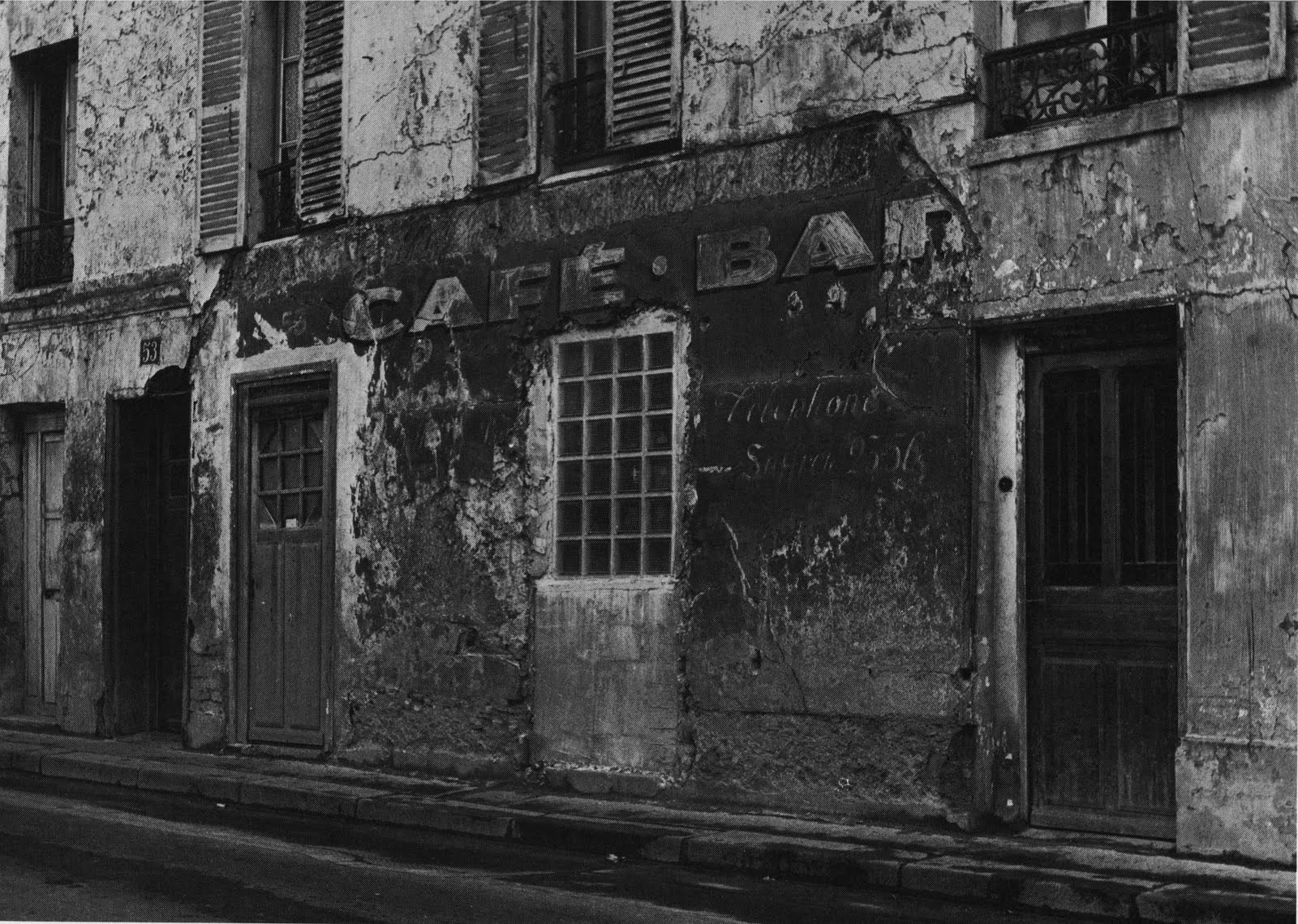
Photo by Nicholas Breach
The Streets of Paris by Richard Cobb (1980) Pantheon Books
According to Beauford's dear friend Burt Reinfrank, Beauford's studio overlooked a schoolyard. The photo below may represent that same schoolyard.

Photo by Nicholas Breach
The Streets of Paris by Richard Cobb (1980) Pantheon Books
Rue Vercingétorix was part of what used to be known as the quartier de Gergovie, which was originally settled by immigrants from Brittany. The photos shown above were taken during the 1970s, at a time when the neighborhood was in steep decline. This was the state of affairs during Beauford's last years there.
Galerie Darthea Speyer Records Go to the Smithsonian
In commemoration of the 32nd anniversary of Beauford's death, I am pleased to reopen the Les Amis de Beauford Delaney blog with a wonderful guest posting that has been contributed by Jason Stieber of the Smithsonian Institution's Archives of American Art. All images below have been provided by the Smithsonian.
**********
One of his most ardent admirers was the American cultural ambassador and art dealer Darthea Speyer. Speyer exhibited Beauford’s work in her Paris gallery and, from the moment of their meeting until her death in 2010, employed her considerable executive skills to advance the cause of his life and work. The Smithsonian’s Archives of American Art in Washington, DC recently acquired the records of the Galerie Darthea Speyer as a gift from the dealer’s estate. These records are a rich trove of information on the network of friends who supported Beauford and whose loyalty proved vital in the dark years near the end of his life. While there are no letters from the artist himself, the collection contains correspondence to Speyer from Romare Bearden, Herbert Gentry, Ahmed Bioud, James Jones, and Bernard Hassell.

Darthea Speyer letter to Romare Bearden, 1974
In 1973, Speyer mounted a solo exhibition of Beauford’s work. The collection contains numerous photographs from the opening of this exhibition as well as documents pertaining to its organization and the sale of artwork. Jazz musician and composer Ornette Coleman made an appearance on opening night, as did one of Beauford’s most generous benefactors, Mme. de Closel, who provided him with a free flat on rue Vercingetorix during the last decade of his life.

Ornette Coleman (far left) and Beauford (middle left) at the 1973 exposition

Beauford and Darthea Speyer (middle right) stand before Beauford's portrait of Speyer


Letter from Romare Bearden to Darthea Speyer
The Galerie Darthea Speyer records are an invaluable primary resource for the study of Beauford’s life. The Archives of American Art is proud to have added these records to our research holdings so that generations of scholars may continue to encounter Beauford’s remarkable spirit. Other collections at the Archives of American Art relating to Beauford and his circle include:
Oral history interview with Darthea Speyer
http://www.aaa.si.edu/collections/interviews/oral-history-interview-darthea-speyer-11786
The Joseph Delaney papers
http://www.aaa.si.edu/collections/joseph-delaney-papers-7477
The Romare Bearden papers
http://www.aaa.si.edu/collections/romare-bearden-papers-5881
The Lawrence Calcagno papers
http://www.aaa.si.edu/collections/lawrence-calcagno-papers-9238
The Roko Gallery records
http://www.aaa.si.edu/collections/roko-gallery-records-7249/more
The Adelyn Breeskin papers
http://www.aaa.si.edu/collections/adelyn-dohme-breeskin-papers-8422
The Al Hirschfeld papers
http://www.aaa.si.edu/collections/al-hirschfeld-papers-7079/more
Oral history interview with Herbert Gentry
http://www.aaa.si.edu/collections/interviews/oral-history-interview-herbert-gentry-11493
The Adeline Herder papers
http://www.aaa.si.edu/collections/adeline-herder-papers-6323/more
For more information on the above mentioned Smithsonian archives, contact:
Jason Stieber
Collections Specialist
Archives of American Art
Smithsonian Institution
(202) 633-7958
Beauford at the Michael Rosenfeld Gallery

Photo possibly taken by Gjon Mili
The Michael Rosenfeld Gallery has mounted an exposition called Abstract Expressionism: Reloading the Canon, which is comprised of a selection of paintings and sculpture. Two of Beauford's works – Composition, 1958 and Composition Bleu, 1960 – are part of the show. Both works are oil on canvas, and both are signed and dated. Beauford painted them during his "Paris years," when he lived in the suburb of Clamart.
To see these works, and the other works in the show, click here. Among the other works are sculptures by Harold Cousins and a painting by Hale Woodruff, both of whom were African Americans who lived in Paris.
Abstract Expressionism: Reloading the Canon
January 22 through March 19, 2011
Michael Rosenfeld Gallery
24, West 57th Street
New York, NY 10019
Tel: 212-247-0082