

Conversations with Beauford - Part 2
Paul Sinclair is the agent for the African-American expatriate artist Ealy Mays. He and Mays are admirers of Beauford's work and students of his life story and Sinclair's profound respect and empathy for Beauford inspired him to represent Mays. The following is a second excerpt from an article that Sinclair wrote after visiting Beauford's solo exposition Beauford Delaney: Internal Light, which was recently held at Levis Fine Art in Manhattan. I have published it here with his permission.
... So as I stood at Levis Fine Arts and solemnly reached into his eyes, I found the man as complex, as soft, as tender, and as serene as the multitude of other witnesses to his existence. He refused my probes for direct answers and where he responded, it was in terms still comprehensible only by geniuses or madmen. His genteel and almost princely Portrait of a Man on White is juxtaposed to the effeminate yet rough portrayal of Howard Swanson, wherein Beauford obviously channeled much of his own inner turmoil into the almost “piggish” face with which he obscured Swanson’s neck. It was the eyes of Portrait of Man in Red that captivated me, and again I wondered while stepping back, “How did Beauford manage to fuse his own persona into this face of a white man?” In studying the portrait, an image of Beauford instantly came alive.

Oil on canvas
18.0 x 15.0 inches (48.7 x 38.1 cm)
Signed on reverse
© Estate of Beauford Delaney, by permission of Derek L. Spratley, Esquire, Court Appointed Administrator
His Portrait of Ahmed Bioud went straight to the core of Bioud’s soul. One is captivated by his eyes and thereafter, seeing the rest of the portrait becomes a blur. Portrait of a Seated Man was again the Beauford with something to hide, yet dignified and meticulous in all that he did. An untitled piece described as Seated Figure in a Café simultaneously places the individual in a forest or jungle, which forced the question of whether an artist can ever truly be anything but himself or herself. The tumult and confusion of Beauford’s mind was such that even moments seated in a city café might unleash attacking lions and tigers, monkeys swinging wildly, and birds singing his favorite tones, all from deep within rain-forest vegetation through which rays of yellow sunlight would extend to yank at his consciousness and return him to the drink in his glass or the food on his plate.
Whatever darkness he felt inside would often give way to a constant light. Where the focus was not on a realist image, Beauford would go dancing in a magical world of light-infused abstracts. Without saying so, it was clear that this was where he found the most solace. He was an abstract painter before the movement and standing there in the gallery, it became clear to me that his strokes into abstraction were the unleashing of impulses formed from deep within. You got the sense that they were not visual formations, but instead the guided manifestation of hands driven by forces from within as Beauford pranced away in some foreign universe. And then he showed me an even more surprising beauty in Abstract in Turquoise, another piece of abstract work but this time a dalliance with a light-infused shade of blue.

Gouache on wove paper, 1961
25.75 x 19.75 inches (65.4 x 50.2 cm)
Signed and dated lower left
© Estate of Beauford Delaney, by permission of Derek L. Spratley, Esquire, Court Appointed Administrator
The man I spoke to was not necessarily insane. He was instead different, and like other geniuses, possibly quite misunderstood. In her biopic definition of the man and his work, Gertrude Stein lauded , as being at the essence of his greatness.the genius of Picasso’s ability to see things differently than the rest of us, as being at the essence of his greatness. According to Stein, “... Picasso was not like that, when he ate a tomato, the tomato was not everybody’s tomato, not at all and his effort was not to express in his way the things seen as everyone sees them, but to express the thing as he was seeing it.” In a different way, Beauford showed me that he too saw things differently from the rest of us.
James Baldwin might have been correct in the following attribution to Beauford Delaney, with the exception of the last portion:
He has been starving and working all of his life – in Tennessee, in Boston, in New York, and now in Paris. He has been menaced more than any other man I know by his social circumstances and also by all the emotional and psychological stratagems he has been forced to use to survive; and, more than any other man I know, he has transcended both the inner and outer darkness.But what I saw and heard from Beauford was a little different. His inner darkness gave way to the outer light and there might not have been a need to transcend any of that. Should there always be an expectation of genius’ coexistence with rationality, or of light in constant opposition to darkness in regards to those who create? Can logical minds or trouble-free souls be reasonable expectations in the creation of art? Those who knew Beauford, those who loved him, and those who were uplifted by his art, were all saddened that the “companions” that drove the genius had in time also devoured the man. But the man was here, and his art now transcends both time and space, and this should be a source of happiness and inspiration for all.
As Homer once said, there can be no pledging of faith between men and lions. It is to be expected that lion will devour man. Beauford would have known that all along and from behind the caged walls of l’hôpital St. Anne in Paris, he yielded to his inner lions on the 26th day March 1979.
Read the first excerpt from Paul Sinclair's article here.
Conversations with Beauford - Part 1
Paul Sinclair is the agent for the African-American expatriate artist Ealy Mays. He and Mays are admirers of Beauford's work and students of his life story and Sinclair's profound respect and empathy for Beauford inspired him to represent Mays. The following is an excerpt from an article that Sinclair wrote after visiting Beauford's solo exposition Beauford Delaney: Internal Light, which was recently held at Levis Fine Art in Manhattan. I have published it here with his permission.
***********
On entering the Levis Fine Art gallery on West 24th Street in Manhattan last week, I felt a selfish sense of ideal timing in that I was visiting Beauford to say hello at about 4pm on a Thursday evening, and I was very happy at the absence of a bustling 6pm crowd that might have interrupted the conversation between Beauford and me. Many Manhattan galleries will inundate you with invitations only to grace your presence with that sense of “trespassing-snobbery.” But at Levis Fine Art, it was different.

Beauford Delaney: Internal Light
Levis Fine Art
© Estate of Beauford Delaney, by permission of Derek L. Spratley, Esquire, Court Appointed Administrator
Jim Levis came out and welcomed me. I told him of my connections to Beauford Delaney and of my absolute pleasure in seeing the exhibit, and I also mentioned that I that I knew a Monique Wells in Paris. He in turn extended a warm welcome and shared a few thoughts on what inspired him to recognize our friend with this wonderful exhibition, entitled Beauford Delaney: Internal Light. It was my second visit to see a Beauford exhibition in as many months. He had featured prominently in the Whitney Museum’s Blues for Smoke exhibition earlier this year, though as part of a group collection by great black artists. At Levis, this was a solo Beauford exhibit, and I had much to discuss with the man.
While standing there, I thought of the many question for Beauford that I had in my head for so many years. I am a “Beauford Delaney kid,” loosely self-described as spending a period of my life in the shadows of Beauford wherein on any given day Beauford might have occupied about hundred out of the average forty thousand thoughts that crossed my mind. His was the other side of Paris; Not exactly Van Gogh’s trail of madness and brilliance through the South of France, but neither was it Henry O. Tanner’s genteel existence of solace found in painting deeply religious images such as Daniel in the Lion’s Den, Return of the Holy Women, or The Resurrection of Lazarus. Tanner, like Beauford, was another kind and gentle soul. Both were sensitive men who had fled the harsh Anglo-Saxon culture of the United States for the soft artistic shores of France, with Tanner leading the way a generation before Beauford.
During my years in Paris, I had met and known so many deeply talented artists who too were tortured souls. So standing there in that gallery, I needed some answers – in particular, to the question of the seemingly perfectly inversed relationship of the genius to the demented, and its reconciliation sooner or later with the bottle or some other form of drug intended to numb the pain. I was not going to wait to read the opinions of some disconnected art writer or of others with varying titles who are paid handsomely to vomit illustrious words per minute, without ever having a single intimate moment with the man or any knowledge of who he was. This was not like a Rembrandt or a Gauguin who lived a thousand years ago and whose works are only to be found in major museums. This was a painter whose roommate had been a father figure for some of us in Paris for years. I was not there to examine brush strokes or contours. Instead, I was there to look Beauford in the eye and ask of him the questions that have been on my mind for these many years.
“Was it true that he had attempted to throw himself into the Seine a few times before being committed?” “Was the use of “yellow” and its many variants done in search of discovering a 4th primary color or was this his media, through which he could abstractly express himself and resonate color and light, his way of shining from within?” “How did he feel to see friends and fellow artists Harold Cousins, Ed Clark, Herbert Gentry, Romare Bearden, and others receive such widespread recognition and fame, while he languished unrecognized for many years?” “What was his reaction to his friend James Baldwin’s meteoric take off after returning to the America in 1957 to participate in the civil rights struggle?” “Did he consider Baldwin’s friendship an important a factor in his life as history had recorded it, and did he feel that Baldwin had done enough for him in his darkest hours of need, as would have been expected of such a ‘dear’ friend and mentee?”
I also wanted to ask Beauford if he was finally at peace and if he was happy with the new found recognition, and dedication of recent years by scholars and writers such as Paris-based freelance writer Monique Wells, who single-handedly prevented the destruction and possible desecration of his “about-to-be abandoned” burial spot and created the Les Amis de Beauford foundation in Paris, solely dedicated to the preservation of the legacy and dignity of Beauford Delaney.
I did not need to ask him how he felt about the exhibition underway at Levis Fine Art Gallery, as I could feel his spirit and I knew he was happy. So I took the time to look Beauford in the eyes and posed my questions. His answers were as varied as could be imagined, and where they were not too clear, I had to infer my own interpretations of the man in yellow. He was no less complex than history had suggested, yet his genteel nature was felt throughout the exhibition halls.

Abstract in Orange and Red, 1963
Gouache on wove paper
25.75 x 19.625 inches
© Estate of Beauford Delaney, by permission of Derek L. Spratley, Esquire, Court Appointed Administrator
Beauford's life was lived with kindness, care, pity, neglect, confusion, paranoia, a little schizophrenia, and a lot of pure genius. Depression, isolation, exploitation, and religious-induced self-hatred for being born gay drove the engine of torture that powered both dimensions of his extremes. His work reflected bright colors and lights, which shone through, while his mood often reflected absolute darkness. The artist manifested one wavelength while his art was of an entirely different genre. In physics we learn that with massive temperature increases past a few hundred degrees Celsius, black bodies start to emit visible wavelengths, appearing red, orange, yellow, blue and white. In seeing Beauford’s work, one can imagine a similar internal increase in neurons, increase in electrons, heightened molecular stimulations to the brain, and near atomic spinning of particles, to produce incredibly serene light and often yellow textures, with delicacies of time, place, moods and circumstances. Internal turmoil enveloped the man while tranquility eased itself into every inch of his work and into much of his external interactions with others. He painted many faces but it was through forceful and poignant construction of the eyes by which he often showed us the souls of his subjects. At times, it was clear that he channeled some of the inner Beauford into his subjects as well. All who knew Beauford described him as a kind, sweet, and loving soul, albeit always in regretfully poignant tones.
On entering the Levis Fine Art gallery on West 24th Street in Manhattan last week, I felt a selfish sense of ideal timing in that I was visiting Beauford to say hello at about 4pm on a Thursday evening, and I was very happy at the absence of a bustling 6pm crowd that might have interrupted the conversation between Beauford and me. Many Manhattan galleries will inundate you with invitations only to grace your presence with that sense of “trespassing-snobbery.” But at Levis Fine Art, it was different.

Levis Fine Art
© Estate of Beauford Delaney, by permission of Derek L. Spratley, Esquire, Court Appointed Administrator
Jim Levis came out and welcomed me. I told him of my connections to Beauford Delaney and of my absolute pleasure in seeing the exhibit, and I also mentioned that I that I knew a Monique Wells in Paris. He in turn extended a warm welcome and shared a few thoughts on what inspired him to recognize our friend with this wonderful exhibition, entitled Beauford Delaney: Internal Light. It was my second visit to see a Beauford exhibition in as many months. He had featured prominently in the Whitney Museum’s Blues for Smoke exhibition earlier this year, though as part of a group collection by great black artists. At Levis, this was a solo Beauford exhibit, and I had much to discuss with the man.
While standing there, I thought of the many question for Beauford that I had in my head for so many years. I am a “Beauford Delaney kid,” loosely self-described as spending a period of my life in the shadows of Beauford wherein on any given day Beauford might have occupied about hundred out of the average forty thousand thoughts that crossed my mind. His was the other side of Paris; Not exactly Van Gogh’s trail of madness and brilliance through the South of France, but neither was it Henry O. Tanner’s genteel existence of solace found in painting deeply religious images such as Daniel in the Lion’s Den, Return of the Holy Women, or The Resurrection of Lazarus. Tanner, like Beauford, was another kind and gentle soul. Both were sensitive men who had fled the harsh Anglo-Saxon culture of the United States for the soft artistic shores of France, with Tanner leading the way a generation before Beauford.
During my years in Paris, I had met and known so many deeply talented artists who too were tortured souls. So standing there in that gallery, I needed some answers – in particular, to the question of the seemingly perfectly inversed relationship of the genius to the demented, and its reconciliation sooner or later with the bottle or some other form of drug intended to numb the pain. I was not going to wait to read the opinions of some disconnected art writer or of others with varying titles who are paid handsomely to vomit illustrious words per minute, without ever having a single intimate moment with the man or any knowledge of who he was. This was not like a Rembrandt or a Gauguin who lived a thousand years ago and whose works are only to be found in major museums. This was a painter whose roommate had been a father figure for some of us in Paris for years. I was not there to examine brush strokes or contours. Instead, I was there to look Beauford in the eye and ask of him the questions that have been on my mind for these many years.
“Was it true that he had attempted to throw himself into the Seine a few times before being committed?” “Was the use of “yellow” and its many variants done in search of discovering a 4th primary color or was this his media, through which he could abstractly express himself and resonate color and light, his way of shining from within?” “How did he feel to see friends and fellow artists Harold Cousins, Ed Clark, Herbert Gentry, Romare Bearden, and others receive such widespread recognition and fame, while he languished unrecognized for many years?” “What was his reaction to his friend James Baldwin’s meteoric take off after returning to the America in 1957 to participate in the civil rights struggle?” “Did he consider Baldwin’s friendship an important a factor in his life as history had recorded it, and did he feel that Baldwin had done enough for him in his darkest hours of need, as would have been expected of such a ‘dear’ friend and mentee?”
I also wanted to ask Beauford if he was finally at peace and if he was happy with the new found recognition, and dedication of recent years by scholars and writers such as Paris-based freelance writer Monique Wells, who single-handedly prevented the destruction and possible desecration of his “about-to-be abandoned” burial spot and created the Les Amis de Beauford foundation in Paris, solely dedicated to the preservation of the legacy and dignity of Beauford Delaney.
I did not need to ask him how he felt about the exhibition underway at Levis Fine Art Gallery, as I could feel his spirit and I knew he was happy. So I took the time to look Beauford in the eyes and posed my questions. His answers were as varied as could be imagined, and where they were not too clear, I had to infer my own interpretations of the man in yellow. He was no less complex than history had suggested, yet his genteel nature was felt throughout the exhibition halls.

Gouache on wove paper
25.75 x 19.625 inches
© Estate of Beauford Delaney, by permission of Derek L. Spratley, Esquire, Court Appointed Administrator
Beauford's life was lived with kindness, care, pity, neglect, confusion, paranoia, a little schizophrenia, and a lot of pure genius. Depression, isolation, exploitation, and religious-induced self-hatred for being born gay drove the engine of torture that powered both dimensions of his extremes. His work reflected bright colors and lights, which shone through, while his mood often reflected absolute darkness. The artist manifested one wavelength while his art was of an entirely different genre. In physics we learn that with massive temperature increases past a few hundred degrees Celsius, black bodies start to emit visible wavelengths, appearing red, orange, yellow, blue and white. In seeing Beauford’s work, one can imagine a similar internal increase in neurons, increase in electrons, heightened molecular stimulations to the brain, and near atomic spinning of particles, to produce incredibly serene light and often yellow textures, with delicacies of time, place, moods and circumstances. Internal turmoil enveloped the man while tranquility eased itself into every inch of his work and into much of his external interactions with others. He painted many faces but it was through forceful and poignant construction of the eyes by which he often showed us the souls of his subjects. At times, it was clear that he channeled some of the inner Beauford into his subjects as well. All who knew Beauford described him as a kind, sweet, and loving soul, albeit always in regretfully poignant tones.
Ba'lls to the Wa'll, Y'all - Part 2
This article is contributed by Maureen Kelleher, who is an avid admirer of James Baldwin and who came to know about Beauford because of his friendship with Baldwin. "Ba'lls to the Wa'll, Y'all" expresses Maureen's thoughts about a painting that she viewed at the ongoing exposition Beauford Delaney: Internal Light.This is the second excerpt from her article.
************

Untitled: Yellow, Red and Black Circles
1966 Gouache on wove paper
25.25 x 19.25 inches (64.1 x 48.9 cm)
Signed and inscribed lower right to James Baldwin
© Estate of Beauford Delaney, by permission of Derek L. Spratley, Esquire, Court Appointed Administrator
Delaney’s work resulted from his trip to Istanbul and meeting up with Baldwin. Untitled: Yellow, Red and Black Circles is a pronouncement.
“I’m here and I’m queer” -- proud, loud, no shame. And “I got balls.”
He hooked up with his buddy, Baldwin. I can easily imagine each man feeling relief – “The cavalry has arrived! I have back–up! I’m saved! I’m normal! All is good with my world, now!” Validation. Affirmation. Hugs. Love. Kindness all around.
The glorious glow that takes one over when we see a person we love, walking toward us, after a long time apart, getting closer, closer, their face, we smile, we start laughing!, we get giddy, and then so thrilled to hug him/ her and have them in our arms! Glory be! I am loved! It’s all okay! You’re here!” “I am so happy you are here!” And that’s just the part that can be expressed in thoughts and words.
And for these two odd [American] balls, who so clearly rejected so much of what was “normal” back “home” in the old streets of the USA: to be within reach of each other was an affirmation of how they chose to live. Pure joy.
Each saw himself in the other, and enjoyed the validation from the other man when in his company, when he watched the other one move, be, talk, relate, eat, joke, drink, smoke, etc.
I can only guess there was an extraordinary vibe and understanding between them, shared: ‘you are me and I am you. Period. Thank god for you.’
I can imagine Baldwin gabbed on and on -- seriously, goofy, humorously, sardonically, subtlely, deeply -- about his love for Delaney (and everything else). He was a talker, sometimes a bullshitter, a sharp-as-shit eye on everything, the voice of what was going on all around him and inside his head, heart, and probably in his loins, too. He talked, he wrote. He wrote more. And more. He got so much up and out. I doubt he would have held back in his verbiage when he met, head on, someone he loved. No lack of expressing the love.
Beauford’s self-expression? I imagine a lot of bear hugs! And jovial physical back and forth with all he came within arm’s length of. And, of course, he expressed through painting.
“Untitled: Yellow, Red and Black Circles,” aka:
"Balls, and I’m proud of 'em."
Or
“Life, and I’m alive!”
Or
“I’m here, I’m queer, and I’m so happy to be.”
Or
“And this is where it all comes from!”
Or
“Life. Let’s get it on.”
Or
“I’m with Jimmy again! Wahoo! I’m so happy!”
Or
“I have no idea what this freaking life is really all about,
but here I am. And here’s where it all started.”
Or
“I know what life is all about, and I’m living it. And here is where I got my start.
Thank you very much!”
------------------------------------------------------------------------
Delaney’s epitaph reads: “I am home.” Clearly he thought about what he wanted to say to the world, when given the last shot.
“I am home.”
My life, his life, our being born: is the leaving of home and trekking out -- being pushed out -- into the world? Out into human existence we go! – to live outside of the home, and death is our happy return ?
Death: the successful coming “full circle” – in which we get back to where it all started? i.e., I made it! I found it! I got back! I’m back!! He believed life was one huge, decades- long search? An effort, the striving, working, to getting back to a special place?
The trail, the damn long road, we each take, once we make that first fluidy wriggle, from that first cell, that meeting of egg and sperm, that will become me? Fall out of the womb, get pushed out, and the trek begins? Striving, from that moment on, to get back in?
To my mind, home is where I feel safe.
While living, Delaney felt at “home” when in the presence of Baldwin. Of that, I feel certain. Baldwin validated so many aspects of Delaney’s being and his essence, too. And vice versa for Baldwin.
For Delaney, he envisioned death was home, and it feels like he looked forward to the relief dying and being back at “home” would bring.
Perhaps he looked forward to the place, the time, where / when he didn’t have to be afraid of and wrestle with and negotiate pain, poverty, demons in his crazy ass head, bills, hunger, the voices, and (I imagine) a monstrously long list of painful crap (that we’ll never know) that his life was chock full of.
Will we ever know the inspiration, Delaney’s real, deep down, inspiration, for this painting? One thing is certain. He dedicated it to Baldwin because he felt love for Jimmy. It is a love letter. It screams love on many levels. It was created while he was in a self-imposed exile, a self-made uprooting, and re-planting in Europe. And within that exile, an even more special trip, days long, to an even more strange (unfamiliar) country, to visit Baldwin.
I’m guessing it was relief, calm, tranquility, love, adoration and all-things- wonderful when one is in the company of a soul mate – in Istanbul in 1966.
And from this came Untitled: Yellow, Red and Black Circles.
For the full article, visit Maureen's Web site at www.beanartbean.com

1966 Gouache on wove paper
25.25 x 19.25 inches (64.1 x 48.9 cm)
Signed and inscribed lower right to James Baldwin
© Estate of Beauford Delaney, by permission of Derek L. Spratley, Esquire, Court Appointed Administrator
Delaney’s work resulted from his trip to Istanbul and meeting up with Baldwin. Untitled: Yellow, Red and Black Circles is a pronouncement.
“I’m here and I’m queer” -- proud, loud, no shame. And “I got balls.”
He hooked up with his buddy, Baldwin. I can easily imagine each man feeling relief – “The cavalry has arrived! I have back–up! I’m saved! I’m normal! All is good with my world, now!” Validation. Affirmation. Hugs. Love. Kindness all around.
The glorious glow that takes one over when we see a person we love, walking toward us, after a long time apart, getting closer, closer, their face, we smile, we start laughing!, we get giddy, and then so thrilled to hug him/ her and have them in our arms! Glory be! I am loved! It’s all okay! You’re here!” “I am so happy you are here!” And that’s just the part that can be expressed in thoughts and words.
And for these two odd [American] balls, who so clearly rejected so much of what was “normal” back “home” in the old streets of the USA: to be within reach of each other was an affirmation of how they chose to live. Pure joy.
Each saw himself in the other, and enjoyed the validation from the other man when in his company, when he watched the other one move, be, talk, relate, eat, joke, drink, smoke, etc.
I can only guess there was an extraordinary vibe and understanding between them, shared: ‘you are me and I am you. Period. Thank god for you.’
I can imagine Baldwin gabbed on and on -- seriously, goofy, humorously, sardonically, subtlely, deeply -- about his love for Delaney (and everything else). He was a talker, sometimes a bullshitter, a sharp-as-shit eye on everything, the voice of what was going on all around him and inside his head, heart, and probably in his loins, too. He talked, he wrote. He wrote more. And more. He got so much up and out. I doubt he would have held back in his verbiage when he met, head on, someone he loved. No lack of expressing the love.
Beauford’s self-expression? I imagine a lot of bear hugs! And jovial physical back and forth with all he came within arm’s length of. And, of course, he expressed through painting.
“Untitled: Yellow, Red and Black Circles,” aka:
"Balls, and I’m proud of 'em."
Or
“Life, and I’m alive!”
Or
“I’m here, I’m queer, and I’m so happy to be.”
Or
“And this is where it all comes from!”
Or
“Life. Let’s get it on.”
Or
“I’m with Jimmy again! Wahoo! I’m so happy!”
Or
“I have no idea what this freaking life is really all about,
but here I am. And here’s where it all started.”
Or
“I know what life is all about, and I’m living it. And here is where I got my start.
Thank you very much!”
------------------------------------------------------------------------
Delaney’s epitaph reads: “I am home.” Clearly he thought about what he wanted to say to the world, when given the last shot.
“I am home.”
My life, his life, our being born: is the leaving of home and trekking out -- being pushed out -- into the world? Out into human existence we go! – to live outside of the home, and death is our happy return ?
Death: the successful coming “full circle” – in which we get back to where it all started? i.e., I made it! I found it! I got back! I’m back!! He believed life was one huge, decades- long search? An effort, the striving, working, to getting back to a special place?
The trail, the damn long road, we each take, once we make that first fluidy wriggle, from that first cell, that meeting of egg and sperm, that will become me? Fall out of the womb, get pushed out, and the trek begins? Striving, from that moment on, to get back in?
To my mind, home is where I feel safe.
While living, Delaney felt at “home” when in the presence of Baldwin. Of that, I feel certain. Baldwin validated so many aspects of Delaney’s being and his essence, too. And vice versa for Baldwin.
For Delaney, he envisioned death was home, and it feels like he looked forward to the relief dying and being back at “home” would bring.
Perhaps he looked forward to the place, the time, where / when he didn’t have to be afraid of and wrestle with and negotiate pain, poverty, demons in his crazy ass head, bills, hunger, the voices, and (I imagine) a monstrously long list of painful crap (that we’ll never know) that his life was chock full of.
Will we ever know the inspiration, Delaney’s real, deep down, inspiration, for this painting? One thing is certain. He dedicated it to Baldwin because he felt love for Jimmy. It is a love letter. It screams love on many levels. It was created while he was in a self-imposed exile, a self-made uprooting, and re-planting in Europe. And within that exile, an even more special trip, days long, to an even more strange (unfamiliar) country, to visit Baldwin.
I’m guessing it was relief, calm, tranquility, love, adoration and all-things- wonderful when one is in the company of a soul mate – in Istanbul in 1966.
And from this came Untitled: Yellow, Red and Black Circles.
For the full article, visit Maureen's Web site at www.beanartbean.com
Ba'lls to the Wa'll, Y'all - Part 1
This article is contributed by Maureen Kelleher, who is an avid admirer of James Baldwin and who came to know about Beauford because of his friendship with Baldwin. "Ba'lls to the Wa'll, Y'all" expresses Maureen's thoughts about a painting that she viewed at the ongoing exposition Beauford Delaney: Internal Light. I've printed a couple of excerpts here and will publish another one next week..
************
I’m a lover of all things about James Baldwin, and, in particular, his biography by David Leeming. It’s Baldwin’s life force that keeps me going back for more, more, more. I’d guess I’ve read some parts of Leeming’s book five times, times two. I’ve used the photos in the book in my art (and so much more), I sometimes call up a story from his life to emphasize a point in mine. The man had balls. Big ones.
And his best buddy, friend, confidant, father figure, pal, great source of mutual [as in reciprocated] love, adoration, and respect: the painter, Beauford Delaney.
-----------------------
Untitled: Yellow, Red and Black Circles
1966 Gouache on wove paper
25.25 x 19.25 inches (64.1 x 48.9 cm)
Signed and inscribed lower right to James Baldwin
© Estate of Beauford Delaney, by permission of Derek L. Spratley, Esquire, Court Appointed Administrator
At Levis Fine Art, W. 24th Street, NYC, Beauford Delaney: Internal Light hangs, shines, glows. Yellow, Lilly Wei points out, was important to Delaney. A lot of these paintings are from Delaney’s years in Paris.
I saw the works the day before the official reception. I had a great sneak peek preview as I waited for Jim Levis to deal with NYC traffic and get to our meeting at the gallery.
I looked at the show, then sat in his office and started a letter. I had about thirty minutes. Of course, I looked up, down, and all around as I thought about what next to write to my pen pal.
I couldn’t miss the additional Delaney paintings that were in Jim’s private space.
On the office walls: art. I was surrounded by it. More compact, tighter, more dense than out in the gallery. Squashed up right against it. The best way to see it. Sitting in a comfy leather chair. Write another sentence, look at the paintings again. Think about the painter.
There was Beauford Delaney, looking at me. His big old head, a piece of sculpture by the door. Delaney was checking me out, too.
“Get up! Pay attention to these paintings!” I said to myself. “He actually touched these!” “These are from across the ocean! From a long time ago!”
Over Jim’s desk I leaned, and then my face was up close and personal with Untitled: Yellow, Red and Black Circles. I kept thinking, over and over, just like when I’m in a museum: “He made this stuff!” “He touched it!” “This painting was in Paris!” and I blurred back into mental fantasy of where / how / when this painting had moved in its ‘life.’ And now, it’s here, right over Jim’s desk, and I could touch it, if I wanted!
This was Delaney’s art. I had only read about him, and then only tangentially (to Baldwin), but here is the stuff he created, right here! I missed it the first time around – lost in my thoughts that I was “actually” in front of work that came from Delaney -- but Jim pointed it out to me, nice semi-Aristotelian style, when we got to talking about the Baldwin and Delaney connection.
“See what it says?” he asked, about the piece over his desk. I got up, I re-looked, and saw the signature in the bottom corner of Untitled. There it was! Damn!!! “For Jimmy, love Beauford” and a notation connecting the piece to Istanbul, 1966.
Ah !!! The connection! So wonderful to see, via Beauford’s inscription !
There it was. The connection that I knew existed, and here it was, original source evidence, in Delaney’s hand. He knew Baldwin!
I had been drawn in by Baldwin; now it was seeping in: Delaney’s force was also a force to be considered, give more attention. Pay attention. There is, here is, this guy’s art, right in front of me! It’s here, it’s now. It is a link to back then, and back there. Surreal. Then is now.
And Delaney’s handwriting: wonderful. Soft, and lots of up and down. Easy to read; relaxed. It doesn’t convey a huge picture (no pun intended) of the artist, but to my sensibilities, I feel a little closer to a person when I see their handwriting. His spirit, in another way, comes through. This is how he moves, how he moves his hand, when he holds a pen or brush and taps into the common symbols-making called the written word.
“For Jimmy” refers to James Baldwin, of course. The reason I was at the gallery, the reason I was in that office, the reason I became a visual artist, the reason I went to 181 Greene Street, retracing Baldwin’s search, looking for Delaney’s house? James Baldwin. James Baldwin. James Baldwin. He lights up some part of my soul, non-stop. “This little [art] light of mine” is fueled, in large part, by The Man with the big old bulging eyes (which weren’t, really, all that bulging).
Now I was bumping up close to Baldwin’s navigator, his wing man, his source, his rock: Beauford Delaney.
Beauford painted Untitled: Yellow, Red and Black Circles, I’m told, during his first trip to Istanbul, where he visited and stayed with Baldwin.
Some possible sources of inspiration, behind the work, for Delaney? Let’s gird our loins; okay. That’s enough. Let ’er rip, and let’s see what this work is.
It is existential.
It’s phallic, it’s penis and scrotum. It’s long and lean, with a big old tip and the line down the middle. It’s swimming amidst the circles. It’s balls on either side.
It’s yellow, it’s egg, it’s yoke.
It’s male and female, kind of swirly, bumping up right against each other. It’s a fried egg! Sitting in front of two balls. Mr. Penis wriggling his way through the players, and across the canvass.
It is the beginning of LIFE.
It is sunshine and light. It is the birth of “this little light of (yours and) mine.”
It’s where all sentient beings, you and me included, got our start. It is my life, Day One.
It is me, way back before I knew what the fuck was going on. It is from whence I sprang, from whence I swam and made my way, disconnected from, and not yet dependent on, air. A little fish swimming around, fluidy and cellular, with not a care in the world, yet. Not in the world, yet. Not in it and not of it, yet, but forces preparing ‘me’ and getting ‘me’ shaped by the two components seen here, sharing the canvass, as shared way back, when I was exactly this same configuration.
It is my self portrait. It is Beauford. It is Jimmy.
It is the masculine.
Delaney and Baldwin: MEN! Of course, their private parts are of utmost importance. Half kidding, and half ... not.
The Half-not part: It is apropos to paint what we care and think about. We definitely care about our organs, and our sexual organs, very definitely.
For the full article, visit Maureen's Web site at www.beanartbean.com
I’m a lover of all things about James Baldwin, and, in particular, his biography by David Leeming. It’s Baldwin’s life force that keeps me going back for more, more, more. I’d guess I’ve read some parts of Leeming’s book five times, times two. I’ve used the photos in the book in my art (and so much more), I sometimes call up a story from his life to emphasize a point in mine. The man had balls. Big ones.
And his best buddy, friend, confidant, father figure, pal, great source of mutual [as in reciprocated] love, adoration, and respect: the painter, Beauford Delaney.
1966 Gouache on wove paper
25.25 x 19.25 inches (64.1 x 48.9 cm)
Signed and inscribed lower right to James Baldwin
© Estate of Beauford Delaney, by permission of Derek L. Spratley, Esquire, Court Appointed Administrator
At Levis Fine Art, W. 24th Street, NYC, Beauford Delaney: Internal Light hangs, shines, glows. Yellow, Lilly Wei points out, was important to Delaney. A lot of these paintings are from Delaney’s years in Paris.
I saw the works the day before the official reception. I had a great sneak peek preview as I waited for Jim Levis to deal with NYC traffic and get to our meeting at the gallery.
I looked at the show, then sat in his office and started a letter. I had about thirty minutes. Of course, I looked up, down, and all around as I thought about what next to write to my pen pal.
I couldn’t miss the additional Delaney paintings that were in Jim’s private space.
On the office walls: art. I was surrounded by it. More compact, tighter, more dense than out in the gallery. Squashed up right against it. The best way to see it. Sitting in a comfy leather chair. Write another sentence, look at the paintings again. Think about the painter.
There was Beauford Delaney, looking at me. His big old head, a piece of sculpture by the door. Delaney was checking me out, too.
“Get up! Pay attention to these paintings!” I said to myself. “He actually touched these!” “These are from across the ocean! From a long time ago!”
Over Jim’s desk I leaned, and then my face was up close and personal with Untitled: Yellow, Red and Black Circles. I kept thinking, over and over, just like when I’m in a museum: “He made this stuff!” “He touched it!” “This painting was in Paris!” and I blurred back into mental fantasy of where / how / when this painting had moved in its ‘life.’ And now, it’s here, right over Jim’s desk, and I could touch it, if I wanted!
This was Delaney’s art. I had only read about him, and then only tangentially (to Baldwin), but here is the stuff he created, right here! I missed it the first time around – lost in my thoughts that I was “actually” in front of work that came from Delaney -- but Jim pointed it out to me, nice semi-Aristotelian style, when we got to talking about the Baldwin and Delaney connection.
“See what it says?” he asked, about the piece over his desk. I got up, I re-looked, and saw the signature in the bottom corner of Untitled. There it was! Damn!!! “For Jimmy, love Beauford” and a notation connecting the piece to Istanbul, 1966.
Ah !!! The connection! So wonderful to see, via Beauford’s inscription !
There it was. The connection that I knew existed, and here it was, original source evidence, in Delaney’s hand. He knew Baldwin!
I had been drawn in by Baldwin; now it was seeping in: Delaney’s force was also a force to be considered, give more attention. Pay attention. There is, here is, this guy’s art, right in front of me! It’s here, it’s now. It is a link to back then, and back there. Surreal. Then is now.
And Delaney’s handwriting: wonderful. Soft, and lots of up and down. Easy to read; relaxed. It doesn’t convey a huge picture (no pun intended) of the artist, but to my sensibilities, I feel a little closer to a person when I see their handwriting. His spirit, in another way, comes through. This is how he moves, how he moves his hand, when he holds a pen or brush and taps into the common symbols-making called the written word.
“For Jimmy” refers to James Baldwin, of course. The reason I was at the gallery, the reason I was in that office, the reason I became a visual artist, the reason I went to 181 Greene Street, retracing Baldwin’s search, looking for Delaney’s house? James Baldwin. James Baldwin. James Baldwin. He lights up some part of my soul, non-stop. “This little [art] light of mine” is fueled, in large part, by The Man with the big old bulging eyes (which weren’t, really, all that bulging).
Now I was bumping up close to Baldwin’s navigator, his wing man, his source, his rock: Beauford Delaney.
Beauford painted Untitled: Yellow, Red and Black Circles, I’m told, during his first trip to Istanbul, where he visited and stayed with Baldwin.
Some possible sources of inspiration, behind the work, for Delaney? Let’s gird our loins; okay. That’s enough. Let ’er rip, and let’s see what this work is.
It is existential.
It’s phallic, it’s penis and scrotum. It’s long and lean, with a big old tip and the line down the middle. It’s swimming amidst the circles. It’s balls on either side.
It’s yellow, it’s egg, it’s yoke.
It’s male and female, kind of swirly, bumping up right against each other. It’s a fried egg! Sitting in front of two balls. Mr. Penis wriggling his way through the players, and across the canvass.
It is the beginning of LIFE.
It is sunshine and light. It is the birth of “this little light of (yours and) mine.”
It’s where all sentient beings, you and me included, got our start. It is my life, Day One.
It is me, way back before I knew what the fuck was going on. It is from whence I sprang, from whence I swam and made my way, disconnected from, and not yet dependent on, air. A little fish swimming around, fluidy and cellular, with not a care in the world, yet. Not in the world, yet. Not in it and not of it, yet, but forces preparing ‘me’ and getting ‘me’ shaped by the two components seen here, sharing the canvass, as shared way back, when I was exactly this same configuration.
It is my self portrait. It is Beauford. It is Jimmy.
It is the masculine.
Delaney and Baldwin: MEN! Of course, their private parts are of utmost importance. Half kidding, and half ... not.
The Half-not part: It is apropos to paint what we care and think about. We definitely care about our organs, and our sexual organs, very definitely.
For the full article, visit Maureen's Web site at www.beanartbean.com
Beauford Delaney and Scholarly Inquiry
This post is contributed by E. L. Kornegay, Jr., Ph. D., author of the many "re-Searching Beauford" articles and other posts that you'll find on the Les Amis blog. I am pleased to note that he is using the Les Amis blog as reference material for the course he is teaching!

Photo courtesy of Dr. Kornegay
During the week of May 20-24, I had the distinct pleasure of teaching a graduate seminar at Chicago Theological Seminary: TEC 474 “Baldwin and Christianity”. The course was my first formal opportunity to present my scholarship as a classroom subject for study. The students were eager to engage me, bringing their particular concerns to the “welcome table” of James Baldwin and the “unusual door” of Beauford Delaney.

Photo courtesy of Dr. Kornegay
Preparation for the class meant that I had to manage class limitations on time and material in order to paint, if you will, the contributions of both men to the world. The lives of the writer and the artist came together in a way that allowed for each student to see, within himself or herself, the possibility of creating a theological aesthetic that reflects an ethical choice – vocation – to create something that somehow speaks to the glory of God.

at the American Cultural Center, Paris
Photo: U.S. Information Service
We devoted a day (Thursday) to Beauford Delaney. The morning was spent reading articles from the Les Amis de Beauford Delaney blog and looking at the various paintings of Beauford found on the blog site. For most, if not all, of the students, it was a first introduction to Beauford Delaney. I gladly told the story of how I found Beauford (or how he found me) and how that led to my connection with Monique and the community that is Les Amis de Beauford Delaney. Upon viewing Beauford’s Dark Rapture, reading Baldwin's “The Creative Process” and being enlightened about his own vocation, an educator writes:
In “The Creative Process," Baldwin captures for me the context in which I, ever incomplete, contemplate vocation: “The precise role of the artist, then, is to illuminate that darkness, blaze roads through that vast forest, so that we will not, in all our doing, lose sight of its purpose, which is, after all, to make the world a more human dwelling place.” Like Beauford's paintings, the work of an educator leads “to a confrontation with reality.” That reality is beauty, goodness, and truth constantly unfolding in changing contexts.
- Ernest Miller

Photo courtesy of Dr. Kornegay
Vocation became the center piece of our discussion. One of the students, reflected on the “isolation” that is experienced by the artist and the “grace” that is the “moral envelope” or “body canvas” whereby the spiritual-artistic and creative-creational come to protect the gift, often at the expense of the gifted One. A viewing of Beauford’s self-portrait at the Art Institute of Chicago was meant to capture the face of vocation – to see first-hand the body as a moral canvas.

Oil on canvas (1944)
Art Institute of Chicago
© Estate of Beauford Delaney, by permission of Derek L. Spratley, Esquire, Court Appointed Administrator
After the viewing, a student wrote:
I was an artist for many years. Once an artist always an artist, but now I do not practice creativity in the same way. It is no longer my vocation. It is still, however, my deepest connection to God. In fact, during my Good Friday sermon I performed a stand-up routine. People need to laugh. It brings them closer to God. As do poetry, painting, sculpture, music, fiction, architecture, theatre, dance, and film. Whatever form my vocational ministry takes next, making art will certainly be part of it as it has for the past few dozen forms my ministries have taken. Art is the expression of God through love. There is no higher form of worship.
- Johnny Kline
This “deep connection to God” is a backdrop that is readily apparent in the work of Beauford and Baldwin and it was quickly picked up on by the class. The Les Amis website, with its paintings, reflections, and its spirit, along with first-person viewing of Beauford’s painting, the reading of Baldwin’s literature, and the viewing of and listening to his interviews, created a spiritual framework whereby both of these great men taught us something about them and in the process taught us something about ourselves and our vocations. As one student put it, through it all neither Baldwin nor Delaney, in the midst of their searching and disillusionment with religion, “lost their intense love for God.” I imagine that the students, much like the young James Baldwin who stepped through the unusual door presented to him by Beauford, are grateful for the sacred, creative and affirming space, which gave Baldwin “the freedom to just be.”
I think my student, Debra Hawkins, said it best:
I greatly appreciated Dr. Kornegay’s authenticity and willingness to be a part of the learning experience along with his students, or more appropriately, co-learners…I come away from this experience enriched and a grateful recipient of the spiritual seeds that have been deposited deep within my spirit, which can never be taken away from me. I am forever grateful for what I am blessed to do and if this is the beginning, then I can joyfully imagine what lies ahead.
Jim Levis on Beauford Delaney: Internal Light
Jim Levis of Levis Fine Art is the driving force behind the hugely successful opening of Beauford Delaney: Internal Light – the first one-man show of Beauford’s work since the Minneapolis Institute of Art exposition Beauford Delaney from New York to Paris in 2004-2005. A specialist in the art of mid-century modernists, Levis represents the estates of artists of this era who, as innovators are deserving of a serious second look. His clients include the estates of Elaine de Kooning, Budd Hopkins, Maurice Golubov, Walter Plate and now, Beauford Delaney.
Levis Fine Art
Image courtesy of Levis Fine Art
Levis has shown Beauford’s work at his gallery since 2006, when he was offered the opportunity to take four paintings on consignment. He says that Beauford’s œuvre, whether figurative or abstract, engages him and others who view it:
Great art resonates with one’s soul. The way Beauford uses color to capture and reflect light makes his paintings, regardless of palette or subject, enervating. Beauford’s art speaks to me in a profound way and its impact is universal. His paintings echo an energy that was his salvation and when it was beyond his brush, and his reality he struggled terribly until he was able to reconnect with his internal light.
Beauford’s life story adds a huge amount of context and makes interacting with the image more meaningful. He was born into a world where one’s imagination was the key to salvation as his family struggled emotionally, physically and financially. One of 12 siblings, only 4 lived to be adults; one of whom was his treasured brother Joseph, a fellow artist and confident. Beauford also forged relationships with many who were in the arts as well as patrons, including James Baldwin, Larry Calcagno, James Jones, Ahmed Bioud, Henry Miller, Bernard Hassel, Al Hirschfield, Alfred Stieglitz and others. Many of these individuals were not only life long friends and supporters but sitters for his portraits.
According to Levis, roughly 500 people attended the opening and he noted with pleasure that they showed genuine interest in Beauford’s work. Despite the social nature of the occasion, people spent a considerable amount of time looking at the paintings and significant sales were made.
Beyond the “revenue metric,” Levis notes that the “awareness factor” for Beauford’s work seems to be truly blossoming. Several people who attended the May 9th opening and who had never seen more than a few Delaneys in the past have already come back to the gallery for a more in depth viewing. Based on the outpouring of congratulations on the show, Levis is considering organizing follow-up events for focused collectors, scholars, and museums.
Over 30 paintings are currently being exhibited, mostly from the Paris Period between1953-1972 with others in reserve. They have a “pristine provenance” in terms of authenticity and ownership and have been certified by the estate. Beauford Delaney: Internal Light features a mix of abstract and figurative works, with the ratio of the two being roughly 3-to-1. As this is the first of a series of planned expositions, subsequent shows may have a different mix.
Because there was no organized transition plan for Beauford’s work when he died in 1979, many of his paintings were lost, misplaced, mishandled, or misappropriated over the next 25 years. Over the past 6 years, Levis has recommended resources to the estate to aid in their recovery, photography, cataloguing, data-basing, additional scholarship and publication. His reputation of serving other artist’s estates earned him the trust of the Estate Administrator, Derek L. Spratley. Beginning, 2 years ago, the first few paintings were sold for several times the high auction record to serious collectors. Based upon his performance, Levis Fine Art has been selected as Official Representative of the estate, a responsibility that Levis takes quite seriously and acknowledges as a milestone for his firm.
One of Levis’ additional responsibilities is to review and selectively catalog letters from of a treasure trove of Beauford’s “papers” that are held by the estate, independent of the documents held by the Schomburg Center in New York. The estate’s collection of documents provides interesting insights for future scholarship.
While other galleries sell Beauford’s work, Levis Fine Art is currently the only gallery authorized to sell paintings on behalf of Beauford’s estate.
Beauford Delaney: Internal Light will run through June 15, 2013.
Levis Fine Art
514 West 24th Street
New York, NY 10011
(646) 620-5000
Contact: James Levis
Email:
Baldwin Delaney Institute for Academic Enrichment and Faith Flourishing
Dr. E. L. Kornegay, Jr., Beauford Delaney scholar and frequent contributor to the Les Amis blog, shared some phenomenal news with me a few weeks ago - he has founded a not-for-profit institution called the
Image courtesy of Dr. Kornegay
The mission of BDI is to teach critical thinking and decision making to youth and young adults. Kornegay's curriculum uses literature and the arts in addition to theo-philosophical approaches to critical theory to assist students in re-imagining themselves and the world in which they live. One of the critical aims is to use what Beauford and Baldwin taught the world to guide youth into their vocation and away from violence.
I asked Kornegay why he chose to name the institute after Beauford and Baldwin. He replied:
I chose to name my Institute after James Baldwin and Beauford Delaney to celebrate the importance of the love and respect these two black men had for one another and to honor the genius of their vocations captured in art and literature. Their concern for the safety of youth exemplified in Beauford’s mentoring of Baldwin and Baldwin’s own writing offers a unique molding of humanity that we can all learn from. The “unusual door” is not merely about the acceptance of a sexualized, gendered or racialized self, but the strength to love and live the greatest and truest vision of your being in spite of the unexamined fear and rage which tries to kill it. I want to use the inextricably connected legacies of words, images, and deeds given to us by Baldwin and Delaney to empower the next generation to make the decision to walk through the unusual door where, on the other side, vocation inspires them to live out the brightest vision they have of their lives.
BDI classes are scheduled to begin on Monday, May 20, 2013 with a summer intensive at Chicago Theological Seminary entitled "Baldwin and Christianity." Among the activities planned is a visit to the Art Institute of Chicago to view Beauford's self-portrait and talk about his influence on Baldwin. In preparation, students will be required to read posts from the Les Amis blog.
Oil on canvas (1944)
Art Institute of Chicago
© Estate of Beauford Delaney, by permission of Derek L. Spratley, Esquire, Court Appointed Administrator
Projections for future activities include a visit to Paris so that students can walk the streets and visit the haunts that were so important to Baldwin and Beauford.
To learn more about BDI on the Web, visit its pages on Facebook and Google+.
Baldwin Delaney Institute for Academic Enrichment and Faith Flourishing
224 1st Avenue
Maywood, IL 60153
E-mail: .
Where to Find Beauford's Art: Galerie Intemporel
Galerie Intemporel is the only place in Paris where you can find Beauford's work on public display.

© Discover Paris!
Owned by Laurence Choko, Intemporel was founded in 1998. It is located in the Beaubourg district, only a few blocks from the Pompidou Center. The gallery’s mission is to expose modern and contemporary works of select artists of the African Diaspora. Choko showed Beauford's Portrait of Vasilli Pikoula at Art Basel Miami in 2010.
Two abstract paintings by Beauford currently hang behind the desk at the gallery. I was privileged to stand before them at the recent reception held at the gallery in commemoration of Beauford's dear friend Richard A. Long, where I read from the tribute to Beauford that Richard contributed to this blog in 2010. An image of Beauford's portrait of Richard sat on the desk beside me.

© Discover Paris!
The blue and burnt orange abstract is an aquarelle dated 1961. The brown and green abstract is an aquarelle and gouache on paper dated 1962.

© Discover Paris!
For more information on these works, contact Laurence Choko at:
Galerie Intemporel
37, rue Quincampoix
75004 Paris
Telephone: 01.44.59.63.29
Metro: Châtelet or Rambuteau
E-mail:
Hours: Tuesday through Saturday 2 PM to 7 PM, or by appointment
Beauford's New York Expositions
As the opening date for Internal Light, the solo exposition of the Beauford's works at Levis Fine Art* approaches, I am inspired to share some of the venues at which he had his work shown during his New York years. It's an impressive list!

© Estate of Beauford Delaney, by permission of Derek L. Spratley, Esquire, Court Appointed Administrator
Whitney Studio Galleries (now the Whitney Museum of American Art) - February 26 - March 30, 1930
New York Public Library (Harlem branch - now the Schomburg Center) - entire month of May 1930
New York Public Library (Main branch) - May 17-28, 1932
Washington Square Outdoor Exhibit - many times, beginning in 1934
International Art Center Show at the Roerich Museum - 1935
8th Street Playhouse (later to become the theater that featured The Rocky Horror Picture Show for many years) - Autumn 1938
Vendome Art Gallery - January 18 - February 2, 1941
Artists' Gallery (closed in 1962) - May 1948
Roko Gallery - many times, beginning in February 1949
*Levis Fine Art
514 West 24th Street
New York, NY 10011
(646) 620-5000
Contact: James Levis
Email: jim@levisfineart.com
Opening for Internal Light: May 9, 2013
BEAUFORD DELANEY: INTERNAL LIGHT
************
Levis Fine Art is pleased to announce the opening of Beauford Delaney: Internal Light, an exhibition of the extraordinary artistic legacy from the Paris period (1953-1972) of this modern master, who exhibited in museums throughout Europe and the United States. Many of these historically significant paintings have not been viewed since the artist’s landmark 1978 exhibition, Beauford Delaney: A Retrospective was held at the Studio Museum in Harlem. The solo exhibition will run from May 9 through June 15, 2013.
The images shown in this post represent a few of the paintings that will be displayed during the exposition:

Oil on canvas
51.5 x 38.5 inches

Oil on canvas
51 1/8 x 38 1/8 inches (130 x 97 cm)
It is broadly recognized that Delaney’s Paris works are among the most significant of his body of work. A number of these Paris-period works to be shown were rescued from Delaney’s apartment shortly before his death. About to be seized by the French Government and auctioned to satisfy delinquent accounts, the paintings were shipped to New York through the efforts of a coterie of the artist’s devoted friends including James Baldwin, Henry Miller, Richard Powell and Richard Long*. These paintings would form the core of the 1978 retrospective.

Marker and mixed media on paper
21 x 14.5 inches
Gouache on wove paper
25.75 x 19.625 inches

Oil on canvas
26 x 21 inches
After thirty-five years of uncertain fate, and the enormous efforts over the past seven years by the estate’s court-appointed Administrator, Derek Spratley, many of these estate paintings have been recovered and are now being presented for the first time in this exhibition, opening to the public on May 9th. A fully illustrated color catalog with essay by Lilly Wei, New York-based independent curator and art critic, will be available. Levis Fine Art is proud to represent the estate of Beauford Delaney.
Levis Fine Art
514 West 24th Street
New York, NY 10011
(646) 620-5000
Contact: James Levis
Email:
Hours: Tuesday-Saturday 10am-6pm or by appointment
*A commemorative reception for Richard A. Long will be held at the Galerie Intemporel, 37, rue Quincampoix, Paris 4e at 5 PM today.
Ealy Mays Talks about Beauford
Ealy Mays created the painting Beauford, What is the Price of a Ticket? as a tribute to Beauford. I featured this work in the January 13, 2013 post on this blog and have reprinted the image below.
I recently interviewed Mays for a two-part article* in an on-going series of articles on contemporary Black life in Paris that I publish in the Entrée to Black Paris blog. One of the questions that I asked was about Beauford. Read my question and his reply below:
ETBP: One of the painters who is a part of the abovementioned legacy is Beauford Delaney. You recently painted a work that was inspired by Beauford and honors him. Tell us about your creation of this work – why did you choose to honor Beauford among all the other painters you could have selected?
Ealy Mays: As it turns out, I have one of Beauford’s original paint boxes, which he had given to Ed Clark and which Ed passed on to me. I was looking through the paint box one day and I thought about the many stories related to me by Ed Clark and Herbert Gentry about their days in Paris, including experiences of the main characters of black literature and art scene at the time such as Beauford, James Baldwin, Richard Wright, Chester Himes, and many more, including incidents unveiled and played out at Haynes’ Restaurant.

© Discover Paris!
While a certain level of neurosis often belies the genius within many artists, Beauford seemed to have been especially touched by both. He did not end up in a psychiatric institution to see the end of his life by accident. His entire life seemed to have condemned him to such an end. He was a man of great depth and sensitivity, and a man who suffered from a lack of acceptance due to his differences as well as from the exploitation of himself and of his work by those who were in positions to do so. Even in death, the failure to accept and recognize his talent and his legacy as an artist for so long, was yet another level of torture for his bereaved and already tortured soul.
Your association "Les Amis" and the work that you have done to secure Beauford some dignity in death, was to some degree necessitated by that continued neglect of Beauford’s legacy by society, by those who profited dearly off Beauford (some of whom are alive and well right here in Paris and are still very much in possession of his prized works), and by the African-American and overall American cultural establishment that forgot about Beauford’s contribution to our cultural heritage.
As an artist in Paris, there have been days when I saw and felt Beauford in me, days when I could understand some of the demons that plagued his genius, and days when I could empathize with the rejection and exploitation he must have experienced. I have had days in Paris when I simply sat back and thought to myself, "poor ole Beauford."
I had previously seen Jazz Quartet and liked the composition. I then wondered what the painting would look like outside of the church setting in which Beauford had painted it. I decided to pay him a tribute. I actually did several iterations of the compositions until I felt satisfied with the final one currently in my collection.

Ealy Mays
(2012) Acrylic on canvas
Image courtesy of the artist
Knowing the importance of the relationship between James Baldwin and Beauford (dating back to Baldwin’s encounter with Delaney as a teenager in New York’s Greenwich Village), and Baldwin’s tribute to Beauford in Price of a Ticket…
The first living proof, for me, that a black man could be an artist. In a warmer time, a less blasphemous place, he would have been recognized as my teacher and I as his pupil. He became, for me, an example of courage and integrity, humility and passion. An absolute integrity: I saw him shaken many times and I lived to see him broken but I never saw him bow.
… I juxtaposed Baldwin’s title, Price of a Ticket, to pose Beauford a question: "Hey Beauford, What’s the Price of a Ticket?" The painting is a tribute to Beauford as well as to the art and literature from that era.
*Black Paris Profiles II: Ealy Mays - Part I
Black Paris Profiles II: Ealy Mays - Part II
Beauford at the Narratives of African American Art and Identity Exposition
This brilliantly colorful abstract by Beauford was displayed in the University of Maryland Art Gallery's exposition entitled Narratives of African American Art and Identity: The David C. Driskell Collection. The exhibit was mounted in conjunction with the announcement of the establishment of the David C. Driskell Center for the Study of the African Diaspora in 1998.

(c. 1964) Oil on canvas
25.5 X 21.25 inches
© Estate of Beauford Delaney, by permission of Derek L. Spratley, Esquire, Court Appointed Administrator
Beauford's painting was included in the section of the exposition entitled "Diaspora Identities - Global Arts" in the context of "transnational explorations" of diaspora identity.
Dr. Adrienne Childs, who is currently an associate of the W.E.B. Du Bois Institute at Harvard University, was the assistant curator for the exposition and managed the production of the catalog (published by Pomegranate Communications) for the show. The following is an excerpt of what she wrote about this work:
Beauford Delaney's untitled 1965 abstraction demonstrates the bold use of color and expressive brush work that is the hallmark of his oeuvre. ... Delaney's relationship with abstraction predated the notorious Abstract Expressionist movement, positioning him as a forerunner of one of the most important ideological and stylistic developments in twentieth-century American art. Although he chose not to identify himself with the movement, as the Abstract Expressionists began to gain notoriety in the late 1940s, Delaney's abstract work increasingly gained attention.The David C. Driskell Collection includes drawings, paintings, prints, mixed media, and sculptures. It is housed at at the University of Maryland, College Park, MD.
Where to Find Beauford's Art: Knoxville Museum of Art
I am very pleased to share the news that the Knoxville Museum of Art (KMA) now houses the paintings for the Delaney estate! The estate executor has allowed the KMA to display the works shown below. Stephen C. Wicks, Barbara W. and Bernard E. Bernstein Curator for the museum, provides the commentary.
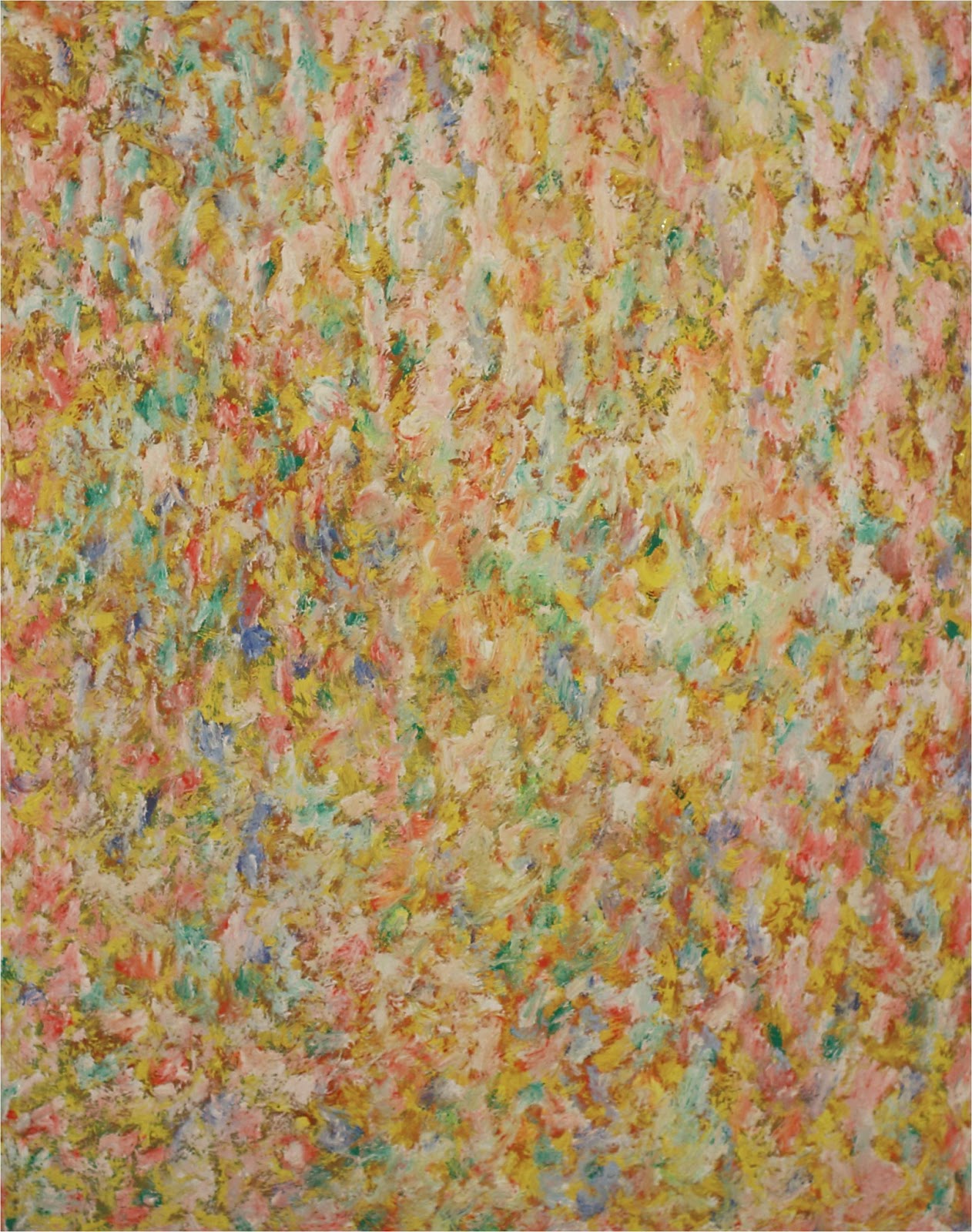
(1964) Oil on canvas
36 5/8 X 28 3/4 inches
© Estate of Beauford Delaney, by permission of Derek L. Spratley, Esquire, Court Appointed Administrator
Scattered Light appears to vibrate with a warm orange glow at first glance. Upon closer inspection one realizes this warm glow is produced by short, thick strokes of yellow, white, green, blue, and red oil pigment applied in dense clusters. For me, Scattered Light’s rich textures and vibrant colors are reminiscent of Monet’s paintings of Rouen Cathedral.
This work is currently hung beside a painting by Joseph Delaney from our collection that is being shown in the KMA’s ongoing flagship exhibition Higher Ground: A Century of the Visual Arts in East Tennessee. Joseph's Marble Collegiate Church (1974-75, oil on canvas, 72 X 47 3/4 inches) depicts a bustling Manhattan crowd dwarfed by a towering church spire and a turbulent sky. Its distinctive frame was designed and built by the artist. In 1986, Joseph returned to Knoxville and was artist-in-residence at University of Tennessee until his death in 1991.

Photo courtesy of Knoxville Museum of Art
Higher Ground is housed in one of the two large top-floor galleries. A permanent installation, it traces the development of fine art in the region over the past century. It tells the largely unknown story of East Tennessee’s rich artistic history and its connections to the larger currents of American art. Featured works are drawn from the KMA collection along with selected works on loan from museums and private collections from around the country.
KMA owns several major paintings by Joseph, but none by Beauford. I consider our lack of Beauford’s work as the single most important acquisition goal for our museum.
Beauford's portrait of his niece Imogene Delaney now hangs in our new temporary exhibition Tradition Redefined: The Larry and Brenda Thompson Collection of African American Art, which is on view through June 16, 2013.

(1963) Oil on canvas
38 ½ x 31 inches
Georgia Museum of Art, University of Georgia
The Larry D. and Brenda A. Thompson Collection of African American Art
GMOA 2011.584
The portrait is made up predominantly of yellow pigment applied in flat, even strokes. Some orange hues appear in the upper 1/3 of the composition. Interestingly, Imogene appears to hover in space because Beauford opted to apply yellow over the area where her armchair would have appeared in order to erase any evidence of its existence.
The Thompsons' extensive collection redefines the landscape of African American art, offering an in-depth, inclusive understanding of artists and their aesthetic and social concerns. Featured artists include Radcliffe Bailey, Romare Bearden, Camille Billops, Beauford Delaney, Joseph Delaney, Lois Mailou Jones, Norman Lewis, and Hale Woodruff. The fact that Tradition Redefined allows viewers to consider Beauford’s and Joseph’s work within the larger context of African American art is one of the major reasons why the KMA was eager to bring the exhibition to Knoxville.
Tradition Redefined hangs in the lower galleries at the KMA. It was organized by the David C. Driskell Center for the Study of the Visual Arts and Culture of African Americans and the African Diaspora at the University of Maryland, College Park.
Beauford at the MRG Chelsea Inaugural Expo
The Michael Rosenfeld Gallery (MRG) holds the largest number of Beauford's paintings among galleries today. It has been and continues to be a great friend of Les Amis de Beauford Delaney. I am taking this opportunity to publicly thank them for their support!
MRG recently relocated to Chelsea after operating for over 20 years at 24 West 57th Street in midtown Manhattan. Beauford's Untitled (Greene Street) was hung by the gallery as part of the inaugural exposition.
,+1950-IMAGE+ONLY.jpg)
(1950) Oil on canvas
47" x 36 1/2"
signed and dated lower left: B. Delaney. 1950
© Estate of Beauford Delaney, by permission of Derek L. Spratley, Esquire, Court Appointed Administrator
This work was part of the African American Art Calendar 2011, created by MRG and published by Pomegranate Press in Petaluma, CA, in which it was the illustration for the month of October. It was shown at INsite/INchelsea: The Inaugural Exhibition for MRG from December 18, 2012-March 9, 2013.
Prior to the gallery's acquisition of this work, it was owned by Clarke Gallery in Mamaroneck, NY. Clarke Gallery obtained it from a private collection, the owner of which obtained it from Beauford.
Michael Rosenfeld Gallery
100 11th Avenue at 19th Street
New York, NY 10011
Telephone: 212-247-0082
Internet: http://www.michaelrosenfeldart.com
Sedat Pakay's Tribute to Beauford
Sedat Pakay is a Turkish photographer and filmmaker who was a great friend of James Baldwin. He met Beauford in Istanbul during the summer of 1966 when Beauford first visited Baldwin's home in the Rumeli Hisarı quarter1 of the city.

Image from Wikipedia Commons
Pakay graciously granted me the following interview about his encounters with Beauford:
Les Amis: What was your first impression of Beauford and how did this change over time (if it did at all)?
Sedat Pakay: Upon arrival to Istanbul he looked very haggard and exhausted after the long arduous journey from Paris2. Within few days, in the company of James Baldwin who adored him, and with help from Black Sea breezes that gently swept by the stone porch where he would sit and sketch daily, he relaxed and looked very radiant and gratified. His chair would almost be placed next to the Bosphorus. Often, I would catch him in contemplative mood watching waves and the sail boats in between his sketching -- on small notepads with colored markers.
Later during the summer, he looked very content -- free from the pressures of living in a big city; this quiet living reflected its joy on his angelic face. He was in a loving environment, working without interruption. He was truly happy, and Jimmy took excellent care of him.
Les Amis: David Leeming writes that Beauford "became an object of veneration among our Turkish friends, who would come to him each afternoon as to a wise guru." Were you one of these friends?
Sedat Pakay: In the Turkish culture elderly people are respected and addressed in words of veneration. I always sought advice of older men and women in my family to resolve personal issues, with expectations that they would have the answers. BD was not any different. I would sit by him and listen to him. If one knows how to listen, words of a wise, experienced person are invaluable.
Les Amis: Did you consider Beauford to be wise?
Sedat Pakay: I did consider him wise. At that point (age 21) I knew very little about his life experience. As I read and heard of his painful past, my respect for the man grew. He was wise, benevolent, and generous. A small sketch he gifted me is a prize possession.
Les Amis: What inspired you to call him "Uncle Beauford"?
Sedat Pakay: I called him "Uncle Beauford" in conforming with Turkish cultural traditions. All old cultures revere their elderly and serve them to make them feel comfortable in their later years. In this tradition, addressing one's senior with words of respect, i.e. "uncle," "aunt," etc. is very proper.

Photograph by Sedat Pakay @1966
reproduced with the permission of the photographer
Les Amis: Regarding the photos that you took of Beauford with Baldwin and singer Bertice Reading in Baldwin's apartment, what was the occasion for this gathering?
Sedat Pakay: It was an afternoon visit by Bertice and her children -- a daughter in her teens, and a baby boy she and her husband adopted in Istanbul. It was a social visit, you know, talk of memories, old gossip, jokes, lots of laughs.
Les Amis: Did Beauford inspire you as a photographic subject?
Sedat Pakay: Faces inspire me as subjects for my photographs. You might say that "I collect faces". It was difficult to capture BD photographically because he would sit by the Bosphorus in a contemplative mood and would not even move a finger. Only when visitors arrived, and the house would come alive did one see him socializing, playing with friends' children, carrying on a quiet conversation.
Les Amis: Did you ever film him?
Sedat Pakay: I never filmed him. I started making films in 1967-68 when I was doing my Masters at Yale Art School.
Les Amis: What is your fondest memory of Beauford?
Sedat Pakay: My fondest memory of Beauford is his stoic disposition, at peace with himself while he was involved in producing his art. As I reflect on it now I realize how much I admired an artist so dedicated to his work which is very lyrical visually, while he was fighting with his demons day in and day out.
1The Rumeli Hisarı quarter takes its name from a majestic fortress built by Mehmet the Conqueror at the narrowest part of the Bosphorus River on the European side of the city. In his biography Amazing Grace: A Life of Beauford Delaney
 , David Leeming states that Beauford often "did watercolors of the hills of Asia across the straits" during his stay with Baldwin.
2David Leeming vividly recounts the details of the journey in Amazing Grace.
Beauford Pastiche - March 2013
I occasionally surf the Web and browse the Leeming biography Amazing Grace: A Life of Beauford Delaney
to look for tidbits of information about Beauford that will bring his life into sharper focus for me and the readers of this blog. I have grouped three interesting items as an information "pastiche" to share with you today.
- After having lived in New York City for ten years, Beauford undertook his first journey back to his hometown of Knoxville in March 1950. He took the train and recorded his thoughts about the trip in his journal. Ever a lover of gospel music and spirituals, he mentioned that a Mahalia Jackson song - "I'm glad salvation is free" - came to mind as he went farther south. He also noted that he stayed awake the entire night of the journey.
Listen to Mahalia Jackson sing "I'm glad salvation is free" by clicking on the image below.
- On a Web page that features the genealogy of the Sicilian and American Manfredi, Percoco, Marino, and Giangrasso families, Catherine Yronwode reports that her father, Giuseppe Manfredi (a.k.a. Joey Manfredi or Fred Manfredi), took painting lessons from Beauford and his brother Joseph when they lived in Greenwich Village. Beauford taught him to paint portraits and he eventually became a WPA artist. He paid for his lessons by acting as a model for Beauford and Joseph. Ms. Yronwode states that her father told her that Beauford was briefly in love with him and says her mother told her that Beauford and her father lived together for a while.

- During the late 1960s and early 70s, Beauford merited the attention of three journalists who wrote "Paris Scratchpad" for Jet Magazine - Gerri Major, Art Simmons, and Ray Frost. In a column written by Ray Frost in June 1971, he is described as painter-writer-philosopher Beauford Delaney, "a familiar and engaging personage frequently seen holding court in various Paris cafés." Frost notes that the reference to "philosopher" stems from Beauford's talent for dispensing sage advice.
An Unexpected Discovery and a Primer for Art Collection
I met Anne Stills several months ago when she wrote to me to comment on the recent publication of my book entitled Black Paris Profiles. Since that time, we communicate frequently by e-mail to share information about Paris.
I received a couple of messages from Anne a few days ago, each with an image attached. I was delighted to find that the images were of paintings by Beauford!

(1942) Pastel on paper
Image courtesy of Anne Stills

(undated) Pastel on paper
Image courtesy of Anne Stills
Anne found these paintings at a private art dealer's establishment* in NYC while she was purchasing art to add to her collection. The dealer, Jon Mellitz, acquired them over 20 years ago from the Betty Esman estate (Esman was a WPA artist, as was Beauford.) Both pieces measure approximately 23x18 inches and are in good condition. The asking price is $7000 for both paintings.
Because I believe that the concept of art collection is foreign to many and because starting and building a collection requires education and advice, I asked Anne to grant Les Amis an interview to talk about art collection and what it means to her. Find our exchange below:

Photo courtesy of Anne D. Stills
Les Amis: When did you first realize that you wanted to collect art?
Anne D. Stills: I have been collecting one thing or another most my life. We are all collectors, all of us. As a young person I collected dolls. I moved on to jazz albums, fashion magazines, cookbooks and mystery novels. As my taste and exposure to the world grew, I started more costly collections of porcelain teapots, Lladro and Herend figurines, and Hermes scarves. As I settled down and started paying more attention to home, I began to think about collecting art first as a means to decorate and later as a passionate pursuit.
Les Amis: Why is it important for you to collect art?
Anne D. Stills: I am a visual person. I need to be surrounded by beauty. The artwork in my home reflects my personal taste and brings a certain energy, joy and peace to my well being and sensibility. It reminds me of my parents and connects me to the history and experience of black people in America and the African Diaspora.
Les Amis: Which genres do you prefer (painting, sculpture, installations, photography…)?
Anne D. Stills: My collection is still young and evolving, therefore, I prefer to remain open and develop a taste for a broad range of mediums. I started with works on paper, along with vintage black and white photos.
Les Amis: Which types of paintings do you prefer (examples: figurative vs. abstract; portraits vs. landscapes; oils vs. watercolors vs. acrylics…)?
Anne D. Stills: My tastes are quite varied. In the beginning stages of collecting, I found myself drawn to abstract works of art. Later to round out my collection, I acquired figurative works. As a serious collector, I am very deliberate about my selections. It is very important that each piece enhances and fits into the overall theme.
I have a wish list of artists I want to collect. When I am considering a work, I mostly think about what that artist is known for and select art that represents a part of either their earlier or later works or sometimes both.
Les Amis: Is Beauford one of the artists whose work you'd like to collect?
Anne D. Stills: Yes, Beauford Delaney is on my wish list. I am partial to his abstracts and bold use of color.
Les Amis: When did you begin to collect art?
Anne D. Stills: My first awareness and deliberate decision to build a collection of fine art started five years ago. Once I made the decision, I thought long and hard about the strategy and artistic goal for my collection. I first went about educating myself and being exposed to many different types of art and artists. Through this exposure and training, I decided I wanted to focus my collection on African-American artists of the WPA (Works Progress Administration) period. This was a federal program established in 1935 during the Great Depression to offer work to the unemployed. There was an arts project component to help keep artists working. This was also during the time of the Harlem Renaissance with its explosion of cultural nationalism, black heritage, pride and the blossoming of black art and literature. I feel a strong affinity to the works created during this era.
Les Amis: What was your first purchase?
Anne D. Stills: My first acquisition was a Romare Bearden lithograph, Brass Section (Jamming at Minton’s), from the Jazz Series, dated 1979. As a lover of jazz music, this piece spoke to me. I remember gazing at the image and being taken back to the 1970s jazz club scene in Greenwich Village, grooving to the sounds of Miles Davis, Sonny Rollins and the voices of Sarah Vaughan, Carmen McRae and Shirley Horn.
Les Amis: How do you feel about the concept of “black art”?
Anne D. Stills: I believe the concept of black art is very subjective. You can ask different people including art historians and scholars this question and receive different answers. It’s a very broad subject. I am only an art lover, not an expert. However, I came of age in NYC during the late 1960s and early 1970s during a major social upheaval and transformational time. There was a proliferation of black expression, pride and the birth of the Black Movement. As a result, I was nurtured and exposed to the works of “black art” by all the many incredibly talented, prolific writers, musicians and artists that look like me and whom I could identify with. This was my bridge into the art world. It established a comfort level for me. As an example, my love for opera music developed because I was able to go and see Leontyne Price, Jessye Norman and Shirley Verrett…people that looked like me.
Black art has illuminated my path, nurtured my growth and given me the freedom to broaden my horizons and develop a global perspective.
Les Amis: Does your collection represent an investment or simply a passion?
Anne D. Stills: My collection comes out of my love and passion for the history and legacy of African-American artists, their art and our collective experiences. I applaud their ability to document what they saw and express their emotions to create something beautiful that I live with and enjoy each day. That is the driving force behind my building a fine art collection. At some point, however, as my collection grew in size and value, it inevitably evolved into an investment. As an investment, there are certain considerations that require management - things such as insurance, tax, and estate planning.
Les Amis: Do you use the Internet to search for works to collect?
Anne D. Stills: The Internet can certainly be used as a source to search for artwork. I much prefer an interactive and proactive approach, including consulting with my art dealers and attending art auctions, galleries and art fairs. The primary source I have used to collect art is through reputable dealers that I have developed a long-term relationship with. They are familiar with the strategy of my collection and have assisted me with evolving, expanding and growing my body of work.
Les Amis: What are the pros and cons of using the Internet?
Anne D. Stills: The down side of buying art on the Internet is that you may purchase a fraudulent work if you are not experienced and knowledgeable. There can be a lot fraud if you don’t know what you are doing. It’s important to receive certificate of authenticity to document the details and value of your artwork. This may not always be possible using an Internet seller. The positive side, however, is that you are purchasing directly as opposed to through a middle man such as an auction house, thereby, getting a better price.
Some dealers use the Internet to sell their inventory. I once came upon a valuable piece of artwork directly via the Internet. It was put up for auction at a major auction house in the past, however, did not sell. The seller’s asking price was thousands of dollars below the auction house estimate. Unfortunately, I was not able to purchase it because it was not within my budget at the time.
Les Amis: How would you advise someone new to art collection to begin?
Anne D. Stills: All serious art collecting begins with educating yourself and building an art library. A great deal of effort must be put in prior to your first purchase. I would advise the novice collector to spend of lot of time visiting museums and galleries as well as attending local art fairs and auctions. Study art magazines and gallery catalogs. Attend exhibits and establish relationships with contemporary artists, gallery owners, curators and collectors. Study the African-American art collections of important private collectors such as Dr. Walter O. Evans (Savannah College of Art and Design), Dr. Harmon and Harriet Kelley (private collection), and Paul R. Jones collection (University of Delaware and University of Alabama)—these are an extremely educational resource. In time you will train your eye and your gut to identify artists that have created the works that speak to you.
Quality artwork by established emerging artists can be found to fit any taste and budget. To develop a good collection, you must develop your eye.
Les Amis: Are there any references, online courses, or other resources that you would recommend to new collectors?
Anne D. Stills: One of the books I consider the bible of African-American art history is A History of African-American Artists, From 1792 to the Present by Romare Bearden & Harry Henderson. The information, artists and works presented in this book and made during this period laid the groundwork for everything that followed. Another important reference and must have is Collecting African American Art, Works on Paper and Canvas by Halima Taha. This book is invaluable with everything the new collector needs to know. The IRAAA (The International Review of African American Art) magazine published by Hampton University Museum is an excellent resource for identifying emerging artists and what is trending in the art world of black artists.
Three excellent books that I would recommend by art historians and scholars are Black Art in the 20th Century and To Conserve a Legacy: American Art of Historically Black Colleges and Universities, both by Richard Powell; and African American Art and Artists by Samella Lewis. Additional resources would include the online archived catalogs at Swann Galleries, and the auction house Web sites for Sotheby’s and Christie’s.
*For more information about the Beauford Delaney portraits, contact Jon Mellitz at 917-721-3608.
Beauford's Portrait of Charlie Parker
Many thanks to the Michael Rosenfeld Gallery LLC, New York, NY for furnishing the images and information presented in this post.
Several of Beauford's paintings are being shown in the Blues for Smoke exposition at the Whitney Museum of American Art in New York. One of them is an untitled work that is also known as Charlie "Bird" Parker:
-IMAGE+ONLY.jpg)
Oil on canvas
28 3/4" x 23 1/2", signed and dated
© Estate of Beauford Delaney, Courtesy of
Michael Rosenfeld Gallery LLC, New York , NY
This painting is signed and dated in the lower right corner: 1968 Beauf Delaney. It is also signed, inscribed and dated in the upper right corner on the back: Beauford Delaney Paris 1968 France. Billy Dee Williams (Los Angeles, CA) acquired it directly from Beauford in 1968 in the accompaniment of James Baldwin. It is currently held by the Michael Rosenfeld Gallery LLC, New York, NY, which loaned it to the Museum of Contemporary Art in Los Angeles (MOCA) for the current exposition. It appears on page 51 of the exhibition catalog.
In an article about Blues for Smoke, published by the New York Times on February 8, 2013, Holland Cotter discusses the few pieces in the show that come from Europe. Beauford's paintings are a part of this group. About the portrait shown above, Holland states:
Europe — Paris — was the adopted home of the painter Beauford Delaney, who has a wonderful little 1968 portrait here of Charlie Parker, dressed like an African chief in a citrus-yellow robe.
+(detail)-IMAGE+ONLY.jpg)
Oil on canvas
28 3/4" x 23 1/2", signed and dated
© Estate of Beauford Delaney, Courtesy of
Michael Rosenfeld Gallery LLC, New York , NY
Blues for Smoke was shown at The Geffen Contemporary at MOCA from October 21, 2012 - January 7, 2013; the show opened at the Whitney Museum of American Art on February 17 and will hang until April 28, 2013.
Click on the links below to read other Les Amis blog posts about Beauford and the Whitney Museum of American Art:
Where to Find Beauford's Art: Whitney Museum of American Art
Beauford at the Whitney Museum Studio Galleries - 1930
Where to Find Beauford's Art: Clark Atlanta University Art Galleries - Part 4
This final segment of the multi-part article on the Beauford Delaney paintings held by Clark Atlanta University Art Galleries comes from Patricia Sue Canterbury*, curator of the solo exposition entitled Beauford Delaney: From New York to Paris that was mounted by the Minneapolis Institute of Arts in 2004.
The group of works that resides in the collection of the Clark Atlanta University Art Galleries (“CAUAG”) is bound together by the two salient factors of color and origin. All seven works, which range between 1962 and 1978, are suffused with yellow, a shade that dominated the artist’s work—particularly after his relocation to Paris in the 1950s. The sun-drenched shade was a flexible, expressive tool that conveyed the perceived essence of his subject matter. The other aspect that contributes special meaning to the works as a group is the fact that all are a bequest from Delaney’s long-time friend, James Baldwin. My thoughts on a few of my favorites follow below.
Baldwin and Delaney’s history spanned decades and, while it began with the artist in the role of mentor to the younger man, by the 1970s Baldwin would take on a protective role towards the man who had taught him in little but profound ways to look beyond the surface of initial impressions. It was also Delaney who was living proof to the young, aspiring writer that a black man could be, and succeed, as an artist. The friendship begun in New York continued across the Atlantic where both men found in Paris a place where each could explore their respective paths with a freedom that opened within them new approaches and ideas in the pursuit of their crafts.
Given their long history, Delaney portrayed Baldwin on many occasions and those likenesses rank as some of the artist’s most powerfully intuited portraits. Therefore, it is not surprising that out of the three portraits by Delaney in the CAUAG collection, it is his portrayal of James Baldwin that projects to us the interior essence of the sitter.

(1971) Oil on canvas
Bequest of James Baldwin
Image courtesy of Clark Atlanta University Art Galleries
Note: Some question whether the person depicted in this portrait is indeed Baldwin.
As Baldwin’s success as an author rose, he would in turn offer Delaney opportunities to vacation with him in various locations, including his timber and stone villa in St. Paul de Vence in the South of France. CAUAG is fortunate to possess two works that mark Delaney’s presence there. In Village (St. Paul de Vence) the artist captured the nature of a town that, to any visitor, is an unending succession of steeply pitched steps that hug the walls of any structure they desire to reach. Here, Delaney collapses a slice of the town into a single plane with multiple stepped paths and the cellular-shaped interiors of the establishments that border them. It is a portrait of a place well loved, which conveys a sense of his delight in its peculiar quality of place.
,+1972.JPG)
(1972) Oil on canvas
Bequest of James Baldwin
Image courtesy of Clark Atlanta University Art Galleries
Yellow Cyprus (1978), painted six years later, and one year before Delaney’s death, translates his experience of the scene that opened before him from the terrace of Baldwin’s house at St. Paul de Vence. In spite of his delicate mental state by this point in time, he obviously divined larger, cosmic meaning underlying the visual phenomena. To get at it, he restricted the color palette and stripped away the unessential elements that would only distract. The yellow orb of the sun does not simply bathe the landscape in golden light; it invades it and transforms it into an extension of itself and threatens to dematerialize it, outright.

(1978) Oil on canvas
Bequest of James Baldwin
Image courtesy of Clark Atlanta University Art Galleries
Anatomy of an Art Exposition - Part 1
Anatomy of an Art Exposition - Part 2
Why Are So Many of Beauford's Paintings in Museum Storage
Beauford's Self-Portrait at Swann Galleries African-American Fine Art Auction
Once again, Beauford's work was represented at the Swann Galleries African-American Fine Art Auction. The most recent sale was held on February 14, 2013. This time, the painting auctioned was an exquisite self-portrait (Lot 73) that I had not seen before.

(1964) Oil on linen canvas
470x337 mm; 18 1/2x13 1/4 inches.
Signed, dated and inscribed "Paris" in oil, verso.
Image courtesy of Swann Galleries
This painting was last held by the Boston Museum of Fine Arts, which acquired it in 2011. It was previously owned by Louise Taylor, St. Michael, MD; Michael Rosenfeld Gallery, New York (1999); and John Axelrod, Boston (1999). It was exhibited in a show called Selections from the Collection of John P. Axelrod at the Addison Gallery of American Art, Philips Exeter Academy, Andover, MA, August 31 - October 31, 1999 and at the Michael Rosenfeld Gallery, New York, 1999, with the labels on the frame back.
Swann Galleries describes the painting as follows:
This modern self-portrait is a striking example of an important body of work--Beauford Delaney made self-portraits throughout his career, from the 1930s through the 1970s. This work is done at the height of his Paris period, the same year as Delaney's solo exhibition at Galerie Lambert in Paris, where he showed both portraits and abstract canvases. There is another 1964 self-portrait, with a cigarette on a yellow background, in the collection of the Reinfrank family, and a very similar Self-Portrait, 1965, in the collection of the Whitney Museum of American Art and illustrated on the cover of David Leeming's biography, Amazing Grace: a Life of Beauford Delaney.The estimated sale price for this piece was $20,000-$30,000. It sold for $30,000*.
*At auction, there are two prices--the hammer price, or the price at which the item sells during the auction, and the price with the buyer's premium. All auction houses have a buyer's premium that the buyer pays to the auction house on top of the hammer price. Swann's premium is 20%. The prices indicated in this article are hammer prices.