

The Baldwin~Delaney Institute Moves into High Gear
I am pleased to bring you an update on the activities of the Baldwin~Delaney Institute in Chicago:

Entrance to The Baldwin~Delaney Institute
Photo courtesy of E. L. Kornegay, Jr., founder
The Baldwin~Delaney Institute (BDI) has moved into high gear with its vision!
BDI is experiencing success in developing key partnerships related to its programming and current research focus on the study of rage as an essential component for eradicating violence. Dr. E. L. Kornegay, Jr.says:
BDI is embarking on the development of a seven-phase plan of action that encompasses research & development based on the study of rage; pilot projects for high school students, families (intergenerational), and graduate students; partnering with organizations in need of programming resources and innovation related to the eradication of violence through the KAPacity! Network; publications; and public policy analyses. All this is being done with a goal of empowering the next generation of scholars, ministers, leaders and everyday folk (young and mature) to live out the brightest vision they have of their lives without the fear of violence hindering them.

Dr. E. L. Kornegay, Jr.
Photo courtesy of E. L. Kornegay, Jr.
Dr. Kornegay is the CEO/Founder of the Baldwin~Delaney Institute for Academic Enrichment and Faith Flourishing and Adjunct Professor of Theology and Ethics at Chicago Theological Seminary. He is also the author of A Queering of Black Theology: James Baldwin’s Blues Project and Gospel Prose.
*Amazing Grace: A Life of Beauford Delaney by David Leeming

Photo courtesy of E. L. Kornegay, Jr., founder
The Baldwin~Delaney Institute (BDI) has moved into high gear with its vision!
BDI is experiencing success in developing key partnerships related to its programming and current research focus on the study of rage as an essential component for eradicating violence. Dr. E. L. Kornegay, Jr.says:
The study of Beauford Delaney is important in the study of rage from the perspective of grappling with it. Beauford was a victim of violence during his New York years, when he was “beaten up several times by white Village toughs simply because he was ‘an artistic Negro’ – that is, gay and black…”* This was maddening for him, figuratively and literally, and also a source of great art. I intend to use the legacy of Beauford to find a way to eradicate violence.
BDI is embarking on the development of a seven-phase plan of action that encompasses research & development based on the study of rage; pilot projects for high school students, families (intergenerational), and graduate students; partnering with organizations in need of programming resources and innovation related to the eradication of violence through the KAPacity! Network; publications; and public policy analyses. All this is being done with a goal of empowering the next generation of scholars, ministers, leaders and everyday folk (young and mature) to live out the brightest vision they have of their lives without the fear of violence hindering them.

Photo courtesy of E. L. Kornegay, Jr.
Dr. Kornegay is the CEO/Founder of the Baldwin~Delaney Institute for Academic Enrichment and Faith Flourishing and Adjunct Professor of Theology and Ethics at Chicago Theological Seminary. He is also the author of A Queering of Black Theology: James Baldwin’s Blues Project and Gospel Prose.
*Amazing Grace: A Life of Beauford Delaney by David Leeming
Man in African Dress
I was privileged to view an original Beauford Delaney painting in a private collection in Paris.

Man in African Dress
(1972) Watercolor on Paper
© Estate of Beauford Delaney
by permission of Derek L. Spratley, Esquire,
Court Appointed Administrator
This work was shown at the Beauford Delaney: The Color Yellow exposition mounted by the High Museum in Atlanta, so it was a rare treat for me to be able to view it "up close and personally."

Identification sticker (rear)
© Discover Paris!
The current owner was kind enough allow me to photograph the painting, removing the frame to avoid reflections.

Beauford's signature (lower left)
© Estate of Beauford Delaney
by permission of Derek L. Spratley, Esquire,
Court Appointed Administrator

Dedication (lower right)
© Estate of Beauford Delaney
by permission of Derek L. Spratley, Esquire,
Court Appointed Administrator

Man in African Dress (detail)
(1972) Watercolor on Paper
© Estate of Beauford Delaney
by permission of Derek L. Spratley, Esquire,
Court Appointed Administrator
He has only vague recollections of Beauford as being one among many visitors at his home when he was a child.

(1972) Watercolor on Paper
© Estate of Beauford Delaney
by permission of Derek L. Spratley, Esquire,
Court Appointed Administrator
This work was shown at the Beauford Delaney: The Color Yellow exposition mounted by the High Museum in Atlanta, so it was a rare treat for me to be able to view it "up close and personally."

© Discover Paris!
The current owner was kind enough allow me to photograph the painting, removing the frame to avoid reflections.

© Estate of Beauford Delaney
by permission of Derek L. Spratley, Esquire,
Court Appointed Administrator

© Estate of Beauford Delaney
by permission of Derek L. Spratley, Esquire,
Court Appointed Administrator

(1972) Watercolor on Paper
© Estate of Beauford Delaney
by permission of Derek L. Spratley, Esquire,
Court Appointed Administrator
He has only vague recollections of Beauford as being one among many visitors at his home when he was a child.
Beauford's Paris: Montparnasse Cemetery
On October 31, 2013, I happened to stroll past the Montparnasse Cemetery. James Baldwin wanted this to be Beauford's final resting place, but neither he nor Beauford's family had the money to pay for a plot.

Montparnasse Cemetery - Main Entrance
© Discover Paris!
The sidewalk in front of the main entrance was dotted with pots of flowers waiting to be sold to those visiting grave sites on the eve of All Saints' Day.

Pots of flowers
© Discover Paris!
When I saw these beautiful yellow mums, I thought of Beauford and all the brilliant paintings that he created in the color yellow.

Yellow chrysanthemums
© Discover Paris!
I also thought about two artists whose acquaintance he had made and who are buried in the cemetery: Man Ray and Constantin Brâncuși.

Grave site of Man and Juliet Ray
© Discover Paris!

Grave site of Constantin Brâncuși
Screen shot from video
According to biographer David A. Leeming, Beauford had seen Brâncuși's sculpture The Kiss here and admired it greatly. The Kiss can be found in at the grave of a friend of Brâncuși in another area of the cemetery.

Le Baiser
Constantin Brâncuși
© Discover Paris!
A smaller Brâncuși sculpture by the same name is also located there.

Le Baiser
Constantin Brâncuși
© Discover Paris!
Beauford's studio at the Hôtel des Ecoles on rue Delambre and the studio on rue Vercingétorix were both within easy walking distance of this prestigious cemetery. It would have been a natural place for him to be interred.

© Discover Paris!
The sidewalk in front of the main entrance was dotted with pots of flowers waiting to be sold to those visiting grave sites on the eve of All Saints' Day.

© Discover Paris!
When I saw these beautiful yellow mums, I thought of Beauford and all the brilliant paintings that he created in the color yellow.

© Discover Paris!
I also thought about two artists whose acquaintance he had made and who are buried in the cemetery: Man Ray and Constantin Brâncuși.

© Discover Paris!

Screen shot from video
According to biographer David A. Leeming, Beauford had seen Brâncuși's sculpture The Kiss here and admired it greatly. The Kiss can be found in at the grave of a friend of Brâncuși in another area of the cemetery.

Constantin Brâncuși
© Discover Paris!
A smaller Brâncuși sculpture by the same name is also located there.

Constantin Brâncuși
© Discover Paris!
Beauford's studio at the Hôtel des Ecoles on rue Delambre and the studio on rue Vercingétorix were both within easy walking distance of this prestigious cemetery. It would have been a natural place for him to be interred.
Homage to Beauford: Douglas Petrovic
From time to time, I "Google" Beauford. When I do so, I inevitably stumble across something intriguing that I never knew about him. Such was the case a few days ago, when I found the logo below on a Web site called Artistes sans Frontières (Artists without Borders):

© Artistes sans Frontières/Douglas Petrovic, 2004
The site also posts a tribute to Beauford that is particularly touching. It was written by Douglas Petrovic, an artist who met Beauford at the Café Sélect in Paris. To further investigate, I sent a message to the Web site and received a response from Helga Strobl, one of the artists whose work is presented there. I learned that Douglas Petrovic was her husband and that he died two years ago.
Helga told me that Douglas shared with her stories of his early years in Paris when he met Beauford:
Douglas founded Artistes sans Frontières in 2001 and the homage to Beauford page was one of the first that they created.
Here is my translation of Douglas' homage:

Untitled
(1970) Gouache
© Artistes sans Frontières/Douglas Petrovic, 2004
© Estate of Beauford Delaney
by permission of Derek L. Spratley, Esquire,
Court Appointed Administrator

Untitled
(1970) Gouache
© Artistes sans Frontières/Douglas Petrovic, 2004
© Estate of Beauford Delaney
by permission of Derek L. Spratley, Esquire,
Court Appointed Administrator
The site also posts a tribute to Beauford that is particularly touching. It was written by Douglas Petrovic, an artist who met Beauford at the Café Sélect in Paris. To further investigate, I sent a message to the Web site and received a response from Helga Strobl, one of the artists whose work is presented there. I learned that Douglas Petrovic was her husband and that he died two years ago.
Helga told me that Douglas shared with her stories of his early years in Paris when he met Beauford:
He had come to Paris in 68 at [the age of] 17...all alone, wanting to be an artist, studying art and surviving as he could. He met Beauford in the circles of artists and philosophers in the Montparnasse area and they became friends, Beauford a bit of a mentor, helping him sometimes. Whenever he spoke of him, it was fond memories he told me and he cherished the paintings of Beauford [that] he had - I still do.
Douglas founded Artistes sans Frontières in 2001 and the homage to Beauford page was one of the first that they created.
Here is my translation of Douglas' homage:
It was in November or December 1968 that I met Beauford Delaney at the café Sélect in Montparnasse in Paris while I took a little nap the morning after an all-nighter. He was sitting next to me and he woke me up because I was snoring too loudly.
As I had just arrived in France, I spoke only rudimentary French and we immediately began a conversation in English. After a few glasses of red wine, I learned from him that he arrived in France during the 1950s for a tour of Europe that he never did - rather, he stayed in Paris. I also learned that he was a painter and had done portraits of many celebrities like Louis Armstrong, Henry Miller, James Baldwin... Because I was only 17 years old, I knew these celebrities by name or by reading and that impressed me enormously.
Because I didn't have a lot of money, he invited me to have lunch with him at the restaurant Milles Colonnes, where they had low-cost meals. (It still exists but it has become a chic restaurant.) It was a place frequented by all the painters, writers, philosophers and Beauford knew almost all of them. This was how I entered into the artistic and intellectual world of 1968 Montparnasse.
As I lived in a tiny room, we saw each other almost every week for many years to have a few glasses of wine, which he loved to do in my company. He brought me to his studio at rue Vercingétorix, near the Gare Montparnasse. I remember well when I went there the first time that even though it was not very big, it was fairly high like an artist's studio and it was full of plants, almost like a jungle. The light entered by the glass roof and was filtered by the plants. When I asked him why the plants were so large, he told me that he had received some of them when they were tiny and he had only watered them from time to time - they grew by themselves.
Today I can say that this was a reflection of his huge heart and his tolerant and generous soul.
He showed me all his paintings. His color abstracts were the most fascinating to me. The portraits were done in a very naive style and were too "kind" for my taste. He could never imagine that someone could act in bad faith. He was oblivious to all the negative characteristics of people and of humanity in general. He was the opposite of Francis Bacon with regard to this aspect of figurative painting.
During the summer of '71, I lived in an apartment on the 7th floor on boulevard du Montparnasse with a balcony that extended the entire length of the apartment. After an evening of jazz at the American Center, boulevard Raspail, I invited Beauford and several musicians to have a drink at my place. At around 6:30 AM, the musicians and Beauford decided to wake Paris up with a jazz concert. The balcony was long but not wide and they lined up, a trumpetist, a cornet player, Beauford in the middle, a guitarist, and a drummer who played the iron railing of the balcony with [pieces of] wood. That was the first time that I heard Beauford sing with a voice so sweet and admirable that you could only imagine it coming from children singing in Baptist choirs in New Orleans. All the windows of the neighboring buildings opened and everybody applauded despite having been awakened too early. The concert lasted a half-hour or more.
We became true friends despite the difference in our ages - he could have been my grandfather. Despite my travels around the world we always found each other again until he was hospitalized in 1975. Today I regret not having visited him during those last years that he spent at Sainte Anne's Hospital in Paris.
For my first marriage, he offered me the two paintings that I present here and that I have kept for 34 years.

(1970) Gouache
© Artistes sans Frontières/Douglas Petrovic, 2004
© Estate of Beauford Delaney
by permission of Derek L. Spratley, Esquire,
Court Appointed Administrator

(1970) Gouache
© Artistes sans Frontières/Douglas Petrovic, 2004
© Estate of Beauford Delaney
by permission of Derek L. Spratley, Esquire,
Court Appointed Administrator
It is because of him that I began painting and went to the Ecole des Beaux Arts. He was my first, and therefore my most important, art critic.
Douglas de Petrovic
Where to Find Beauford's Art: Charles H. Wright Museum of African American History
A new exposition is being co-organized by the Flint Institute of Arts in Flint, Michigan and the Charles H. Wright Museum of African American History in Detroit, Michigan. It's called Point of View: African American Art from the Elliot and Kimberly Perry Collection and it will be shown from January 26, 2014 through April 13, 2014. Works by Beauford and his brother Joseph will be displayed as part of the Masterworks collection at the Charles H. Wright Museum of African American History. Contemporary works will be displayed at the Flint Institute of Arts.
The image below represents the painting by Beauford that will be shown:

Untitled
(1964) oil on canvas
25 x 21 inches
Collection of Elliot & Kimberly Perry
Image courtesy of Ashley Phifer
© Estate of Beauford Delaney
by permission of Derek L. Spratley, Esquire,
Court Appointed Administrator
From the Flint Arts Organization Web site:
Ashley Phifer, Assistant Curator at the Flint Institute of Arts, has informed Les Amis that the museums in Flint and in Detroit are only an hour apart and both are cultural centers in their respective cities. Through this collaboration, they hope to foster an even larger sense of community. One can easily visit both museums in one day and experience the true impact of the collection. Both museums are excited about the story that these works tell and the experiences that the artists and the collectors have infused into them.
The catalog for the exposition includes two essays: one by Erica Moiah James, Assistant Professor, Yale University on the contemporary works in the Perry collection (Flint), and the other by Jacqueline Francis, Ph.D., Associate Professor, California College of the Arts, San Francisco, California on the Masterworks in the collection (Detroit). It will be available when the exhibition opens in January.
For more information, contact Ashley Phifer at .
The image below represents the painting by Beauford that will be shown:

(1964) oil on canvas
25 x 21 inches
Collection of Elliot & Kimberly Perry
Image courtesy of Ashley Phifer
© Estate of Beauford Delaney
by permission of Derek L. Spratley, Esquire,
Court Appointed Administrator
From the Flint Arts Organization Web site:
Regarded as one of the most important collections of contemporary art in the country, the Elliot Perry Collection of African American Art represents over a decade of collecting art. The former NBA player started collecting, in 1996, such artists as John Biggers, Norman Lewis, Alma Thomas, Charles White, Jacob Lawrence, Beauford Delaney, Elizabeth Catlett, and Eldzier Cortor. In 2005, he shifted his focus to emerging, mid-career artists and has since added artists such as Kara Walker, Wangechi Mutu, Mickalene Thomas, Kehinde Wiley, Leslie Hewitt, Carrie Mae Weems, Glenn Ligon, Rashid Johnson, and Lynette Yiadom-Boakye to his collection.
Ashley Phifer, Assistant Curator at the Flint Institute of Arts, has informed Les Amis that the museums in Flint and in Detroit are only an hour apart and both are cultural centers in their respective cities. Through this collaboration, they hope to foster an even larger sense of community. One can easily visit both museums in one day and experience the true impact of the collection. Both museums are excited about the story that these works tell and the experiences that the artists and the collectors have infused into them.
The catalog for the exposition includes two essays: one by Erica Moiah James, Assistant Professor, Yale University on the contemporary works in the Perry collection (Flint), and the other by Jacqueline Francis, Ph.D., Associate Professor, California College of the Arts, San Francisco, California on the Masterworks in the collection (Detroit). It will be available when the exhibition opens in January.
For more information, contact Ashley Phifer at .
Christie's Paris Sells Beauford Delaney Abstract at Auction
Christie's Paris placed Beauford's abstract painting Untitled, 1970 up for auction at its Rendez-Vous / Intérieurs Contemporains sale on October 9th.

Untitled, 1970 Oil on canvas, 65 x 54 cm.
© Christie's Images, 2013 © Estate of Beauford Delaney
by permission of Derek L. Spratley, Esquire,
Court Appointed Administrator
Painted at the artist’s studio : 53 rue Vercingétorix, Paris 14ème
Signed, dated, and situated in blue ink ‘Beauford Delaney 1970 Paris’ (lower middle)
Signed and dated in red paint ‘Beauford Delaney 1970’ (lower right)
This auction featured works of Impressionist and modern art, contemporary art, 20th-century decorative arts & design, and photography. Beauford's work shared the auction block with œuvre by renowned artists such as Picasso, Braque, and Dalí.
Sylvain Briet - an expert on Beauford’s art who has been called upon by Christie's in Paris and London to authenticate works for sale - provided Les Amis with information about Untitled in a previous blog post:
Where to Find Beauford's Art: Christie's Paris October 2013 Rendez-Vous / Intérieurs Contemporains Auction
The estimated sale price for the painting (Lot 146) was 4000€ to 6000€. It sold for 5000€ ($6784).

© Christie's Images, 2013
by permission of Derek L. Spratley, Esquire,
Court Appointed Administrator
Signed, dated, and situated in blue ink ‘Beauford Delaney 1970 Paris’ (lower middle)
Signed and dated in red paint ‘Beauford Delaney 1970’ (lower right)
This auction featured works of Impressionist and modern art, contemporary art, 20th-century decorative arts & design, and photography. Beauford's work shared the auction block with œuvre by renowned artists such as Picasso, Braque, and Dalí.
Sylvain Briet - an expert on Beauford’s art who has been called upon by Christie's in Paris and London to authenticate works for sale - provided Les Amis with information about Untitled in a previous blog post:
Where to Find Beauford's Art: Christie's Paris October 2013 Rendez-Vous / Intérieurs Contemporains Auction
The estimated sale price for the painting (Lot 146) was 4000€ to 6000€. It sold for 5000€ ($6784).
Beauford's "Embrun" Sells at Swann Auction Galleries African-American Fine Art Auction
Per last week's posting, Swann Auction Galleries placed three paintings by Beauford up for auction at its October 2013 auction: Point of Departure: Postwar African-American Fine Art.
Embrun, the most dramatically colored of the works, sold for $12,500 (including buyer's premium*).

Embrun
(1963) Watercolor on wove paper
641x501 mm; 25 1/4x19 3/4 inches
Signed and dated "July 19, 1963" in ink, lower right
Image courtesy of Swann Auction Galleries
© Estate of Beauford Delaney
by permission of Derek L. Spratley, Esquire,
Court Appointed Administrator
This painting was exhibited at the Studio Museum in Harlem, New York, with the label on the frame back.
The other two paintings remain unsold.
Swann Auction Galleries
104 East 25th Street
New York, NY 10010
Telephone: 212-254-4710
*At auction, there are two prices--the hammer price, or the price at which the item sells during the auction, and the price with the buyer's premium. All auction houses have a buyer's premium that the buyer pays to the auction house on top of the hammer price. Swann's premium is 20%. Swann Auction Galleries now reports the "hammer price" and the price that include the buyer's premium in its online catalog.
Embrun, the most dramatically colored of the works, sold for $12,500 (including buyer's premium*).

(1963) Watercolor on wove paper
641x501 mm; 25 1/4x19 3/4 inches
Signed and dated "July 19, 1963" in ink, lower right
Image courtesy of Swann Auction Galleries
© Estate of Beauford Delaney
by permission of Derek L. Spratley, Esquire,
Court Appointed Administrator
This painting was exhibited at the Studio Museum in Harlem, New York, with the label on the frame back.
The other two paintings remain unsold.
Swann Auction Galleries
104 East 25th Street
New York, NY 10010
Telephone: 212-254-4710
*At auction, there are two prices--the hammer price, or the price at which the item sells during the auction, and the price with the buyer's premium. All auction houses have a buyer's premium that the buyer pays to the auction house on top of the hammer price. Swann's premium is 20%. Swann Auction Galleries now reports the "hammer price" and the price that include the buyer's premium in its online catalog.
Where to Find Beauford's Art: Swann Auction Galleries African American Fine Art Auction - October 2013
After selling a Beauford Delaney self-portrait at its African American Fine Art Auction in February, Swann Galleries is pleased to offer three magnificent paintings by Beauford at its October 2013 auction: Point of Departure: Postwar African-American Fine Art.
The first work that appears in the auction catalog is entitled Embrun:
Embrun
(1963) Watercolor on wove paper
641x501 mm; 25 1/4x19 3/4 inches
Signed and dated "July 19, 1963" in ink, lower right
Image courtesy of Swann Auction Galleries
© Estate of Beauford Delaney
by permission of Derek L. Spratley, Esquire,
Court Appointed Administrator
This painting was exhibited at the Studio Museum in Harlem, New York, with the label on the frame back. The estimated sale price is $8,000 - $12,000.
The second of the three paintings is entitled Untitled (Composition in Blue).
+Oct+3+2013.jpg)
Untitled (Composition in Blue)
(1963) Watercolor on wove paper
641x501 mm; 25 1/4x19 3/4 inches
Signed, dated and inscribed "Paris" in ink, lower right
Image courtesy of Swann Auction Galleries
© Estate of Beauford Delaney
by permission of Derek L. Spratley, Esquire,
Court Appointed Administrator
The estimated sale price for this work is $8,000 - $12,000.
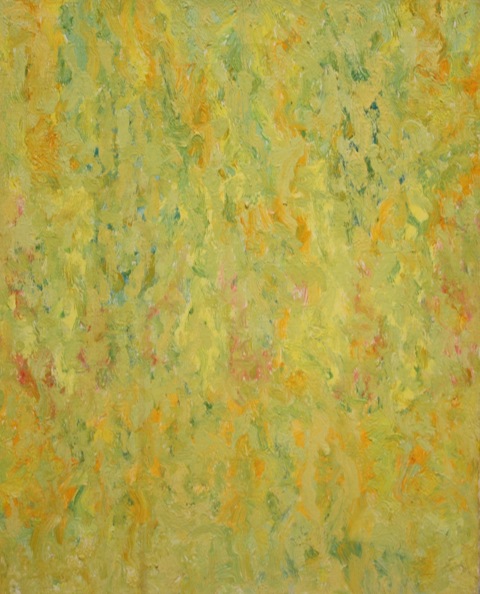
The third painting, also called Untitled, is the pièce de résistance – the showpiece of the three works. It was created in Beauford's favorite color - yellow.

Untitled
(1968) Oil on cotton canvas
610x502 mm; 24x19 3/4 inches
Signed and dated in oil, lower left
Image courtesy of Swann Auction Galleries
© Estate of Beauford Delaney
by permission of Derek L. Spratley, Esquire,
Court Appointed Administrator
It was also exhibited at the Studio Museum in Harlem, New York, with the label on the frame back.
Swann Auction Galleries describes Untitled as follows:
Its estimated sale price is $50,000 - $75,000.
All three paintings were acquired directly from the artist by James and Gloria Jones in Paris. From the estate of Gloria Jones, New York, they were acquired for a private New York collection. American writer James Jones and his wife Gloria were close friends, collectors and supporters of Beauford while he lived in Paris.
Point of Departure: Postwar African-American Fine Art is listed as Sale 2323 on Swann Auction Galleries Web site. For details, click here.
The first work that appears in the auction catalog is entitled Embrun:
(1963) Watercolor on wove paper
641x501 mm; 25 1/4x19 3/4 inches
Signed and dated "July 19, 1963" in ink, lower right
Image courtesy of Swann Auction Galleries
© Estate of Beauford Delaney
by permission of Derek L. Spratley, Esquire,
Court Appointed Administrator
This painting was exhibited at the Studio Museum in Harlem, New York, with the label on the frame back. The estimated sale price is $8,000 - $12,000.
The second of the three paintings is entitled Untitled (Composition in Blue).
+Oct+3+2013.jpg)
(1963) Watercolor on wove paper
641x501 mm; 25 1/4x19 3/4 inches
Signed, dated and inscribed "Paris" in ink, lower right
Image courtesy of Swann Auction Galleries
© Estate of Beauford Delaney
by permission of Derek L. Spratley, Esquire,
Court Appointed Administrator
The estimated sale price for this work is $8,000 - $12,000.
The third painting, also called Untitled, is the pièce de résistance – the showpiece of the three works. It was created in Beauford's favorite color - yellow.

(1968) Oil on cotton canvas
610x502 mm; 24x19 3/4 inches
Signed and dated in oil, lower left
Image courtesy of Swann Auction Galleries
© Estate of Beauford Delaney
by permission of Derek L. Spratley, Esquire,
Court Appointed Administrator
It was also exhibited at the Studio Museum in Harlem, New York, with the label on the frame back.
Swann Auction Galleries describes Untitled as follows:
In this striking canvas, Beauford Delaney combines a representation of an African fertility figure within a saturated yellow color field painting. Delaney had an interest in African sculpture going back to his reading of Alain Locke's New Negro, and visiting artist Cloyd Boykin's Primitive African Arts Center in the 1930s. Having seen the influence of African art on Picasso and other modernist painters in both New York and Paris, Delaney often incorporated African motifs and figures, including Earth Mother, 1950 and Mokonde Figure, 1952. This oil is from the same year as his Portrait of Ella Fitzgerald in the Walter O. Evans Collection of African-American Art, the last fully productive year of his Parisian period. In both paintings, the figure is subsumed within the dominant yellow swirls of color. Three years later, Delaney even portrayed himself as an African figure in his Self-Portrait, 1971. Leeming p. 41 and 102; Powell p. 58.
Its estimated sale price is $50,000 - $75,000.
All three paintings were acquired directly from the artist by James and Gloria Jones in Paris. From the estate of Gloria Jones, New York, they were acquired for a private New York collection. American writer James Jones and his wife Gloria were close friends, collectors and supporters of Beauford while he lived in Paris.
Point of Departure: Postwar African-American Fine Art is listed as Sale 2323 on Swann Auction Galleries Web site. For details, click here.
Where to Find Beauford's Art: Christie's Paris October 2013 Rendez-Vous / Intérieurs Contemporains Auction
Sylvain Briet - an expert on Beauford’s art who has been called upon by Christie's in Paris and London to authenticate works for sale - has graciously provided Les Amis with the following information about a singular Delaney painting that will be offered at auction by Christie's Paris on October 9, 2013:
Untitled, 1970 Oil on canvas, 65 x 54 cm.
© Christie's Images, 2013 © Estate of Beauford Delaney
by permission of Derek L. Spratley, Esquire,
Court Appointed Administrator
Painted at the artist’s studio : 53 rue Vercingétorix, Paris 14ème
Signed, dated, and situated in blue ink ‘Beauford Delaney 1970 Paris’ (lower middle)
Signed and dated in red paint ‘Beauford Delaney 1970’ (lower right)
Beauford Delaney was a total artist, an inventive artist. This painting (done at the age of 68) shows his perpetual interest in researching and experimenting with new techniques and visual effects—in what I call creating. The organization of forms on the canvas, the use of bright yellow that can even be found on one of the edges of the back of the painting, as well as the clear border that frames the composition, are all elements that affirm that this painting was created by Beauford.

Rear of Untitled, 1970
© Christie's Images, 2013 © Estate of Beauford Delaney
by permission of Derek L. Spratley, Esquire,
Court Appointed Administrator
The double signature is not unique to Delaney. His red signature can be found on All the Races, another painting dated 1970 that my brother Philippe and I showed at the Philippe Briet Gallery. The form of the letters in blue ink (made with a pen) is also characteristic of Beauford's style during that era.
When we enlarge the reproduction to its maximum we have a true feeling of the painting, its texture, and how Beauford Delaney managed to combine its colors with softness, which is quite remarkable.
Provenance:
There is unfortunately no record between the moment the painting left Beauford’s studio and its purchase by the actual owner in the south of France. The work was sold to the actual owner in 1998 by Michel Martiniani at Art Trade, an antique shop in La Garde. This small city is located in the Var department, not far from the French Riviera and Saint-Paul de Vence, where Beauford stayed and painted at James Baldwin’s home on several occasions in 1971, 72 and 73. But this was long after the painting was created.
Untitled, 1970, Lot 146, will be offered for sale at Christie’s, 9 avenue Matignon, Paris 8ème, during the Rendez-Vous / Intérieurs Contemporains auction, Sale 3557, on October 9, starting at 2:30 PM. Estimate: €4,000 - €6,000 ($5,316 - $7,975).
© Christie's Images, 2013
by permission of Derek L. Spratley, Esquire,
Court Appointed Administrator
Signed, dated, and situated in blue ink ‘Beauford Delaney 1970 Paris’ (lower middle)
Signed and dated in red paint ‘Beauford Delaney 1970’ (lower right)
Beauford Delaney was a total artist, an inventive artist. This painting (done at the age of 68) shows his perpetual interest in researching and experimenting with new techniques and visual effects—in what I call creating. The organization of forms on the canvas, the use of bright yellow that can even be found on one of the edges of the back of the painting, as well as the clear border that frames the composition, are all elements that affirm that this painting was created by Beauford.

© Christie's Images, 2013
by permission of Derek L. Spratley, Esquire,
Court Appointed Administrator
The double signature is not unique to Delaney. His red signature can be found on All the Races, another painting dated 1970 that my brother Philippe and I showed at the Philippe Briet Gallery. The form of the letters in blue ink (made with a pen) is also characteristic of Beauford's style during that era.
When we enlarge the reproduction to its maximum we have a true feeling of the painting, its texture, and how Beauford Delaney managed to combine its colors with softness, which is quite remarkable.
Provenance:
There is unfortunately no record between the moment the painting left Beauford’s studio and its purchase by the actual owner in the south of France. The work was sold to the actual owner in 1998 by Michel Martiniani at Art Trade, an antique shop in La Garde. This small city is located in the Var department, not far from the French Riviera and Saint-Paul de Vence, where Beauford stayed and painted at James Baldwin’s home on several occasions in 1971, 72 and 73. But this was long after the painting was created.
Untitled, 1970, Lot 146, will be offered for sale at Christie’s, 9 avenue Matignon, Paris 8ème, during the Rendez-Vous / Intérieurs Contemporains auction, Sale 3557, on October 9, starting at 2:30 PM. Estimate: €4,000 - €6,000 ($5,316 - $7,975).
re-Searching Beauford Delaney: A Final Reflection
This post is contributed by E. L. Kornegay, Jr., Ph. D., author of the many "re-Searching Beauford" articles and other posts that you'll find on the Les Amis blog. Though it is the final article in the "re-Searching Beauford" series, I will continue to ask Dr. Kornegay to share his musings about Beauford's legacy as it pertains to inspiration and service in the workings of the Baldwin-Delaney Institute.
************
You could not have told me nearly three years ago that I would be where I am now, in great part, because of Beauford Delaney.
My study of James Baldwin and my desire to understand the man who taught him how to write so colorfully led to me “meet” Beauford.

James Baldwin and Beauford
at the American Cultural Center, Paris
Photo: U.S. Information Service
Through that introduction I have met wonderful people – friends of Beauford, seen beautiful works of art – Beauford’s paintings, and encountered wonderful memories – Beauford’s spirit. And like James Baldwin, I have been inspired to write by the man whom he called his mentor. I have earned my Ph.D., written my first book (to be released in December of this year), and established the Baldwin-Delaney Institute for Academic Enrichment and Faith Flourishing at Chicago Theological Seminary. Needless to say, I have walked through the unusual door!*
When my soul looks back over this time, I find myself in the grasp of Beauford’s model of manhood; a manhood that dares to live within the grace given by God to pursue the fulfillment of your gift. It takes great energy to maintain the worldly identities that are thrust upon us and the pursuit of one’s vocation beyond the stifling dependency on these identities often comes at great cost. Yet, that cost is minimal when put up against the madness of pursuing mediocrity, the middle ground, the easy life, the safe thing to do.
The door that Beauford opened is one that few walk through completely and the path he pioneered is one that few navigate successfully. I see Beauford and imagine his exhaustion: an exhaustion that comes with carrying the great burden of manhood encumbered by blackness and being misunderstood sexually. Yet, his craft did not fail him nor does it fail us. In spite of it all, the rage never limited the beauty of his art or the import of his sacrifice, even if it cost him his sanity.
+Oct+3+2013.jpg)
Untitled (Composition in Blue)
1963 Watercolor on Wove Paper
© Estate of Beauford Delaney
by permission of Derek L. Spratley, Esquire,
Court Appointed Administrator
I think that more than anything, the purpose of the paintings Beauford left for us is to inspire us to live our greatest vision of ourselves. So here I am at the end of one thing and the beginning of another. It is Beauford that guided me here, giving me the strength to go through the unusual door and unto the path of greatness. It is not a path for the faint of heart and Beauford reminds us of what can happen, but not that it has to happen. So, I move forward wanting to make the world a better place, desiring to be a good steward of the path of vocational freedom, and to love well while I live.

Beauford Delaney
Rue Guilleminot
France 1973
© Errol Sawyer
Every time I look at Beauford’s face, every time I look at one of his paintings, I am reminded of this. Thank you Beauford, for showing me the way and for being my friend.
*According to James Baldwin, the “unusual door” is a lyric from a song that “Beauford would often sing.” Baldwin speaks of this in his essay “The Price of the Ticket” in Collected Essays ed. Toni Morrison.(New York: Library of America, 1998), p. 830.
You could not have told me nearly three years ago that I would be where I am now, in great part, because of Beauford Delaney.
My study of James Baldwin and my desire to understand the man who taught him how to write so colorfully led to me “meet” Beauford.

at the American Cultural Center, Paris
Photo: U.S. Information Service
Through that introduction I have met wonderful people – friends of Beauford, seen beautiful works of art – Beauford’s paintings, and encountered wonderful memories – Beauford’s spirit. And like James Baldwin, I have been inspired to write by the man whom he called his mentor. I have earned my Ph.D., written my first book (to be released in December of this year), and established the Baldwin-Delaney Institute for Academic Enrichment and Faith Flourishing at Chicago Theological Seminary. Needless to say, I have walked through the unusual door!*
When my soul looks back over this time, I find myself in the grasp of Beauford’s model of manhood; a manhood that dares to live within the grace given by God to pursue the fulfillment of your gift. It takes great energy to maintain the worldly identities that are thrust upon us and the pursuit of one’s vocation beyond the stifling dependency on these identities often comes at great cost. Yet, that cost is minimal when put up against the madness of pursuing mediocrity, the middle ground, the easy life, the safe thing to do.
The door that Beauford opened is one that few walk through completely and the path he pioneered is one that few navigate successfully. I see Beauford and imagine his exhaustion: an exhaustion that comes with carrying the great burden of manhood encumbered by blackness and being misunderstood sexually. Yet, his craft did not fail him nor does it fail us. In spite of it all, the rage never limited the beauty of his art or the import of his sacrifice, even if it cost him his sanity.
+Oct+3+2013.jpg)
1963 Watercolor on Wove Paper
© Estate of Beauford Delaney
by permission of Derek L. Spratley, Esquire,
Court Appointed Administrator
I think that more than anything, the purpose of the paintings Beauford left for us is to inspire us to live our greatest vision of ourselves. So here I am at the end of one thing and the beginning of another. It is Beauford that guided me here, giving me the strength to go through the unusual door and unto the path of greatness. It is not a path for the faint of heart and Beauford reminds us of what can happen, but not that it has to happen. So, I move forward wanting to make the world a better place, desiring to be a good steward of the path of vocational freedom, and to love well while I live.

Rue Guilleminot
France 1973
© Errol Sawyer
Every time I look at Beauford’s face, every time I look at one of his paintings, I am reminded of this. Thank you Beauford, for showing me the way and for being my friend.
*According to James Baldwin, the “unusual door” is a lyric from a song that “Beauford would often sing.” Baldwin speaks of this in his essay “The Price of the Ticket” in Collected Essays ed. Toni Morrison.(New York: Library of America, 1998), p. 830.
Where to Find Beauford's Art: Dolan/Maxwell Gallery
On Thursday I had the pleasure of speaking with Ron Rumford, director of the Dolan/Maxwell Gallery in Philadelphia. Dolan/Maxwell is proud to offer two Beauford Delaney paintings for sale:

Untitled (Grape Motif)
(1946) Pastel on paper image: 17 x 23.125 inches
sheet: 18 x 24 inches
© Estate of Beauford Delaney,
by permission of Derek L. Spratley, Esquire,
Court Appointed Administrator

Untitled (Yellow series)
(1962) Oil on linen 26 x 21 inches Annotated in verso
© Estate of Beauford Delaney,
by permission of Derek L. Spratley, Esquire,
Court Appointed Administrator
Both works were obtained from a private collector whose husband knew Beauford personally.
About these paintings, Rumford writes:
Dolan/Maxwell specializes in work by artists from the 1930's to the present, ranging from WPA, Modernist, European, and New York School to African-American and International Contemporary.
Dolan/Maxwell Gallery
2046 Rittenhouse Square Street
Philadelphia, Pennsylvania 19103 USA
Telephone: 215-732-7787
Facsimile: 215-790-1866
Email:
www.dolanmaxwell.com

(1946) Pastel on paper
sheet: 18 x 24 inches
© Estate of Beauford Delaney,
by permission of Derek L. Spratley, Esquire,
Court Appointed Administrator

(1962) Oil on linen
© Estate of Beauford Delaney,
by permission of Derek L. Spratley, Esquire,
Court Appointed Administrator
Both works were obtained from a private collector whose husband knew Beauford personally.
About these paintings, Rumford writes:
Beauford Delaney's pastel was made in New York c. 1946 and reflects a dynamic, frenzied energy often associated with that city. He contradicts our expectations of what a simple bunch of grapes might imply by surrounding the delicately colored fruit with zigzagging lines that echo the jagged edges of the grape leaves. Powerful, contrasting bands of pinks, purples, blue, and brown shatter the notion that we are looking at a mere still life.
Untitled (Yellow series) 1962 was painted in Paris, where Delaney allows the objective world to escape from his work. Now painting is about light, about applying the paint and finding meaning within the act of mixing color and orchestrating brushstrokes. Yellow is the brightest color of the spectrum and in making this radiant choice Beauford assigns himself the greatest painting challenge of inventing a new visual reality out of oil paint. He rises to that challenge again and again with the yellow paintings he made in Paris.
Dolan/Maxwell specializes in work by artists from the 1930's to the present, ranging from WPA, Modernist, European, and New York School to African-American and International Contemporary.
Dolan/Maxwell Gallery
2046 Rittenhouse Square Street
Philadelphia, Pennsylvania 19103 USA
Telephone: 215-732-7787
Facsimile: 215-790-1866
Email:
www.dolanmaxwell.com
Beauford's Paris: Cité Falguière

© Ralf.treinen
Creative Commons License
Cité Falguière is an impasse located near the rear of the Montparnasse train station in the 15th arrondissement. Less than ten-minute's walk from the location of Beauford's last studio on rue Vercingétorix, it was constructed as a series of 30 ateliers for artists during the late 19th century. Urban renewal of the impasse began in the 1960s and of the original structures, only Numbers 9 and 11 remain standing today (shown above). Both buildings continue to house artists' studios.
One of Beauford's dearest friends, Charley Boggs, lived in a small studio at 5, cité Falguière. Boggs was a painter whom Beauford met during his first few weeks in Paris in 1953; the two men became close when Boggs brought Beauford chicken broth while Beauford was suffering from the flu in October of that year. Boggs, his wife Gita, and their son Gordon, became a surrogate family for Beauford, but Boggs and his wife had separated by the time he moved to the Cité.
Beauford would visit Boggs frequently at his studio and would often sleep in the loft there during the early 1970s. For a brief time in 1969, Beauford rented a studio near Cité Falguière in which to store his paintings.
Beauford would undoubtedly have been thrilled to know that Ecole de Paris painter Amadeo Modigliani had a studio at Cité Falguière (Number 14). Modigliani's name was found on one of Beauford's sketchbook journals dating from the early 1940s in connection with Beauford's studies on the use of color. Other well known artists from Modigliani's era who lived and worked at the Cité were Chaim Soutine (Number 11), Tsuguharu Foujita, and Constantin Brancusi (whom Beauford knew personally).
African-American painters Ed Clark (a personal friend of Beauford) and Sylvester Britton also worked in studios at Cité Falguière after the Second World War.
Beauford in Provence
As events begin to unfold in celebration of the 50th anniversary of the March on Washington, I am reminded of a brief anecdote in Beauford's biography, Amazing Grace: A Life of Beauford Delaney . Author David Leeming describes how Beauford traveled to the town of Solliès Toucas, in the region of Provence in southern France, to spend time with friends Bernard Hassell, Richard Olney, and Mary Painter. He indicates that
In previous posts on this blog, I published images of paintings by Beauford that bear the name (although misspelled) of this Provençal town. One of them is dated 1963 and the other is undated:

© Estate of Beauford Delaney,
by permission of Derek L. Spratley, Esquire,
Court Appointed Administrator

© Estate of Beauford Delaney,
by permission of Derek L. Spratley, Esquire,
Court Appointed Administrator
Undoubtedly, one of them was painted during the time of Baldwin's visit to Paris. Given the similarity of the two works, the other may well have been painted during the same trip.
To read the articles in which these images were first published, click on the links below:
Where to Find Beauford's Art: Ink Miami Art Fair - Aaron Galleries
Roy Freeman Remembers Beauford
. Author David Leeming describes how Beauford traveled to the town of Solliès Toucas, in the region of Provence in southern France, to spend time with friends Bernard Hassell, Richard Olney, and Mary Painter. He indicates thatBeauford painted a great deal and, as always, enjoyed the sun, but was upset at missing James Baldwin's quick visit to Paris to gather expatriate support for the March on Washington.
In previous posts on this blog, I published images of paintings by Beauford that bear the name (although misspelled) of this Provençal town. One of them is dated 1963 and the other is undated:
Sollis Toucan
(1963) Oil on canvas
Signed, dated and titled, on the stretcher
16 3/8 x 13 inches
by permission of Derek L. Spratley, Esquire,
Court Appointed Administrator

Soullis Toucas
(Beauford's gift to Roy Freeman)
Oil on canvas
by permission of Derek L. Spratley, Esquire,
Court Appointed Administrator
Undoubtedly, one of them was painted during the time of Baldwin's visit to Paris. Given the similarity of the two works, the other may well have been painted during the same trip.
To read the articles in which these images were first published, click on the links below:
Where to Find Beauford's Art: Ink Miami Art Fair - Aaron Galleries
Roy Freeman Remembers Beauford
The Many Sidedness of Beauford Delaney's Art: Commentary
Last week, I published "The Many Sidedness of Beauford Delaney's Art," an article by Dr. Catherine St. John that discusses Beauford's art in the context of the recent solo exposition Beauford Delaney: Internal Light at the Jim Levis Gallery. Today, I bring you comments on that article by Sylvain Briet - an art expert and the brother of the late Philippe Briet, a French gallery owner and publisher who was passionate about the work of Beauford Delaney. The Briet brothers operated the Philippe Briet Gallery in SoHo, Manhattan in the late 1980s and mounted two retrospectives of Beauford's works.
************
My remarks are not about Catherine Saint John's vision of the art of Beauford Delaney, which is by far more interesting than many writings published for decades. I believe in her talent in understanding Beauford's work, as my late brother did. She is a true friend and my comments are not meant to give her discrédit (discredit). But there are some points that needed some éclaircissement (clarification, explanation), as we say in French:
Catherine St. John (CSJ) wrote "...artists living abroad were more apt to explore diversity in an environment where a traditional art market was absent." I wonder why she says that, since by the early 1950s numerous art magazines were active in France, such as La Gazette des Beaux-Arts (1859-2002), Cimaise (1953 to present), L'Œil (January 1955 to present), Connaissance des Arts (1952 to present), Jardin des Arts (1954 to present), Cahiers d'Art (1926-1960), and XXe Siècle (1938-1974). There were also hundreds of galleries already in Paris. When I checked in an issue of Cimaise dating from 1956, I was able to see ads for American, Italian and English galleries. There's even a section with the articles translated into English.
The famous auction house Hôtel Drouot was inaugurated in Paris in 1852 and is still a flourishing business. The auctioneer House of Paris was created in 1801. Sotheby's had its first sale in the U.S. in 1955 and opened an office in Paris in 1967. Christie's in New York didn't have its first auction before 1977, and its first in Paris in 2002. And of course, until 1964 and that now famous Venice Biennal that awarded Rauschenberg, all the art American people were interested in was coming from Europe, and particularly France. So there was a strong art market when Beauford arrived in France.
The thing about Beauford was that he was in his own mental world, creating, and not interested in the art business. Also, he didn't have a partner to take care of his business. When he didn't give his works as presents to friends, he sold them for survival and to be able to produce more works. If he had had a close friend for promoting his art, his life would have been totally different.
CSJ's reference to the traditional art market was derived from an article on Gerhard Richter in Art Journal "that took into consideration a wider continental art market." One sure point is that we can't write generalities on a specific subject. And knowing the French and American culture is "indispensable" in understanding the time when Beauford Delaney was living! So, when it is written "where a traditional art market was absent," this is absolutely wrong. The image below provides evidence:

An auction in Paris including paintings and jewels, in April 1748
Image courtesy of Sylvain Briet
On another note, CSJ uses the expression "modest in size" about Beauford Delaney's paintings. As if the painter was not able to buy and then to create paintings on a larger scale, and as if this would be such a disadvantage in his career. There is nothing in them that makes them modest anyway, because size has nothing to do with quality. Dürer has never done paintings 7 meters long as did Cy Tombly and Rauschenberg. Neither did Van Gogh or Vermeer. Some people need to show big work to be seen!!!
"Modest" has a negative connotation. And the abstract paintings, the yellow ones we exhibited in New York, were not small.
I think that to imagine that Beauford was not able to buy large canvases is a false problem. I believe that he was comfortable creating works that were adapted to his natural gestures and movements and in concert with the development of his ideas. These works need not have been gigantic.
CSJ also mentions that "Untitled: Abstract in Black, Calligraphic Lines with Red, Diptych, probably completed in 1956, was inspired by an invitation from painter Larry Calcagno to join him on a trip to Ibiza, Spain." More precisely, the work was completed in Ibiza in August 1956, during a trip with painter Larry Calcagno. The name of the island is featured on the work.
It is interesting to see that the Jim Levis Gallery has put the works together, when apparently Beauford decided to make two works from the original one, signing each part. When put exactly next to each other, one can verify that Beauford reframed each part, eliminating some surface, whether on the top (work on the left) or on the bottom (work on the right).

Composite image of Untitled: Abstract in Black, Calligraphic Lines with Red, Diptych by Sylvain Briet
© Estate of Beauford Delaney,
by permission of Derek L. Spratley, Esquire,
Court Appointed Administrator
If some criticism could be made regarding the Jim Levis installation of the exhibition, it is that there is no pertinence in having the portraits presented in between abstract works.

Beauford Delaney: Internal Light
Levis Fine Art
Image courtesy of Levis Fine Art
It is as though Levis didn't believe in the portraits by themselves and thought that displaying an abstract painting next to a portrait would help people to see or to understand and be more likely to purchase the portrait! It is not a proper way to present the paintings to serve the artist.
My remarks are not about Catherine Saint John's vision of the art of Beauford Delaney, which is by far more interesting than many writings published for decades. I believe in her talent in understanding Beauford's work, as my late brother did. She is a true friend and my comments are not meant to give her discrédit (discredit). But there are some points that needed some éclaircissement (clarification, explanation), as we say in French:
Catherine St. John (CSJ) wrote "...artists living abroad were more apt to explore diversity in an environment where a traditional art market was absent." I wonder why she says that, since by the early 1950s numerous art magazines were active in France, such as La Gazette des Beaux-Arts (1859-2002), Cimaise (1953 to present), L'Œil (January 1955 to present), Connaissance des Arts (1952 to present), Jardin des Arts (1954 to present), Cahiers d'Art (1926-1960), and XXe Siècle (1938-1974). There were also hundreds of galleries already in Paris. When I checked in an issue of Cimaise dating from 1956, I was able to see ads for American, Italian and English galleries. There's even a section with the articles translated into English.
The famous auction house Hôtel Drouot was inaugurated in Paris in 1852 and is still a flourishing business. The auctioneer House of Paris was created in 1801. Sotheby's had its first sale in the U.S. in 1955 and opened an office in Paris in 1967. Christie's in New York didn't have its first auction before 1977, and its first in Paris in 2002. And of course, until 1964 and that now famous Venice Biennal that awarded Rauschenberg, all the art American people were interested in was coming from Europe, and particularly France. So there was a strong art market when Beauford arrived in France.
The thing about Beauford was that he was in his own mental world, creating, and not interested in the art business. Also, he didn't have a partner to take care of his business. When he didn't give his works as presents to friends, he sold them for survival and to be able to produce more works. If he had had a close friend for promoting his art, his life would have been totally different.
CSJ's reference to the traditional art market was derived from an article on Gerhard Richter in Art Journal "that took into consideration a wider continental art market." One sure point is that we can't write generalities on a specific subject. And knowing the French and American culture is "indispensable" in understanding the time when Beauford Delaney was living! So, when it is written "where a traditional art market was absent," this is absolutely wrong. The image below provides evidence:

Image courtesy of Sylvain Briet
On another note, CSJ uses the expression "modest in size" about Beauford Delaney's paintings. As if the painter was not able to buy and then to create paintings on a larger scale, and as if this would be such a disadvantage in his career. There is nothing in them that makes them modest anyway, because size has nothing to do with quality. Dürer has never done paintings 7 meters long as did Cy Tombly and Rauschenberg. Neither did Van Gogh or Vermeer. Some people need to show big work to be seen!!!
"Modest" has a negative connotation. And the abstract paintings, the yellow ones we exhibited in New York, were not small.
I think that to imagine that Beauford was not able to buy large canvases is a false problem. I believe that he was comfortable creating works that were adapted to his natural gestures and movements and in concert with the development of his ideas. These works need not have been gigantic.
CSJ also mentions that "Untitled: Abstract in Black, Calligraphic Lines with Red, Diptych, probably completed in 1956, was inspired by an invitation from painter Larry Calcagno to join him on a trip to Ibiza, Spain." More precisely, the work was completed in Ibiza in August 1956, during a trip with painter Larry Calcagno. The name of the island is featured on the work.
It is interesting to see that the Jim Levis Gallery has put the works together, when apparently Beauford decided to make two works from the original one, signing each part. When put exactly next to each other, one can verify that Beauford reframed each part, eliminating some surface, whether on the top (work on the left) or on the bottom (work on the right).

© Estate of Beauford Delaney,
by permission of Derek L. Spratley, Esquire,
Court Appointed Administrator
If some criticism could be made regarding the Jim Levis installation of the exhibition, it is that there is no pertinence in having the portraits presented in between abstract works.

Levis Fine Art
Image courtesy of Levis Fine Art
It is as though Levis didn't believe in the portraits by themselves and thought that displaying an abstract painting next to a portrait would help people to see or to understand and be more likely to purchase the portrait! It is not a proper way to present the paintings to serve the artist.
The Many Sidedness of Beauford Delaney’s Art
Catherine St. John, Doctor of Arts at Berkeley College, brings us another review of Beauford’s work as she saw it at the recent solo exposition Beauford Delaney: Internal Light at Levis Fine Art Gallery in New York.
************
Beauford Delaney produced paintings that demonstrate a multiplicity of approaches, a way of working characteristic of much postwar European art. The many sidedness of his art was clearly visible before he left New York City for Paris in 1953 and while American artists often became tied to a “signature” style, artists living abroad were more apt to explore diversity in an environment where a traditional art market was absent. Delaney’s work opens up new avenues for thinking about creativity. His range emphasizes difference which, properly understood, reveals continuity.
For Beauford Delaney, art was an internal necessity. Art mattered greatly to him and it can be said that his visually absorbing paintings reflect his own identity as a human being. The major stimulus of his work is the act of painting. His work speaks to the continual relevance of paint and canvas. He explores the boundaries between representational and abstract modes, which need not be inconsistent. There is a sense of intimacy, a truth to his pictorial gestures. His marks and lines give depth to flatness, bending form to the needs of inner content. Lightness seems to emanate from within the surface of his paintings and comes towards us, an inner illumination and spirit, especially noticed in his rich yellow grounds.
There is much to be gained from repeated looking at Delaney’s art of the 1950s and 60s at Levis Fine Art. On entering the exhibit Beauford Delaney: Internal Light in the gallery on West 24th Street in Chelsea, New York, we discover the recurring balance between the profound humanity of Delaney himself and the products of imagination that unfolded from his mind’s eye. His spirit and the world around him are experienced in paintings modest in size, scaled to small studios. With a range of formal complexity, richly colored threads of paint are interwoven in both quietly contemplative portraits and alternate abstractions, suggesting layers of absent selves.
In selecting two specific paintings from more than two dozen to discuss, viewers are offered a recognizable sensibility as well as an opportunity to observe Beauford Delaney’s working methods. Suggestive of drawing, perhaps the most abstract medium of art, both seem like writing. Composites of strokes give the paintings surface unity.
Untitled: Abstract in Black, Calligraphic Lines with Red, Diptych, probably completed in 1956, was inspired by an invitation from painter Larry Calcagno to join him on a trip to Ibiza, Spain. It is a gouache with thinly worked red color accents that seem to be lit from behind. Areas of wove paper show through. We also see in the overlapping ovals in black, perhaps a figure eight or spiral, a striking formal repetition that adds an aspect of coherence to his works and reveal the momentum of his brush in response to impulse.

Untitled: Abstract in Black, Calligraphic Lines with Red, Diptych
(ca. 1956) Gouache on wove paper
Signed lower left and lower right
© Estate of Beauford Delaney,
by permission of Derek L. Spratley, Esquire,
Court Appointed Administrator
Image supplied by Levis Fine Art*
Also gouache on wove paper, Untitled: Abstract in Red, Green, Ochre and Black was completed in 1962. It is a bold, modernist flat painting. As seen in synthetic cubism, planar segments of red and green overlap in some places and fit together in others. Strokes in varying directions extend the viewer’s attention across the painted surface. There are no defined focal points but it is possible to discern an implied human or figural presence in the drawn lines that emerge in black strokes from the maze of flat areas of the color complements. Delaney’s lines and shapes interlace with a sureness of paint application.

Untitled: Abstract in Red, Green, Ochre and Black
(1962) Gouache on wove paper
Signed and dated lower right, Paris
© Estate of Beauford Delaney,
by permission of Derek L. Spratley, Esquire,
Court Appointed Administrator
Image supplied by Levis Fine Art Gallery*
Not exhibited chronologically, we sense in the paintings on display an all encompassing awakening of consciousness, his visual presence revealed over time by his dynamic range of marks both actual and conceptual. The reverence with which he handles paint engages viewers physically. There is a mastery of the artist’s craft. In more than two dozen paintings, we experience the material truth of color and gesture, each with a sense of individual character and an immediacy that casts its own mood. Lines and shapes are interlocked, invested with subjective perception.
There are four portraits in the exhibit. Done with great candor, they offer the inward qualities that Beauford Delaney discovered in his subjects. The same energetic paint handling that we observe in his non-figurative works can be seen in the portraits. Suggestive of the lives behind the faces they are, in essence, a collective narrative from which the emergent history of his time and place can be written. The portraits aid in illuminating the origins of this artist’s emotionally and intellectually resonant, profoundly human work. Can these paintings of aesthetic, historical and social significance be intellectualized or are their meanings too deep?
In closing, the poem “Description” by Christopher Stackhouse published in Plural (Counterpath Press, 2012) introduces lexical units of short phrases in which readers must look for connecting threads:
Can these lines provide a path toward a greater understanding of Beauford Delaney’s art?
To read additional contributions by Dr. St. John to the Les Amis blog, click on the links below:
Beauford’s Portraits of James Baldwin – Part 1
Beauford’s Portraits of James Baldwin – Part 2
Where to Find Beauford’s Art: Hampton University Museum
*Levis Fine Art, Inc.
514 West 24th St., 3-W
New York, NY 10011
Member of Fine Art Dealers Association (FADA)
Contact: Jim Levis
jim@levisfineart.com
www.levisfineart.com
T: 646-620-5000
Beauford Delaney produced paintings that demonstrate a multiplicity of approaches, a way of working characteristic of much postwar European art. The many sidedness of his art was clearly visible before he left New York City for Paris in 1953 and while American artists often became tied to a “signature” style, artists living abroad were more apt to explore diversity in an environment where a traditional art market was absent. Delaney’s work opens up new avenues for thinking about creativity. His range emphasizes difference which, properly understood, reveals continuity.
For Beauford Delaney, art was an internal necessity. Art mattered greatly to him and it can be said that his visually absorbing paintings reflect his own identity as a human being. The major stimulus of his work is the act of painting. His work speaks to the continual relevance of paint and canvas. He explores the boundaries between representational and abstract modes, which need not be inconsistent. There is a sense of intimacy, a truth to his pictorial gestures. His marks and lines give depth to flatness, bending form to the needs of inner content. Lightness seems to emanate from within the surface of his paintings and comes towards us, an inner illumination and spirit, especially noticed in his rich yellow grounds.
There is much to be gained from repeated looking at Delaney’s art of the 1950s and 60s at Levis Fine Art. On entering the exhibit Beauford Delaney: Internal Light in the gallery on West 24th Street in Chelsea, New York, we discover the recurring balance between the profound humanity of Delaney himself and the products of imagination that unfolded from his mind’s eye. His spirit and the world around him are experienced in paintings modest in size, scaled to small studios. With a range of formal complexity, richly colored threads of paint are interwoven in both quietly contemplative portraits and alternate abstractions, suggesting layers of absent selves.
In selecting two specific paintings from more than two dozen to discuss, viewers are offered a recognizable sensibility as well as an opportunity to observe Beauford Delaney’s working methods. Suggestive of drawing, perhaps the most abstract medium of art, both seem like writing. Composites of strokes give the paintings surface unity.
Untitled: Abstract in Black, Calligraphic Lines with Red, Diptych, probably completed in 1956, was inspired by an invitation from painter Larry Calcagno to join him on a trip to Ibiza, Spain. It is a gouache with thinly worked red color accents that seem to be lit from behind. Areas of wove paper show through. We also see in the overlapping ovals in black, perhaps a figure eight or spiral, a striking formal repetition that adds an aspect of coherence to his works and reveal the momentum of his brush in response to impulse.

(ca. 1956) Gouache on wove paper
Signed lower left and lower right
© Estate of Beauford Delaney,
by permission of Derek L. Spratley, Esquire,
Court Appointed Administrator
Image supplied by Levis Fine Art*
Also gouache on wove paper, Untitled: Abstract in Red, Green, Ochre and Black was completed in 1962. It is a bold, modernist flat painting. As seen in synthetic cubism, planar segments of red and green overlap in some places and fit together in others. Strokes in varying directions extend the viewer’s attention across the painted surface. There are no defined focal points but it is possible to discern an implied human or figural presence in the drawn lines that emerge in black strokes from the maze of flat areas of the color complements. Delaney’s lines and shapes interlace with a sureness of paint application.

(1962) Gouache on wove paper
Signed and dated lower right, Paris
© Estate of Beauford Delaney,
by permission of Derek L. Spratley, Esquire,
Court Appointed Administrator
Image supplied by Levis Fine Art Gallery*
Not exhibited chronologically, we sense in the paintings on display an all encompassing awakening of consciousness, his visual presence revealed over time by his dynamic range of marks both actual and conceptual. The reverence with which he handles paint engages viewers physically. There is a mastery of the artist’s craft. In more than two dozen paintings, we experience the material truth of color and gesture, each with a sense of individual character and an immediacy that casts its own mood. Lines and shapes are interlocked, invested with subjective perception.
There are four portraits in the exhibit. Done with great candor, they offer the inward qualities that Beauford Delaney discovered in his subjects. The same energetic paint handling that we observe in his non-figurative works can be seen in the portraits. Suggestive of the lives behind the faces they are, in essence, a collective narrative from which the emergent history of his time and place can be written. The portraits aid in illuminating the origins of this artist’s emotionally and intellectually resonant, profoundly human work. Can these paintings of aesthetic, historical and social significance be intellectualized or are their meanings too deep?
In closing, the poem “Description” by Christopher Stackhouse published in Plural (Counterpath Press, 2012) introduces lexical units of short phrases in which readers must look for connecting threads:
Af-am contribution to Abstraction, variation
Pattern making, smallness versus the typified
‘Grand gesture’, to write as one draws, geometric
Lines, subsets confined and confirmed by points
Beauford Delaney, Edward Bannister, Gerhard Richter
Ellsworth Kelly’s yellow square, infinities of touch
Can these lines provide a path toward a greater understanding of Beauford Delaney’s art?
To read additional contributions by Dr. St. John to the Les Amis blog, click on the links below:
Beauford’s Portraits of James Baldwin – Part 1
Beauford’s Portraits of James Baldwin – Part 2
Where to Find Beauford’s Art: Hampton University Museum
*Levis Fine Art, Inc.
514 West 24th St., 3-W
New York, NY 10011
Member of Fine Art Dealers Association (FADA)
Contact: Jim Levis
jim@levisfineart.com
www.levisfineart.com
T: 646-620-5000
Danny Simmons on Beauford Delaney
Danny Simmons is a contemporary, self-proclaimed, “neo-African abstract expressionist” painter as well as an author and television producer (Def Poetry Jam). Hailing from Queens, NY, he is a co-founder of Rush Galleries and co-founder and vice president of the Rush Philanthropic Arts Foundation. He graciously granted Les Amis an interview about Beauford and the Beauford Delaney work that is part of his private art collection.
************
Les Amis: When and how did you learn about Beauford Delaney?
DS: I learned about Delaney's work about ten years ago at the black fine art show...one of the older established galleries had a few pieces for sale...I was intrigued by his abstraction. ..at the time I’d only seen figurative work by many of the artists of that period.
Les Amis: How would you describe his work?
DS: Well the work I’m most familiar with is mostly expressionist abstraction. I admit I’m not that well versed on his whole body of work. But in some of his figurative work I admire that he incorporated African images into the paintings . . . also his use of paint . . .how he thickly applied it . . . his portraits were soulful and captured the essence of his subjects.

Portrait of the Artist’s Mother
(1930) Pencil, ink and watercolor on paper
© Estate of Beauford Delaney,
by permission of Derek L. Spratley, Esquire,
Court Appointed Administrator
Les Amis: You are a “neo-African abstract expressionist” painter. What does this mean?
DS: What I meant when I coined that term many years ago is that I try to channel the intent and spiritual feeling of traditional African art and allow it to influence the abstract images that I paint. African art was created for social and religious reasons and invoked power. I try to infuse that same spiritual power into my work.
Les Amis: How much did Beauford’s work influence yours, if any?
DS: I was already on my artistic path when I encountered his work . . . but the freedom and depth I saw in Delaney's art helped to push me to relax a bit more with my painting and find a deeper voice from within to bring to the canvas.

Portrait of the Artist’s Mother (detail)
(1930) Pencil, ink and watercolor on paper
© Estate of Beauford Delaney,
by permission of Derek L. Spratley, Esquire,
Court Appointed Administrator
Les Amis: Have you used any of Beauford’s work as part of the arts education programs that you offer at Rush Philanthropic Arts Foundation?
DS: I don’t believe the kids have used Delaney specifically but I am aware that they have looked at art from that period by artists of color. And I’m sure he was among them.
Les Amis: How did you come to obtain the portrait of Beauford’s mother?
DS: A great collector dealer friend of mine told me he had a client that wanted to sell a Delaney that was within my affordability. Beauford’s work is quite pricey. I was hoping for an abstraction but was pleasantly surprised when I saw the stunning portrait of his mother. I pulled the resources together and quickly purchased it before someone else snapped it up.
Les Amis: What drew you to this work?
DS: I was drawn to purchase his work for two reasons:
Les Amis: Is there a “certain something” that motivates an artist (yourself included) to create abstract rather than figurative works?
DS: I think abstraction is a drawing on one’s soul to create the work. It’s a powerful experience to create something that comes totally from your spirit and imagination.
Les Amis: Do you think it is significant that Beauford continued to paint figurative portraits as he produced more and more abstract expressionist paintings?
DS: I think that artists have the ability to move across the creative spectrum and I admire that Beauford was able to allow himself the freedom to do so.
Les Amis: Any final thoughts?
DS: Only that I’m honored to be one of a very small group in the world that is lucky enough to have some of his work.
Les Amis: When and how did you learn about Beauford Delaney?
DS: I learned about Delaney's work about ten years ago at the black fine art show...one of the older established galleries had a few pieces for sale...I was intrigued by his abstraction. ..at the time I’d only seen figurative work by many of the artists of that period.
Les Amis: How would you describe his work?
DS: Well the work I’m most familiar with is mostly expressionist abstraction. I admit I’m not that well versed on his whole body of work. But in some of his figurative work I admire that he incorporated African images into the paintings . . . also his use of paint . . .how he thickly applied it . . . his portraits were soulful and captured the essence of his subjects.

(1930) Pencil, ink and watercolor on paper
© Estate of Beauford Delaney,
by permission of Derek L. Spratley, Esquire,
Court Appointed Administrator
Les Amis: You are a “neo-African abstract expressionist” painter. What does this mean?
DS: What I meant when I coined that term many years ago is that I try to channel the intent and spiritual feeling of traditional African art and allow it to influence the abstract images that I paint. African art was created for social and religious reasons and invoked power. I try to infuse that same spiritual power into my work.
Les Amis: How much did Beauford’s work influence yours, if any?
DS: I was already on my artistic path when I encountered his work . . . but the freedom and depth I saw in Delaney's art helped to push me to relax a bit more with my painting and find a deeper voice from within to bring to the canvas.

(1930) Pencil, ink and watercolor on paper
© Estate of Beauford Delaney,
by permission of Derek L. Spratley, Esquire,
Court Appointed Administrator
Les Amis: Have you used any of Beauford’s work as part of the arts education programs that you offer at Rush Philanthropic Arts Foundation?
DS: I don’t believe the kids have used Delaney specifically but I am aware that they have looked at art from that period by artists of color. And I’m sure he was among them.
Les Amis: How did you come to obtain the portrait of Beauford’s mother?
DS: A great collector dealer friend of mine told me he had a client that wanted to sell a Delaney that was within my affordability. Beauford’s work is quite pricey. I was hoping for an abstraction but was pleasantly surprised when I saw the stunning portrait of his mother. I pulled the resources together and quickly purchased it before someone else snapped it up.
Les Amis: What drew you to this work?
DS: I was drawn to purchase his work for two reasons:
- To expand my collection of African-American masters.
- I’m still hoping to find an abstraction I can afford, but to have such a prominent historical artist in my home is a real blessing. His life in Paris is an amazing story.
Les Amis: Is there a “certain something” that motivates an artist (yourself included) to create abstract rather than figurative works?
DS: I think abstraction is a drawing on one’s soul to create the work. It’s a powerful experience to create something that comes totally from your spirit and imagination.
Les Amis: Do you think it is significant that Beauford continued to paint figurative portraits as he produced more and more abstract expressionist paintings?
DS: I think that artists have the ability to move across the creative spectrum and I admire that Beauford was able to allow himself the freedom to do so.
Les Amis: Any final thoughts?
DS: Only that I’m honored to be one of a very small group in the world that is lucky enough to have some of his work.
Les Amis Looks Back
As July 2013 comes to a close, I am awed when I look back over the past four years! It was in July 2009 that I wrote to Richard Gibson to inquire about the location of Beauford's grave. This triggered the chain of events that led to the establishment of Les Amis de Beauford Delaney.
Today I am posting several photos that bear witness to the path that we have opened to honor Beauford's life and work and to make them better known to the world. Click on the links in the captions to access the story behind each image.

Thiais Cemetery Division 86 - location of Beauford's final resting place
© Discover Paris!
 Announcement for the creation of Les Amis de Beauford Delaney
© Discover Paris!

Ambassador Rivkin writes a letter of support for fundraising
© Discover Paris!

Dorothy's Gallery sells Henry Miller painting in support of fundraising effort
© Discover Paris!

Gravesite ceremony
© Discover Paris!

Program for celebration at the Hôtel Tallyrand
© Discover Paris!

Invitees enjoying the cocktail
© Discover Paris!

Burt and Pat Reinfrank talk of their memories of Beauford for filmmaker Zachary Miller
© Discover Paris!

1st anniversary celebration of the laying of the stone
© Discover Paris!

Tending Beauford's Gravesite
© Discover Paris!
Today I am posting several photos that bear witness to the path that we have opened to honor Beauford's life and work and to make them better known to the world. Click on the links in the captions to access the story behind each image.

© Discover Paris!

© Discover Paris!

© Discover Paris!

© Discover Paris!

© Discover Paris!

© Discover Paris!

© Discover Paris!

© Discover Paris!

© Discover Paris!

© Discover Paris!
re-Searching Beauford: A Penultimate Reflection for a Generation Now
This post is contributed by E. L. Kornegay, Jr., Ph. D., author of the many "re-Searching Beauford" articles as well as other posts on this blog. I consider him to be the first Beauford Delaney scholar!
************

E. L. Kornegay, Jr., Ph. D.
Photo courtesy of Dr. Kornegay
I have been reflecting on Beauford for quite a while now. My first reflection was published on this site in 2011. Since then I have written a handful of short essays about my journey as I’ve searched for an understanding of Beauford. I have met a handful of people along the way, seen a handful of Beauford’s paintings, read a handful of other reflections on the work, person, and life of Beauford Delaney. A handful here, a handful there, a gathering of souls putting handfuls together offering portions of a picture of the man, the painter, the soul of Beauford Delaney – all desiring to be made whole.
I wonder, in this moment, if desire is enough to express the spaces in between the handfuls? Yes, desire is the source of both the problem and the solution to understanding Beauford as a whole. There is a desire to understand who Beauford was and the call to understand Beauford as he is. Who Beauford was is a memory held by friends, family, and admirers reminded of a history framed by maddening genius, spiritual giftedness, and human frailty. This is who Beauford was. It is something – this history – that is indisputable for it is real to those who knew Beauford. But what does this mean for those who want to know Beauford now?
Beauford Delaney
Rue Guilleminot
France 1973
© Errol Sawyer*
I am not playing a game of semantics here. We know who Beauford was, but are we really willing to know who he is for us now? How do we “shake loose” the loving memory of Beauford so that we can find a new story – the story of his humanity, his blackness, his masculinity and what remains of him as an artist? How do the handfuls come together to reveal new depth, clarity and truth to who Beauford is to us now?
I have a “critical orientation” to the challenges these two perspectives pose. I believe that what gets said about Beauford Delaney today must be said about who he is to us now. I believe that his story can liberate those who have no one to peer into their souls and guide them into a truth they never dared to imagine for themselves. This is an embodiment of who Beauford is and should be to a new generation of youth that is “young, gifted, and black.”
There is a tangible meaning to Beauford’s life and art that intersects with the community and culture of his birth. That which extends beyond who he was and how his life is remembered must somehow circle back to the everyday folk he painted from memory. His art was his “amazing grace,” but his choice to become an artist against all odds is an amazing feat we can all learn from!

Beauford's Paint Box
© Discover Paris!
In a world where little black boys and girls get lost in a world where their gifts are often snuffed out early on, Beauford offers us a lasting memory and an ever present tangible hope for a way forward beyond the violence, injustice, and madness that unique ability encounters because of race, gender, sexuality and religion. Just like a young James Baldwin, this generation can benefit from a “rite of passage” consisting of Beauford’s past and present, and not a moment too soon. For youth facing the dangers of dreams deferred and the real possibility of losing their lives, the handfuls of Beauford need to come together and work toward an outcome befitting his legacy.
I am going to write more about Beauford, maybe even a book. I will have to see what comes next, but I know our youth need Beauford and we need Beauford – every last handful of him – now.
*To read about Errol Sawyer's portrait of Beauford, click here.

Photo courtesy of Dr. Kornegay
I have been reflecting on Beauford for quite a while now. My first reflection was published on this site in 2011. Since then I have written a handful of short essays about my journey as I’ve searched for an understanding of Beauford. I have met a handful of people along the way, seen a handful of Beauford’s paintings, read a handful of other reflections on the work, person, and life of Beauford Delaney. A handful here, a handful there, a gathering of souls putting handfuls together offering portions of a picture of the man, the painter, the soul of Beauford Delaney – all desiring to be made whole.
I wonder, in this moment, if desire is enough to express the spaces in between the handfuls? Yes, desire is the source of both the problem and the solution to understanding Beauford as a whole. There is a desire to understand who Beauford was and the call to understand Beauford as he is. Who Beauford was is a memory held by friends, family, and admirers reminded of a history framed by maddening genius, spiritual giftedness, and human frailty. This is who Beauford was. It is something – this history – that is indisputable for it is real to those who knew Beauford. But what does this mean for those who want to know Beauford now?
Rue Guilleminot
France 1973
© Errol Sawyer*
I am not playing a game of semantics here. We know who Beauford was, but are we really willing to know who he is for us now? How do we “shake loose” the loving memory of Beauford so that we can find a new story – the story of his humanity, his blackness, his masculinity and what remains of him as an artist? How do the handfuls come together to reveal new depth, clarity and truth to who Beauford is to us now?
I have a “critical orientation” to the challenges these two perspectives pose. I believe that what gets said about Beauford Delaney today must be said about who he is to us now. I believe that his story can liberate those who have no one to peer into their souls and guide them into a truth they never dared to imagine for themselves. This is an embodiment of who Beauford is and should be to a new generation of youth that is “young, gifted, and black.”
There is a tangible meaning to Beauford’s life and art that intersects with the community and culture of his birth. That which extends beyond who he was and how his life is remembered must somehow circle back to the everyday folk he painted from memory. His art was his “amazing grace,” but his choice to become an artist against all odds is an amazing feat we can all learn from!

© Discover Paris!
In a world where little black boys and girls get lost in a world where their gifts are often snuffed out early on, Beauford offers us a lasting memory and an ever present tangible hope for a way forward beyond the violence, injustice, and madness that unique ability encounters because of race, gender, sexuality and religion. Just like a young James Baldwin, this generation can benefit from a “rite of passage” consisting of Beauford’s past and present, and not a moment too soon. For youth facing the dangers of dreams deferred and the real possibility of losing their lives, the handfuls of Beauford need to come together and work toward an outcome befitting his legacy.
I am going to write more about Beauford, maybe even a book. I will have to see what comes next, but I know our youth need Beauford and we need Beauford – every last handful of him – now.
*To read about Errol Sawyer's portrait of Beauford, click here.
Beauford: His Art and His Light
Today, as I reflect on the tremendous reception that Beauford's work has received at the recent Beauford Delaney: Internal Light exposition in New York, I think of the inextricable way that his life and art were intertwined. Indeed, I believe that most people who knew him could not separate him from his art and the light that he not only saw in his surroundings, but also emanated himself and brought to his art. Here are a few brief quotes that bear witness to this.
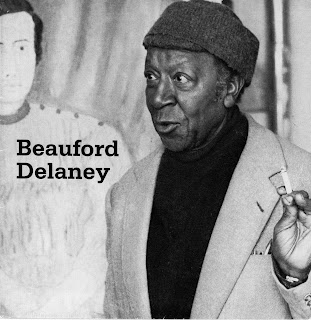
Invitation card to 1973 exposition at Galerie Darthea Speyer
Image courtesy of Galerie Darthea Speyer
Beauford, you are the complete artist, not just in the medium of paint but in the medium of life.
- James Jones
I learned about light from Beauford Delaney, the light contained in every thing, in every surface, in every face.
- James Baldwin
Beauford was an artist from before birth; he was an artist in the womb, and even before that.
- Henry Miller
First and last Beauford is an artist - one of the most sensitive and talented of all artists of all times.
- Joseph Delaney
...this is indeed, the hallmark of Beauford's art, a joyful pursuit of the exact.
- Richard A. Long
For many years, the sparkle of his gaze shone around him and attracted a crowd of friends, fascinated by this strong, if silent, presence. It was not his discourse that captivated, but a light that emanated from him and permeated everyone. (Translated from French)
– Darthea Speyer
To see a short video of the Beauford Delaney: Internal Light exposition opening, click here.

Image courtesy of Galerie Darthea Speyer
Beauford, you are the complete artist, not just in the medium of paint but in the medium of life.
- James Jones
I learned about light from Beauford Delaney, the light contained in every thing, in every surface, in every face.
- James Baldwin
Beauford was an artist from before birth; he was an artist in the womb, and even before that.
- Henry Miller
First and last Beauford is an artist - one of the most sensitive and talented of all artists of all times.
- Joseph Delaney
...this is indeed, the hallmark of Beauford's art, a joyful pursuit of the exact.
- Richard A. Long
For many years, the sparkle of his gaze shone around him and attracted a crowd of friends, fascinated by this strong, if silent, presence. It was not his discourse that captivated, but a light that emanated from him and permeated everyone. (Translated from French)
– Darthea Speyer
To see a short video of the Beauford Delaney: Internal Light exposition opening, click here.
Beauford to Be Added to Thiais Cemetery Celebrity List
A miracle has occurred!
After waiting for two years to pay the concession fee for Beauford's grave, I received notification that his grave site will henceforth be conserved by the City of Paris and that within the next few weeks, Beauford's name will be added to the list of famous persons buried at Thiais cemetery!
The story goes as follows:
When I founded the French non-profit association Les Amis de Beauford Delaney in 2009, the principal goals were to pay the fee that would keep Beauford's remains interred and to place a stone at his unmarked grave. At the time, I was told that an exception would be made so that Les Amis could pay the concession fee because only Beauford's family or a legal representative of his estate was legally allowed to do so. Les Amis paid all previously owed sums and brought accounts up to date through 2010.

Beauford's grave site in 2009
© Discover Paris!

Beauford's tombstone in 2010
© Discover Paris!
In 2011, I wrote to the cemetery to indicate that Les Amis was ready to submit the funds to cover the next ten years of the concession. I was told once again that Les Amis had no right to submit this payment and that a two-year grace period would go into effect to allow a family member or legal representative to come forth and pay (or move Beauford's remains elsewhere). I had to wait until 2013 to contact them again.
I wrote to the cemetery in March of this year, reiterating that Les Amis was ready to pay the sum due. I received a reply stating that though an exception was made in 2010, Les Amis would not be allowed to pay the concession this year. However, my contact at the cemetery, Deputy Director Marilyn Pin, took it upon herself to contact the main cemetery office at Père Lachaise in Paris and request that Beauford's name be added to the list of "celebrities" interred at Thiais. If this request were granted, the City of Paris would take responsibility for preserving his grave site and no future funds would need to be submitted.
On June 7th, I received a call from Madame Pin stating that her request had been granted and that a letter would be forthcoming. On July 4th, I received her letter confirming that Beauford's grave will now be conserved by the City of Paris. This means that Beauford's family and estate no longer need to worry about paying a fee to keep his remains buried.
From an historical standpoint, the fact that Beauford's name will be added to the list of famous persons buried at the Parisian Cemetery of Thiais is yet another milestone in the preservation of the legacy of the African-American presence in Paris.
After waiting for two years to pay the concession fee for Beauford's grave, I received notification that his grave site will henceforth be conserved by the City of Paris and that within the next few weeks, Beauford's name will be added to the list of famous persons buried at Thiais cemetery!
The story goes as follows:
When I founded the French non-profit association Les Amis de Beauford Delaney in 2009, the principal goals were to pay the fee that would keep Beauford's remains interred and to place a stone at his unmarked grave. At the time, I was told that an exception would be made so that Les Amis could pay the concession fee because only Beauford's family or a legal representative of his estate was legally allowed to do so. Les Amis paid all previously owed sums and brought accounts up to date through 2010.

© Discover Paris!

© Discover Paris!
In 2011, I wrote to the cemetery to indicate that Les Amis was ready to submit the funds to cover the next ten years of the concession. I was told once again that Les Amis had no right to submit this payment and that a two-year grace period would go into effect to allow a family member or legal representative to come forth and pay (or move Beauford's remains elsewhere). I had to wait until 2013 to contact them again.
I wrote to the cemetery in March of this year, reiterating that Les Amis was ready to pay the sum due. I received a reply stating that though an exception was made in 2010, Les Amis would not be allowed to pay the concession this year. However, my contact at the cemetery, Deputy Director Marilyn Pin, took it upon herself to contact the main cemetery office at Père Lachaise in Paris and request that Beauford's name be added to the list of "celebrities" interred at Thiais. If this request were granted, the City of Paris would take responsibility for preserving his grave site and no future funds would need to be submitted.
On June 7th, I received a call from Madame Pin stating that her request had been granted and that a letter would be forthcoming. On July 4th, I received her letter confirming that Beauford's grave will now be conserved by the City of Paris. This means that Beauford's family and estate no longer need to worry about paying a fee to keep his remains buried.
From an historical standpoint, the fact that Beauford's name will be added to the list of famous persons buried at the Parisian Cemetery of Thiais is yet another milestone in the preservation of the legacy of the African-American presence in Paris.